
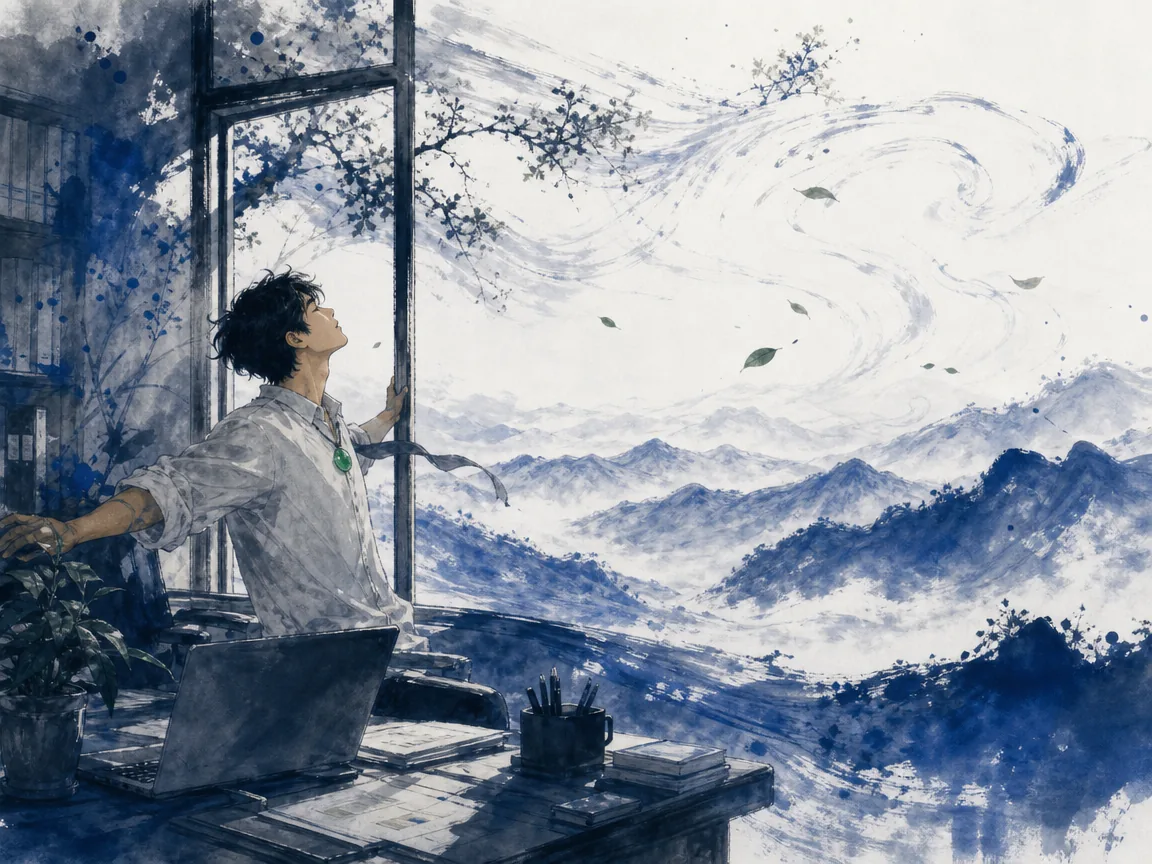
You may have scrolled through social media recently and noticed something shifting. Posts about sunsets, autumn leaves, golden light, and traditional Chinese motifs seem to appear with quiet frequency, carried by a generation that grows increasingly drawn to natural textures and classical forms. Whether it is photography of mist rolling over hills, the appeal of handcrafted woodware, or the growing interest in traditional patterns, there is a recognizable aesthetic current moving through contemporary Chinese culture.
For those who notice it, the pull feels real — even if the reason feels difficult to name. It is easy to dismiss this as a passing trend or a cultural revival that belongs to the past. But beneath the surface of these preferences lies something older and more structured than fashion. This is the kind of aesthetic instinct that grows from a philosophical foundation, one that frames the relationship between people and the natural world in a particular and deliberate way.
That foundation is commonly known as harmony between Heaven and humanity (Tiān Rén Hé Yī, harmony between Heaven and humanity (tiān rén hé yī, 天人合一)), often translated as "Heaven and Humanity as One." It is not merely a historical idea preserved in textbooks. It has shaped how Chinese aesthetics are constructed, how objects are designed, how spaces are arranged, and how people relate to the environment around them. For readers living in a world defined by screens, climate disruption, and a persistent sense of disconnection, this framework offers a lens worth examining — not as a replacement for any modern practice, but as a tradition of thought that has been considered for centuries.
Heaven and Humanity As One: The Roots of a Resurgence
The current attention toward Chinese aesthetics does not emerge from a vacuum. In a period marked by digital saturation and rapid urbanization, many people find themselves seeking forms of beauty that feel grounded, intentional, and anchored in something larger than themselves. Aesthetic preferences are rarely arbitrary, even when they feel spontaneous. They tend to reflect deeper ways of understanding how human life fits within the world.
This is where the concept of Heaven and Humanity as One becomes relevant. It proposes that the natural world and human existence are not separate realms but part of a single, integrated whole. Within this view, humans are not positioned as rulers over nature but as participants within it. The idea carries implications for art, architecture, daily objects, and personal conduct. It explains why certain designs feel harmonious and why others feel jarring, even when both are technically functional.
It is worth noting that the modern sense of disconnection from the natural world is not unique to China. People everywhere navigate the tension between technological progress and ecological awareness. What distinguishes the Chinese aesthetic tradition is the extent to which the philosophy of Heaven and Humanity as One has been woven into material culture over thousands of years. Recognizing this lineage helps explain why the aesthetic revival feels meaningful rather than decorative.
What Is Harmony Between Heaven and Humanity (Tiān Rén Hé Yī, harmony between Heaven and humanity (tiān rén hé yī, 天人合一))?
The phrase tiān rén hé yī (harmony between Heaven and humanity (tiān rén hé yī, 天人合一)) literally joins the characters for Heaven (天) and humanity (人) with the concept of union or unity (合). While interpretations vary across historical periods and philosophical schools, the core intuition is consistent: the cosmos functions as a unified system, and human beings are embedded within it rather than standing outside it.
This stands in contrast to intellectual traditions that emphasize a strict separation between nature and humanity. Such contrasts should not be read as judgments on either tradition, but rather as different starting points for thinking about where human life fits in the broader order of things. Within the Chinese context, these ideas were informed by centuries of agricultural life, seasonal rhythm, and close observation of natural cycles. Practices such as planting, harvesting, and adapting to climate were not merely economic activities but lived experiences of interdependence.
One of the most frequently cited articulations comes from the Northern Song dynasty philosopher Zhang Zai, who wrote in his work Zheng Meng (正蒙):
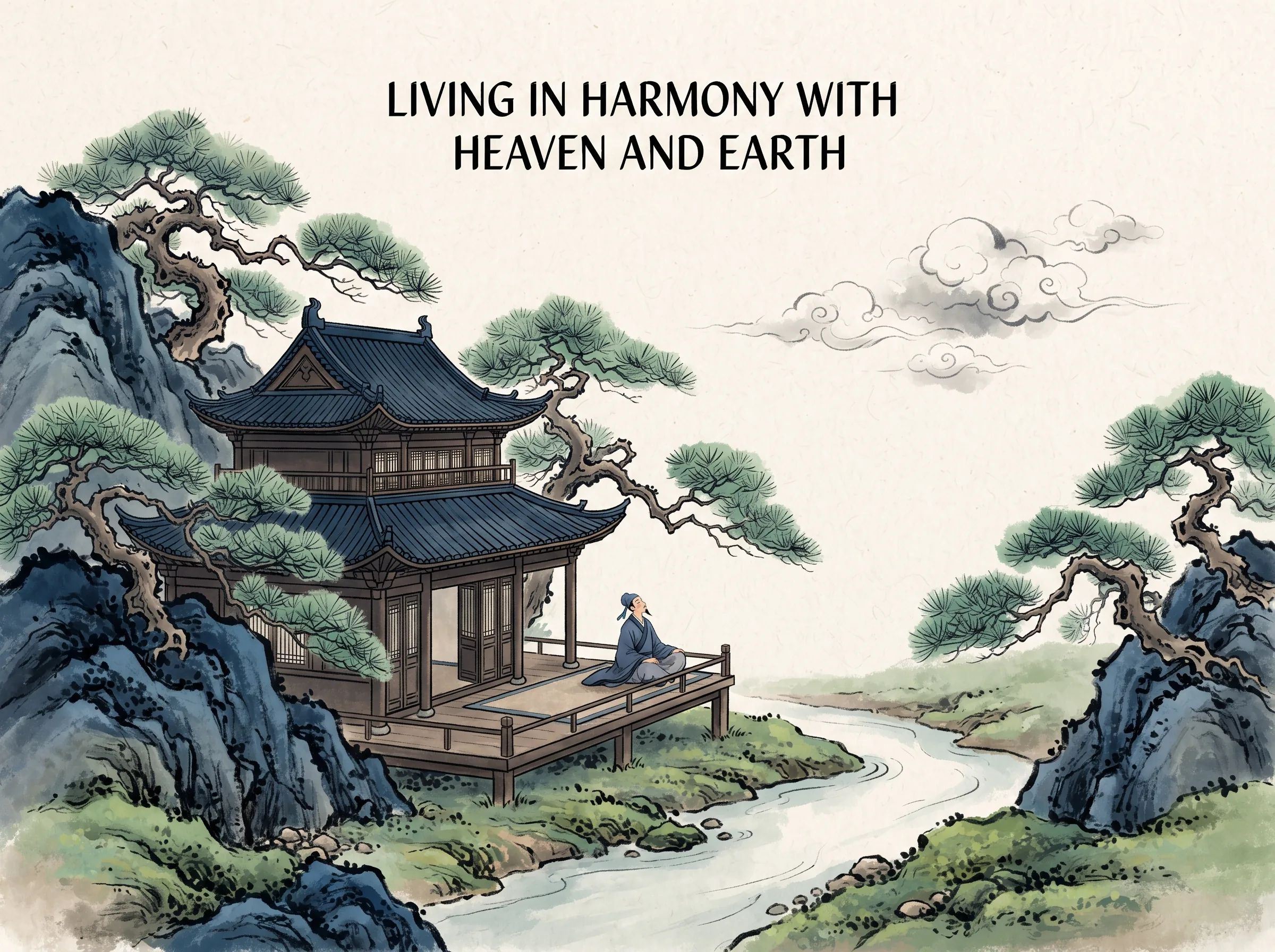
"All people are my brothers and sisters, and all things are my companions." (Mín wú tóngbāo, wù wú yǔ yě, 民吾同胞,物吾与也。) ("The people are my siblings; the things of the world are my companions.") [1]
The full passage appears in the Qiancheng chapter of Zheng Meng, where Zhang Zai frames humanity and the cosmos as a single familial and relational network [2]. The formulation is profound in its simplicity: it extends kinship beyond humans to include all of existence. Whether read literally or philosophically, it places responsibility and care at the center of how people relate to their surroundings.
It is important to approach such classical statements with care. Translations differ, scholarly debates exist over exact dating and interpretation, and these texts emerge from specific historical contexts that cannot always be reduced to modern categories. What is clear is that the idea has retained cultural significance and continues to inform artistic and aesthetic practices in Chinese-speaking communities today.
How harmony between Heaven and humanity (tiān rén hé yī, 天人合一) Shapes Chinese Aesthetics
The philosophy of Heaven and Humanity as One is not confined to abstract texts. It appears repeatedly in the material world — in objects people use daily, in buildings they inhabit, and in artistic compositions they encounter. Three patterns are especially visible.
Imitation of Cosmic Order
Many traditional Chinese designs encode cosmic principles through simple geometric logic. The classic motif of Round Heaven and Square Earth (Tiānyuán Dìfang, 天圆地方) — appears throughout Chinese material culture. Ancient copper coins featured a round exterior with a square hole in the center, a shape that served both practical manufacturing needs and symbolic meaning. Go boards are square, while the pieces are round, often in black and white representing the interplay of yin and yang. Cultivate quiet mindfulness in everyday living through the meditative tea ritual in A Cup of Tea Holds a World: Six Chinese Philosophies for Modern Living.
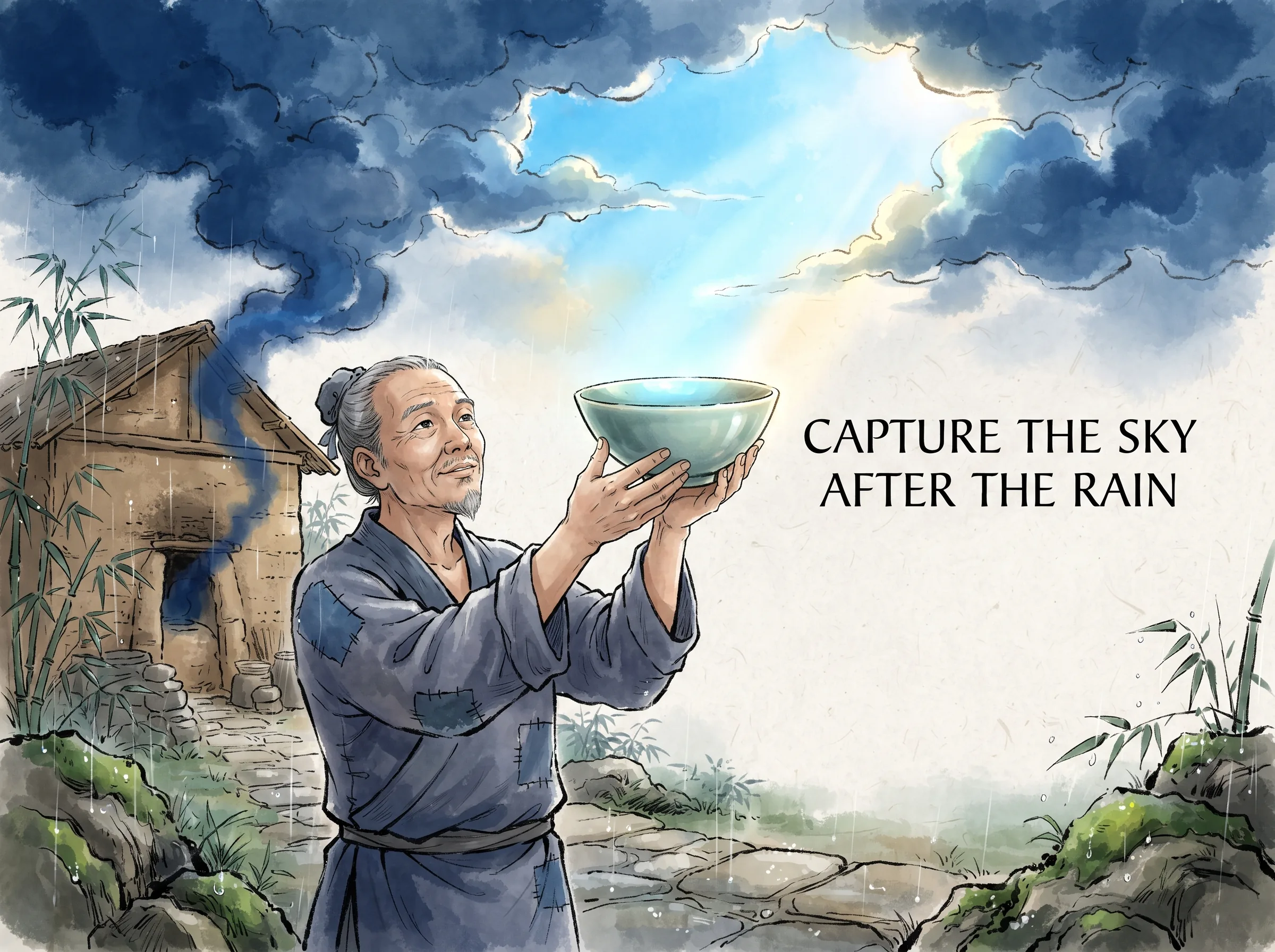
Ming dynasty furniture offers another example. Tables and cabinets maintain fundamentally rectangular structures, yet their corners are frequently softened with gentle curves. The round is contained within the square, suggesting balance rather than opposition. These design choices are not accidental. They reflect a worldview in which human-made objects should echo the structure of the cosmos rather than impose something entirely separate upon it.
Absorbing Nature Into Daily Space
Chinese architecture and garden design have long treated the boundary between interior and exterior as permeable rather than absolute. Windows in traditional gardens were often designed as framed views, transforming the outdoors into living paintings visible from within. The Qing dynasty writer Li Yu described in Xianqing Ouji (闲情偶寄) his vision for boat windows on West Lake, imagining them as "eyes" for the vessel — frames that would capture moving scenes of boats, people, and scenery as natural, ever-changing pictures [3].
Literary tradition reinforces this sensibility. Tao Yuanming, writing in the Return Home Rhapsody (归去来兮辞), expressed the desire to lean against a southern window and find freedom within a modest dwelling [4]. The window becomes a portal through which the wider world enters the private sphere. Architecture in this tradition does not attempt to dominate nature; it invites nature in.
This approach contrasts sharply with designs that treat windows merely as openings for light or ventilation. When space is organized to frame natural elements deliberately, the act of looking itself becomes a form of engagement with the environment.
Following Natural Materials and Context
Chinese aesthetics have traditionally favored materials sourced directly from the natural world — wood, stone, bamboo, silk, clay. The Chinese character for artificiality or falseness (伪) literally combines the elements for "person" and "false," suggesting a historical sensitivity to excessive human modification. This value system appears in traditional instrument construction, where earth, wood, silk, and bamboo form the primary materials, and in regional architecture, where building materials are chosen to harmonize with local landscapes rather than stand in contrast to them.
Blue brick and dark tile architecture in the Jiangnan region exemplifies this principle. These structures blend into the green, misty environment of the south, creating a visual continuity that would feel incongruous if transplanted to the yellow loess landscapes of the north. Beauty, in this framework, arises from context-appropriate harmony rather than from imposing a uniform aesthetic across diverse environments.
From Aesthetics to Self-Cultivation
The philosophy of Heaven and Humanity as One extends beyond objects and spaces. It also shapes how individuals understand personal development and moral character. The most widely known expression of this idea appears in the motto of Tsinghua University, which draws directly from passages in the I Ching (易经).
The motto consists of two lines:
"As Heaven's movement is vigorous, the exemplary person strives ceaselessly." (Tiān xíng jiàn, jūnzǐ yǐ zìqiáng bùxī, 天行健,君子以自强不息。) ("Heaven moves with strength; the noble person strives without ceasing.")
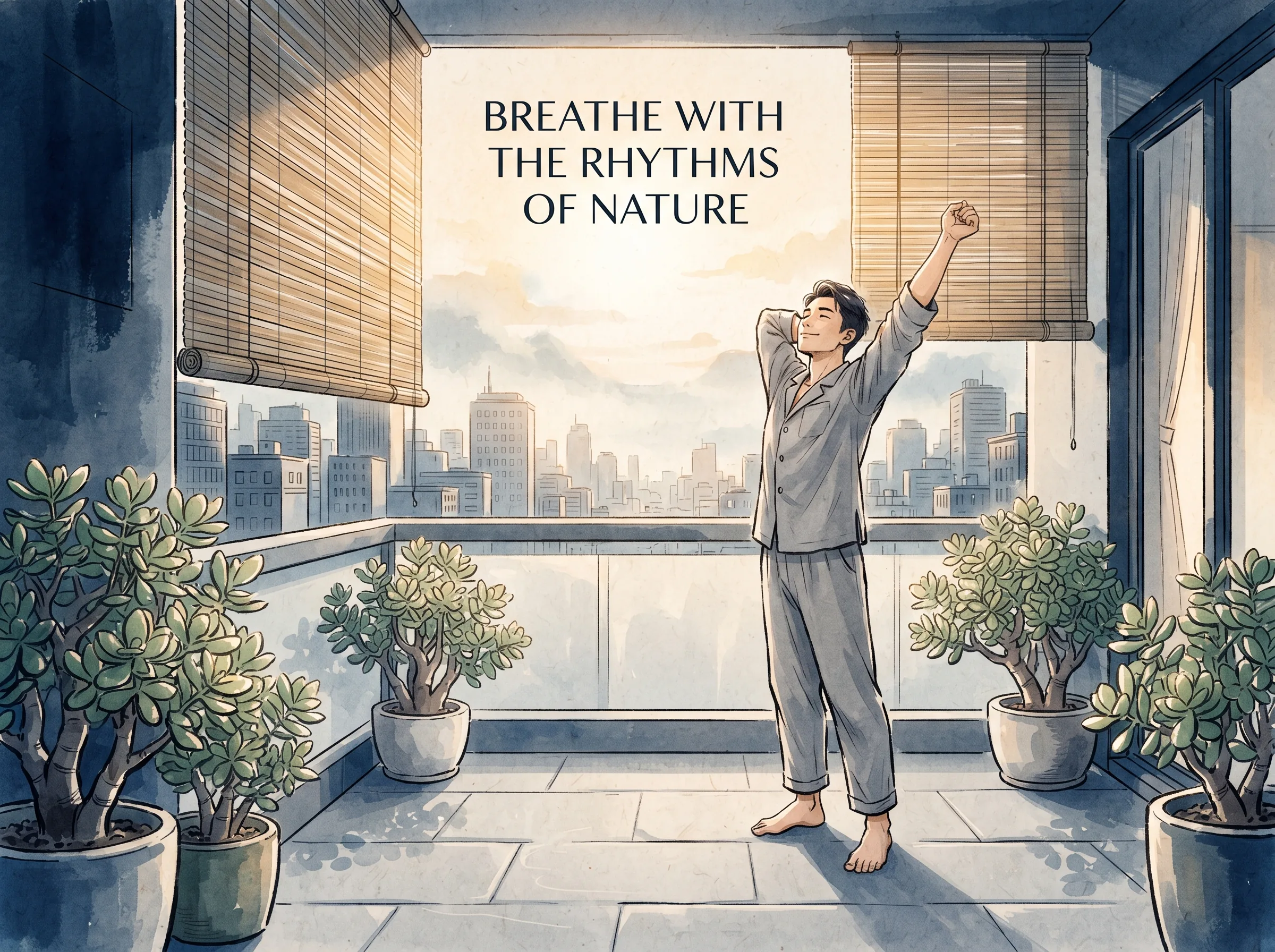
"As Earth's capacity is receptive, the exemplary person sustains all things through abundant virtue." (Dìshì kūn, jūnzǐ yǐ hòudé zàiwù, 地势坤,君子以厚德载物。) ("Earth is broad and nurturing; the noble person bears all things with virtue.")
These lines connect personal conduct to the patterns observed in nature. Heaven's relentless movement becomes a model for perseverance, while Earth's capacity to sustain all things becomes a model for generosity and receptivity. The Tsinghua connection to these passages is documented in the university's own historical records, which note that Liang Qichao quoted these lines in a 1914 address at the institution, and the eight characters were subsequently adopted as the school motto [5] [6].
This integration of cosmic principle and personal cultivation illustrates how the philosophy operates at multiple levels simultaneously. It is not enough to appreciate beautiful objects or serene gardens; the underlying worldview encourages a corresponding orientation toward one's own character and actions. The aesthetic and the ethical are treated as continuous rather than separate domains.
Why This Matters for Modern Readers
Modern life presents specific conditions that make the philosophy of Heaven and Humanity as One particularly relevant. Digital devices occupy increasing amounts of attention. Natural environments are often filtered through screens rather than experienced directly. Urban architecture prioritizes efficiency and enclosure over connection with seasonal change and natural light. Under these conditions, the feeling of disconnection is not simply personal — it is structural.
The Chinese aesthetic tradition offers an alternative model, one that does not require abandoning modern life but rather reframing how modern spaces and habits relate to the natural world. This might look like choosing materials that carry natural texture over synthetic alternatives. It might mean arranging a living space to acknowledge seasonal shifts rather than creating a climate-controlled bubble. It could involve recognizing that the objects we use daily — a bowl, a chair, a window frame — can carry philosophical intention rather than serving purely functional purposes.
The aesthetic revival among younger generations may reflect exactly this kind of searching. It is not nostalgia for a romanticized past but a recognition that contemporary life has lost something measurable — a sense of belonging within a larger natural order. The philosophy of Heaven and Humanity as One provides vocabulary for that loss and a framework for addressing it.
Practical engagement with this tradition does not require specialization in Chinese philosophy or access to traditional gardens. It begins with attention — noticing how materials feel, how light changes through a day, how objects in a room relate to one another and to the outside world. These are small acts, but they accumulate into a different relationship with everyday experience.
Looking Forward
The Chinese aesthetic tradition rooted in Heaven and Humanity as One is not a closed system preserved for academic study. It is a living set of ideas that continues to generate new forms of expression, from contemporary architecture to product design to environmental philosophy. Its relevance for modern readers lies not in offering wholesale solutions to contemporary problems but in providing a coherent framework for understanding the relationship between people and the natural world.
Those interested in exploring this tradition further might begin by examining the objects and spaces around them with new questions: What materials were used? How does this design relate to its environment? Does this space invite connection with the natural world, or does it isolate its inhabitants from it? Such observation is itself a form of practice — a way of training attention toward the kinds of relationships this philosophy values.
The goal is not to replicate historical forms but to understand the principles that shaped them. When those principles are grasped, they can be applied creatively to contemporary challenges — from urban design and environmental sustainability to personal well-being and aesthetic education. The ancient idea that Heaven and humanity belong to one integrated whole remains, perhaps more than ever, a useful lens for thinking about how to live well in the modern world.
FAQ
Is harmony between Heaven and humanity (tiān rén hé yī, harmony between Heaven and humanity (tiān rén hé yī, 天人合一)) a religious concept or a philosophical one?
It functions primarily as a philosophical and cosmological idea within Chinese thought, though it has been adopted and interpreted differently across Confucian, Daoist, and folk traditions. It is not tied to a single religion but represents a worldview about the relationship between humans and the cosmos.
Can I apply these aesthetic principles without studying Chinese philosophy in depth?
Yes. The practical implications — choosing natural materials, designing spaces that connect interior and exterior, observing seasonal change — do not require scholarly expertise. They can be approached as mindful design choices in everyday life.
Does this philosophy conflict with modern technology or urban living?
Not necessarily. The tradition is about integration rather than rejection. Many contemporary architects and designers draw on these principles while working with modern materials and technologies.
Where did the concept of Heaven and Humanity as One originate?
The idea has roots in early Chinese thought spanning multiple periods and traditions. It was articulated systematically by later philosophers such as Zhang Zai during the Song dynasty, though earlier texts contain related intuitions about cosmic harmony and human responsibility.
Examine this artistic principle further through the classical aesthetic philosophy of Why Your City Feels Noisy — And What Ancient Chinese Wisdom Can Teach Us About Better Design.
Deepen your understanding of these principles in our reflection on What Are the Five Levels of Chinese Aesthetics — and Where Do You Stand?.
Sources & Further Reading
[1] Correcting Youthful Ignorance: Chapter 17 (正蒙/17) – Wikisource (维基文库) — Zhang Zai, — Includes the original text containing "All people are my brothers, all things are my companions" (Mín wú tóngbāo, wù wú yǔ yě, 民吾同胞,物吾与也) from the Qiancheng chapter of Zheng Meng.
[2] Correcting Youthful Ignorance (正蒙) – Wikisource (维基文库) — Entry confirming Zhang Zai as author and the Northern Song dynasty attribution of Zheng Meng.
[3] Sketches of Idle Pleasure: Volume 8 (閑情偶寄卷八) – Shidian Guji (識典古籍) — Li Yu's description of boat window design in Xianqing Ouji, demonstrating the principle of absorbing nature into daily life.
[4] Return Home Rhapsody (归去来兮辞) – Guwendao (古文岛) — Tao Yuanming's original text including the line "leaning on the south window to rest in pride" (yǐ nánchuāng yǐ jì'ào, 倚南窗以寄傲).
[5] Clarification of Tsinghua Motto (清华大学校训释疑) – Tsinghua University History Museum (清华大学校史馆) — Documents the 1914 Liang Qichao address and the adoption of the Tsinghua motto drawn from the I Ching.
[6] Clarification of Tsinghua Motto (清华大学校训释疑) – Tsinghua University History Museum (清华大学校史馆) — Confirms the origin of self-discipline and moral integrity (zìqiáng bùxī, hòudé zàiwù, 自强不息,厚德载物) from the I Ching (Qian and Kun hexagrams).
Further Reading
- Beauty in Chinese Eyes (《中国人眼中的美》) by Professor Zhang Yan — A broader exploration of Chinese aesthetic principles, referenced in contemporary discussions of this topic.
- Book of Changes (易经 / I Ching) — Classical text containing the hexagram passages referenced in the Tsinghua motto.
- Occasional Lodging of Leisure Feelings (闲情偶寄) by Li Yu — Qing dynasty work on lifestyle aesthetics, including architecture, gardens, and daily objects.
- Return Home (归去来兮辞) by Tao Yuanming — Jin dynasty literary piece expressing harmony with nature and simple living.
- Correcting Ignorance (正蒙) by Zhang Zai — Northern Song philosophical text containing key formulations of cosmic unity.







[…] The poem does not describe beauty as an abstract concept or a set of measurable features. It presents beauty as something sensory, embodied, and atmospheric. The dew on petals, the play of light, the texture of clothing against skin — these are not decorative details but the very substance of beauty itself. Classical Chinese aesthetics consistently treats beauty as experienced through the body, not contemplated by the mind alone. Examine this artistic principle further through the classical aesthetic philosophy of Why “Heaven and Humanity as One” Still Matters: What Ancient Chinese Aesthetics Can Teac…. […]
[…] For broader philosophical context, consult our related exploration on Why “Heaven and Humanity as One” Still Matters: What Ancient Chinese Aesthetics Can Teac…. […]