
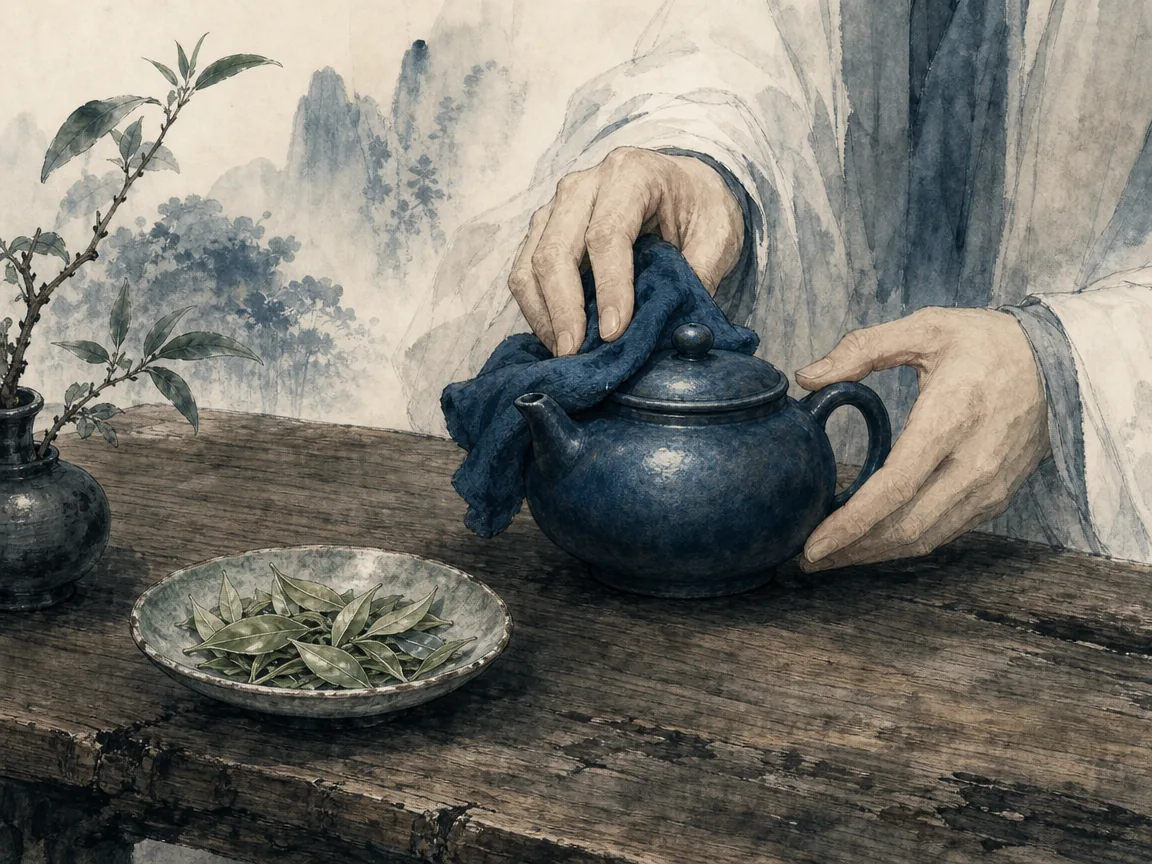
There is a quiet contrast between two kinds of everyday objects: a sleek, mass-produced mouse or laptop, and a modest Yixing purple-clay teapot. Both are designed to serve a function. But they carry very different relationships with the people who hold them. The mouse is meant to be replaced when a newer model arrives. The teapot is meant to be kept, handled, warmed, and gradually transformed by the very act of using it.
In Chinese craft tradition, the making of the pot is only half of its life. The rest unfolds slowly, through daily care — pouring tea, wiping the surface, turning it in the palm. Over time, the clay develops a soft luster. This is not dirt; it is a record of attention. It is what many Chinese speakers describe as a kind of cultivation, expressed with the character yǎng (养), which carries meanings of nurturing, fostering, and raising — language more commonly used for living things than for objects—a foundational perspective explored in Purple Clay Teapot.
What does this difference teach us? It suggests a way of living with things that stands in gentle opposition to the logic of the modern economy: replace, upgrade, discard. A teapot asks something different of its owner. It asks for patience. It asks for a long relationship. And in that request lies a question worth carrying into our own lives.
Purple Clay Teapot: Why We Throw Things Away
Modern consumer culture runs on a simple rhythm: acquire, use, upgrade, replace. Objects are evaluated by efficiency and novelty. A smartwatch moves from version 1.0 to 2.0 to 3.0, and each new iteration makes the previous one feel obsolete. This cycle is not accidental. It is built into business models that reward speed, novelty, and repetition.
Within that framework, objects are tools first and companions never. When something breaks, is replaced, or no longer serves a function, it is removed. There is little expectation — let alone encouragement — to imagine that an object might accompany you for decades, or outlast you entirely.
This pattern is so familiar that it often goes unquestioned. Yet there have been movements that push back against it, even if imperfectly. The Japanese concept of decluttering and detachment (Danshari, 断捨離), for instance, has been widely discussed in recent years as a approach to simplifying possessions. Its origin lies in ideas drawn from yoga philosophy, and it encourages people to examine their relationship with objects by letting go of what is no longer useful [2]. In some readings, this can come across as a stance of separation — breaking attachment, clearing clutter, moving past the old. That impulse is not wrong. But it still frames the human-object relationship as one of distance rather than continuity.
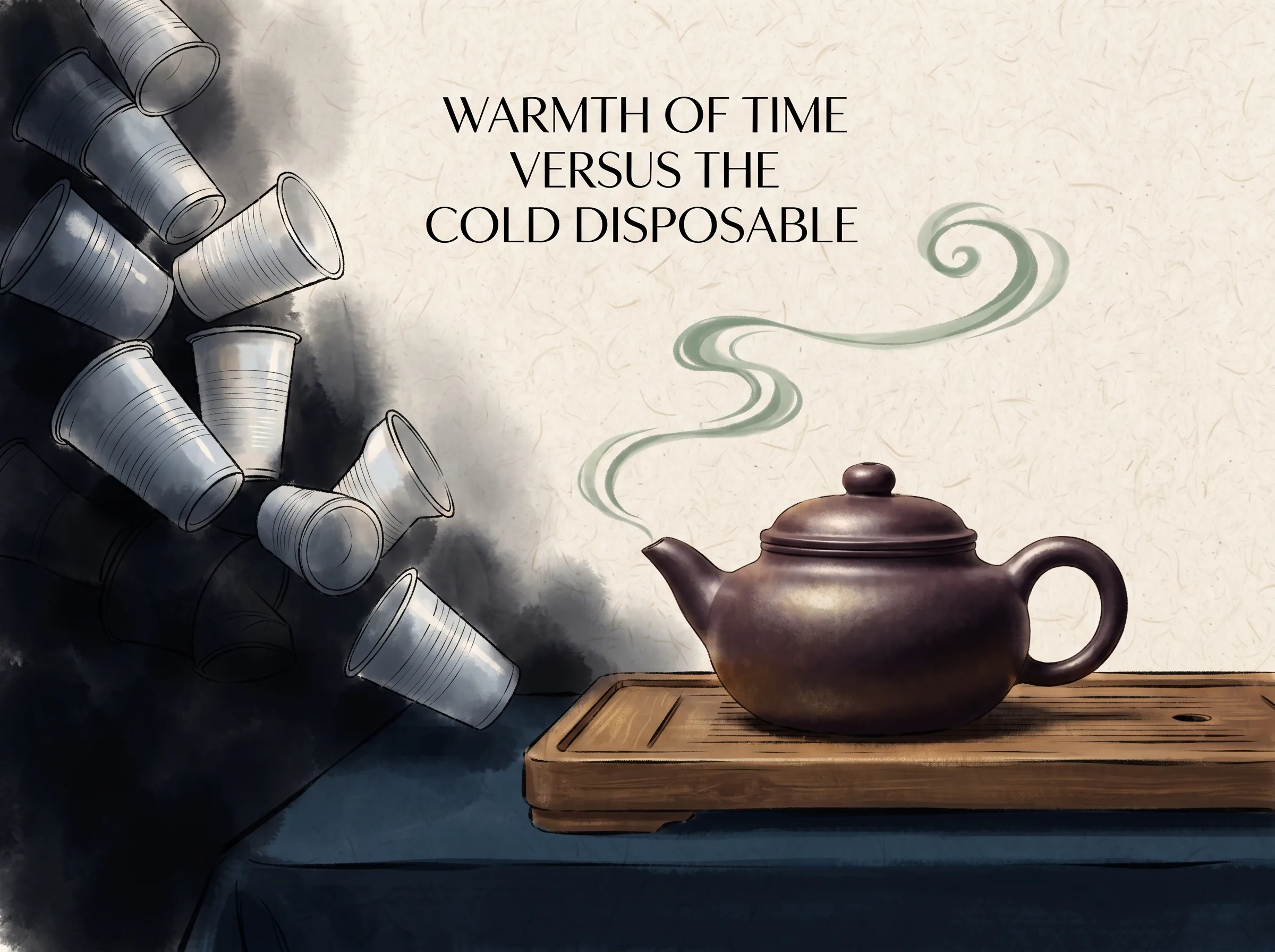
The Chinese craft tradition offers a different model. It does not ask you to reject objects, nor does it ask you to cling to them out of obligation. It asks something simpler: attend to what is already in your life, and let the relationship deepen over time.
Patina as Friendship
The Yixing purple-clay teapot is made from a special type of unglazed stoneware clay [1]. Its body contains minute pores that are fine enough to make the pot impermeable to water, yet absorbent enough to interact with what is poured into it. After long periods of use, the interior develops a tea-stained surface that can enrich the flavour of subsequent infusions, producing a deeper, rounder taste [1].
To a visitor unfamiliar with this practice, the accumulated patina inside a well-used teapot might simply look like residue. But within the tradition, that residue is not a sign of neglect — it is the signature of care. The pot has absorbed years of attention, ritual, and presence. It has become something new, shaped jointly by the maker's hands and the user's habits.
This challenges a basic assumption of modern design: that beauty is something to be delivered complete, at the moment of purchase. In the teapot's case, beauty is unfinished at the start. It is co-created across time. The object does not merely serve the user; it changes alongside the user. A clean mug is valued because it is hygienic. A patinated teapot is valued because it is alive with memory. Cultivate quiet mindfulness in everyday living through the meditative tea ritual in Why Do Machines Need Efficiency, But Humans Need “Uselessness”?.
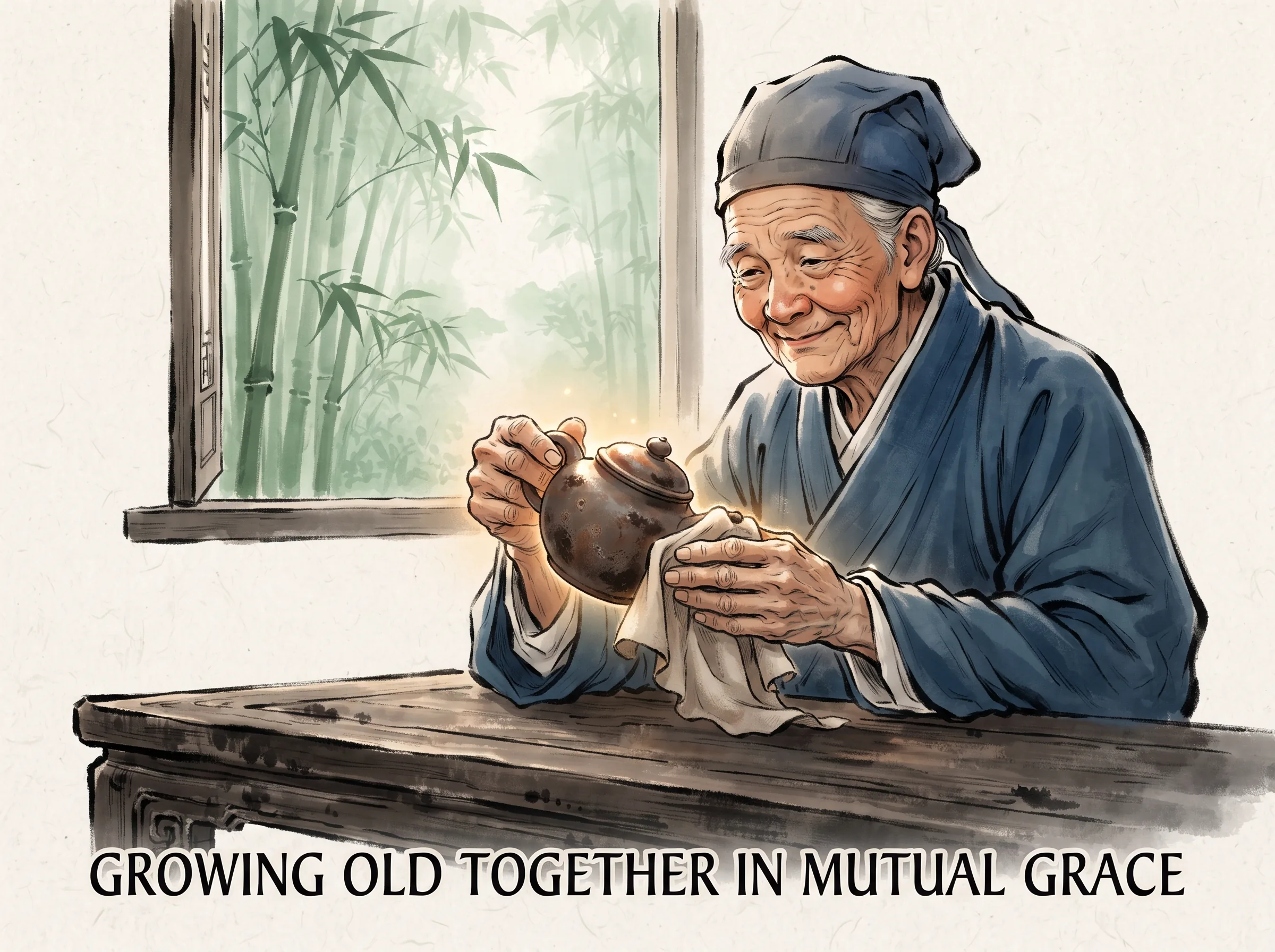
There is a quiet dignity in this. It asks us to slow down, to notice that an object can grow richer through routine rather than deteriorate. It suggests that friendship is not limited to people — it can be a quality of how we relate to the world around us.
The Heirloom Question
The idea of passing objects down through generations — what some cultures call a family heirloom — is fading in many parts of the world. Few people today imagine that their phone, their laptop, or their kettle will be handled by their children or grandchildren. When everything is designed for replacement, the concept of permanence loses its anchor.
But consider a simple question: what is one object you are willing to keep, care for, and eventually pass on? It does not need to be expensive. It does not need to be valuable in any market sense. It needs only to be something that has gathered meaning through use — a wooden spoon, a notebook filled with marginalia, a watch that has stopped ticking but still belongs to someone you love.
An object that carries a story becomes a bridge between people. A gifted teapot can keep a relationship present long after the gift is given. Each time it is used, it recalls the person who offered it. Human bonds, like the patina on clay, deepen through shared presence over time.
The Scroll as an Open Work
The relationship between user and object is not limited to daily rituals. It can also extend across generations of viewers, readers, and collectors. A Chinese handscroll offers a striking example.
Consider the famous calligraphy piece known as Kuai Xue Shi Qing Tie (Quick Snow, Fine Weather), a short letter written by the eastern Jin dynasty calligrapher Wang Xizhi to greet a friend after a heavy snowfall. The original text is only twenty-eight characters [3]. Yet when it was exhibited at the National Palace Museum in Taipei, the display was remarkably long. That is because the scroll carried extensive later inscriptions — comments, poems, and reflections added by collectors and scholars over many centuries, including the Qianlong emperor, who deeply admired the work and grouped it with two other masterpieces as part of his "Three rarities among Xizhi's calligraphic works" [3].
A Western oil painting, by contrast, is generally understood as a closed work. The artist signs it, and it is considered finished. Later owners do not add their own voices to the canvas. The Chinese handscroll operates differently. It is an open document — a space where successive generations can contribute their own responses, and where the artwork grows through conversation rather than standing alone as a solitary statement.
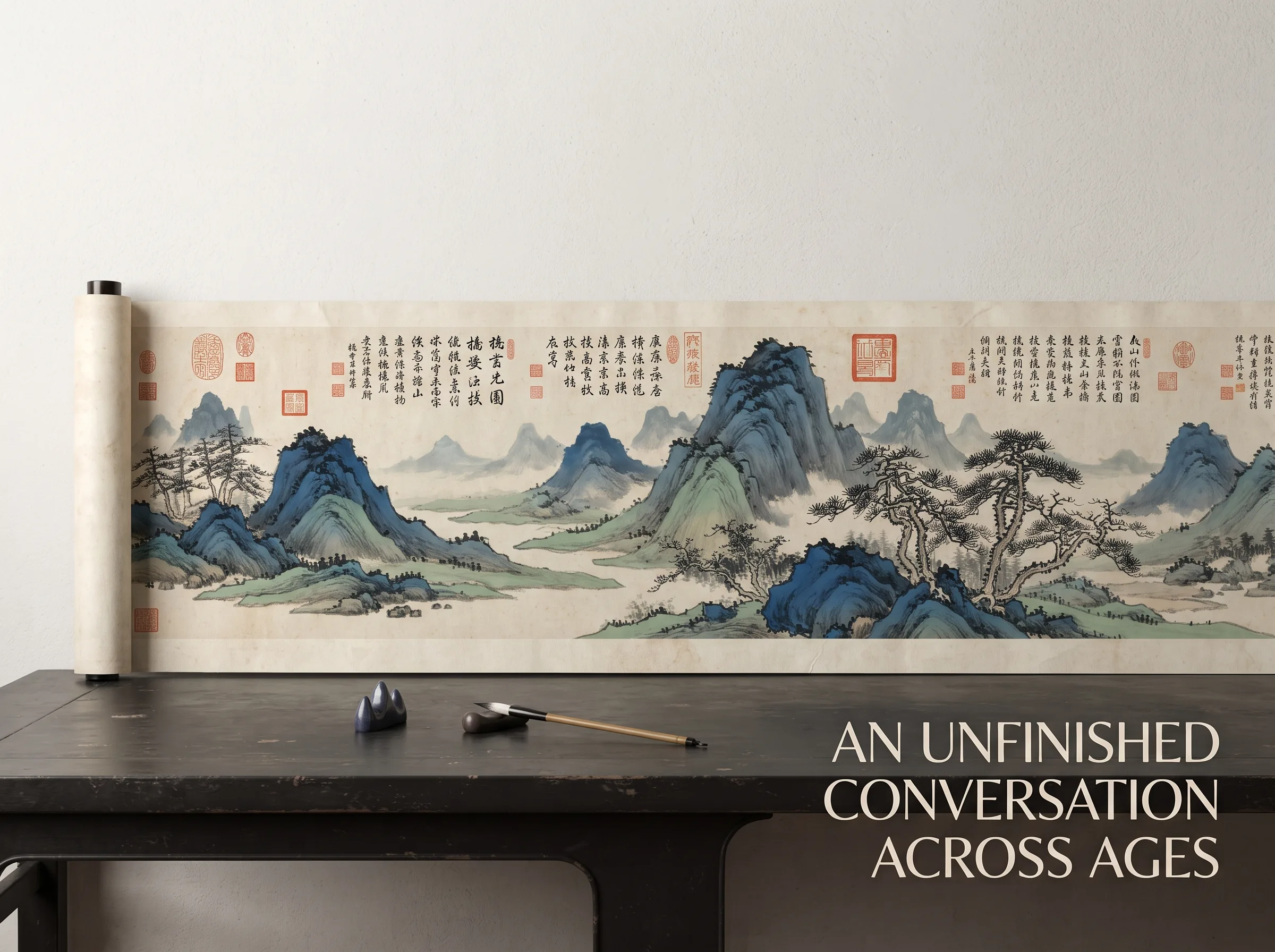
This is not merely an artistic preference. It reflects a cultural orientation: meaning is not fixed at a single point in time. It accumulates. It is shared. A work of art can remain unfinished in one important sense — not because it lacks a creator, but because it invites everyone who engages with it to become part of its ongoing life.
A Practical Reflection
None of this requires abandoning modern life. The point is not to stop upgrading your devices or to collect antiques as an investment. The point is to notice the difference in attitude between two ways of relating to the material world.
One way treats objects as temporary tools — useful until they are not. The other treats objects as companions — capable of growing more meaningful through sustained attention. Both approaches can coexist. But when the first becomes the only mode, something subtle is lost: the sense that an ordinary object can hold a story, that care over time is a form of beauty, that we do not need to move on from everything in order to live well.
A simple practice might be this: choose one object in your life — something you already own, something that is no longer new or impressive — and commit to using it deliberately for thirty days. Notice what changes. Notice whether your attention to it changes the way it appears to you. You do not need to polish it or restore it. You only need to be present with it.
What These Images Share
The teapot, the scroll, the inherited object, the accumulated inscription — these are not dramatic artworks. They are ordinary things approached in an ordinary way. Yet together they reveal something about a cultural orientation that deserves consideration: objects are not only tools. They can be companions. Art is not only a private statement. It can be a communal conversation. A life does not only move forward through acquisition and replacement. It can also deepen through continuity and care.
Ancient Chinese wisdom does not ask you to reject the modern world. It asks you to slow down, look closer, and cultivate deeper affection for what is already in your hands.
FAQ
Is patina on a teapot actually beneficial, or is it just cosmetic?
The tea-stained interior of a well-used Yixing teapot is understood to enrich the flavour of subsequent infusions over time, producing a stronger and more rounded taste [1]. The value is both practical and symbolic — the pot literally holds the memory of past uses.
Does Danshari (断舍离) encourage discarding everything?
Danshari is a method of personal organization inspired by yoga philosophy, encouraging people to examine what they keep and let go of what no longer serves them [2]. Interpretations vary, and some practitioners understand it as a gentle reflection on consumption rather than a strict programme of removal.
Is the Qianlong emperor's involvement with the Kuai Xue Shi Qing Tie widely documented?
Yes. The current version of the work is generally regarded as a fine Tang dynasty copy, and records show that the Qianlong emperor deeply admired it, grouping it with two other calligraphic works as part of his "Three rarities" collection [3].
Can I apply this mindset to everyday objects without becoming a collector?
Absolutely. The practice does not require owning rare or expensive items. It only asks for attention — choosing to stay with one object rather than constantly replacing it, and allowing your relationship with it to mature over time, reflecting the enduring wisdom of Purple Clay Teapot.
Cultivate quiet mindfulness in everyday living through the meditative tea ritual in What a Leaf Can Teach You: Ancient Chinese Wisdom in the Art of Tea.
For a deeper comparative examination of these ideas, explore our related study on The Patina of Time: What Chinese Wisdom Teaches Us About Growing Rich, Not New.
Sources & Further Reading
[1] Hong Kong Museum of Art](https://hk.art.museum/en/web/ma/collections/ks-lo-tea-ware-and-seals.html) — K.S. Lo Collection of Tea Ware and Seals
[2] Danshari (断捨離®)](https://yamashitahideko.com/profile/) — Yamashita Hideko Official Site
[3] National Palace Museum](https://theme.npm.edu.tw/selection/Article.aspx?sNo=04001001) — Kuai Xue Shi Qing Tie (快雪時晴帖)
Further Reading
- Danshari Official Site (断捨離® 公式サイト) — Yamashita Hideko (for background on the origins and philosophy of Danshari)
- Hong Kong Museum of Art — K.S. Lo Collection of Tea Ware and Seals (for additional context on Yixing teapot materials and use)
- National Palace Museum — Kuai Xue Shi Qing Tie (for further detail on Wang Xizhi's letter and its reception history)






