
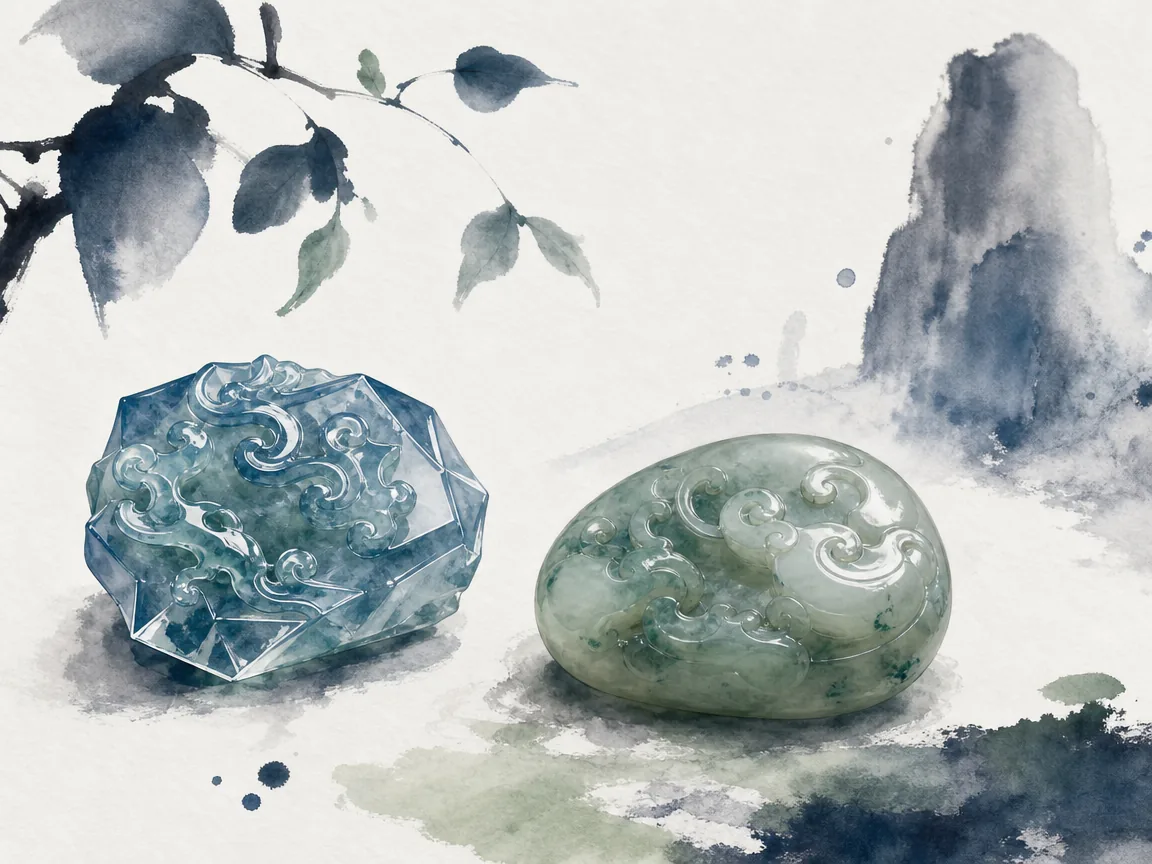
A brand-new jade stone sits cold and glassy on a velvet pad, its surface reflecting light with a flat, aggressive brightness. The same piece, worn smooth by a decade of daily handling, takes on a warm, translucent glow — not from polish or treatment, but from the slow accumulation of human touch, air, and time. In Chinese aesthetics, this transformation is captured by the concept of patina (bāojiāng, 包浆). It is a quality no amount of money can purchase. A thirty-year-old teapot develops a soft luster only through repeated use; a wooden desk becomes silk-smooth across generations of hands. The light that emerges is not borrowed from the material — it is earned by time.
There is something quietly subversive about a tradition that treats age as a compliment. In much of the world today, value is measured by how new something remains — how recently it was released, how untouched it appears, how quickly it can be replaced. Yet in Chinese antique appreciation, the finest objects are precisely those that have been lived with, carried, held, and allowed to age openly. The marks are not hidden. They are honored. As the scholar Zhu Liangzhi has observed, the light of a freshly made object comes from its raw materials, while the light of a well-aged one comes from years — two entirely different kinds of radiance [2]—a foundational perspective explored in Baojiang in Chinese Culture.
This contrast may speak to something many of us feel but cannot quite name. We are told constantly to upgrade: our appearance, our careers, our minds, our identities. But rarely are we told that growing deep matters as much as growing new. What would it look like to build a sense of self-worth not through fresh starts and constant reinvention, but through the slow, patient accumulation of a life well-lived?
Baojiang in Chinese Culture: And What It Does Not
Patina (bāojiāng, 包浆) is a term rooted in Chinese antique appreciation, originally used to describe the surface patina that forms naturally on objects such as furniture, ceramics, bronze vessels, and inkstones over long periods of use [2]. It results from a combination of oxidation, gentle friction, contact with hands, exposure to air, and the slow passage of time. The layer it produces is sometimes described as resembling “condensed liquid” (凝结的浆水) — a thin, liquid-like sheen that settles into the surface rather than sitting on top of it.
The concept has been discussed in Chinese literary sources since at least the Ming period, though the practice of valuing aged objects traces back even further [2]. It is important to note, however, that not every kind of wear qualifies as patina (bāojiāng, 包浆). Scratches from neglect, cracks from poor care, and the dull haze of accumulated grime are not the same thing. Scholars and collectors distinguish carefully between genuine patina and artificial aging techniques designed to mimic it — the latter may look convincing at first glance, but they lack the quiet, weathered simplicity and natural quality that comes from real use [2]. Rust is not patina. Bitterness is not maturity. The difference lies in whether experience has been metabolized with awareness.
What makes patina (bāojiāng, 包浆) philosophically interesting is that it is never merely about the object. The shine on a well-used teapot carries within it the memory of countless mornings, the warmth of palms, the rhythm of a daily ritual. A grandmother's wooden chair, worn smooth at the arms, holds the trace of every person who once sat there. The object becomes a vessel for human presence across time — which is why appreciating patina (bāojiāng, 包浆) has sometimes been compared to the Confucian practice of recovering one's lost mind, in the sense that both involve recognizing value that exists beneath the surface of the obvious [2].
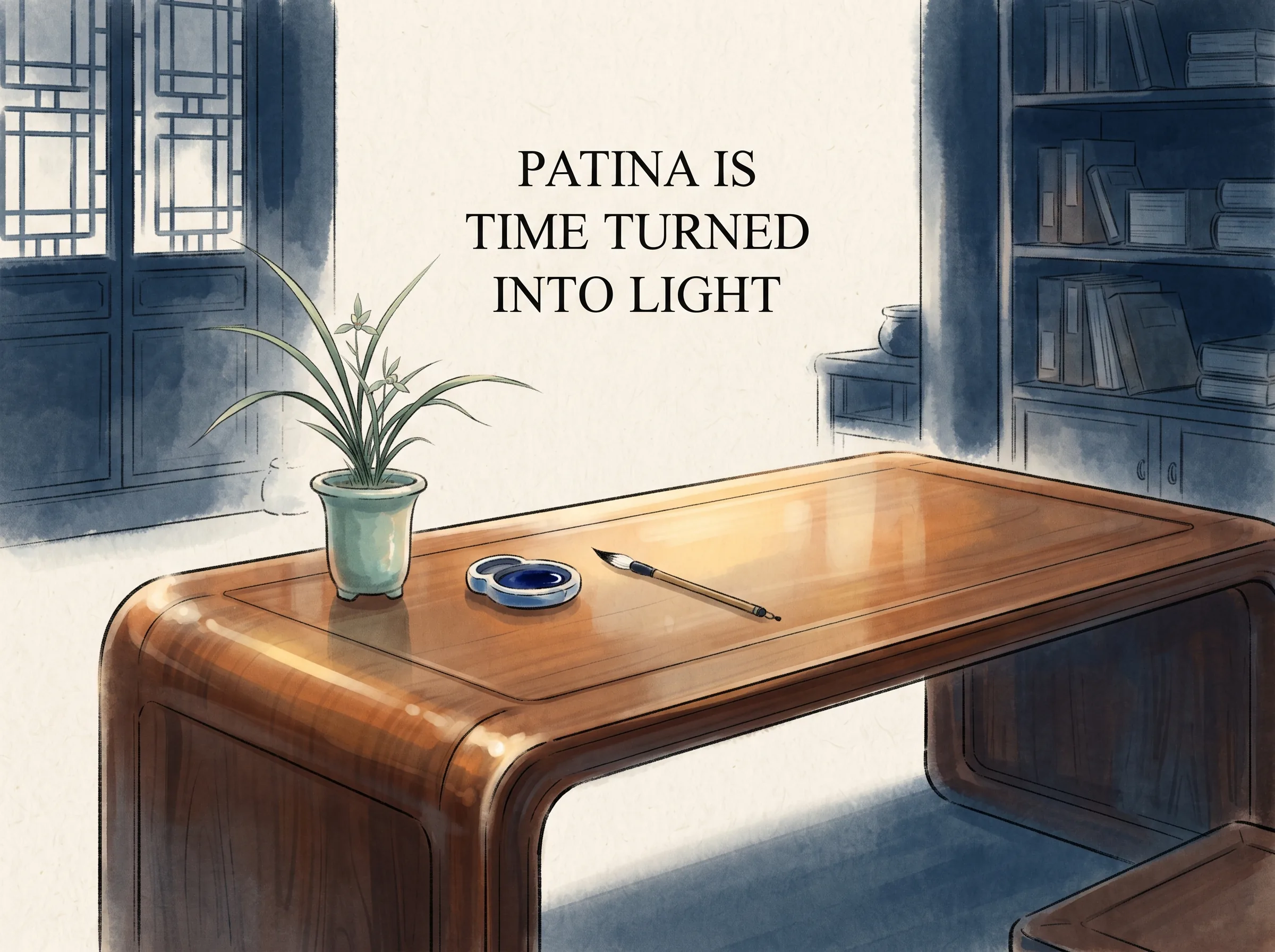
This gives us a useful lens. We often judge ourselves the way a shopkeeper might judge a shelf of merchandise: Is it new? Is it flawless? Would it sell today? But what if the more honest measure of a life is closer to the antique dealer's standard — not whether something is untouched, but whether it has been lived with, and whether that living has left it richer?
The Depth That Time Makes Possible
The Chinese tradition of valuing patina (bāojiāng, 包浆) does not float in isolation. It rests on deeper currents of philosophical thought about time, persistence, and the nature of strength.
One of the most resonant passages comes from the Zhouyi (《周易》, also known as the Book of Changes), specifically Hexagram 32, titled Duration or Constancy (héng, 恒). The hexagram statement reads: "Duration. Success. No blame. Perseverance furthers. It furthers one to have somewhere to go." [6] The image evoked is one of enduring through time not by force, but by maintaining a consistent direction. The quality being celebrated is not intensity but steadiness — the kind of persistence that allows something to mature rather than burn bright and fast. In the context of self-cultivation, this suggests that what gives a person depth is not dramatic transformation but faithful repetition over years.
Zhuangzi offers another complementary insight. In the chapter “In the World of Men” (Rénjiān Shì, 人间世), the figure Nubo Ziqi encounters a massive tree that carpenters pass without a second glance precisely because its wood is useless for construction [3]. Its gnarled, asymmetrical form makes it worthless to the saw — and that is exactly what preserves it. Zhuangzi uses this image to explore a paradox that runs through much of Daoist thought: the qualities that the utilitarian world dismisses are often the very ones that allow something to endure. The tree that survives is not the one that best conforms to external standards; it is the one that was never forced into a shape that did not fit its nature.
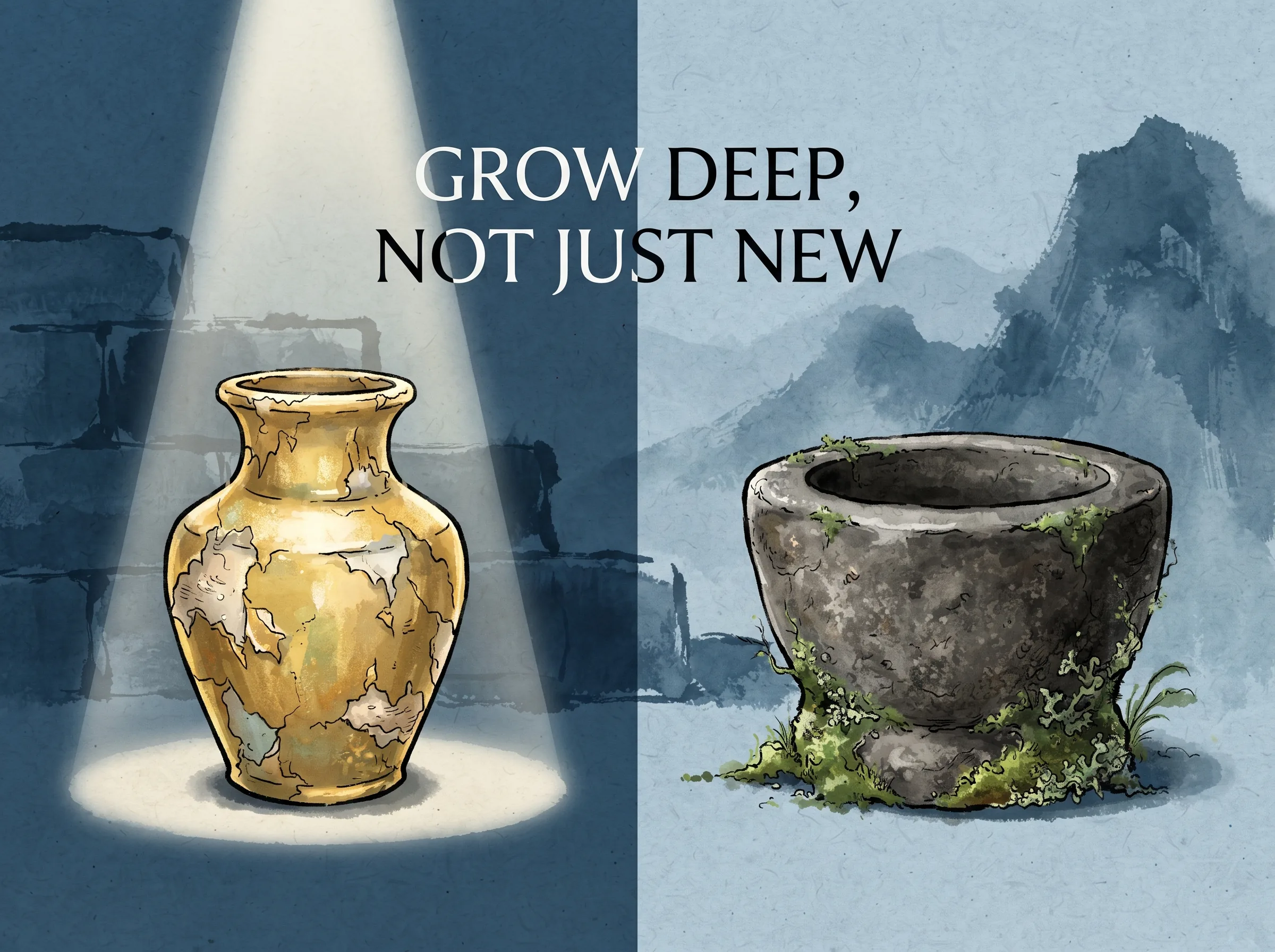
Applied to the question of self-worth, this becomes quietly liberating. The detours, the so-called failures, the relationships that did not work out, the versions of ourselves we outgrew — these are not evidence that something went wrong. They may be, in a different frame, the very things that make a life substantial. A person who has never been tested is like a new object: bright, but not yet rich. A person who has been worn by experience and has not turned bitter has something closer to patina (bāojiāng, 包浆).
This does not mean that all wear is valuable. The Zhuangzi story specifically highlights a tree whose particular shape allowed it to escape destruction — not every tree that survives does so through the same mechanism, and not every hardship produces depth. What the tradition suggests is that the accumulation of a life, when met with attention and reflection, tends to produce something more grounded than the pursuit of novelty ever could. Examine this artistic principle further through the classical aesthetic philosophy of When Everything Is Stripped Away: What Chinese Aesthetics Teaches Us About Inner Structure.
Cultivating Your Own Patina
Understanding patina (bāojiāng, 包浆) intellectually is one thing. Living it is another. Here are five practical shifts that align with the spirit of this concept — not as rules, but as invitations.
1. Stop treating your past as debris to remove
The modern urge is to delete, restart, and rebrand. A failed project becomes a line on a resume you wish could be erased. A heartbreak becomes a chapter you want to close permanently. But the philosophy of patina (bāojiāng, 包浆) suggests the opposite: those marks are not damage to be concealed — they are the grain that gives wood its character.
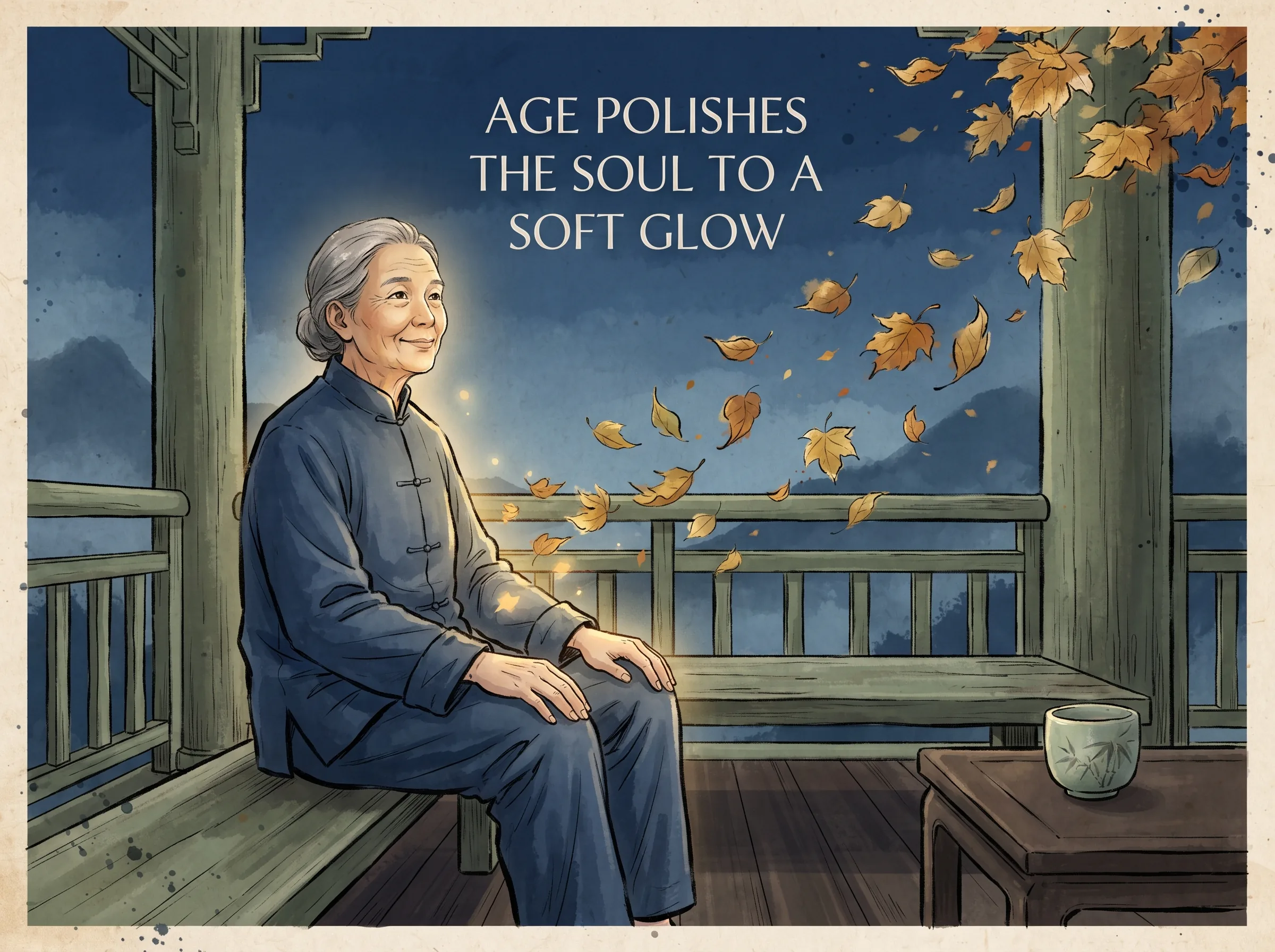
Your mistakes, losses, and detours are not files to delete. They are texture. If you understand them, they become part of what makes you coherent. If you ignore them, they remain wounds. This is not about romanticizing suffering; it is about recognizing that a life without history is a life without roots. A person who has never wrestled with difficulty may be efficient, but they are also likely to be fragile when difficulty arrives. A person who has passed through and continued — that person carries a different kind of steadiness.
2. Choose long use over frequent replacement
In a culture of constant upgrades, the radical act is to keep something for a long time. A coffee mug you reach for every morning. A journal that accumulates years of thought. A pair of shoes that eventually conform to your feet. A friendship that has survived several versions of each other.
This aligns with the Confucian appreciation for constancy (héng, 恒). It is not about stubbornness; it is about depth. When you use one thing for a long time, it stops being an object you consume and becomes a partner in your life. It develops its own history alongside yours. And in return, it teaches you the difference between novelty and meaning.
3. Commit to one practice for years
A person who writes daily, even imperfectly, develops a voice. A person who cooks for their family every week develops a rhythm. A person who shows up for a friend through seasons of change develops a presence that cannot be faked. Long-term commitment produces a kind of quiet authority — not the loud confidence of someone who has mastered every trend, but the calm assurance of someone who has simply stayed.
The Zhouyi hexagram on constancy (héng, 恒) teaches that success comes not from sporadic bursts of effort but from maintaining direction over time [6]. You do not need to do everything well. You need to do something well for a long time.
4. Let your heart develop patina too
Young hearts are reactive. They flare at perceived slights, brighten at small validations, shake at uncertainty. This is natural. But maturity, in the Chinese sense, is not about becoming numb — it is about becoming stable. The Daoist concept sometimes described as “guarding the center” (shǒu zhōng, 守中) points toward a poise that is not indifference but composure [11]. A heart with patina (bāojiāng, 包浆) is not hard; it is centered. It still feels, but it does not fracture under every passing opinion.
You can cultivate this. It begins with noticing when you are being pulled by external reactions — praise, criticism, comparison — and asking yourself: What would it look like to let this pass through me without demanding an immediate response? The answer often emerges only after enough time has passed for the surface agitation to settle.
5. Keep some old things — and the memories attached to them
An old photograph. A book with notes in the margins. A letter from someone who is no longer in your life. These are not hoarding; they are anchoring. A person without a past drifts. A person with a past has something to stand on.
Keeping old things is also a practice in humility. It reminds you that you were different once, that you have changed, and that change is not failure — it is evidence of a life in progress.
Patina Is Not Cliché — It Is a Discipline
It is worth addressing a possible misunderstanding. Patina (bāojiāng, 包浆) does not mean accepting every kind of wear. Not all aging is deepening. Some people grow harsher, not wiser. Some experiences leave them brittle rather than grounded. The distinction matters.
Time is necessary for patina (bāojiāng, 包浆), but it is not sufficient. What transforms experience into depth is awareness — the willingness to reflect, to integrate, to refuse bitterness even when bitterness would be easier. As one interpretation of this tradition puts it: old but not warm is merely decay; warm and luminous in age is patina (bāojiāng, 包浆) [2]. The same applies to a person. A life that has accumulated years but not compassion is not rich — it is just old. A life that has been tested and has chosen gentleness is what the concept points toward.
So the question is not whether you should get older. The question is whether you are metabolizing your life with attention, or merely passing through it.
FAQ
Is patina (bāojiāng, 包浆) exclusive to Chinese culture? No. While the specific concept and terminology of patina (bāojiāng, 包浆) are Chinese, the underlying intuition — that age and use can add value — appears in other traditions as well. Japanese ceramic culture, for example, similarly values objects that have been regularly used and cared for, noting that pieces left unused often appear listless and only develop their distinctive beauty through patient handling [2]. The Chinese tradition is notable for how systematically it has developed this aesthetic into a philosophical category, but it is not alone in recognizing the dignity of aged things.
Can someone "fake" their own version of patina (bāojiāng, 包浆)? Yes, and it is more common than we might think. Pretending to be weathered — performing depth without having lived through the conditions that produce it — is a kind of spiritual counterfeit, not unlike the artificial aging techniques used in the antique trade to mimic genuine patina [2]. Real patina (bāojiāng, 包浆) requires actual time, real use, and honest reflection. There is no shortcut.
Does this mean we should reject modernity and new things? Not at all. The philosophy of patina (bāojiāng, 包浆) is not anti-new; it is anti-haste. New things have their place. The point is that novelty alone does not create depth, and that a life devoted exclusively to the new risks remaining superficial. Balance — knowing when to embrace what is fresh and when to let something mature — is itself a form of wisdom.
How is patina (bāojiāng, 包浆) different from simply getting old or tolerating decline? Patina (bāojiāng, 包浆) requires intentionality. A neglected object deteriorates; a cared-for object matures. Similarly, a person can grow older without growing deeper, accumulating years without accumulating insight. The difference lies in whether the passage of time has been met with attention, reflection, and a commitment to remain open rather than hardened.
What to Do Next
If this way of thinking resonates with you, here is one practical step you might consider this week: choose one thing — an object, a habit, a relationship, a practice — and commit to it for five years. Not perfectly. Not dramatically. Simply consistently. Let it accumulate meaning the way a well-used teapot accumulates its glow. You may find that what you gain is not excitement, but something quieter and more durable: a sense that you are becoming, rather than merely replacing.
The patina of a life well-lived cannot be rushed. But it can be tended — one careful day at a time, reflecting the enduring wisdom of Baojiang in Chinese Culture.
Examine this artistic principle further through the classical aesthetic philosophy of The Teapot That Is Raised, Not Used.
For a deeper comparative examination of these ideas, explore our related study on Reimagining Ritual: What Ancient China Can Teach Us About Meaningful Ceremony.
Sources & Further Reading
[1] Zhu Liangzhi (朱良志). “Objects of Time — Reflections on Patina” (《时间之物 — — 关于“包浆”的思考》). Xinhua (新华网).
[2] *Zhuangzi — In the World of Men* (《莊子·人間世》). Wikisource (維基文庫).
[3] *Zhouyi — Constancy* (《周易·恒》). Wikisource (维基文库).
[4] Stanford Encyclopedia of Philosophy. "Confucius."
Further Reading
- Burton Watson, translator. Chuang Tzu: Basic Writings. Columbia University Press. (English translation of the Zhuangzi, including the "In the World of Men" chapter.)
- Wing-tsit Chan, editor. A Source Book in Chinese Philosophy. Princeton University Press. (Contains translations of key Daoist and Confucian texts, including passages relevant to the philosophy of constancy and self-cultivation.)
- The I Ching (Book of Changes), Hexagram 32 — Constancy (héng, 恒). Various English translations are available; the hexagram on Duration offers a foundational text for understanding the Chinese philosophical appreciation of constancy over time.






