
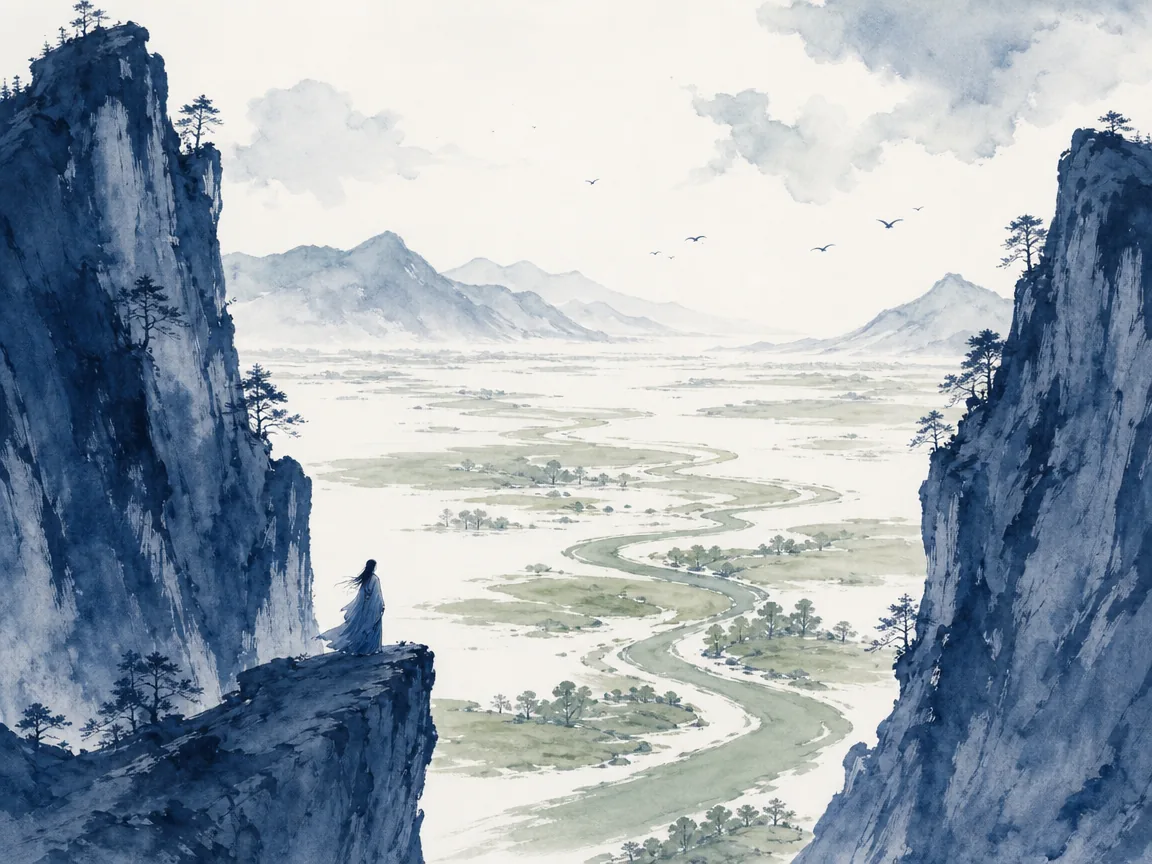
A successful person reaches a point where their world narrows. They have proved themselves again and again. Their methods work. Their judgments are trusted. People defer to them. And slowly, almost without noticing, the capacity to be surprised, to listen, to admit that something might work differently, begins to atrophy. The danger is no longer that they lack strength. The danger is that their strength has become a cage.
This is not a failure of character. It is a failure of structure. Success rewards decisiveness, specialization, and confidence. Those same qualities, carried too far, become rigidity. The person who cannot tolerate uncertainty stops seeking new information. The leader who knows only how to push loses the ability to receive. The identity that grows too large for the person wearing it leaves no room for change. This pattern is familiar — in boardrooms, in creative fields, in the quiet private life of anyone who has ever confused their achievements with their whole self—a foundational perspective explored in Daodejing Chapter 28.
Over two thousand years ago, the Chinese philosopher Laozi addressed precisely this problem in the twenty-eighth chapter of the Daodejing (道德经). His answer was not to reject strength, knowledge, or success. It was to hold them alongside their opposites — to know hardness and guard softness, to know brightness and guard darkness, to know honor and guard humility. The chapter does not advise weakness. It warns against the quiet danger of becoming one-note, of being carved into a single function until everything else is cut away. What follows is an exploration of that warning and what it might mean for anyone who has ever stood still long enough to feel trapped by their own competence.
Daodejing Chapter 28: The Trap of Becoming One Function
Human life moves through stages of increasing specialization. A child is open and unformed. Through education, training, and experience, they acquire skills, roles, and identities. This process is not optional — civilization depends on it. Laozi himself acknowledged that this is what happens when undifferentiated potential becomes useful form: the uncarved block is divided into tools Without division of labor, society cannot sustain complex cooperation
The problem arises when a person becomes so identified with a single function that they lose contact with their broader capacity for change. A manager who solves every problem through authority gradually erodes the initiative of everyone around them. A creative professional whose style wins awards becomes afraid to explore anything outside it. A scholar who has built a paradigm may find it impossible to consider evidence that does not fit. None of these people are immoral. They are simply trapped by the narrow path that success has carved for them.
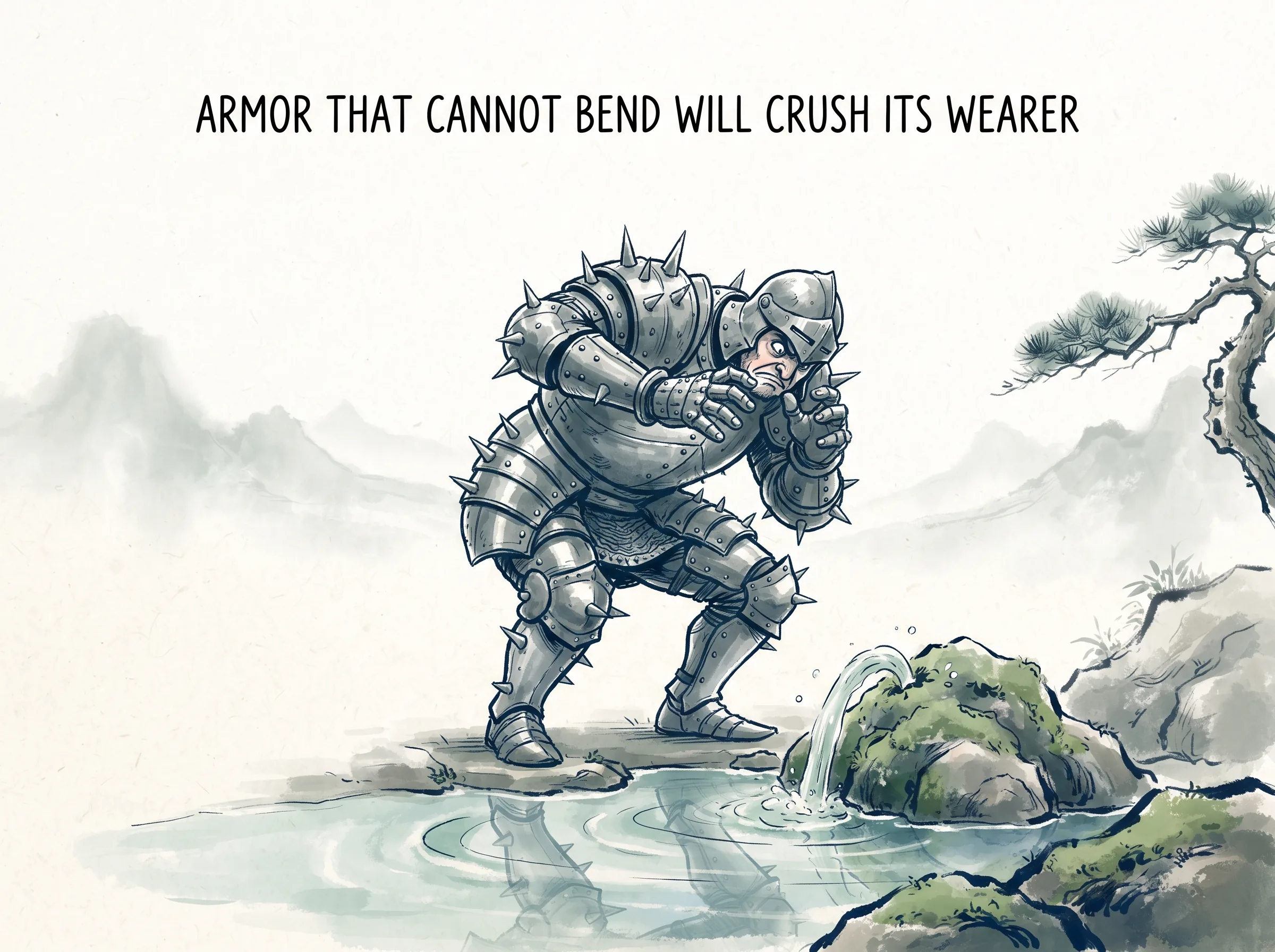
In this sense, growing strong and growing closed are often the same motion. As capability accumulates, the world appears simpler — there are fewer viable options, fewer routes worth considering, fewer voices that matter. The person who can no longer imagine another way is not necessarily arrogant. They may simply have forgotten that possibility still exists.
Continue with the deeper interpretation and practical application.
ChiDestiny members get access to the full analysis, modern applications, and the growing Chinese Wisdom Library.
Frequently Asked Questions
Does Laozi really advise us to stay weak? No. The chapter repeatedly says "know" the strong, the bright, the honored — not "avoid" them. The instruction is to hold strength alongside softness, not to replace one with the other. A person who has never faced difficulty and calls it virtue has not practiced wisdom; they have simply lacked opportunity. Laozi's point is that true softness is chosen, not inherited from helplessness.
How do I know when I am being too rigid? Rigidity often reveals itself as irritation toward anything that does not fit your existing framework. If you find yourself consistently dismissing new information, feeling threatened by alternative approaches, or struggling to imagine a version of yourself outside your current role, those are signs that your identity may be narrowing. Another indicator is a growing reliance on past success as proof that future decisions will also be correct — a pattern that research on dogmatism suggests correlates with less information-seeking under uncertainty [1].
Is this idea unique to Laozi or found in other traditions? The basic structure — holding opposites together, guarding against the excess of one quality — appears in many philosophical and spiritual traditions. Greek thought spoke of moderation and the golden mean. Buddhist teaching emphasizes non-attachment to fixed views. Stoicism cultivates the ability to endure both fortune and misfortune. Laozi's contribution is his particular imagery — the valley, the uncarved block, the return to the infant — and his insistence that the danger is not in having power but in being consumed by it.
Can someone be both decisive and open to change? Yes. Decisiveness and openness are not opposites. The chapter distinguishes between acting from a place of full awareness and acting from a place of compulsion. A person who decides quickly because they have gathered information and considered alternatives is exercising strength with clarity. A person who decides quickly because they cannot tolerate uncertainty is exercising rigidity disguised as confidence. The difference lies in what happens after the decision — whether new evidence can still reach them.
Conclusion
The central insight of Laozi's twenty-eighth chapter is that the greatest risk to a person is not weakness but the narrowing that comes with accumulated strength. Knowledge, success, and identity are not enemies. They are necessary parts of a full life. The danger appears when any one of them becomes the whole story — when a person can no longer imagine themselves outside the role they have played so well for so long.
Preserving openness does not require abandoning achievement. It requires remembering, regularly and deliberately, that you are more than what you have achieved. It means letting your softness travel with your strength, your curiosity travel with your certainty, your humility travel with your honor. It means becoming, in Laozi's metaphor, someone who can be used without being reduced — a person who carries function without being consumed by it.
The next step is not dramatic. It is simply to notice where you have become one-note and to introduce one opposite into the picture. Listen more than you speak in your next important conversation. Admit uncertainty out loud where you would normally perform confidence. Step away from the role that defines you and spend time doing something for which you are a beginner. Small acts of resistance against your own narrowing are, in the end, the practice Laozi describes.
To explore these themes from another angle, read our related reflection on What It Means to Be Truly Strong: Laozi’s Answer Is Not What Most People Think.
For a deeper comparative examination of these ideas, explore our related study on Governing Through Stillness: The Tao Never Acts, Yet Leaves Nothing Undone.
Sources & Further Reading
[1] Dogmatism Manifests in Lowered Information Search Under Uncertainty — National Center for Biotechnology Information (PMC7733856) — Reports that higher dogmatism correlates with reduced information-seeking behavior in uncertain situations across two general population samples.
Recommended Resources
- Daodejing (道德经), Chapter 28 — Various English translations by Jonathan Barnett, David Waley, Roger T. Ames and Henry Rosemont Jr., and Robert E. Henricks offer differing readings of key terms such as masculine/feminine (xióng/cí, 雄/雌), unhewn block (pǔ, 朴), and vessel (qì, 器).
- The Tao Te Ching: A New Translation by Robert E. Henricks — Includes discussion of manuscript variants between the received text and the Mawangdui silk texts.
- Scholarly work on Laozi's Chapter 28 and the textual relationship between "great governance does not carve up" (dà zhì bù gē, 大制不割) and its variant (dà zhì wú gē, 大制无割) across different manuscript traditions.







[…] To explore these themes from another angle, read our related reflection on Keeping Your Softness While Gaining Strength: Laozi’s Chapter 28 for Modern Life. […]
[…] For a deeper comparative examination of these ideas, explore our related study on Keeping Your Softness While Gaining Strength: Laozi’s Chapter 28 for Modern Life. […]
[…] The wisdom of Daodejing Chapter 28 Translation addresses a fundamental human dynamic: how we navigate ambition, quietude, and the natural flow of existence. In the classical tradition, this passage serves as both a metaphysical mirror and a practical compass for daily living and leadership. Explore how this principle translates into contemporary daily life in our guide to Keeping Your Softness While Gaining Strength: Laozi’s Chapter 28 for Modern Life. […]