
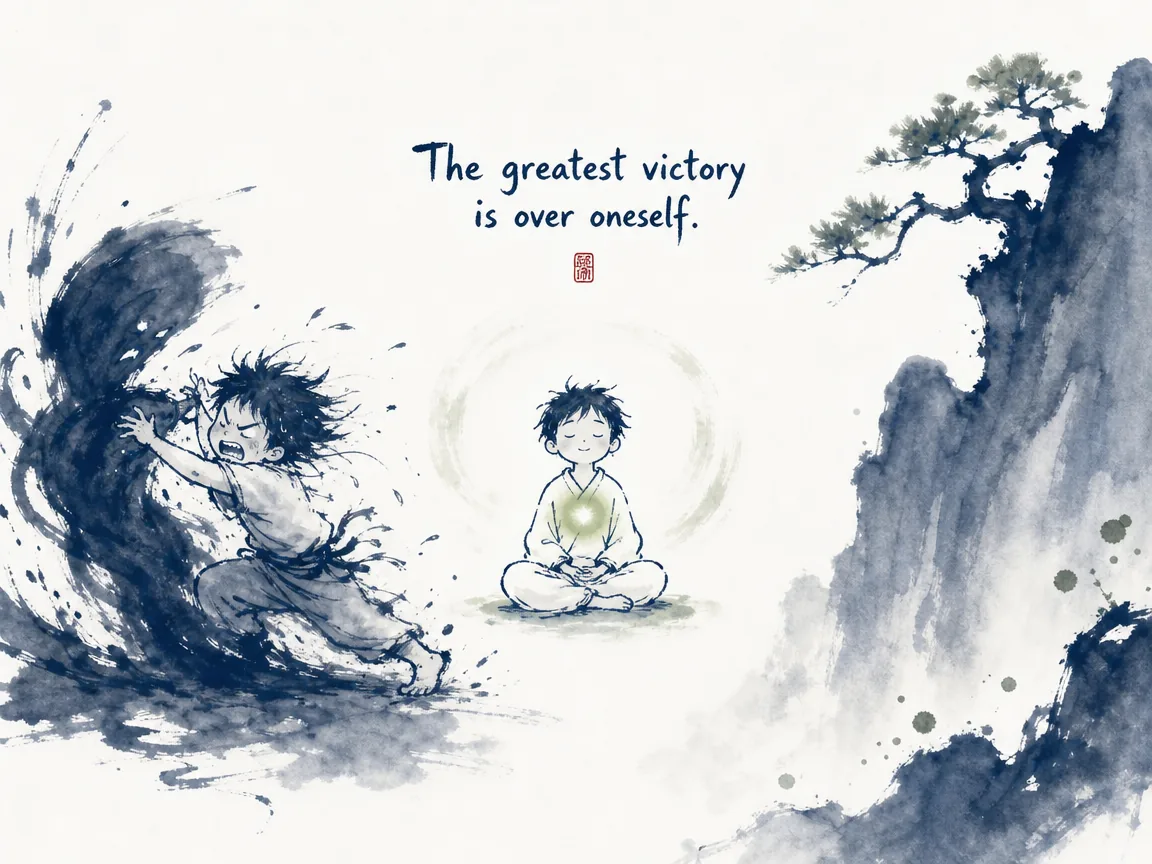
We live in a culture that equates strength with dominance. Win the argument, close the deal, outrun the competition, accumulate more than your peers — these are the metrics most of us inherit without question. We are taught early that life is a series of battles and that being strong means coming out on top. Yet something quietly undermines all of this pursuit. You can win every external contest and still feel hollow. You can accumulate accolades and still not recognize the person looking back at you.
The ancient Chinese thinker Laozi addressed this paradox over two thousand years ago in what is now In Daodejing Chapter 33 of the Dao De Jing — a text whose transmission and final form were shaped across centuries and preserved through later commentaries such as those attributed to Wang Bi [2]. Rather than dismissing the value of knowing others or achieving external success, Laozi reframes the entire question. Real strength, he suggests, is not defeating others but mastering oneself. It is the ability to see clearly, govern your impulses, set boundaries around greed, sustain purpose beyond mood, hold your ground through change, and create something that does not vanish with the body.
This is not a philosophy of passivity or resignation. It is a rigorous path of inner sovereignty. And in an age of burnout, comparison, and restless ambition, it may be exactly what we need to hear.
Daodejing Chapter 33: Knowing Others Is Wisdom. Knowing Yourself Is Clarity.
Most people are skilled at judging others. We can diagnose a colleague's ambition, label a partner's insecurities, criticize someone else's greed or rigidity. We consume endless information about the world — trends, opinions, other people's lives — while remaining strangely unfamiliar with our own motives, fears, and hidden dependencies. We label our own vanity as ambition, our own control as responsibility, our own anger as justified response.
In Daodejing Chapter 33, Laozi draws a deliberate distinction: knowing others is wisdom (zhi), but knowing yourself is illumination (ming) [2]. He does not dismiss the value of understanding the world around you. That kind of discernment is undeniably useful in relationships, work, and navigating complex environments. But he elevates self-knowledge to a higher register — not merely knowing more, but seeing clearly.
Think of awareness like a lamp. If you always shine it outward, you may navigate the world efficiently. But if the lamp never turns toward the person holding it, you remain blind to your own shape. Self-knowledge is uncomfortable because it may require admitting that your ideals contain vanity, your devotion carries attachment, your principles sometimes defend pride, and your anger is not always about the other person's wrongdoing.
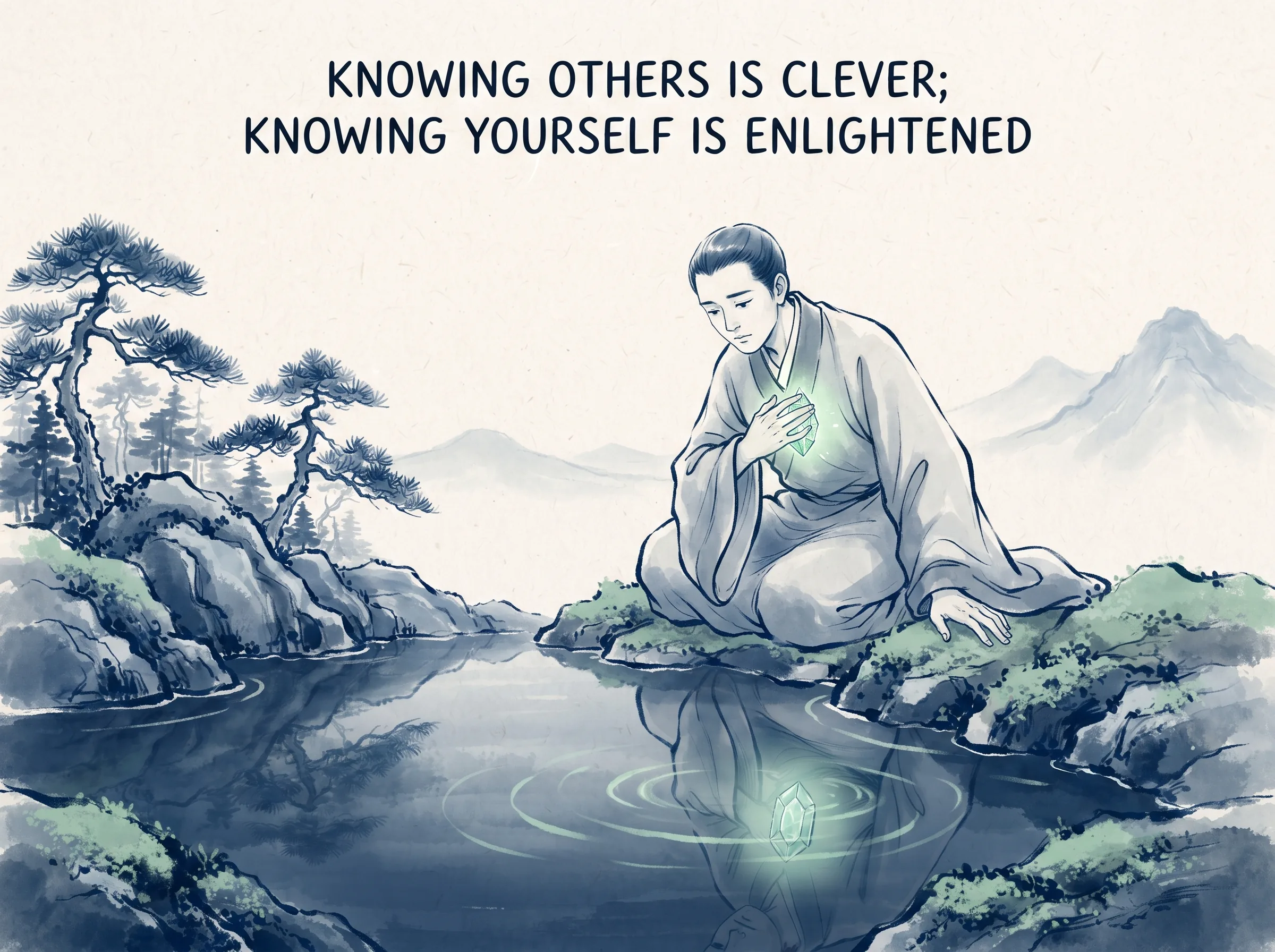
A simple daily practice can begin to build this habit. When you feel a strong reaction to someone — frustration, judgment, rivalry — pause and ask: Why do I need to be right here? What need of mine is being triggered? You are not trying to suppress the reaction. You are simply turning the lamp inward for a moment.
Continue with the deeper interpretation and practical application.
ChiDestiny members get access to the full analysis, modern applications, and the growing Chinese Wisdom Library.
FAQ
Does Laozi's teaching mean I should stop competing altogether? No. The Dao De Jing does not dismiss the value of knowing others or achieving external success. It reorders priorities. Competition is not wrong; placing your entire sense of worth on winning is fragile. True strength begins with self-governance, which then allows you to engage the world from a steadier place.
How is self-knowledge different from introspection or therapy? Self-knowledge in this tradition is not diagnostic labeling — it is ongoing observation of your motives, fears, dependencies, and reactions. While modern psychology and therapy offer valuable tools, Laozi's approach is specifically about seeing clearly without the protective stories we tell ourselves. It is less about categorizing your personality and more about catching yourself in the act of self-deception.
Can contentment and ambition coexist? Yes, when ambition is purified by contentment. Contentment sets the boundary around greed; ambition provides the direction. You can strive deeply without being driven by the belief that you are never enough. The difference is subtle but essential: one kind of ambition chases validation; the other pursues a chosen direction with clarity about what is sufficient.
Is Chapter 33 only relevant to people interested in Eastern philosophy? No. The concerns addressed — identity built on external comparison, the emptiness of relentless achievement, the importance of knowing yourself, the search for lasting meaning — are universal. The framework is expressed through ancient Chinese thought, but the questions it raises belong to anyone navigating modern life.
Closing Thought
True strength is not about becoming invincible. It is about becoming whole. It is the ability to look at yourself without flinching, to govern your impulses without self-violence, to pursue purpose without being consumed by it, and to create meaning that outlasts the body. Laozi does not ask you to escape the world. He asks you not to lose yourself within it.
If this exploration resonated with you, consider following Chidestiny for more writing that connects classical Chinese wisdom to the challenges of modern life. You might also explore how Daoist ideas about balance and simplicity intersect with contemporary discussions on well-being, or how Confucian teachings on relationships offer practical guidance for navigating modern social dynamics.
Discover the historical and philosophical roots in the classical foundation in Caring for Oneself: When People Do Not Fear Coercive Power.
For a deeper comparative examination of these ideas, explore our related study on Keeping Your Softness While Gaining Strength: Laozi’s Chapter 28 for Modern Life.
Sources & Further Reading
[1] Primary Source Discussed
[2] Laozi (Stanford Encyclopedia of Philosophy/Spring 2026 Edition)
[3] Related Philosophical Traditions
[4] Buddhism (Stanford Encyclopedia of Philosophy)
[5] Confucianism (Stanford Encyclopedia of Philosophy)
[6] Aristotle's Ethics (Stanford Encyclopedia of Philosophy)
Further Reading
- Dao De Jing (Laozi) — Various translated editions and scholarly commentaries, including interpretations by Wang Bi and Heshang Gong
- Mawangdui silk manuscripts (1973) — Early textual witnesses to the Dao De Jing that inform modern scholarly understanding of the text's development
- Comparative studies on self-knowledge across philosophical traditions, including works on Aristotelian practical wisdom and Buddhist self-inquiry practices






