
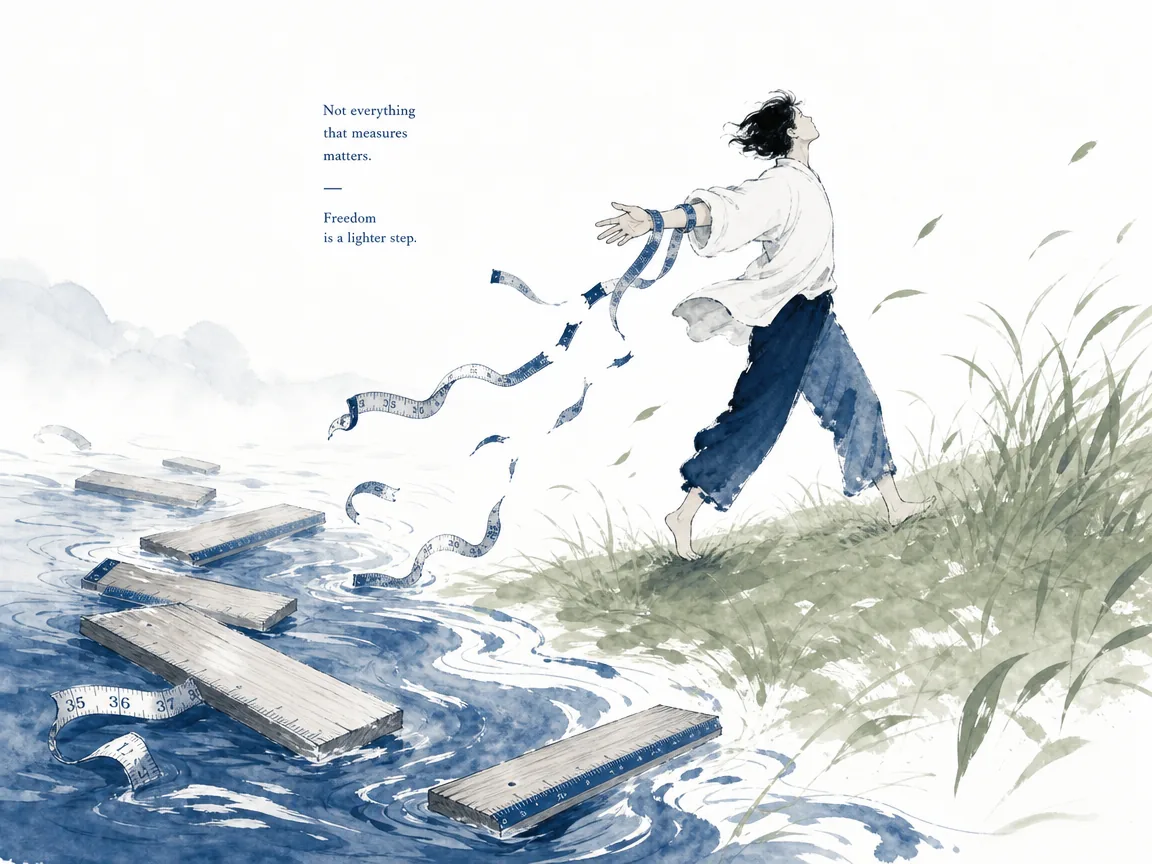
You hand out business cards with your title printed on them. You post your follower count on your profile. Your doctor asks your weight, your blood pressure, your steps per day — all reduced to numbers. Somewhere along the way, you stopped asking whether these labels describe you, and started believing they define you.
A child is called "not talented" after one bad report card and grows up performing to match the prediction. An employee lives and dies by their quarterly score. A woman builds a personal brand around being the "confident, independent career woman" — and slowly forgets she is allowed to be uncertain, tired, or uncertain about what she wants next. We did this to ourselves. Or rather, we let ourselves be shaped by systems that measure without understanding, name without knowing—a foundational perspective explored in Daodejing Chapter 32.
Laozi, the ancient thinker behind the Daodejing, warned about this more than two millennia ago. Not because he hated institutions or disliked language — he understood that names and roles are necessary for society to function — but because he saw clearly what many of us have forgotten: that the map is not the territory, and the label is not the life. In a world that keeps asking us to optimize, track, and quantify ourselves into better versions, his question still cuts straight through: when did your growth stop serving you, and start consuming you?
Daodejing Chapter 32: The World Before the Name
One of the most striking lines in the Daodejing — traditionally Daodejing Chapter 32 — opens with a statement that sounds almost paradoxical at first:
"The Dao is eternally nameless. Though the uncarved block is small, none under heaven can master it." (Dào cháng wúmíng. Pǔ suī xiǎo, tiānxià mò néng chén yě, 道常无名。朴虽小,天下莫能臣也。)
The Dao is always nameless. The uncarved block, though seemingly small, is something no one in the world can make subservient to themselves [1].
"Dao" here refers not to a religion or a deity but to the underlying pattern of reality — the way things happen, grow, connect, and change without needing an instruction manual. "Before" we gave it a name, it was already operating. Rain falls. Seasons turn. Cells divide. A forest regenerates after a fire. None of this waits for us to name it.
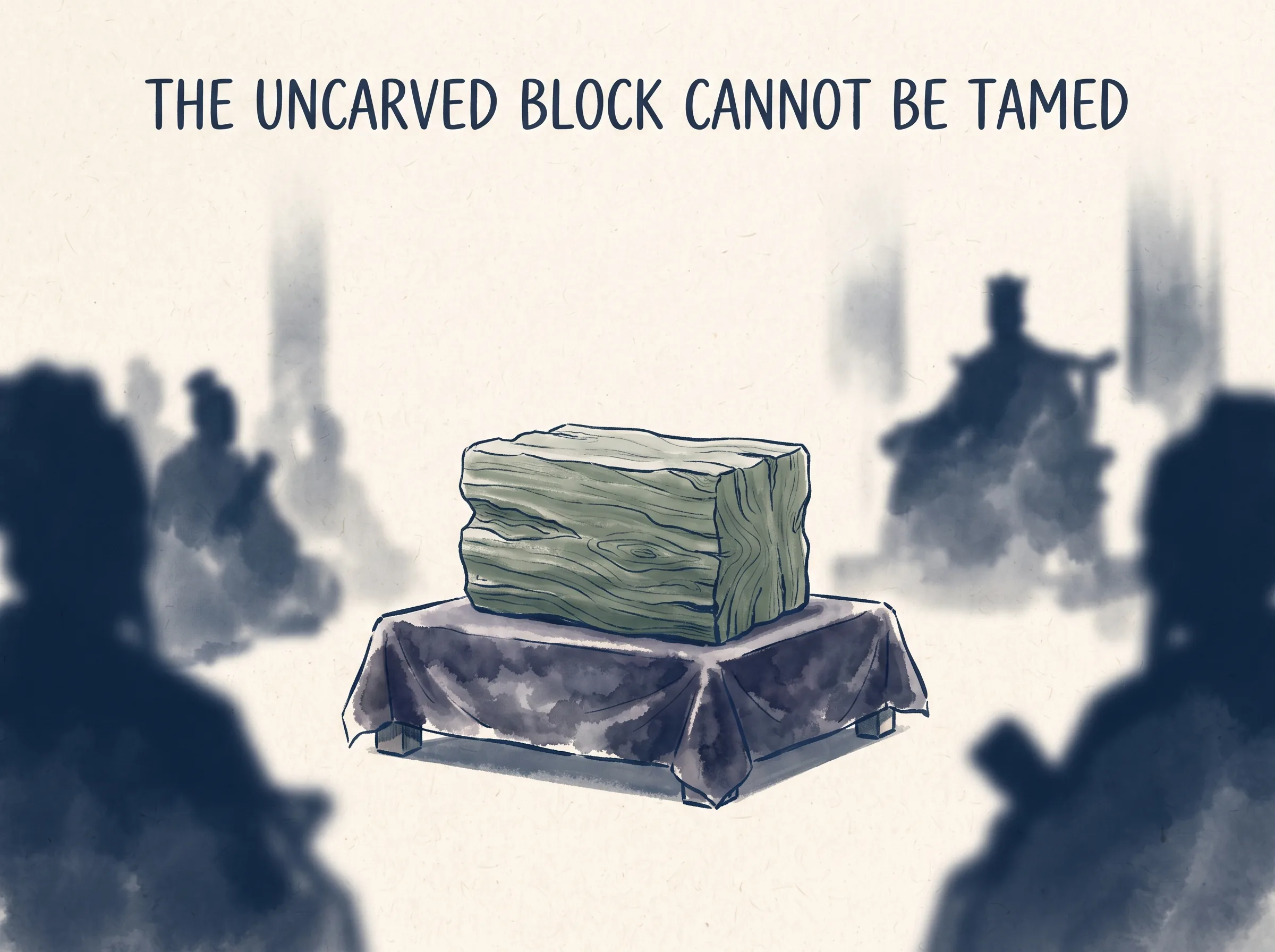
The word Laozi uses alongside "nameless" is the uncarved block (pǔ, 朴) — often translated as the "uncarved block." This is not merely a call to live simply. It points to something deeper: raw potential before it has been cut into fixed function. A block of wood before it becomes a table, a chair, a beam — it has not yet been assigned a single purpose, and so it contains every purpose within it. Carve it, and you gain specificity but lose possibility [1].
This matters because every label we accept — "high performer," "creative type," "anxious," "successful," "burnt out" — is a kind of carving. It gives us a shape. It also narrows what we think we can become.
The Stanford Encyclopedia of Philosophy notes that Daoist thought views names and classifications as cutting reality into types and kinds, which shapes how we perceive and respond to the world [2]. The tool is useful. The trap is forgetting it is a tool.
Continue with the deeper interpretation and practical application.
ChiDestiny members get access to the full analysis, modern applications, and the growing Chinese Wisdom Library.
FAQ
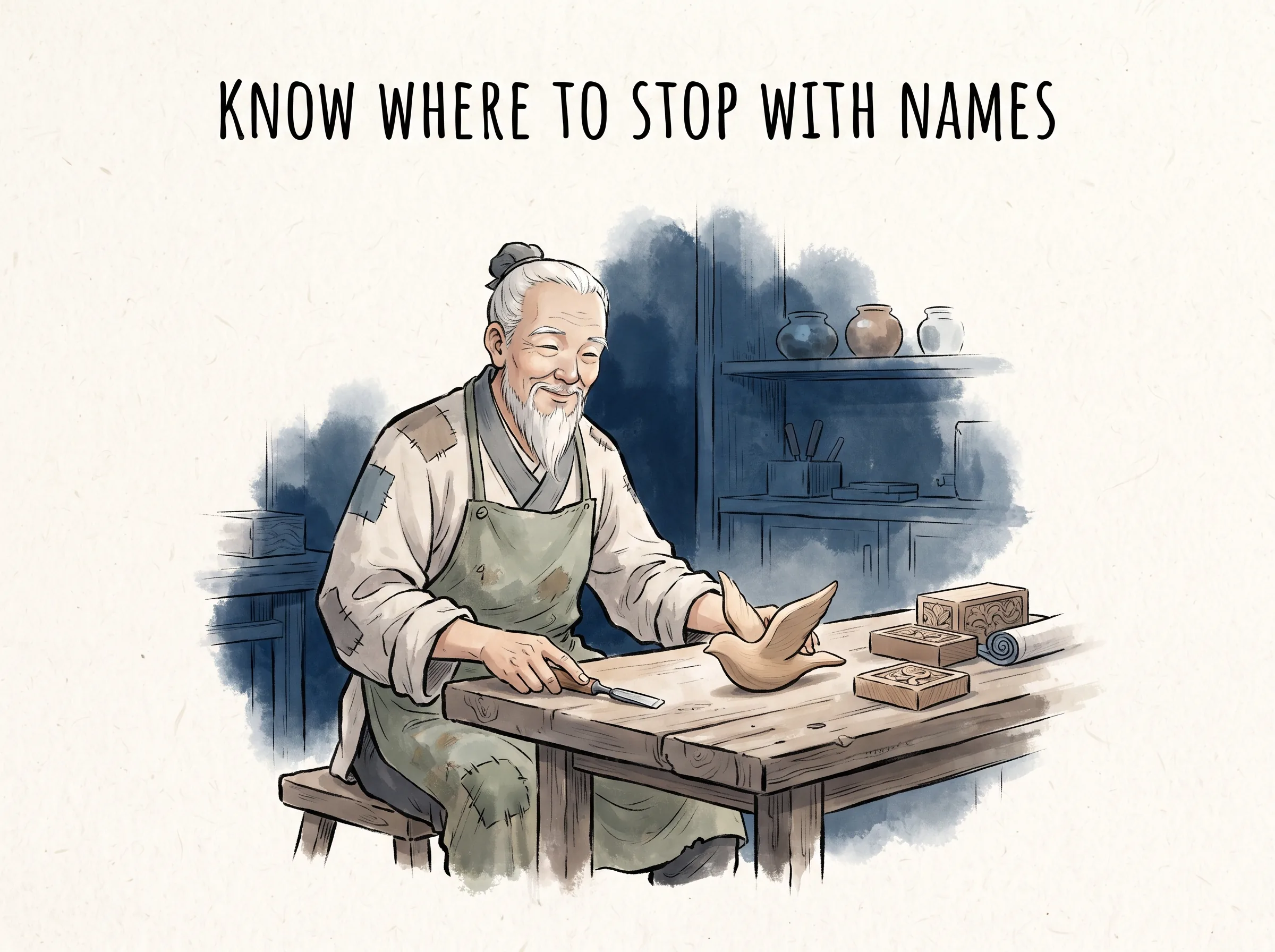
Is Laozi saying we should stop using names and roles entirely? No. The text acknowledges that names and systems are necessary — "once names have been established," the question is not whether to use them but whether to know when to stop. Civilization requires labels. The warning is against mistaking the label for the whole person.
What does "knowing where to stop" actually look like in practice? It looks like noticing when a system that was meant to help you begins to harm you — and choosing to step back. It might mean deleting a fitness app that makes you anxious, declining a promotion that would consume your health, or refusing to let a single performance score define your worth. It is the practice of recognizing limits before they become damage.
Does Daoism have anything to say about modern productivity and self-optimization culture? Yes, indirectly. The idea of knowing when to stop (zhī zhǐ, 知止) — is a direct challenge to cultures that equate constant growth with goodness. Daoist thought questions the assumption that more is always better, and suggests that restraint, restraint, and the willingness to pause are themselves forms of wisdom rather than signs of failure.
How is non-action (wúwéi, 无为) different from laziness or giving up? As scholars note, non-action (wúwéi, 无为) is not total inaction — it is action that does not force, manipulate, or violate natural processes [2]. A gardener who waters and weeds is practicing wuwei. A gardener who yanks plants upward to make them grow faster is practicing coercion. The difference is whether you are working with a process or trying to override it.
Where to Go From Here
The world will keep handing you labels. Job titles will change. Numbers will update. People will keep describing you in ways that feel convenient to them. None of this is inherently evil. But the moment you begin to believe that the description is the thing described — that you are your KPI, your follower count, your diagnosis, your role — you have handed a key to something that was never meant to hold one.
Laozi's answer is not to burn down the systems that measure and name us. It is to remember, again and again, that the world existed before your name was given to you, and it will continue beyond it. The uncarved block is still there, beneath every label you have ever accepted.
Take a moment today to ask yourself: Which of my labels am I carrying too closely? Not to abandon them — but to hold them more lightly.
To explore these themes from another angle, read our related reflection on Keeping Your Softness While Gaining Strength: Laozi’s Chapter 28 for Modern Life.
For a deeper comparative examination of these ideas, explore our related study on The Gravity of Virtue: The Heavy Is the Foundation of the Light.
Sources & Further Reading
[1] Daoism. Stanford Encyclopedia of Philosophy.
[2] Laozi. Stanford Encyclopedia of Philosophy (Spring 2026 Edition).
[3] Over-Optimization of Academic Publishing Metrics — Observing Goodhart's Law in Action. arXiv — 1809.07841.
Further Reading
- The Daodejing (Laozi) — Various scholarly translations, including those by David Hinton, D.C. Lau, and Henrike Hamann, offer different renderings of Chapter 32 and its key terms.
- Wang Bi's commentary on the Daodejing — One of the most influential traditional interpretations of the text.
- Heshang Gong's commentary on the Daodejing — Another major classical interpretive tradition.
- Goodhart's Law — Originally formulated by economist Charles Goodhart; widely cited in discussions of metrics, incentive design, and organizational behavior.






