
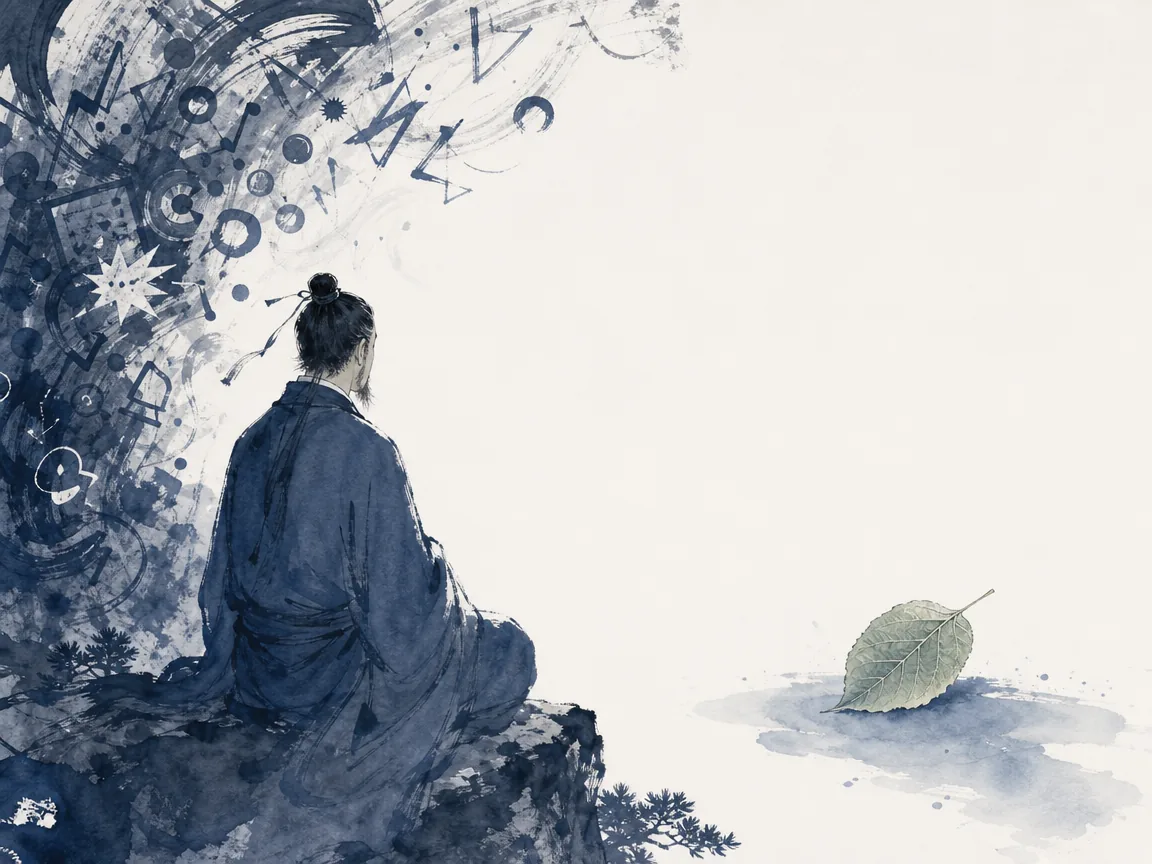
It is a familiar rhythm. You sit down to rest, to unwind, maybe to find a moment of quiet between tasks. You open an app. Screens glow. Images rush past — faces, products, opinions, headlines, snippets of other people's lives — each one a small hook pulling at your attention. Ten minutes become thirty. Thirty become an hour. When you finally look up, something strange has happened: you feel drained, unsettled, strangely empty. You were looking at everything, and yet you feel like you saw nothing at all.
What is happening here is not simply a matter of poor time management or weak willpower. A different kind of question lies beneath it. Why does consuming more visual information often leave us feeling less satisfied rather than more? Why does an abundance of choice, content, and stimulation sometimes produce the opposite of what we expect — not fulfillment, but a growing inner hollow? This principle is central to Daodejing Chapter 12.
These are not new questions, even if the technology that surfaces them is. Over two thousand years ago, a figure known as Laozi wrote a brief chapter in the Dao De Jing that describes exactly this pattern: when the senses are flooded by external stimuli, the mind moves outward and the inner self grows thin. This is not a condemnation of the modern world, nor is it a call to abandon screens or retreat from contemporary life. It is, rather, an invitation to examine how we relate to what we see, hear, and consume — and to consider whether our devices are serving us or quietly displacing us.
Daodejing Chapter 12: The Smartphone as Modern "Five Colors"
The opening line traditionally attributed to Laozi's twelfth chapter reads, in many translations, "The five colors blind the eye." Taken literally, this would suggest that bright or varied colors damage vision in a physical sense. But the phrase has long been understood within the Chinese philosophical tradition as describing something deeper — a kind of perceptual and spiritual dulling that comes not from a lack of stimulation but from an excess of it.
In today's context, the "five colors" map easily onto the saturated, algorithmically curated visual landscape of smartphones and social media. Every scroll presents a new image, carefully composed and optimized for attention. Feeds are filled with polished aesthetics — food, travel, bodies, homes, lifestyles — each one designed to hold the gaze. The result is not clarity but a kind of visual noise. We consume images faster than we can process them, and what remains is not understanding but a scattered, restless afterimage.
The blindness Laozi describes is not literal. It is the loss of the ability to see what matters — to distinguish between what is merely striking and what is meaningful, between what captures attention and what nourishes it. When the screen becomes the primary window through which we experience the world, we stop choosing what to look at. The algorithm chooses for us. The feed decides. We become passive recipients of a stream we did not design and do not fully understand.
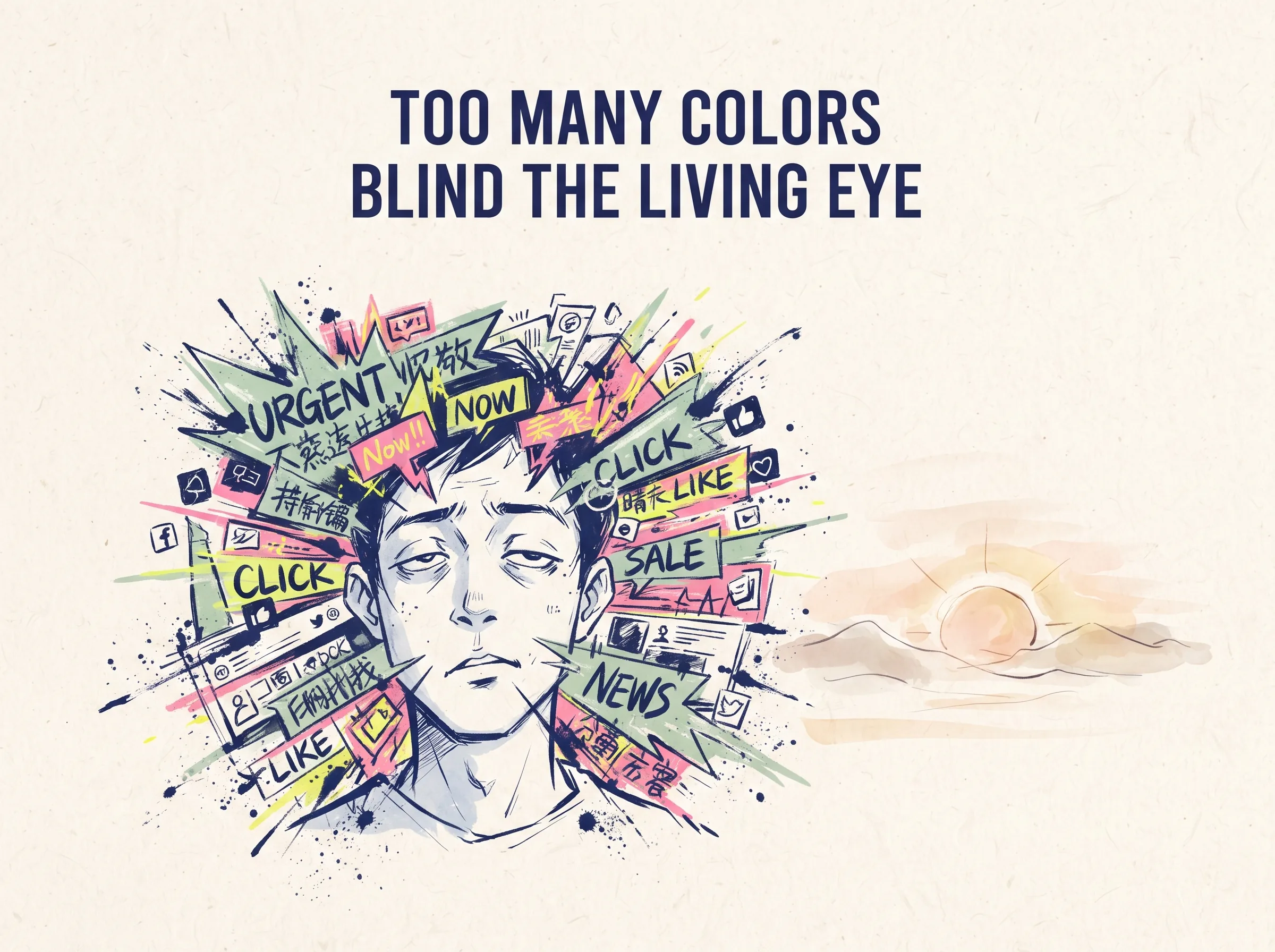
Research on compulsive scrolling supports a related intuition. Studies have found that doomscrolling — the repetitive, often involuntary act of consuming negative or overwhelming content online — is associated with higher levels of psychological distress and lower well-being. While these findings are correlational and do not establish direct causation, they align with the sense many people report: that prolonged exposure to endless streams of information can produce a distinctive kind of inner fatigue, one that goes beyond simple tiredness.
This is the modern "blinding." Not a failure of the eyes, but a failure of attention — the gradual displacement of deliberate seeing by reflexive scrolling.
Continue with the deeper interpretation and practical application.
ChiDestiny members get access to the full analysis, modern applications, and the growing Chinese Wisdom Library.
FAQ
Is the Dao De Jing actually attributed to a single historical figure named Laozi? The authorship of the Dao De Jing is a subject of scholarly debate. Traditional accounts attribute the text to a figure named Laozi, but modern scholarship generally holds that the text was likely compiled from earlier materials over time rather than written by a single author [2]. The dating and biographical details remain contested among specialists.
Does scrolling really affect mental health, or is that just a cultural worry? Empirical research has found associations between compulsive scrolling behaviors and higher levels of psychological distress, along with lower well-being and life satisfaction [3]. Other studies have linked perceived information overload to social media fatigue, which in turn relates to emotional stress and anxiety These findings are correlational and do not prove that scrolling causes distress, but they do provide evidence that heavy, unstructured screen use can coincide with measurable well-being costs.
Does Laozi's advice mean I should quit social media entirely? No. The chapter does not advocate abandoning the modern world. It asks whether we are being guided by our own genuine needs or by externally manufactured desires. The point is discernment, not withdrawal — learning to use technology without letting it use you.
What does "for the belly, not the eye" mean in everyday terms? It means prioritizing what genuinely sustains you over what merely stimulates you. In practice, this might mean choosing a walk instead of scrolling through a feed, cooking a simple meal and eating it without distraction, or setting deliberate boundaries around screen time. It is about restoring the internal compass rather than following every external signal.
What Comes Next
The emptiness that follows endless scrolling is not a personal failing. It is a predictable consequence of living in an environment engineered to capture attention and amplify desire. Laozi's insight, however ancient, cuts to the heart of the matter: when the outer world grows too loud, the inner world grows thin.
The remedy is not to retreat from the world but to recover a sense of proportion. To notice when the eye is leading and the belly is starving. To choose, again and again, to return to what is real, what is sufficient, and what is truly yours.
The smartphone will not disappear. Information will keep flowing. But between the scroll and the stop, there is always a small space — wide enough for a breath, wide enough for a choice, wide enough to remember who is doing the looking, reflecting the enduring wisdom of Daodejing Chapter 12.
Discover the historical and philosophical roots in the classical foundation in Guarding the Tao: The Wisdom of Frugality and Restraint.
Deepen your understanding of these principles in our reflection on Why Does a Society That Praises a Virtue Most Often Prove It Has Lost It?.
Sources & Further Reading
[1] Laozi (Stanford Encyclopedia of Philosophy) — Scholarly overview of Laozi texts and their complex compositional history
[2] Doomscrolling Scale: its Association with Personality Traits, Psychological Distress, Social Media Use, and Wellbeing – PMC — Empirical study linking doomscrolling to psychological distress and lower well-being indicators
[3] How compulsive WeChat use and information overload affect social media fatigue and well-being during the COVID-19 pandemic? A stressor-strain-outcome perspective – PMC — Research on information overload, social media fatigue, and emotional stress among young users
Further Reading
- The Dao De Jing, Chapter 12 — several English translations available, including those by D.C. Lau (Penguin Classics) and Victor Mair
- Works on attention economics and digital minimalism for contemporary perspectives on the same concerns







[…] To explore these themes from another angle, read our related reflection on Why the More We See, the Less We Actually See. […]
[…] The wisdom of Daodejing Chapter 12 Translation addresses a fundamental human dynamic: how we navigate ambition, quietude, and the natural flow of existence. In the classical tradition, this passage serves as both a metaphysical mirror and a practical compass for daily living and leadership. Explore how this principle translates into contemporary daily life in our guide to Why the More We See, the Less We Actually See. […]