
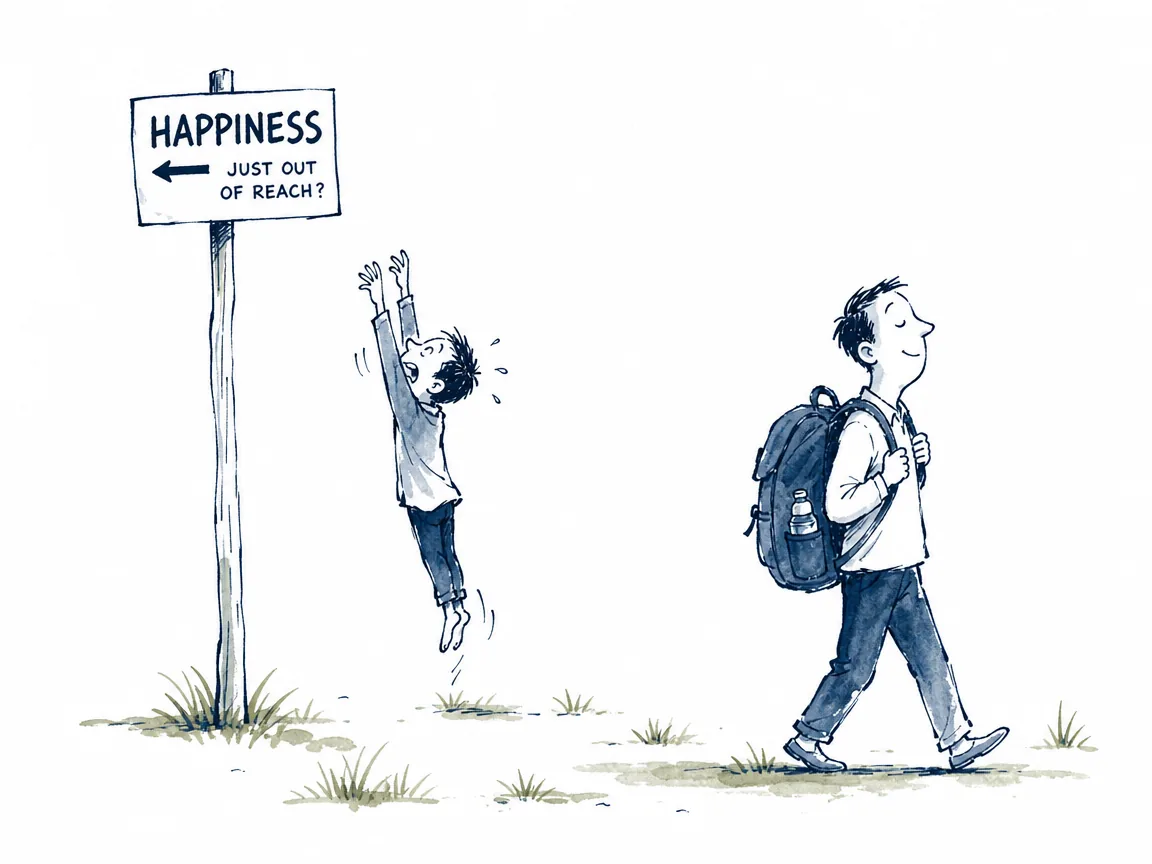
We live in an age that equates fatigue with virtue. The language of optimization, speed, and relentless output saturates our workplaces, schools, and social media feeds. When something isn't working, the default prescription is usually more effort, faster pacing, and less rest. Yet anyone who has pushed through exhaustion knows the pattern: the harder you strain, the more quickly the results collapse. This is not a personal failing. It is a structural problem, one that an ancient Chinese philosophical tradition recognized with startling precision.
Burnout has been formally recognized by the World Health Organization as an occupational phenomenon resulting from chronic workplace stress that has not been successfully managed [WHO FAQ on Burn-out]. It is characterized by energy depletion, growing mental distance from one's work, and a sense of reduced professional efficacy. A global systematic review found a statistically significant association between long working hours and burnout among healthcare professionals, suggesting that sustained overexertion carries measurable risk [Occupational Risk Factors for Burnout Syndrome Among Healthcare Professionals]. But the pattern extends far beyond any single profession. The instinct to push harder often undermines exactly what it aims to achieve — a dynamic that Laozi described over two millennia ago—a foundational perspective explored in Daodejing Chapter 24.
The oldest surviving manuscripts of the Laozi, such as the Mawangdui silk texts dating to at least the second century BCE, contain chapters that articulate this insight with unusual directness [Laozi (Stanford Encyclopedia of Philosophy)]. Chapter 24, one of the most cited passages in the entire text, opens not with an abstract principle but with two simple physical observations: standing on tiptoes does not produce stability, and taking excessively long strides does not produce sustainable progress. From these everyday images, the chapter builds into a broader meditation on what happens when effort exceeds its natural conditions. The question it raises is still urgent: why does pushing harder often destroy what we are trying to build?
Daodejing Chapter 24: The Paradox of Hustle
Hustle culture rests on a straightforward assumption: more effort produces more results. When progress stalls, the logical response is to increase input. More hours, more intensity, more discipline. The problem is that this assumption treats human capacity and organizational systems as if they respond linearly to force. They do not.
Systems — whether a body, a team, or a practice — have limits built into their structure. When effort respects those limits, growth is sustainable. When effort ignores them, the system compensates, resists, or breaks. The ancient observation in the Laozi is not anti-effort. It is anti-overexertion. It asks us to notice what happens when the means we use to achieve a result actively undermine the conditions that result depends on.
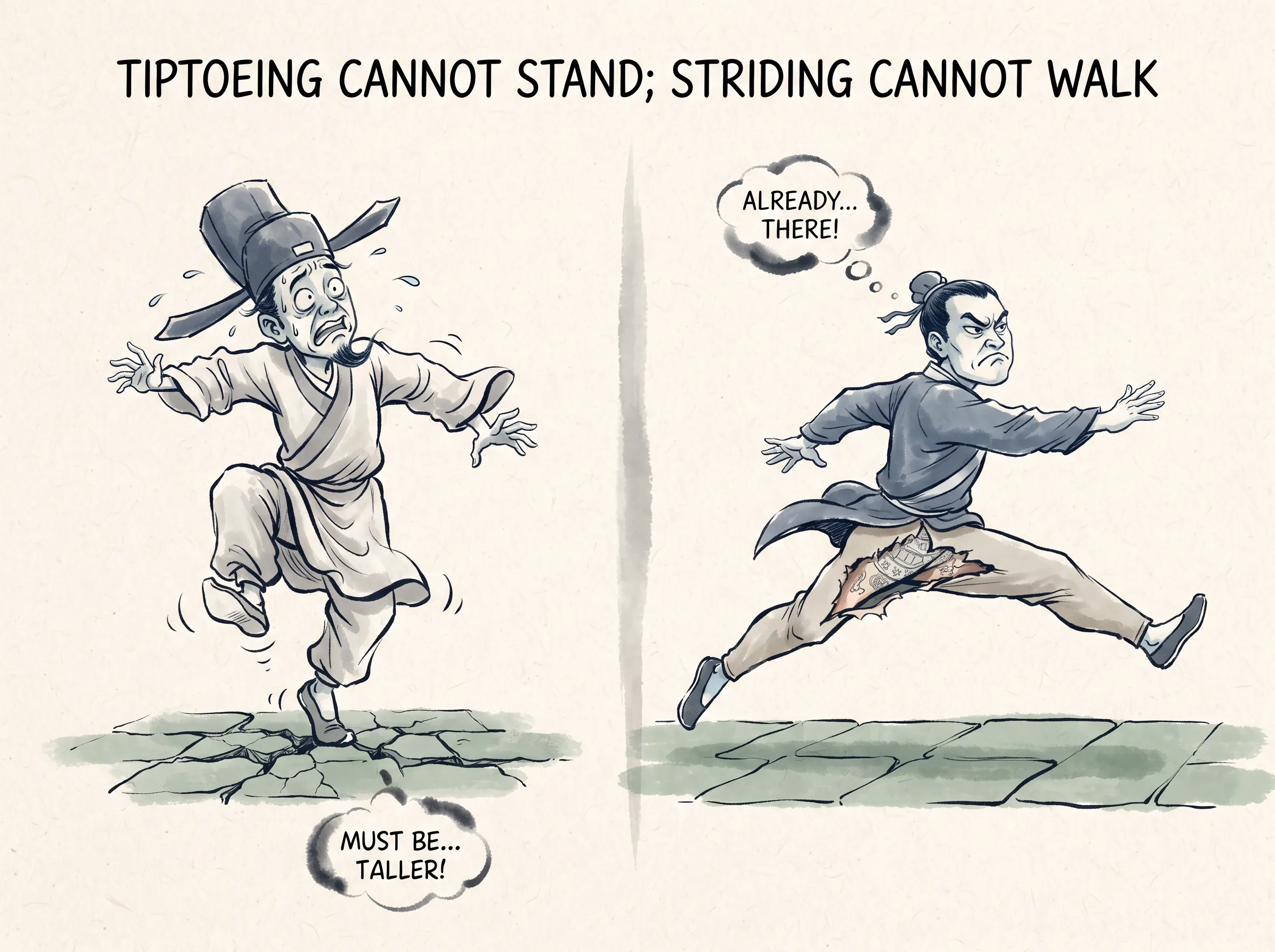
Daodejing Chapter 24 frames this in several layers. The first two images deal with pace and posture. The middle section examines five patterns of ego inflation. The closing lines summarize the insight: these behaviors are like leftover food or extra limbs — they exceed what is useful and become burden [Laozi (Stanford Encyclopedia of Philosophy)]. The chapter does not tell us to do less. It tells us to pay attention to whether what we are doing is building or quietly dismantling.
Standing on Tiptoes: The Cost of Premature Height
The image of standing on tiptoes is deceptively simple. If you want to appear taller in a crowd, raising yourself onto your toes works — temporarily. You gain height. But the height comes at a cost: balance. Tiptoeing shifts your center of gravity forward, requires continuous muscular effort to maintain, and leaves you unstable the moment you stop concentrating. You are not standing. You are performing the act of standing.
In modern life, this pattern shows up everywhere. A company scales its operations faster than its management capacity can support it. An individual builds a public persona before the underlying competence exists to sustain it. A student accelerates through a curriculum without letting understanding take root. In each case, the outward appearance of growth is real. The internal structure is not.
The distinction matters because what looks like height without foundation is actually precarity disguised as success. The higher you raise yourself without building the ground beneath you, the more energy you must devote simply to staying upright. At some point, the effort required to maintain the pose exhausts the energy available for actual progress. The person who builds a brand before building craft, or an organization that expands before developing its internal systems, is not stronger than someone who grows steadily. They are more fragile.
This is not a call to avoid ambition. It is a call to check whether the ambition is supported by the structure. True height is not achieved by raising yourself above your foundation. It is achieved by letting the foundation grow until it can naturally support the height.
Continue with the deeper interpretation and practical application.
ChiDestiny members get access to the full analysis, modern applications, and the growing Chinese Wisdom Library.
FAQ
Is the Laozi really two thousand years old? The text attributed to Laozi likely took shape during the fourth and third centuries BCE, with the oldest complete manuscripts — the Mawangdui silk texts — dated to at least the second century BCE [Laozi (Stanford Encyclopedia of Philosophy)]. The exact authorship and earliest form remain debated among scholars, but the wisdom it contains is genuinely ancient.
Does this mean I should stop working hard? No. The Laozi does not advocate laziness or the rejection of effort. It advocates effort that is aligned with sustainable conditions. Pushing hard in a way that destroys the foundation is different from working diligently within your capacity. The distinction matters.
Can burnout be reversed? Yes. Burnout is recognized as a reversible occupational phenomenon, not a permanent medical condition [WHO FAQ on Burn-out]. Recovery typically involves reducing the chronic stressors that caused it, allowing rest, and rebuilding engagement gradually. Professional support can be helpful.
Does this philosophy apply only to individuals? No. The patterns described in Chapter 24 operate at every level — personal habits, team dynamics, organizational culture, and social systems. Overexertion is not just an individual problem. It is a structural one.
The world rewards effort. But it rewards sustainable effort more. The danger is not ambition or diligence — it is the conviction that more force always produces better results. The Laozi offers a different picture: effort that respects limits builds. Effort that ignores limits destroys what it tries to strengthen. The path forward is not less effort. It is wiser effort — effort that does not overstride, overextend, or overclaim. The person who keeps their feet on the ground walks farther than the one who leaps ahead and collapses.
If this resonated, explore our other writings on applying classical Chinese wisdom to contemporary challenges.
To explore these themes from another angle, read our related reflection on Why the More We See, the Less We Actually See.
For a deeper comparative examination of these ideas, explore our related study on The Way of Heaven: Bending the Great Bow to Balance Abundance and Scarcity.
Sources & Further Reading
[1] Burn-out an occupational phenomenon: International Classification of Diseases — World Health Organization. Defines burnout as a syndrome resulting from chronic workplace stress, characterized by energy depletion, mental distance from work, and reduced professional efficacy.
[2] Occupational Risk Factors for Burnout Syndrome Among Healthcare Professionals: A Global Systematic Review and Meta-Analysis — PMC. Reports a statistically significant association between long working hours and burnout among healthcare workers, with a pooled odds ratio of 1.23.
[3] Laozi — Stanford Encyclopedia of Philosophy. Provides scholarly overview of the Laozi text, its transmission history, and the Mawangdui silk manuscripts dating to at least the second century BCE. Further Reading:
[4] Tao Te Ching — Translations by David Hinton, Ursula K. Le Guin, and Wing-tsit Chan offer accessible entry points into the text.
[5] The Tao of Pooh by Benjamin Hoff — A gentle introduction to Daoist ideas through familiar characters.
[6] Daoism Handbook edited by Liu Xiaogan — A scholarly overview of Daoist philosophy and its historical development.






