

You set a plan in motion. It looks solid on paper—career trajectory, relationship expectations, health targets, financial goals—and you follow through with discipline and effort. Then reality diverges from the plan. Not slightly, but in ways that feel personal, as though the world has failed to keep its end of an agreement. The natural reaction is frustration, then a tightening grip: work harder, plan more carefully, control more tightly. And yet the more force is applied, the more the situation seems to resist, spiral, or collapse entirely.
This pattern is so common that it shapes modern life. We are taught that stronger wishes bend reality, tighter plans guarantee outcomes, and more effort produces proportional results. When outcomes don't match our input, we tend to interpret the gap as a personal failing rather than a structural mismatch. We feel not merely disappointed but offended—as if the world should have complied. Relationships shift and we blame the other person. Health declines despite discipline and we blame our bodies. Industries change overnight and we blame external chaos. The underlying assumption, almost invisible in its pervasiveness, is that the world should revolve around a single will—a foundational perspective explored in Daodejing Chapter 25.
Two thousand years ago, Laozi approached this problem from a radically different angle. In the twenty-fifth chapter of the Daodejing, he does not begin by telling people what to do. He begins by reordering their place in the world. He describes a generative foundation that precedes Heaven and Earth, establishes a chain of orientation from human action to cosmic patterns, and concludes with one of the most quoted and most misunderstood lines in the Chinese philosophical tradition: Dao models itself on ziran—on the self-so. The chapter is not a gentle reminder to relax and go with the flow. It is a complete architecture for understanding why the pursuit of total control is structurally mistaken, and what effective action looks like once that mistake is recognized.
Daodejing Chapter 25: The Illusion That Stronger Will Should Bend Reality
The modern assumption is straightforward: if I want something enough, if I plan carefully enough, if I execute with sufficient persistence, reality ought to conform. This assumption structures education, career culture, personal finance, relationships, and self-improvement industries. It is reinforced by language itself—we speak of "manifesting" outcomes, of "designing" our lives, of "taking control." The deeper problem is not that these goals are wrong. It is that the model of causation behind them is incomplete.
When a plan fails, the instinctive response is to double down on control. A parent who sees a child struggling academically may increase supervision, structure every hour, and remove all obstacles. A manager who wants a team to perform may tighten metrics, reduce autonomy, and monitor details. A person who wants a relationship to be secure may seek constant reassurance, monitor the other's behavior, and preemptively manage any sign of distance. In each case, the intention is protective. The structural effect is the opposite of protection.
The reason is not that the world is hostile to human will. It is that the world operates through conditions, not through commands. A child raised under constant management either rebels against the constraints or fails to develop the capacity for independent judgment. A team treated as incapable of self-direction waits for instructions and ceases to practice decision-making. A relationship built on surveillance replaces trust with performance. In every case, the longer and more intensively control is applied, the more extreme the return tends to be. This is not moral punishment. It is structural feedback.
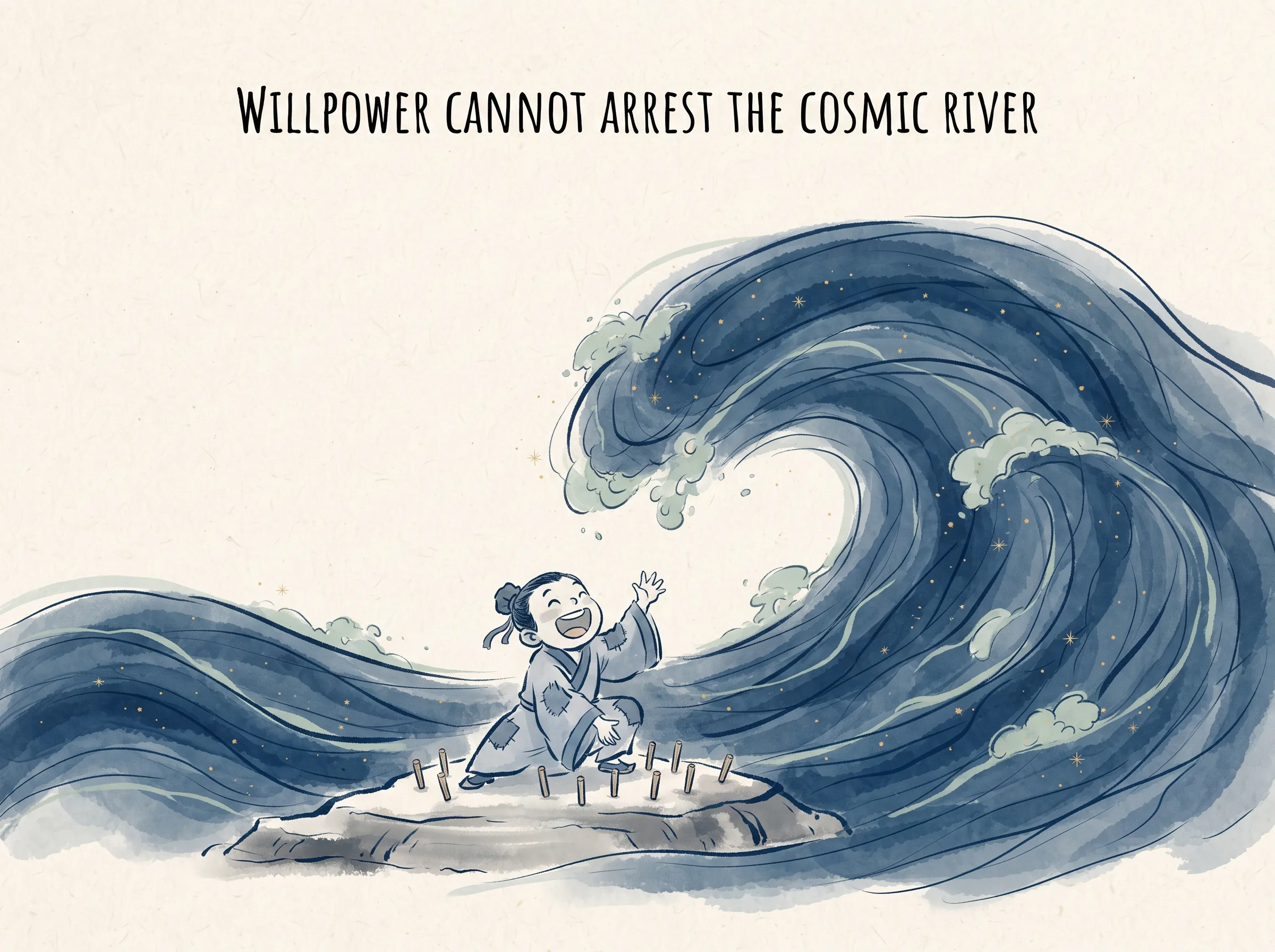
What the modern mind often mistakes for a failure of will is frequently a failure of orientation. The plan was not wrong because it lacked force. It was brittle because it did not account for the conditions that make any outcome possible. Laozi's challenge in Daodejing Chapter 25 is precisely to correct that orientation.
Continue with the deeper interpretation and practical application.
ChiDestiny members get access to the full analysis, modern applications, and the growing Chinese Wisdom Library.
FAQ
Is Laozi saying we should give up on planning and just let things happen? No. The Daodejing does not advocate passivity. As noted in philosophical scholarship, wuwei is contrasted with action driven by self-serving desire, not with action itself [3]. Planning is compatible with Laozi's approach when the plan is grounded in real conditions rather than in wishful thinking. The difference is between a plan that imposes a desired outcome onto reality and a plan that works with the conditions that actually exist.
Does "Dao models itself on ziran" mean Dao has a higher authority above it? No. The phrase means that Dao operates according to its own inner coherence, not according to an external commander. Ziran is not a separate entity above Dao. It is the principle by which Dao functions—self-so, uncaused, without an external source of direction. This is why the phrase is sometimes rendered as "Dao is spontaneously so" rather than "Dao follows nature."
Can this framework be applied to organizational leadership and management? Yes, and the implications are significant. The chapter's argument that higher position requires greater restraint rather than greater control has direct relevance to leadership. The principle that effective governance creates conditions for self-organization rather than micromanaging details aligns with what modern organizational theory calls empowered autonomy. The warning that expansion beyond carrying capacity generates structural feedback applies to companies, teams, and institutions at every scale.
How do I know when I'm confusing ziran with avoidance? The distinguishing factor is discernment. Avoidance shrinks the field of perception—it simplifies a complex situation into "nothing can be done." Ziran enlarges it—it asks what conditions are present, what is possible within those conditions, and what action aligns with reality rather than with fear or habit. If your conclusion leads to paralysis without examination, it is likely avoidance. If it leads to a specific, conditional action plan, it is closer to ziran.
Conclusion
The more you try to control your life, the more things spiral—not because the universe is adversarial, but because control ignores the conditions that make any outcome possible. Laozi's insight in Chapter 25 is not that effort is useless. It is that effort without orientation is brittle. The four-stage chain—Earth, Heaven, Dao, ziran—offers a method for calibrating action to reality rather than imposing will upon it.
The practical takeaway is simple to state and difficult to practice: begin with what is actually there. Your body, your resources, your relationships, the season, the cycle, the system you are part of—these are not obstacles to your plans. They are the ground your plans must stand on. When action is rooted in conditions rather than in wishes, it does not lose force. It gains direction.
The next step is not to abandon your goals. It is to examine the conditions your goals require and to ask whether you are building on solid ground or on sand. If the conditions are missing, the natural action is not to force the outcome but to create the conditions. If the conditions are present, the natural action is to move with them rather than against them. This is what Dao fa ziran means in practice—not less ambition, but clearer sight.
To explore these themes from another angle, read our related reflection on When Softness Outlasts Hardness: What Laozi’s 43rd Chapter Teaches About Real Power.
For a deeper comparative examination of these ideas, explore our related study on Why Trying Harder to Control Everything Backfires — And What Ancient Wisdom Says Instead.
Sources & Further Reading
[1] Laozi / Dao De Jing – Chinese Text Project — Primary text of the Daodejing, Chapter 25 (Wang Bi edition)
[2] Heshanggong Commentary on Laozi, Chapter 25 – Chinese Text Project — Early commentary tradition on Chapter 25
[3] Laozi – Stanford Encyclopedia of Philosophy — Scholarly overview of Daoist philosophy, including discussions of wuwei, ziran, and the nature of Dao
[4] Analysis of Variants in Bamboo Slip No. 21 of Guodian Laozi Group A (郭店老子甲組21號簡異文解釋) — Analysis of textual variants in the Guodian bamboo slip version of Chapter 25
[5] Micromanagement in clinical supervision: a scoping review – PMC — Research on the effects of excessive control in supervisory contexts
Further Reading
- Laozi: A New Reading of the Classic by Liu Xiaogan — Contemporary scholarly interpretation of the Daodejing
- The Art of the War / The Art of Not Fighting by David Hawkes — Accessible translation and commentary on the Daodejing
- Dao De Jing: A Minimalist Translation by John Minford — Alternative rendering emphasizing clarity and concision






