
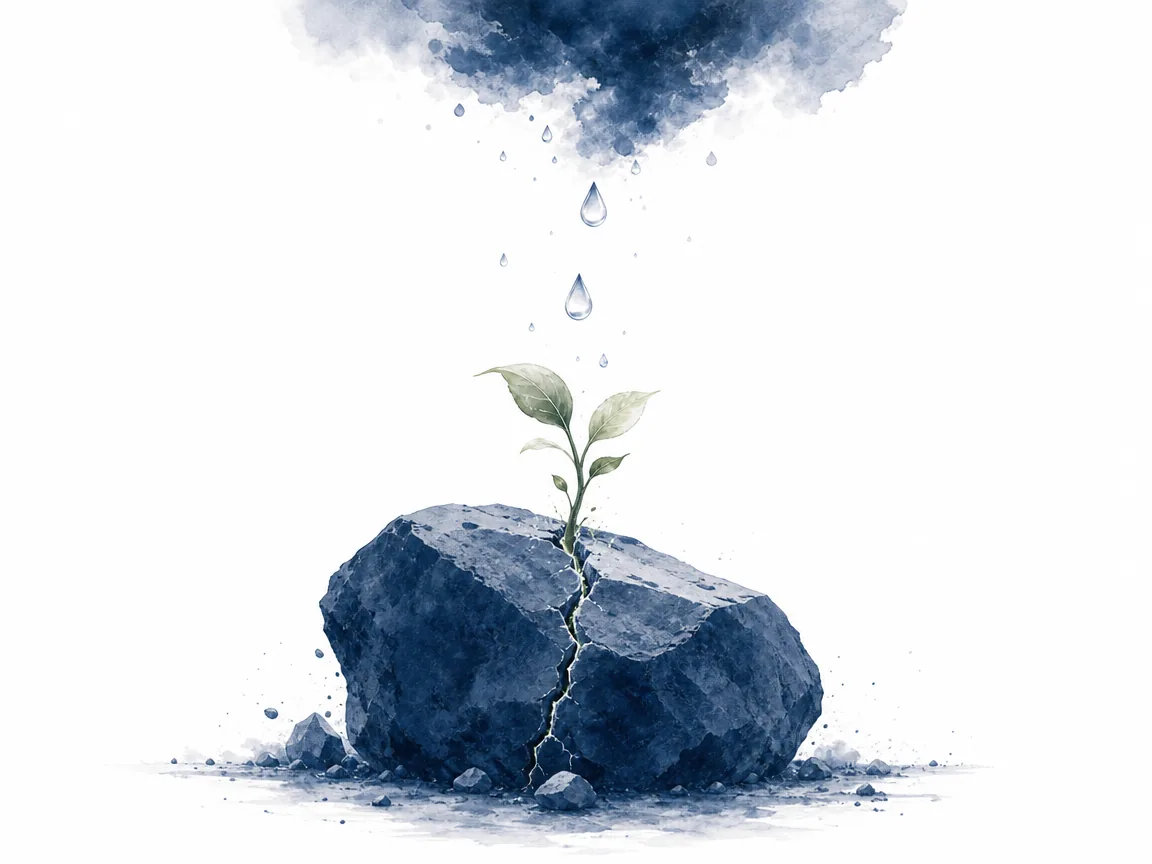
We tend to think of power as something hard. To break a wall, we bring a heavier hammer. To defeat an opponent, we must be stronger. To fix a broken system, we impose more control. This logic feels obvious because it works — in the short run, in direct confrontation, against simple problems. But anyone who has tried to change a stubborn habit, repair a damaged relationship, or shift a rigid culture knows a different truth: force often meets with resistance, and sometimes the harder you push, the more the thing resists back.
Laozi saw this pattern clearly. In Daodejing Chapter 43 of the Daodejing, he offers what sounds like a paradox and turns out to be a deeply practical insight: "The softest thing in the world moves freely through the hardest. The formless enters the seam-less." This is not a gentle slogan about being nice. It is a claim about how change actually works in complex systems — claims that challenge the way we think about power, influence, and action itself.
Daodejing Chapter 43: The Radical Simplicity of Chapter 43
The full passage reads: "The softest thing under heaven gallops through the hardest. That which has no substance enters where there is no space. Thus I know the benefit of non-action. The teaching without words, the benefit of non-action — few under heaven reach it" (Tiānxià zhī zhì róu, chíchěng tiānxià zhī zhì jiān. Wú yǒu rù wú jiān, wú shìyǐ zhī wúwéi zhī yǒuyì. Bù yán zhī jiào, wúwéi zhī yì, tiānxià xī jí zhī, 天下之至柔,驰骋天下之至坚。无有入无间,吾是以知无为之有益。不言之教,无为之益,天下希及之) — "The softest thing in the world gallops through the hardest. The formless enters the seam-less. From this I see the benefit of non-action. The teaching without words, the benefit of non-action — few in the world reach to it" [4].
What makes this line striking is its structure. Laozi does not begin with a moral command to be gentle. He begins with an observation about how the world works, then draws a conclusion about action. The chapter moves from description to principle: if the soft can traverse the hard, and the formless can enter what has no gaps, then non-action (无为) must have real value. The final line — that few in the world can match this — suggests Laozi knew his account ran against the grain of ordinary thinking about power.

This chapter does not stand alone. It belongs to a cluster in the middle of the Daodejing that works through the implications of "weakness" as a central idea. Daodejing Chapter 43 states: "Return is the movement of the Dao. Weakness is the use of the Dao. All things in the world are born from being; being is born from non-being" [1]. Chapter 42 describes how all things carry yin and embrace yang, how opposing forces combine into harmony, and warns that "the violent do not meet a natural end" [1]. Chapter 43 then answers the question this thread raises: how exactly does weakness function as the Dao's mode of operation? The answer is not that weakness defeats strength in a head-on contest, but that it operates by a different logic entirely.
What Does "Supreme Softness" Actually Mean?
When Laozi speaks of "the softest thing in the world," many readers immediately think of water. There is good reason for this. Chapter 8 says "The highest good is like water" (上善似水), and Chapter 78 states plainly: "Nothing in the world is as soft and weak as water, yet nothing is better at overcoming the hard and strong" [1]. Water takes the shape of its container. It flows downward. It wears away stone over time. As the commentator He Shanggong noted, "The supremely soft is water; the supremely hard is metal and stone" [3].
But Chapter 43 does not mention water directly. It says "the softest thing in the world" — a broader claim than any single substance. If Laozi meant only water, he could have said so. The phrase points to a pattern of action that water illustrates but is not limited to.
Four features help clarify what this softness involves:
It does not lock itself into one fixed form. Hardness depends on maintaining a particular shape. That is its strength and its limitation. The harder something is, the more conditions it needs to stay hard. Softness adapts. It changes shape in response to what it meets without losing its capacity to act.
It does not treat head-on collision as the only way to act. Force against force produces a winner and a loser — and often mutual damage. Softness bypasses that frame. It finds paths around resistance rather than assuming resistance must be met head-on.
It absorbs impact through deformation instead of breaking. A rigid structure that cannot bend shatters when stress exceeds its limit. A flexible structure distributes pressure through change of form and remains intact. Preservation of future possibility matters as much as immediate resistance.
It keeps options open rather than committing everything to one position. Strength often concentrates power into a single display. Softness spreads presence across many directions at once, making it harder for any single defense to contain it.
None of this means softness equals weakness, cowardice, or passivity. What Laozi describes is a different strategy of engagement — one that refuses to accept the terms of a contest designed to favor only one kind of power.
Why "Gallops Through" Changes Everything
The Chinese verb Laozi uses — galloping freely (chíchěng, 驰骋) — carries more weight than "passes through." It originally relates to horses running freely across open ground. It implies movement that is not merely permitted but expansive, operating across a whole field rather than squeezing through a single gap.
This matters because it reframes the relationship between soft and hard. Hardness defends specific boundaries. A wall stops what hits its face directly. But no structure can defend against every possible form of influence at once. A wall may resist a battering ram and yet admit moisture, temperature change, time, or the slow erosion of loyalty among those who maintain it. Every strength has blind spots. What appears as an impenetrable exterior often protects only against the type of pressure it was built to withstand.
Continue with the deeper interpretation and practical application.
ChiDestiny members get access to the full analysis, modern applications, and the growing Chinese Wisdom Library.
FAQ
Does Laozi mean we should never use force? No. The chapter describes a pattern of influence that operates differently from direct force, not a prohibition against force in all situations. Direct confrontation has its place — in emergencies, in physical defense, in stopping immediate harm. Laozi's point is that force is not the only or always the best way to produce lasting change, especially in complex, open systems where resistance multiplies the cost of coercion.
Is "the formless enters the seam-less" literally about physical objects? Not primarily. While water and erosion provide vivid physical examples, the phrase is best understood as describing influences that do not require physical bulk to be effective — language, culture, habit, trust, fear, norms. These do not occupy space the way stones do, yet they shape behavior in ways that physical force alone cannot sustain.
How is wu-wei different from doing nothing? Wu-wei is selective action — action that aligns with conditions rather than imposing external will regardless of context. It means intervening where intervention helps, stepping back where intervention disrupts, and avoiding the temptation to fill every gap with visible control. Doing nothing out of indifference is not wu-wei; doing nothing out of strategic restraint often is.
Can this principle be used to manipulate people more effectively? It can be — and that is a real danger. Using soft influence to bypass someone's conscious awareness for purposes of control is manipulation, not wisdom. The ethical distinction lies in intent and transparency: is the goal to serve the other person's flourishing and genuine understanding, or to achieve an outcome they would resist if fully aware? Laozi's framework is descriptive, not amoral — it reveals how influence works, but the direction of that influence remains a choice.
Next Steps
If this chapter resonates with you, the most useful step is not to adopt it as a new belief but to practice looking for its patterns in areas where force has not produced the change you wanted. Where have you pushed harder and met more resistance? Where might a softer approach — a different question, a changed environment, a pause instead of an intervention — open space that force closed?
You might also return to the surrounding chapters of the Daodejing. Chapters 40, 42, and 43 form a cluster that deepens each other, and Chapter 8's meditation on water and Chapter 11's meditation on emptiness both reinforce the logic Chapter 43 articulates. Reading them together reveals a coherent picture rather than isolated maxims.
And if you want to explore how this idea connects to other traditions that value restraint, indirect action, or structural influence over direct coercion, there is a wide landscape of thought to investigate — not to replace Laozi, but to see how different cultures have arrived at similar observations about the limits of force and the persistence of softer forms of change.
To explore these themes from another angle, read our related reflection on How to Stop Deciding Who Is Useful and Who Is Not — Laozi on True Judgment.
For a deeper comparative examination of these ideas, explore our related study on Moving First: How Ancient Strategy Teaches Us to Shape the Board, Not Just the Battle.
Sources & Further Reading
[2] *Daode Zhenjing Qushan Ji — Volume 7* (道德真經取善集/卷七) – Wikisource (维基文库). Classical commentaries on Chapter 43 concepts such as supreme softness and formlessness.
[3] *Laozi — De Jing — Universal Utility Chapter 43* (老子/徳経/徧用第四十三) – Web Kanbun Taikei. Compiles received text and historical commentaries.
[4] Hancheng Classical Culture Portal (汉程网). Reference edition for transmitted text.
[5] Further reading (not cited as evidence in this article):
[6] Watson, Burton (trans.). The Complete Works of Chuang Tzu. Columbia University Press. For comparative perspective on Daoist views of softness and action.
[7] Henricks, Robert G. (trans.). Lao Tzu: The Tao Te Ching. Madison Books. Scholarly translation with textual notes on variant readings including Mawangdui and received texts.






