
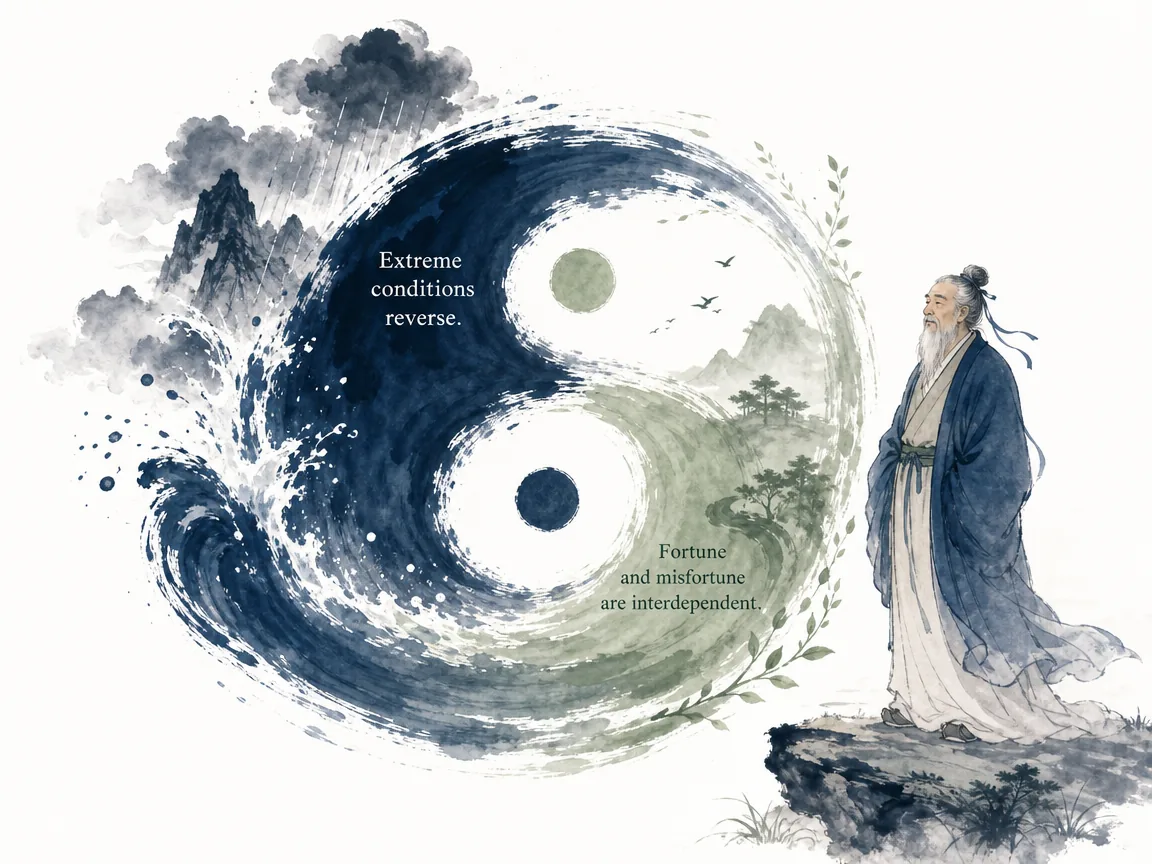
We often assume that a principle worth holding is infinitely worth extending—that clarity, discipline, order, and care can only be improved when increased. More rules mean less chaos. Tighter metrics mean better performance. Stronger boundaries mean greater integrity. This intuition feels right because it comes from good instincts. But it also turns out to be one of the most reliable paths to getting things wrong.
Laozi observed this not as a moral complaint but as a structural insight. In Daodejing Chapter 58 of the Tao Te Ching, he opens with an observation about governance that sounds almost bureaucratic: when rules are broad and unhurried, people tend to remain straightforward; when rules are hyper-detailed and scrutinizing, people find loopholes and become calculating [2]. The point is not that rules are bad. It is that any rule, once introduced, changes the environment in which it operates. People respond to what they are measured, managed, and rewarded for—and the original purpose of the rule can quietly erode as a result.
What follows from that single observation is a surprisingly complete map of how correctness can turn into its opposite. The chapter does not advise abandoning principles. It advises something harder: learning where a principle stops serving the good and begins reshaping the world against it.
Daodejing Chapter 58: When Measurement Becomes the Thing Itself
The modern name for what Laozi was describing is sometimes called Goodhart's Law, phrased popularly as: when a measure becomes a target, it ceases to be a good measure [1]. The insight has appeared in many forms across disciplines, but the mechanism is consistent. A metric is designed to approximate something valuable—learning, performance, quality—and once people learn to optimize for the metric itself, the thing it was supposed to represent begins to disappear.
A school wants students to understand complex material. Standardized testing is introduced as a way to gauge that understanding. Teachers and students quickly learn that the test rewards certain patterns of answer selection, time management, and content coverage rather than deep comprehension. Curriculum shifts toward test preparation. Performance on the test improves. Actual understanding becomes harder to verify, because the instrument that was supposed to reveal it is now shaping what is taught and how it is taught.
A company wants employees to do meaningful work. Productivity is measured through output quotas, response times, or deliverable counts. Employees begin prioritizing activities that improve those numbers, even when those activities do not improve the underlying work. Managers notice the numbers rising and conclude the system is working. Meanwhile, the qualities that made the work valuable in the first place—judgment, patience, attention to context—are no longer rewarded and therefore no longer cultivated.
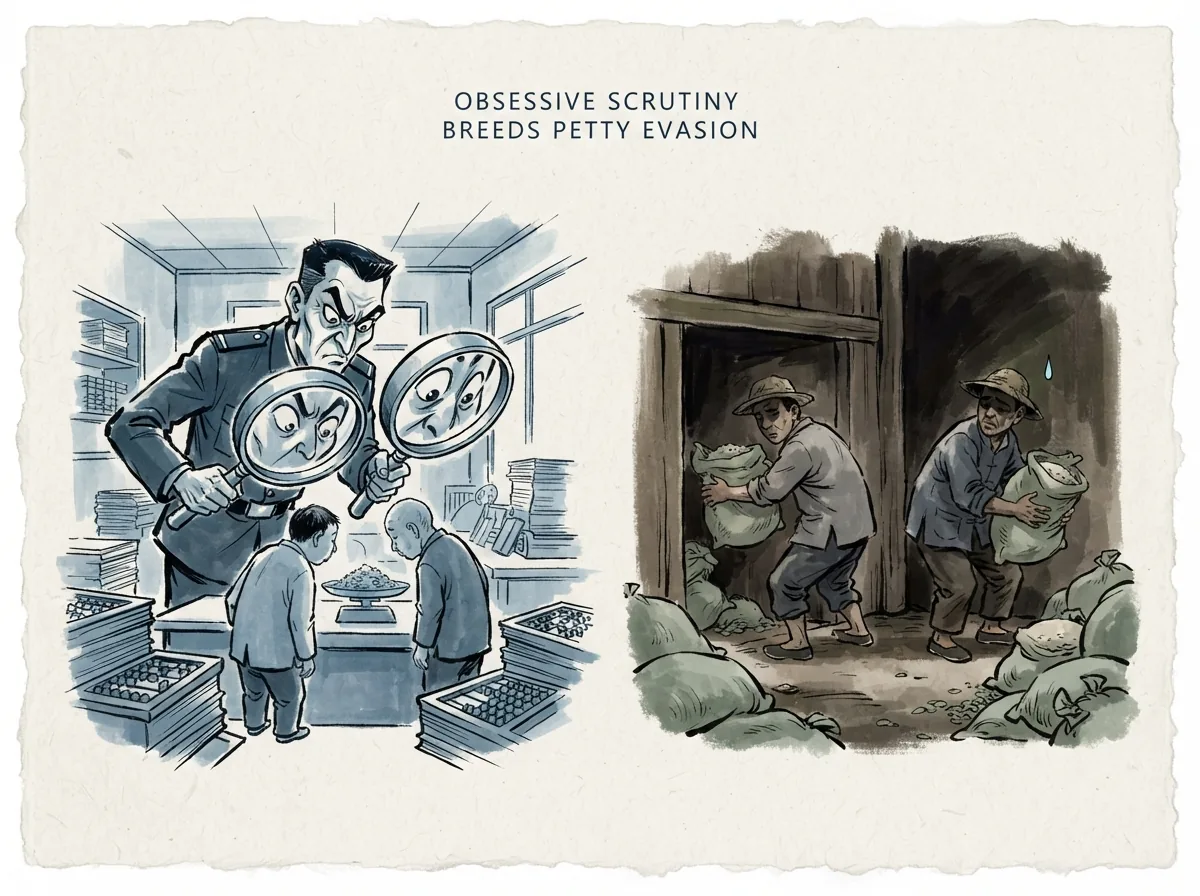
The pattern repeats in organizations, platforms, and personal routines alike. The original intention was never corrupted by malice. It was displaced by adaptation. Laozi's opening observation in Daodejing Chapter 58—its governance is broad, its people remain simple; its governance is scrutinizing, its people become calculating—captures this dynamic more directly than most modern management theory [2]. The danger is not that people are inherently resistant to order. The danger is that order, when intensified beyond its function, generates new behaviors that undermine it.
This is why the question matters less as "should we have rules?" and more as "what happens to the system once everyone knows the rules?" Any structure you design will be read, interpreted, and adjusted to. That is not a failure of people. It is a feature of systems.
Continue with the deeper interpretation and practical application.
ChiDestiny members get access to the full analysis, modern applications, and the growing Chinese Wisdom Library.
FAQ
Does Laozi mean we should avoid all certainty and judgment?
No. Chapter 58 explicitly describes a person who is square, keen, upright, and bright—qualities that require clear judgment and strong boundaries. The chapter opposes not judgment itself but the belief that any single judgment is complete or final. The mature position is to act on current information while remaining open to revision when conditions change.
Is the idea that "good things go wrong when pushed too far" unique to Laozi?
The pattern Laozi describes appears in many traditions and disciplines. In modern terms, it resembles concepts like diminishing returns, second-order effects, and Goodhart's Law, which notes that measures tend to deteriorate as targets [1]. What is distinctive about Laozi's treatment is the emphasis on scale and boundary rather than on the inherent wickedness of any particular practice.
How does this chapter relate to the more familiar idea of "yin and yang"?
Chapter 58 shares with yin-yang thinking an awareness that conditions transform into their opposites under sustained pressure. However, the chapter is more specific than the general yin-yang framework. It focuses not on cosmic balance but on a social and psychological mechanism: the ways in which human systems respond to rules, metrics, and intensifying intentions.
Can this approach lead to inaction or excessive caution?
It can, if misunderstood. The chapter warns against treating any single outcome as final, but it does not argue that action is impossible. The recommended posture is action with ongoing attention—acting on present information while keeping the door open to adjustment. Inaction driven by fear of getting it wrong is not the same as the calibrated openness the chapter describes.
Discover the historical and philosophical roots in the classical foundation in Manifesting True Substance: Sincere Words Are Not Fine-Sounding.
For a deeper comparative examination of these ideas, explore our related study on Guarding the Subtle: A Tree of Giant Girth Begins as a Tiny Shoot.
Sources & Further Reading
[1] The Project Gutenberg eBook of Dao De Jing, by Lao Zi — Primary classical reference for Chapter 58 of the Tao Te Ching.
[2] "When a Measure Becomes a Target, It Ceases to be a Good Measure" – PMC — Discussion of Goodhart's Law and its implications for measurement in professional and organizational contexts.
Further Reading
- Victor H. Mair, Tao Te Ching: The Classic Book of Integrity and the Way (1990) — Translation and commentary on the Tao Te Ching with attention to textual variants.
- Robert G. Henricks, Laozi: New Translation of the Tao Te Ching (2000) — Translation based on archaeological editions including the Mawangdui silk texts.
- Stanford Encyclopedia of Philosophy — Laozi — Scholarly overview of Laozi's philosophy and key interpretive debates.
- Chinese Text Project — Dao De Jing, Chapter 58 — Parallel texts and annotations across major recensions of the Tao Te Ching.
Note: Classical Chinese passages from the Tao Te Ching referenced in this article are drawn from the received Wang Bi textual tradition as presented in public-domain English translations. Variant readings exist across editions, including the Mawangdui silk texts and other recensions, and scholars sometimes differ on specific character choices and their interpretation.






