
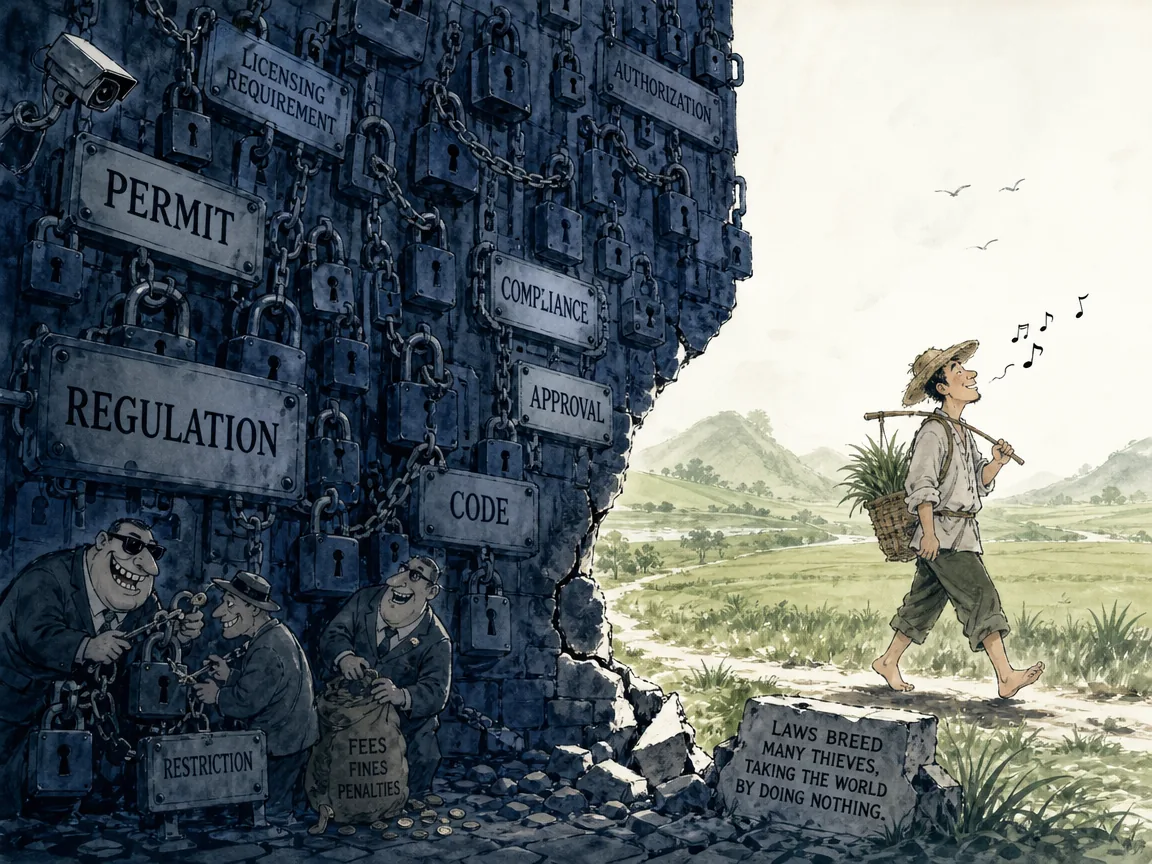
You know the feeling. Something isn't working — a project is drifting, your child isn't following through, your own routines keep collapsing — and your first instinct is to impose more structure. Tighter rules. More frequent check-ins. A fresh spreadsheet. Another policy. The logic seems unshakable: if the current level of control isn't producing the desired result, the solution must simply be more control.
For most of us, this impulse feels reasonable. It even feels virtuous. We tell ourselves that good leaders, responsible parents, and disciplined people are the ones who stay engaged, set clear expectations, and intervene when things go off track. But there is a quiet paradox lurking beneath this instinct — one that became strikingly clear to me as I studied Laozi's Dao De Jing, particularly In Daodejing Chapter 57, and reflected on how modern organizations and families actually operate. Sometimes the very act of trying to solve a problem generates the problem.
Laozi wrote over two millennia ago, in a world vastly different from ours. Yet his observation cuts directly at a pattern we still recognize today: when we fill every gap with rules, when we try to manage every variable, we don't eliminate complexity — we breed it. The more we cling to control, the more elusive what we're trying to control becomes.
Daodejing Chapter 57: The Feedback Loop That Traps Us
Every rule changes behavior. And changed behavior creates new problems, which then justify new rules. This cycle is the invisible engine behind much of the exhaustion we feel in modern workplaces, schools, and homes.
Consider a company that introduces strict expense approval processes to curb wasteful spending. At first, the rule seems logical. But employees quickly learn to adapt — spending more time on paperwork, finding workarounds, redirecting their energy from actual work to managing the appearance of compliance. The system doesn't simply respond to the rule; it strategically adapts to it. Soon, another rule is added. Then another. Before long, the organization is buried under procedures that consume more energy than they save.
This is not a minor organizational quirk. Research on performance governance shows that when metrics become influential targets, people and institutions adapt their behavior to optimize for the measurement rather than the underlying goal — a phenomenon documented across public and private sectors [1]. The metric ceases to reflect reality and starts shaping it. What looks like improved performance on paper can mask real deterioration underneath.
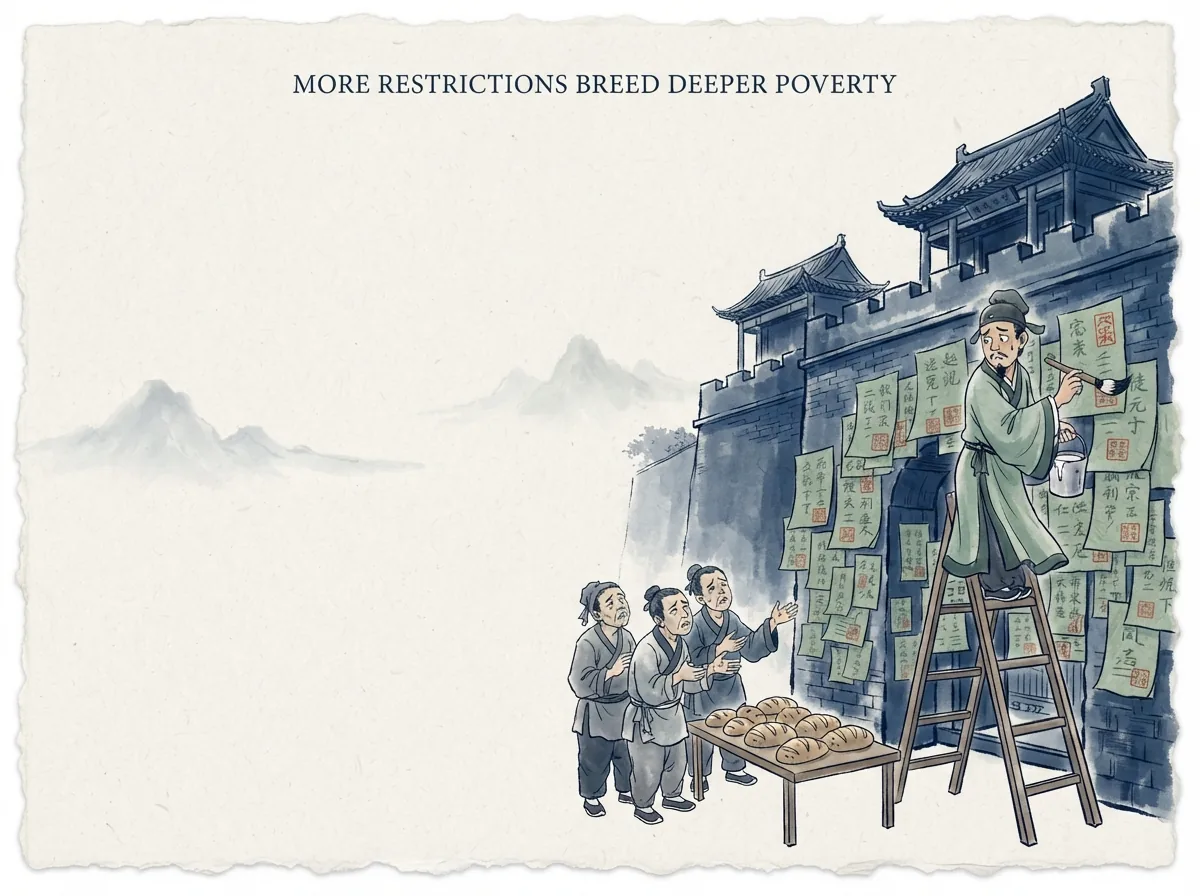
The same pattern plays out in families. A parent introduces stricter phone rules to protect a teenager's focus. The child learns concealment. The parent, sensing evasion, increases surveillance. Trust erodes. The system produces exactly the behavior the parent feared — not through failure of the child, but through the structural logic of escalating control.
One cross-cultural longitudinal study examining parent–adolescent communication found that parental monitoring and adolescent secrecy are linked in complex, reciprocal ways rather than simple cause-and-effect chains — suggesting that control and concealment reinforce each other over time rather than one simply producing the other [2]. The takeaway isn't that all monitoring fails, but that the dynamics are far more nuanced than "stricter rules produce obedience."
Laozi captured this insight sharply. In Daodejing Chapter 57 of the Dao De Jing, he writes that when taboos and prohibitions multiply, people grow poorer; when sharp tools increase, the state grows confused; when clever techniques flourish, strange goods arise; and when laws and decrees become ever more elaborate, thieves and robbers multiply. The passage is often read as a blanket condemnation of rules, but that misses its deeper point. Laozi is describing a feedback structure — a system in which the management itself generates the problems it claims to solve.
The word scholars often point to here is self-so spontaneity (zì, 自), meaning "of its own accord" or "by itself." In the closing lines of Chapter 57, Laozi frames four transformations — people self-organize, self-correct, prosper, and return to simplicity — each triggered not by external force but by the space that restraint creates. This repeated character marks the philosophical core: order can emerge without being designed. The Dao De Jing as a text raises broader questions about human nature and order that have been extensively discussed in philosophical scholarship [3], and this idea of self-organizing order is one of its most distinctive contributions.
Continue with the deeper interpretation and practical application.
ChiDestiny members get access to the full analysis, modern applications, and the growing Chinese Wisdom Library.
FAQ
Is Laozi saying we should abolish all rules and govern nothing?
No. The Dao De Jing acknowledges that rules, laws, and governance are necessary. The point is that intervention has costs, and those costs are often invisible in the short term. The question Laozi invites us to ask is not "Should we govern?" but "Where does our governance begin to create more problems than it solves?"
Does Chapter 57 apply only to politics, or can it guide personal life too?
It applies to both. While traditionally read as political philosophy, the dynamics it describes — the feedback loop between control and resistance, the distortion caused by metrics, the value of restraint — play out in families, workplaces, and within our own self-discipline. We are often our own harshest governors.
What exactly is wuwei? Is it the same as doing nothing?
Not at all. Scholarly interpretations generally understand wuwei as non-coercive, non-forced action — acting in alignment with the natural tendencies of a system rather than against them [3]. It is the difference between steering a river and trying to dam it.
How do I know when my level of control is healthy versus harmful?
A useful test: if removing your intervention would cause immediate collapse, your role may be essential. If the system continues to function well after you step back — or functions better — your previous level of control may have been masking dependencies you created. Healthy control builds autonomy. Harmful control creates reliance.
To explore these themes from another angle, read our related reflection on The Trap of Defined Beauty: How External Standards Steal Our Peace — A Reading of Laozi Chapter 2.
For a deeper comparative examination of these ideas, explore our related study on Why Your Best Plans Keep Unraveling (and What Laozi Suggests Instead).
Sources & Further Reading
[1] Governance by Indicators and the Re-politicisation of Expertise
[3] Laozi – Stanford Encyclopedia of Philosophy
Further Reading
- The Dao De Jing (Chapters 56–57), various English translations — recommended for readers wishing to explore the original text.
- Systems thinking and complexity theory — fields that offer modern frameworks for understanding the feedback loops described in ancient wisdom.
- Self-determination theory in psychology — research on autonomy, competence, and intrinsic motivation that aligns with the idea that order can emerge without constant external direction.






