
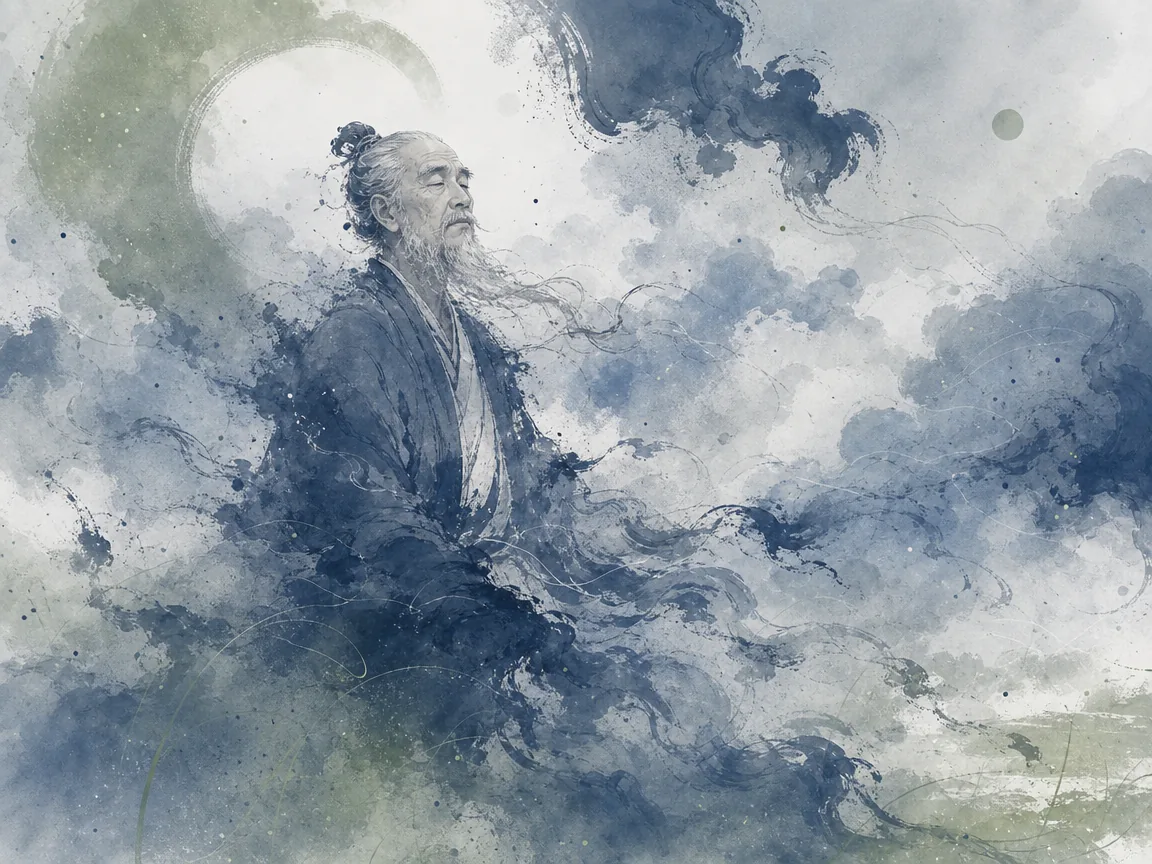
You have probably noticed it: the person who once needed everyone to agree with them seems quieter now. Not quieter because they have nothing to say, but quieter because something inside them has shifted. They no longer seem to require an audience for their competence, a crowd for their convictions, or a scoreboard for their worth. This is not resignation. It is something subtler and more durable—an internal stability that does not crumble when someone disagrees, when someone overlooks them, or when life simply does not reward them the way they expected.
Modern life amplifies the opposite tendency at every turn. Social media measures worth in likes and shares. Workplace culture often rewards those who can narrate their own accomplishments most persuasively. Even casual conversations can subtly compete for recognition, and a single critical comment can send someone spiraling into hours of mental rehearsal. When your sense of self becomes hostage to external feedback loops, exhaustion is not a side effect—it is the default condition—a foundational perspective explored in Daodejing Chapter 56.
Ancient Chinese philosophy offers a different map. In Chapter 56 of the Tao Te Ching, attributed to Laozi, we find a series of concise instructions that describe precisely this kind of inner stability [1]. The chapter does not urge people (quàn rén, 劝人) to silence themselves or retreat from the world. Instead, it sketches a gradual process of unlearning the compulsion to perform, compare, and justify—a process that resonates unexpectedly with the very modern predicament we face. What follows is an exploration of that chapter's core movements and how they might translate into a calmer, more grounded way of living today.
Daodejing Chapter 56: The Exhaustion of Perpetual Self-Proof
Consider the common pattern: someone shares an opinion online, and within minutes they are drafting responses, gathering evidence, and rehearsing counterarguments they have not even been asked to defend. A colleague receives ambiguous feedback at work and spends the evening replaying the conversation, convinced they have been judged as incompetent. A friend posts creative work and checks analytics obsessively, interpreting a modest number of views as personal failure. These reactions feel ordinary because they are widespread, but each one shares a common structure: the self has been placed in a position where it must (bìxū, 必须) be confirmed by external validation.
Laozi opens Daodejing Chapter 56 with a line that many readers initially misinterpret: "Those who know do not speak; those who speak do not know" (Zhī zhě bù yán, yán zhě bù zhī) [1]. Taken at face value, this seems to praise silence and disparage speech. But the Tao Te Ching is itself a book made of words, so the intention cannot be simply anti-linguistic. A more careful reading recognizes that Laozi is drawing a distinction between two kinds of engagement with language. One kind treats words as a substitute for genuine understanding—a way to perform wisdom without having integrated it. The other kind uses words sparingly, because what has truly become part of a person's life structure no longer needs constant verbal reinforcement.
This distinction matters enormously for anyone who has experienced the fatigue of perpetual self-proof. There is a difference between expressing a considered view and needing to be believed. The former serves communication; the latter serves a fragile sense of self that requires external affirmation to stay upright. When the two are confused, every conversation becomes a test, every disagreement feels like an attack, and every moment of silence is interpreted as rejection.
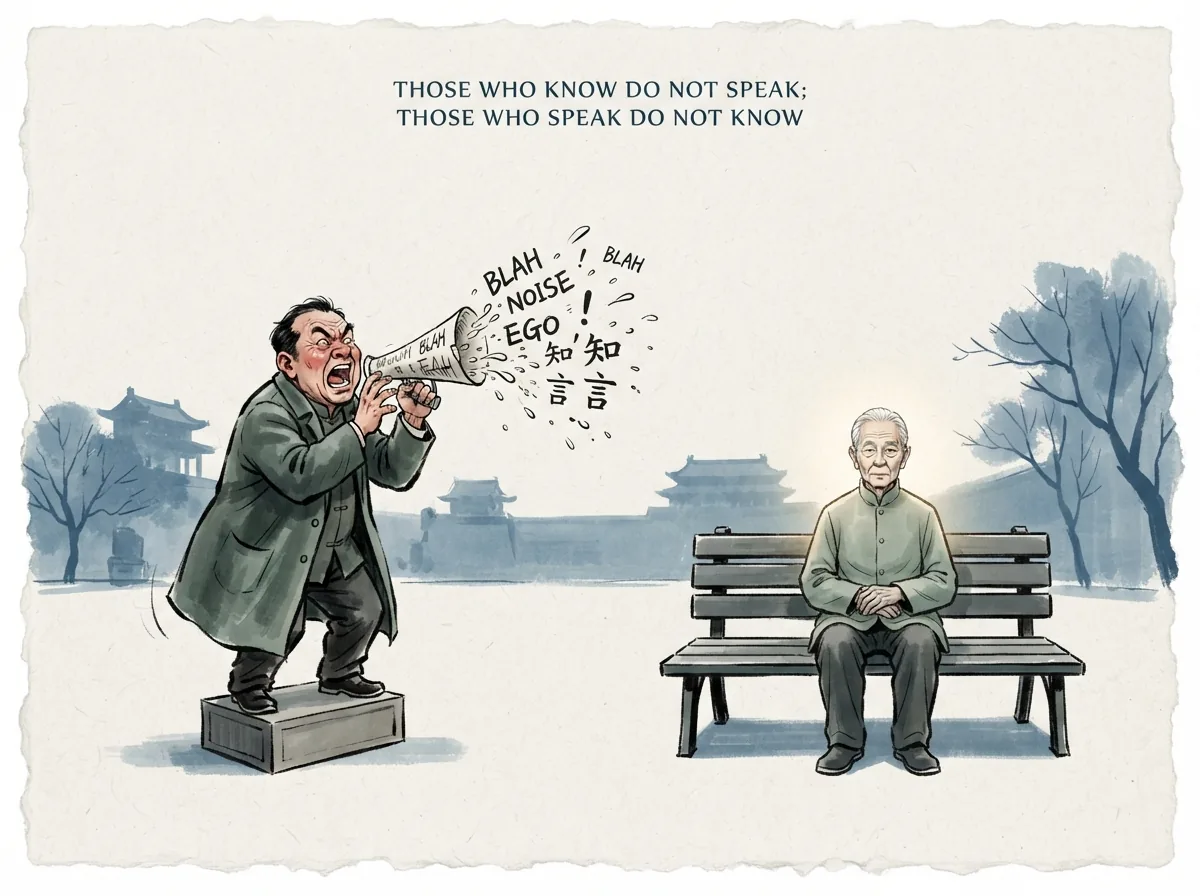
The modern landscape makes this confusion especially costly. Information is abundant, attention is fragmented, and social comparison is continuous [3]. The result is a culture in which many people feel they must constantly articulate, demonstrate, and defend who they are—because if they stop, they fear they will disappear. But Laozi's observation suggests something counterintuitive: the more a person depends on external confirmation, the more unstable their inner life actually is. True understanding, in this view, carries its own quiet confidence and does not require an audience to remain real.
Continue with the deeper interpretation and practical application.
ChiDestiny members get access to the full analysis, modern applications, and the growing Chinese Wisdom Library.
FAQ
Is Laozi advocating silence or passivity in Chapter 56? No. The chapter does not argue that people should stop speaking, acting, or engaging with the world. It describes a shift in motivation: from acting out of a need for external confirmation to acting from internal clarity. A person who has cultivated this stability may still speak forcefully, debate passionately, or defend their boundaries—but their actions are no longer driven by the fear of being misunderstood or undervalued.
What exactly does mysterious harmony (xuántóng, 玄同) mean? Translations of this term vary among scholars and practitioners. It has been rendered as "mystic oneness," "profound identification," and other expressions depending on the translator's interpretive framework [2]. In the context of Chapter 56, it generally refers to a state of inner equilibrium in which one's sense of self is no longer dependent on external comparison, praise, or social identity. Different readers may emphasize different aspects of this concept, and scholarly translations reflect this diversity of interpretation.
Can these ideas be applied without adopting a religious or spiritual identity? Yes. The practices described in Chapter 56 do not require belief in any particular doctrine. They are fundamentally psychological: learning to distinguish between internal and external sources of validation, setting boundaries around attention, and cultivating a sense of self that is less reactive to external events. People from diverse backgrounds can apply these principles as tools for emotional regulation and personal clarity.
How does this relate to modern psychology? Several concepts in contemporary psychology mirror the dynamics described in this chapter. Cognitive behavioral therapy, for example, explores how automatic thoughts about self-worth can be triggered by external events. Attachment theory examines how early relationships shape patterns of seeking or avoiding validation. The Tao Te Ching reaches similar conclusions through a different method—observation of natural patterns rather than clinical study—but the practical implications overlap significantly.
Conclusion
The journey from perpetual self-proof to inner stability is not a sudden revelation but a gradual unlearning. It begins with noticing when the need to be right, to be seen, or to be validated is driving behavior more than the behavior's own purpose. It continues through the practice of setting boundaries around attention, softening the compulsive edge, and allowing some misunderstandings to dissolve without resistance. And it deepens when a person discovers that their worth does not disappear when others fail to recognize it.
Laozi's Chapter 56 does not promise that this state is easy to reach. It does suggest, however, that it is natural—the default condition of a mind that is no longer at war with itself and the world. The person who reaches it does not become indifferent to feedback or disengaged from life. They become free from the exhausting requirement that life constantly confirm them. They can act, create, and connect without the hidden cost of needing everyone to agree.
If you are drawn to explore this tradition further, consider reading the Tao Te Ching in a translation that includes notes on textual variants and interpretive differences, as the received text has been transmitted through multiple commentarial traditions [3]. The Stanford Encyclopedia of Philosophy offers a scholarly overview of Laozi's historical context and the formation of the text, which can help readers situate these chapters within their broader intellectual tradition [3]. For practical guidance on applying classical Chinese wisdom to modern challenges, several contemporary writers have explored the intersection of Daoist thought and psychological practice, though readers should evaluate such interpretations against the primary text rather than accepting secondary summaries uncritically.
Discover the historical and philosophical roots in the classical foundation in The Sourceless Origin: The Inexhaustible Depth of the Void.
For a deeper comparative examination of these ideas, explore our related study on Caring for Oneself: When People Do Not Fear Coercive Power.
Sources & Further Reading
[1] Daodejing (Wang Bi Edition, 道德經/王弼本) – Wikisource (維基文庫) — Primary classical text used for chapter references; contains the received Wang Bi version of the Tao Te Ching, including Chapters 9, 22, 45, and 56.
[2] Laozi (Stanford Encyclopedia of Philosophy) — Scholarly overview of the historical Laozi, the formation and transmission of the Tao Te Ching, and the relationship between received texts and earlier manuscript traditions.
[3] Tao Te Ching – Chapter 56 – Taoism.net — Discussion of Chapter 56 translations and interpretive approaches, including variations in rendering the term mysterious identification (xuántóng, 玄同).
Further Reading
-
Robert Henricks, Lao Tzu: Te Ching, A New Translation (1989) — Comparative translation with notes on textual variants.
-
David Wayne Chapman, Comparative Study of Received vs. Mawangdui Texts of the Tao Te Ching — Analysis of differences between transmitted and manuscript versions of key chapters.






