
We live in an age that celebrates relentless forward motion. Hustle culture rewards those who grind hardest, optimize longest, and push furthest. Social media feeds us a constant parade of success stories—overnight breakthroughs, five-a.m. routines, side-hustles layered on top of full-time jobs. We are told, explicitly and implicitly, that more discipline, more output, more upward mobility is always the answer. And yet, alongside this cultural praise of constant acceleration, we also see something else: people collapsing under its weight. Burnout rates are climbing. Anxiety and chronic exhaustion have become common companions for working professionals across industries. Why does pushing yourself harder often lead to earlier burnout? And what might an ancient Chinese insight, spoken over two thousand years ago, tell us about sustainable strength?
The World Health Organization has recently recognised burn-out as an occupational phenomenon—a syndrome resulting from chronic workplace stress that has not been successfully managed [1]. It is not classified as a medical condition, and it refers specifically to the occupational context, but the pattern it describes is recognisable far beyond the workplace: when a person pushes past the point where recovery keeps pace with demand, the system begins to consume itself. Laozi, traditionally associated with the Dao De Jing (or Laozi), observed this dynamic long before the modern vocabulary of burnout existed. In Daodejing Chapter 55, he offers one of the most striking metaphors in classical Chinese philosophy for what real vitality looks like—not the force of someone who never stops, but the wholeness of a newborn child. The lesson is not anti-growth; it is anti-haste.
Daodejing Chapter 55: Not Naivety, But Wholeness
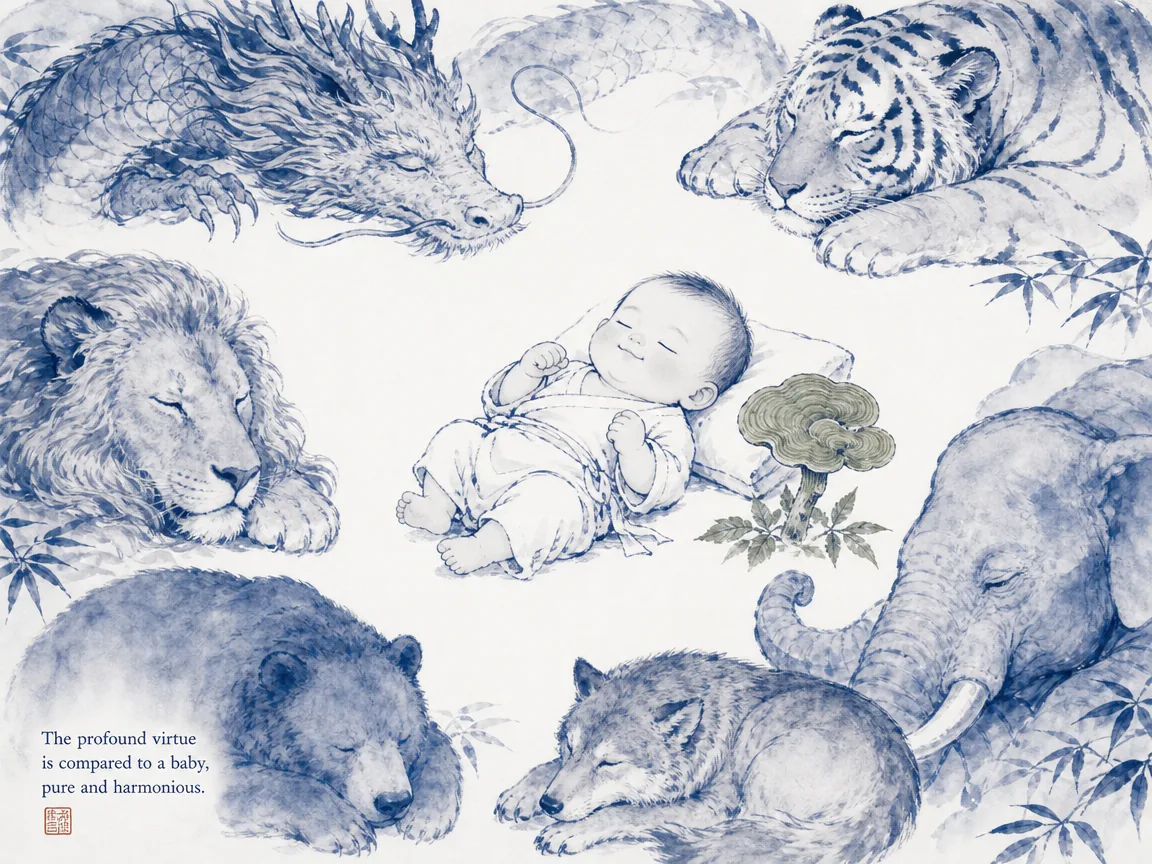
One of the most famous lines attributed to Laozi in Daodejing Chapter 55 runs: "He whose virtue is profound is like a newborn child" — often rendered from the Chinese as han de zhi hou, bi yu chi zi . The image is gentle, almost disarmingly simple. A newborn does not strategise. It does not compare itself to other infants. It does not lie awake worrying whether it is growing fast enough, loving correctly, or achieving the right milestones. It is hungry, so it cries. It is tired, so it sleeps. Its life moves through natural rhythms rather than manufactured urgency.
Modern readers sometimes mistake this metaphor for a call to regress—to adopt a kind of naive simplicity, to shut off the adult mind and retreat into childlike ignorance. That is not what Laozi is suggesting. A more careful reading, reflected in contemporary commentary on the chapter, makes clear that the newborn image is about coherence, not about abandoning knowledge or responsibility. The child has not yet been fractured by the complex self-evaluating systems that characterise adult life: constant comparison, shame about needs, fear of falling behind, the habit of measuring one's worth against external metrics. The adult whose inner life is at war with itself—driven by competing voices that say push and stop, want more and feel guilty for wanting—is precisely the person Laozi's imagery warns against.
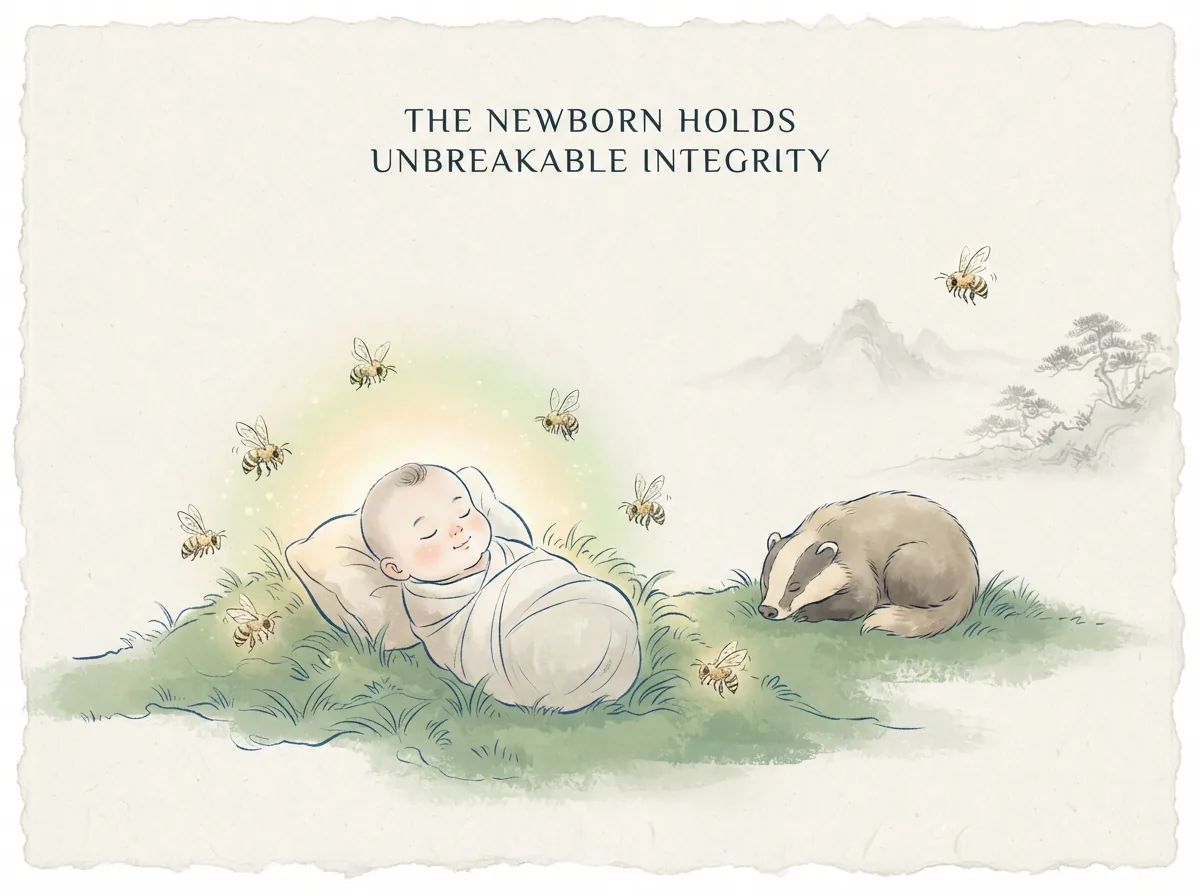
This is not a philosophical argument for staying childlike. It is an observation about what happens when a life loses its internal coherence. Growth is still possible; indeed, Laozi elsewhere speaks of returning to the newborn state as an achievement of maturity, not its opposite. But growth requires a living system that is not constantly tearing itself apart from within.
Softness as Capacity, Not Weakness
Another striking image from Chapter 55 describes the newborn as having "weak bones and soft tendons, yet a firm grip" — gu ruo jin rou er wo gu. On the surface, this seems paradoxical. How can something soft and underdeveloped possess genuine strength? The answer, according to the philosophical tradition Laozi represents, lies in a redefinition of what strength actually is.
In Daoist thought, softness (rou) is not weakness. It is flexibility—the capacity to adapt, recover, bend without breaking. By contrast, rigidity may look powerful in the moment but is inherently brittle. A mind that cannot admit error appears strong, but it is one misstep from collapse. A body trained into chronic tension cannot generate real force; it can only sustain perpetual strain. An organisation that refuses to pivot may seem decisive, but it is vulnerable to the smallest shift in conditions.
This idea recurs throughout the Dao De Jing. Chapter 40 states that "the soft and weak overcome the hard and strong" [2], while Chapter 76 contrasts living things, which are soft and supple, with dead things, which are hard and rigid. The point is not that softness is morally superior, but that it is functionally superior for sustaining life over time. Flexibility is not a compromise—it is the structural requirement for resilience.
Consider the modern professional who cannot delegate, not because they lack trust in others, but because releasing control feels like losing power. Consider the athlete who trains through pain rather than recovering, mistaking damage for dedication. Consider the person whose entire sense of identity is built on achievement, making rest feel like moral failure. These are forms of rigidity. They look like strength. They function as self-depletion.
Continue with the deeper interpretation and practical application.
ChiDestiny members get access to the full analysis, modern applications, and the growing Chinese Wisdom Library.
FAQ
Is Laozi saying we should stop working hard? No. Laozi is not arguing against effort, ambition, or growth. His concern is with a specific kind of effort — effort that ignores the body's signals, dismisses the need for recovery, and mistakes acceleration for vitality. The newborn metaphor is about sustainability, not about ceasing to act.
Does Chapter 55 of the Dao De Jing actually exist in the versions we have today? The Dao De Jing survives in multiple textual traditions, including the Wang Bi and Heshanggong commentaries, and archaeological discoveries such as the Guodian and Mawangdui manuscripts have confirmed the general shape of the text while also revealing variant readings [3]. Scholars note that the exact wording of specific chapters, including Chapter 55, has been subject to transmission changes and editorial influence over centuries. The interpretation offered here draws on established commentary traditions while acknowledging the complexities of textual history.
Can these ancient ideas really apply to modern burnout? The World Health Organization defines burn-out as a syndrome arising from chronic, unmanaged workplace stress [1]. While Laozi did not use this modern clinical language, his observation that pushing a system beyond its sustainable limits consumes it from within closely parallels what we now recognise as the mechanics of chronic stress and burn-out. The parallel is interpretive, not claim of identical frameworks.
What does "returning to the newborn" mean for an adult with responsibilities? It means reclaiming the internal coherence that the newborn naturally possesses — the absence of the chronic second-layer suffering that comes from judging yourself for having human limits. Adults cannot unlearn what they know, nor should they want to. The goal is to shed the unnecessary self-coercion that disguises itself as discipline, and to build a life that includes seasons of rest and expansion rather than pretending that constant acceleration is the only mode of being.
Closing
The question that Laozi's Chapter 55 leaves us with is not whether we should strive, grow, or achieve. It is whether our striving is preserving the life it is supposed to serve, or whether it is slowly consuming it. Burnout does not arrive as a single dramatic event. It accumulates in small choices — the extra hour worked, the skipped rest day, the quiet voice that says you should be able to handle more. The newborn is not a model for ignorance. It is a model for a life that has not yet learned to wage war against itself. Returning to that wholeness as an adult does not mean abandoning responsibility. It means recognising that the strongest life is not the one that never stops, but the one that knows when to, and in knowing, endures.
Discover the historical and philosophical roots in the classical foundation in Cosmic Evolution: The Tao Gives Birth to One, Two, and Three.
For a deeper comparative examination of these ideas, explore our related study on Mysterious Virtue: Those Who Know Do Not Speak; Those Who Speak Do Not Know.
Sources & Further Reading
[1] WHO — Burn-out an occupational phenomenon: International Classification of Diseases — Burn-out an occupational phenomenon: International Classification of Diseases.
[2] Stanford Encyclopedia of Philosophy — Laozi
[3] WHO — Psycho-social risks and mental healthPsycho-social risks and mental health.
Further Reading
- Guodian and Mawangdui manuscript studies on the Dao De Jing for readers interested in textual history and variant readings
- Contemporary commentaries on the Dao De Jing by scholars such as Henry Rosemont Jr., Roger T. Ames, and Livia Kohn for deeper engagement with Daoist concepts of de, wu wei, and he






