
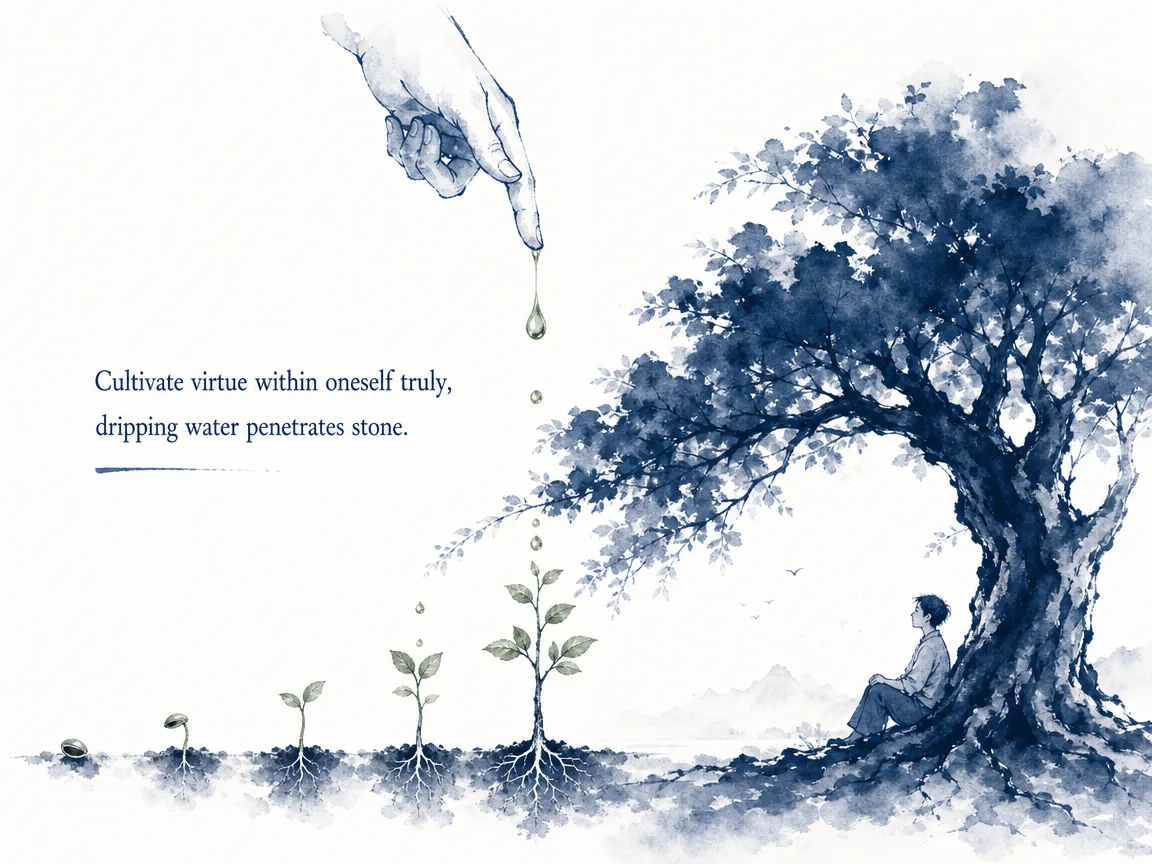
You start a new habit with real conviction. You wake up early, stick to a routine, quit something difficult. It works — for a while. Then life shifts. A late meeting, a stressful week, a disrupted schedule. And the habit collapses almost immediately, as if it was never really there. The same pattern shows up in relationships that depend entirely on one person's constant mediation, and in companies that grind to a halt the moment their founder steps away.
This is not simply a failure of willpower. It is a structural problem. Something that survives only through continuous effort was never truly established — it was merely held in place by temporary energy. When that energy stops, the whole thing falls apart—a foundational perspective explored in Daodejing Chapter 54.
The Daodejing, a foundational text of Chinese philosophy traditionally attributed to Laozi [1], raises exactly this question over two millennia ago. Its 54th chapter offers a diagnosis that still applies to everything from personal routines to global institutions: a habit, a relationship, or an organization only counts as genuinely established when it can sustain itself without your constant intervention.
Daodejing Chapter 54: The Difference Between Holding On and Building Something Real
Most modern self-improvement assumes that discipline is about force: pushing yourself to do the right thing even when you don't feel like it. That approach can produce short-term results, but it also produces a specific kind of fragility.
Research into how habits actually form supports a different picture. Studies define habits as "memory-based propensities to respond automatically to specific cues, which are acquired by the repetition of cue-specific behaviours in stable contexts" [2]. What this means in practice is that a real habit is not sustained by daily negotiation — it runs on autopilot once it has taken root. Two longitudinal datasets found that "context stability predicted more automaticity and higher habit repetition goal attainment" [2]. When the surrounding conditions stay consistent, the behaviour becomes automatic and more likely to persist. When context shifts abruptly — a move, a change in schedule, a new job — previously formed habits can weaken or disappear.
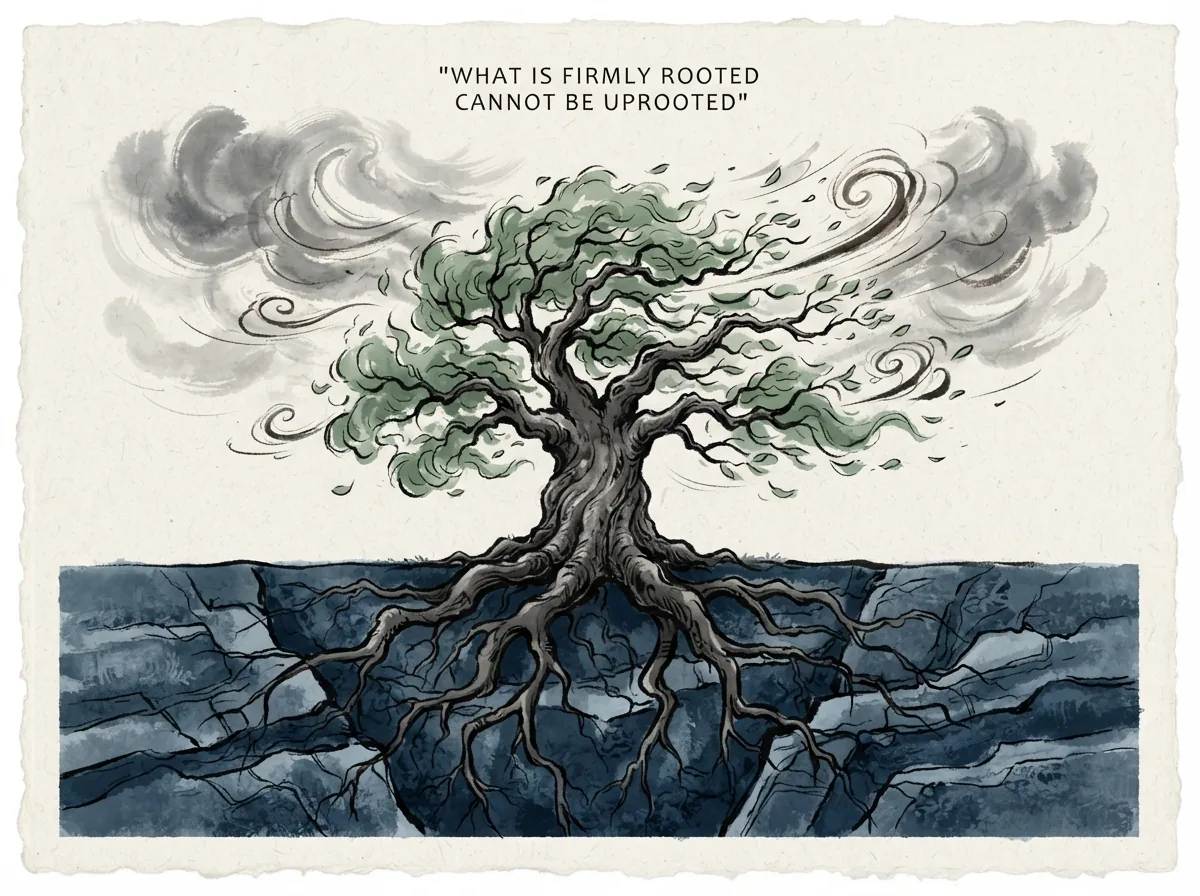
The lesson here is simple but radical: willpower is not the engine of lasting change. Structure is.
Continue with the deeper interpretation and practical application.
ChiDestiny members get access to the full analysis, modern applications, and the growing Chinese Wisdom Library.
FAQ
Q: If habits rely on context stability, what happens when my life changes unexpectedly? A: This is precisely why structural change matters more than motivational change. When context shifts, habits built only on willpower dissolve. Habits built through deeper structural change — identity, environment, social context — tend to adapt more flexibly. The goal is not to eliminate all disruption but to build a foundation that does not collapse when conditions change.
Q: Isn't this just another version of "start small"? A: "Start small" is tactical advice. This framework is structural. It asks not just where to begin but what kind of beginning creates lasting change. The distinction matters: starting small can still rely on force. Structural change asks what makes force unnecessary.
Q: Does this mean I should stop trying to influence others? A: No. The 54th chapter moves outward deliberately — from self to family to community to wider society. But it insists on sequence: a principle must first prove real at the smallest scale before it can be trusted at larger ones. Influence without internal structure is projection, not leadership.
Q: How do I know when a habit is truly "established" versus just temporarily maintained? A: Test it by reducing your effort. If the behaviour collapses the moment you stop pushing, it was never structural — it was dependent on your intervention. A genuinely established habit continues, even partially, when your conscious effort decreases.
What Comes Next
The question the 54th chapter leaves us with is not "what should I do more of?" but "what do I already have in place that no longer requires my constant effort?" That is where real structure lives.
If your habits, relationships, or work life collapse the moment you stop forcing them, the issue may not be your willpower. It may be that you have been building tents instead of trees. Start by asking which parts of your life could function without your daily supervision. Then work backward from there — designing environment, identity, and routine so that the behaviour you want becomes automatic rather than exhausting.
The path from personal practice to wider impact is not skipped. It is built, layer by layer, from what is real at the smallest scale outward.
To explore these themes from another angle, read our related reflection on When Softness Outlasts Hardness: What Laozi’s 43rd Chapter Teaches About Real Power.
Deepen your understanding of these principles in our reflection on Why Everything You Gain Can Become Your Greatest Fear — Laozi’s Warning from 2,500 Years Ago.
Sources & Further Reading
[1] Stanford Encyclopedia of Philosophy — Laozi — An academic overview of Laozi's life, textual history, and philosophical significance, including discussion of scholarly debates around the figure of Laozi and the dating of the Daodejing.
[2] Context Stability in Habit Building Increases Automaticity and Goal Attainment — Empirical research demonstrating that stable contexts predict greater habit automaticity and higher goal attainment, with habits defined as memory-based propensities triggered by specific cues in consistent environments.
Further Reading
- Translations and commentaries on the Daodejing by scholars such as Henrik Sørensen, David Hall, and Roger Ames
- Research on habit discontinuity theory by Wendy Wood and colleagues on how environmental change disrupts established habits
- Contemporary discussions of wuwei in organizational and leadership studies






