
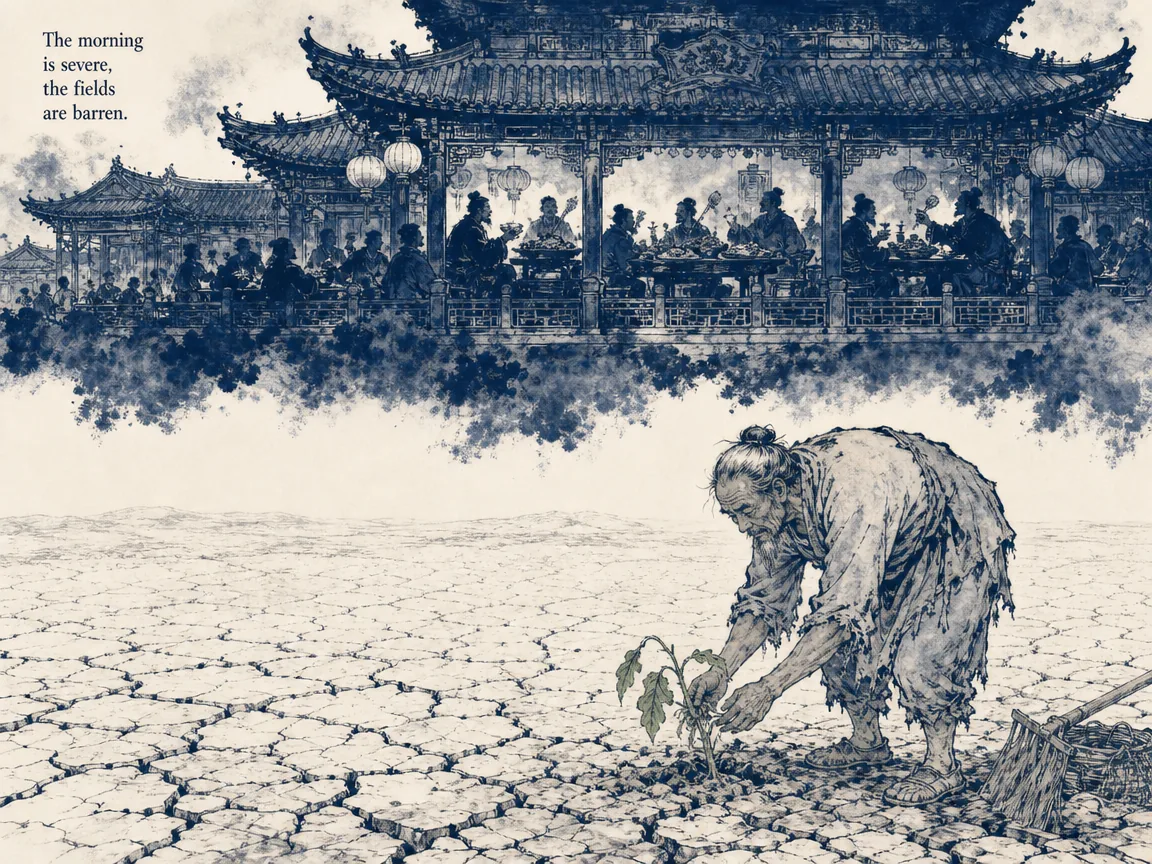
There is a peculiar pattern that repeats across histories and industries: the most glittering institutions, the most polished companies, and the most impressive cities sometimes sit precisely atop invisible exhaustion. We mistake centralized display for collective prosperity. A gleaming headquarters becomes proof of strength while frontline capacity thins. An iconic skyline rises as public infrastructure quietly crumbles. The spectacle is real — but it does not answer the question that matters most. Where did the resources come from, and what was left behind?
Over two thousand years ago, a collection of short passages now known as the Daode jing (or Laozi) offered one of the sharpest political diagnoses in ancient Chinese thought [1]. In Laozi Chapter 53 Meaning places two images side by side: the center adorned with splendid clothing, sharp swords, lavish food, and accumulated wealth, and the periphery with barren fields and empty granaries. Rather than praise the court, the text names this arrangement deeply problematic. The chapter does not argue that beauty, weapons, or wealth are inherently bad. It asks a more structural question — whether central brilliance is built on the productive ground that sustains it, or whether it is sustained by drawing that ground dry.
The question is not whether societies should have impressive centers. Every functioning community invests in administration, culture, and shared spaces. The ancient warning is subtler: when the display at the center grows more elaborate while the foundation weakens, the spectacle may no longer be a sign of health. It may be a sign that the system is consuming the conditions that produced it in the first place.
Laozi Chapter 53 Meaning: The Two Pictures Laozi Sets Side by Side
The core gesture of this chapter is visual. It forces the reader to hold two scenes at once rather than admiring one and ignoring the other. One scene shows a center of power dressed in fine garments, girded with sharp swords, indulging in abundant food, and hoarding wealth. The adjacent scene shows fields left fallow and granaries running empty [2].
Read alone, the first scene looks like success. Read together, the second scene changes what the first scene proves. If the center is brilliant because the whole society is thriving, then the barren fields and empty granaries should not appear at all. Their presence beside the splendor suggests something harder to face: the center may be prosperous not because the foundation is strong, but because it is drawing from the foundation faster than the foundation can recover.
This is not an argument against all display or all accumulation. It is an argument about proportion and direction. When administrative centrality, ceremonial ornamentation, armed protection, lavish consumption, and concentrated reserves grow heavy while production and common stores thin out, the relationship between center and ground has shifted. The center no longer serves the whole that sustains it. It begins to treat the whole as a resource to be managed.
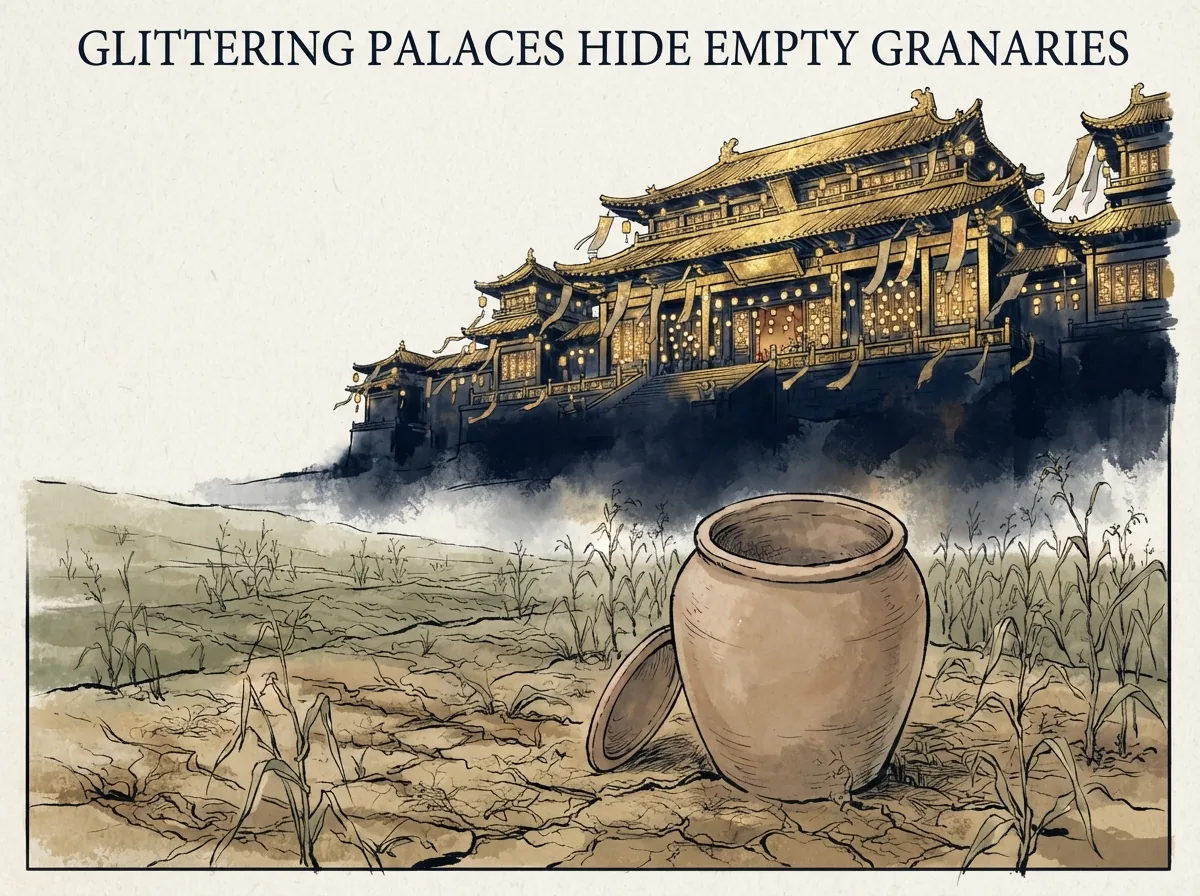
Modern organizations often recognize this pattern without naming it. A company invests heavily in brand, executive visibility, and headquarters design while the teams doing the actual work lack tools, time, or support. A city funds landmark projects and high-visibility initiatives while maintenance backlogs accumulate. In each case, the visible center looks strong. The question that matters is whether that strength is generated by a living base or extracted from one that is slowly emptied.
Continue with the deeper interpretation and practical application.
ChiDestiny members get access to the full analysis, modern applications, and the growing Chinese Wisdom Library.
FAQ
Does this passage mean all wealth and display are bad?
No. The text criticizes a specific relationship, not wealth itself. It raises concern when concentrated display appears alongside depleted fields and empty granaries, not when prosperity is broad and productive capacity is strong.
Is this argument only about ancient governments?
No. The pattern applies to modern organizations, institutions, and personal life. Any system that draws energy from its productive base while rewarding itself for the appearance of strength risks the same imbalance.
How do I tell whether an initiative is a real investment or just a shortcut?
Ask who benefits, who bears the cost, and whether the arrangement strengthens the ground over time. Real investment expands capacity and shares risk. Shortcuts concentrate benefit, hide cost, and often require ever more attention to maintain their appearance.
Should I stop investing in visible projects altogether?
No. Visible projects can serve real purposes. The point is to check whether they are supported by a healthy foundation and whether they eventually reinforce that foundation rather than drain it, reflecting the enduring wisdom of Laozi Chapter 53 Meaning.
To explore these themes from another angle, read our related reflection on Why You Feel Trapped by Labels—Chinese Wisdom for Modern Life.
For a deeper comparative examination of these ideas, explore our related study on Unity and Divergence: When the Superior Scholar Hears of the Tao.
Sources & Further Reading
[1] Stanford Encyclopedia of Philosophy, "Laozi"
[2] Golden Elixir, "Daode jing — From The Encyclopedia of Taoism"
Further Reading
- Stanford Encyclopedia of Philosophy, "Laozi"
- Golden Elixir, "Daode jing — From The Encyclopedia of Taoism"






