
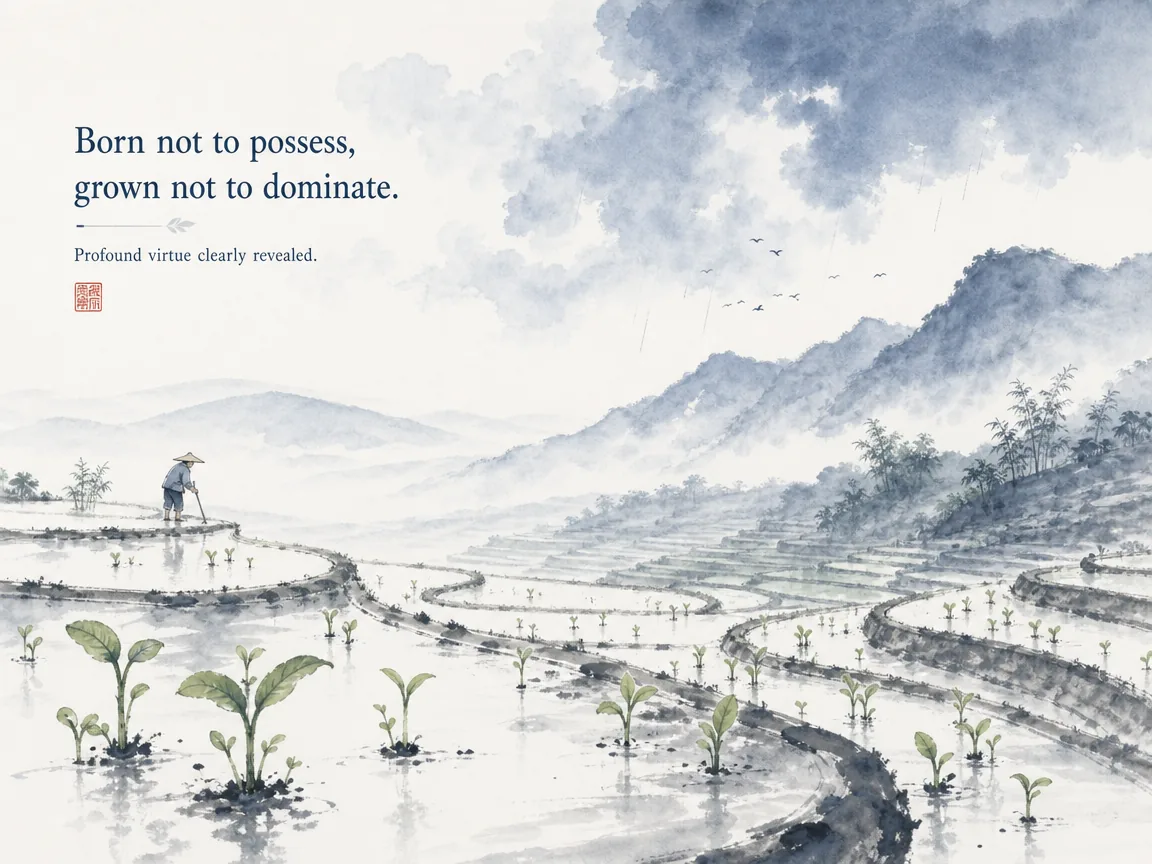
We have all seen it, or perhaps practiced it without noticing: someone invests deeply in another person — a parent raising a child, a teacher shaping a student, a founder building a team, a creator launching a platform — and over time, that investment quietly hardens into a sense of ownership. The logic feels almost inevitable. I made this happen, so it belongs to me. Without my effort, none of this would exist. And yet, the moment care turns into claim, something vital is lost. The very thing being nurtured begins to wither under the weight of invisible strings.
Laozi addressed this problem more than two thousand years ago, not with a gentle suggestion to be humble, but with a radical restructuring of how we understand creation itself. In Daodejing Chapter 51 of the Dao De Jing, he describes an extraordinary process of nourishment — one that is continuous, thorough, and deeply involved — and then delivers a conclusion that cuts against every instinct we have about merit (gōngláo, 功劳) and entitlement. The deepest form of generative power succeeds precisely by refusing to treat what it raises as its own property. This is what Laozi calls profound virtue (xuándé, 玄德), often translated as "profound virtue." It is not passive indifference. It is active, sustained nurturing that stops short of possession.
The question this chapter forces us to confront is not whether we should help, guide, or create. Laozi assumes we do all of these things. The question is what we do after the helping is done. When a parent raises a child, when a leader builds an organization, when a teacher imparts knowledge — does the relationship end in mutual flourishing, or in quiet ownership? The answer to that question determines whether what we have nurtured is truly alive, or merely an extension of ourselves.
Daodejing Chapter 51: The Structure of Profound Nourishment
Daodejing Chapter 51 opens with one of the most systematic accounts of generation in the entire Dao De Jing. The received text reads: "Dao produces them, virtue nourishes them, things give them form, circumstances complete them" [1]. Laozi then lists the ongoing work of nurturing in vivid detail: "They are grown, they are reared, they are matured, they are developed, they are protected, they are sheltered" [1]. The language is expansive and warm. There is nothing cold or distant about this care.
And then, at the very end, comes the turn that redefines everything: "They produce but do not possess, they act but do not rely on their achievement, they guide but do not dominate. This is called profound virtue" [1].
These three phrases — "nourishing without possessing, acting without claiming credit, leading without dominating" (shēng ér bù yǒu, wéi ér bù shì, zhǎng ér bù zǎi, 生而不有,为而不恃,长而不宰) — form a connected argument, not three separate tips for being nice. Each one blocks a different way that contribution becomes control. The first stops the jump from "I caused this" to "this is mine." The second stops the jump from "I helped" to "you owe me." The third stops the jump from "I guided you when you were weak" to "I still decide for you." Together, they describe a pattern of influence that is real, continuous, and yet refuses to fossilize into ownership.
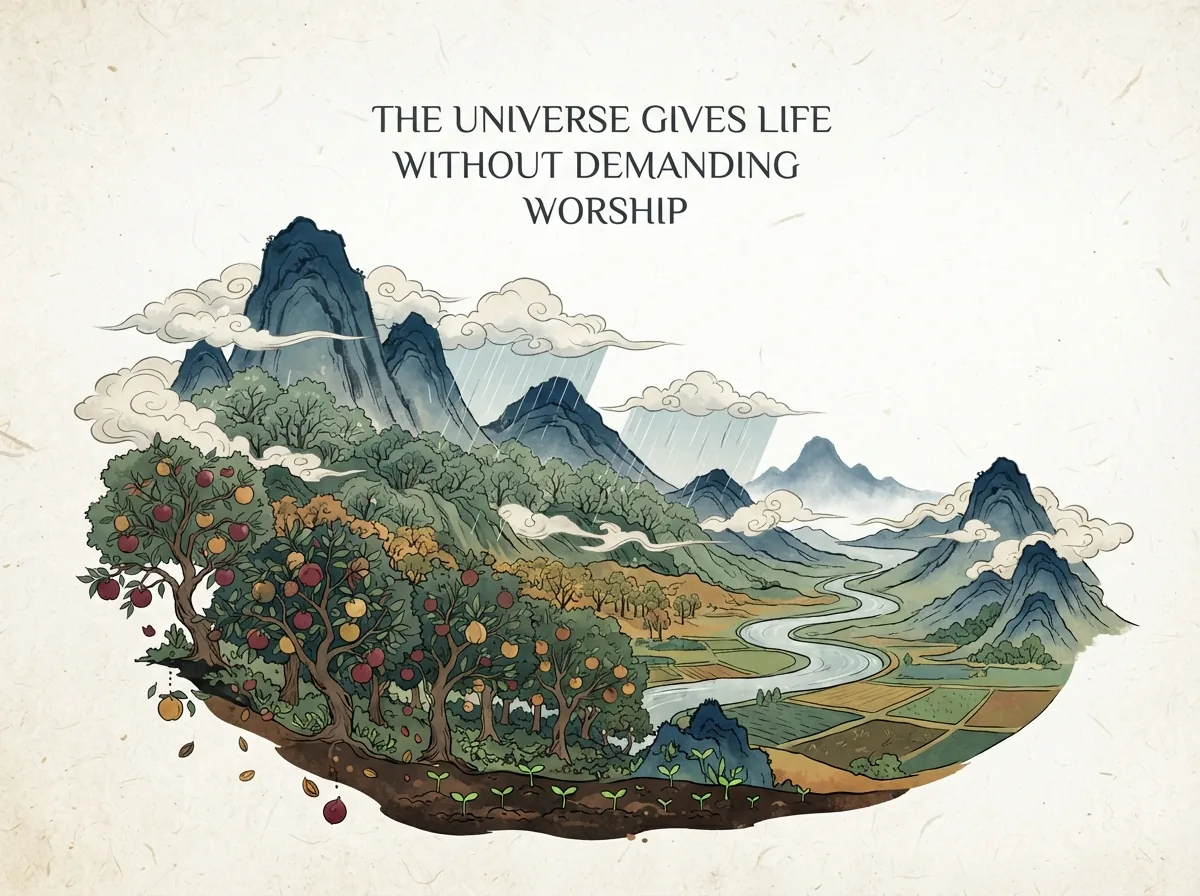
It is important to note what Laozi is not saying. He is not advocating neglect. The preceding lines make clear that the full process of nurturing involves growth, cultivation, maturation, protection, and sheltering — a comprehensive commitment. The radical move is not in the doing but in the attitude toward what has been done. True generative power does not cancel itself out after the work is complete; it simply refuses to convert that work into a permanent claim.
Continue with the deeper interpretation and practical application.
ChiDestiny members get access to the full analysis, modern applications, and the growing Chinese Wisdom Library.
FAQ
Does nourishing without possessing (shēng ér bù yǒu, 生而不有) mean I should not take credit for my work? Not exactly. Laozi is not asking you to deny your contribution or to refuse reasonable recognition. He is pointing out a specific logical error: the jump from "I contributed" to "I own." Attribution and copyright have their place. What profound virtue (xuándé, 玄德) challenges is the assumption that contribution gives you permanent, unbounded control over what you helped bring into being. You can be acknowledged and still release ownership.
If I let go of control, won't people make mistakes? They will — and that is part of what learning requires. Over-protection that prevents mistakes also prevents the development of judgment. The goal of nurturing is not a mistake-free outcome but a capable person. Some errors are necessary tuition for autonomy. The question is whether the errors happen in a context of genuine growth or in a context of enforced conformity.
Does this apply only to personal relationships, or also to business and governance? It applies wherever one party generates conditions for another's development. Founders and organizations, teachers and institutions, leaders and communities — all of these involve generative relationships. The principle is the same: contribution does not convert into perpetual dominion.
Is Xuande the same as being passive or doing nothing? No. The chapter describes extensive, ongoing nurturing — growth, cultivation, maturation, protection, sheltering. What is refused is not action but ownership. The difference between profound virtue (xuándé, 玄德) and passivity is that Xuande requires deep engagement followed by the discipline of non-possession. Doing nothing requires no discipline at all.
The insight of Laozi's Chapter 51 is both simple and unnerving. It asks us to examine whether our care has quietly become control, whether our contribution has become a claim, whether our love has turned into a silent ownership agreement. None of us escapes this temptation entirely, because it is woven into the psychology of investment. But the moment we notice it, we gain a choice.
If you want to explore this idea further, consider reading Chapter 51 in full and comparing how different translators handle the key phrases. You may also find Chapter 34 useful — it describes how the great Dao nourishes all things without acting as their master [2]. And if you are interested in how ancient Chinese thought engages with contemporary questions of power, care, and freedom, Chidestiny publishes regular essays that connect classical wisdom to modern life.
Discover the historical and philosophical roots in the classical foundation in Cultivating Inner Capability: Embracing the Primal Wholeness of the Newborn.
For a deeper comparative examination of these ideas, explore our related study on Pure Virtue: The Ancient Masters Who Fostered Genuine Simplicity.
Sources & Further Reading
[1] Daodejing Translation Chapter 51 (道德经译文第五十一章) – Shandong University School of Economics — Verified text of Chapter 51 of the received Dao De Jing, including the opening generation sequence and the closing lines on profound virtue (xuándé, 玄德).
[2] Laozi – Stanford Encyclopedia of Philosophy — Scholarly overview of Laozi's thought, including discussion of textual variants such as the Mawangdui silk manuscripts.
Further Reading
- Chapter 34 of the Dao De Jing — Explores the idea that the great Dao nourishes all things without claiming mastery over them.
- Chapter 50 of the Dao De Jing — Examines how over-attachment to life and excessive protection can push one toward harm, providing a complementary perspective to Chapter 51.
- Chapter 52 of the Dao De Jing — Continues the theme of generation and the mother metaphor, building on the ethical boundaries established in Chapter 51.
- [Wang Bi Commentary on Laozi Daodejing (王弼《老子道德經注》) – Dingren Daoist Institute] — Collection of Wang Bi's commentary on the Dao De Jing, an important traditional interpretive source.






