
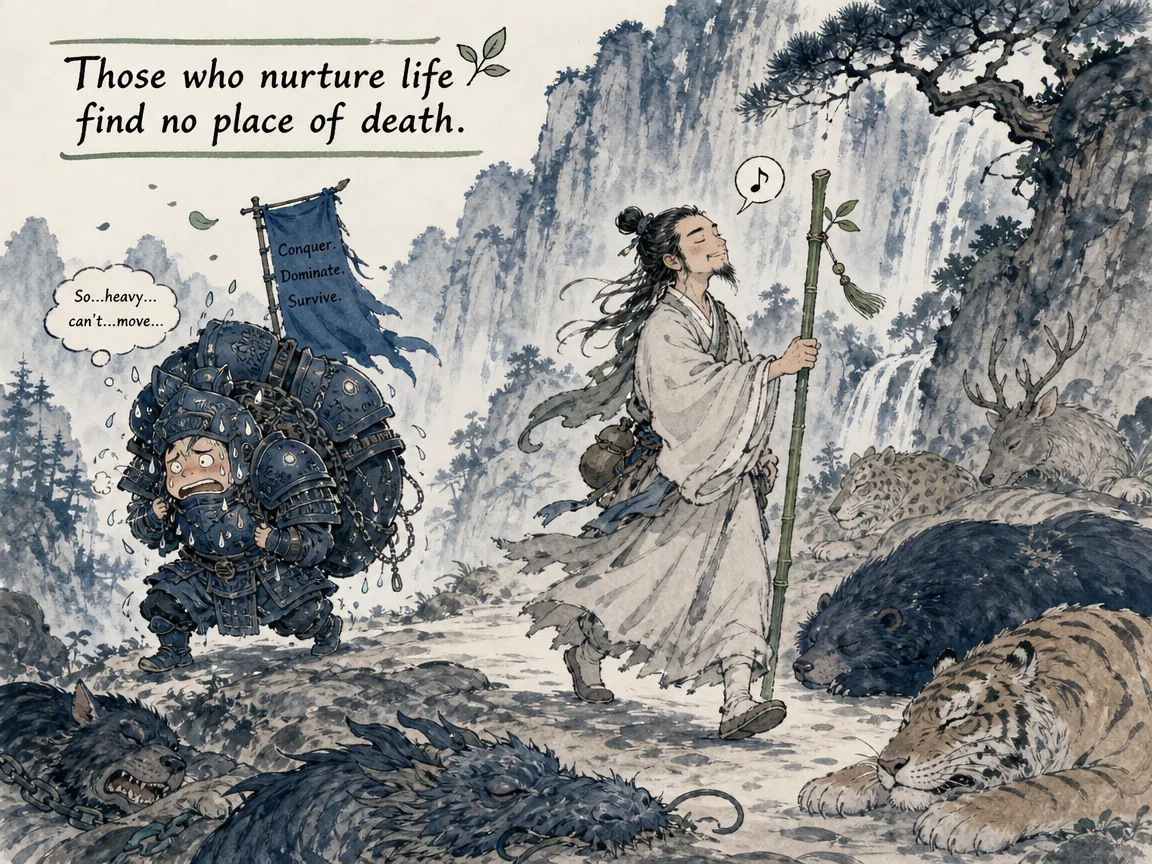
You may have noticed something unsettling about the way many of us live today. The more we try to control our health, our finances, our relationships, and our futures, the more brittle everything feels. We track our sleep, monitor our symptoms, hoard resources, plan every scenario — and yet anxiety seems to grow alongside our precautions. The very actions meant to protect us begin to exhaust us. There is a strange paradox at work here, one that has concerned thinkers for millennia.
Laozi, the ancient Chinese philosopher traditionally credited with the Daodejing, observed this pattern over two thousand years ago. In the fifty-first chapter of that text, he wrote what some scholars interpret as a diagnosis of exactly this condition: that people who could have lived well instead push themselves into danger through an excessive, unbounded effort to secure and prolong their lives. He did not advise carelessness. He named a structural problem — the inversion of means and ends — and pointed to a different way of moving through the world—a foundational perspective explored in Daodejing Chapter 50.
Daodejing Chapter 50: The Paradox We All Recognize
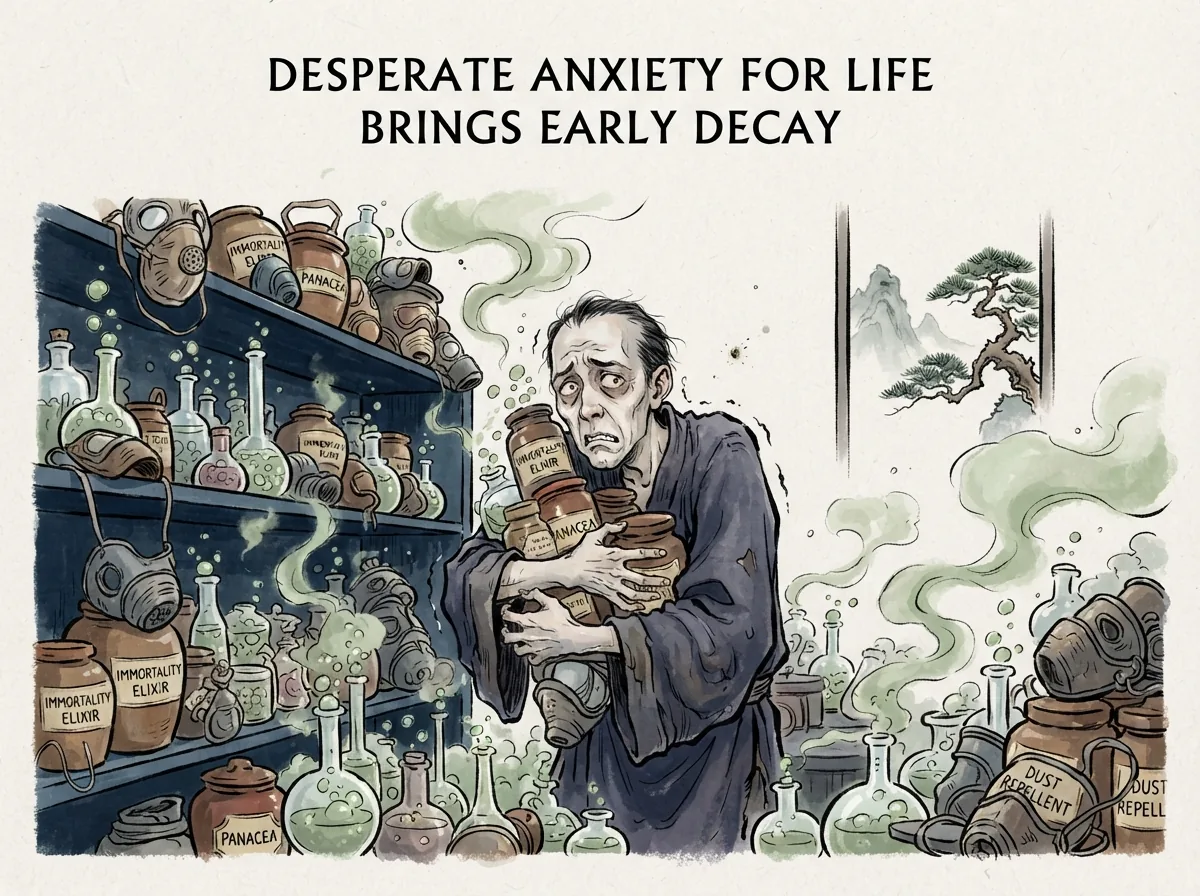
The pattern is familiar. A person becomes so afraid of losing health that they spend hours each day checking their body, searching symptom lists, and consuming wellness advice until the search itself dominates their life. Another person accumulates wealth as a hedge against uncertainty, only to find their time and energy consumed by managing what they have gathered. A nation builds up its defences in the name of security, while neighbours interpret the same steps as threat — and the cycle intensifies. In each case, the action taken to create safety generates new forms of vulnerability.
This is the paradox Laozi's text invites us to look at honestly. It is not a judgment on people who are genuinely vulnerable. A person facing poverty, systemic violence, genetic disease, or accident cannot be blamed for danger they did not create. But for those whose choices operate within a field of real possibility, Laozi asks a searching question: why do actions meant to protect life sometimes become the mechanism that harms it?
The Key Line: Living Toward a Boundary
The chapter opens with a line often read as a grounding statement: "Born into life, moving toward death" (chū shēng rù sǐ, 出生入死). Read in this way, it does not sound like pessimism. It sounds like observation. We enter life already oriented toward its limit. That limit is not an external enemy waiting to ambush us — it is a structural fact of existence.
Accepting finitude is not the same as surrendering to it. It means drawing a realistic map of where effort belongs. When death is acknowledged as a boundary rather than a solvable problem, some of the urgent compulsion to engineer a risk-free life begins to loosen. This does not mean we stop seeking medical care, avoiding unnecessary danger, or caring for our bodies. It means we stop treating the elimination of all risk as the central project of living.
What Laozi describes in the chapters that follow is not a call to recklessness. It is a distinction between natural limits — which cannot be removed — and self-made traps — which can be recognised and released.
Continue with the deeper interpretation and practical application.
ChiDestiny members get access to the full analysis, modern applications, and the growing Chinese Wisdom Library.
FAQ
Does Laozi say we should stop taking care of ourselves? No. The text distinguishes between reasonable care and compulsive over-investment. Seeking medical treatment for real symptoms, avoiding unnecessary danger, and protecting loved ones are all consistent with the principle described. The concern is with the inversion that occurs when survival becomes the only project and everything else is sacrificed to it.
Can this teaching be used to blame people who are ill or suffering? No. The chapter addresses choices made within a field of real agency. It does not explain illness caused by genetics, accidents, poverty, state violence, or systemic failure. Another chapter in the same text explicitly warns against blaming the vulnerable for conditions imposed on them by structural forces.
Is the language about tigers and weapons meant literally? No. The imagery is metaphorical. The point is that danger enters through gaps created by attachment, vanity, and the inability to withdraw — not that a cultivated person becomes physically immune to harm. Any reading that treats the passage as a claim of magical protection misreads the literary form.
How is this different from modern self-help advice about risk management? Self-help approaches typically teach better techniques for eliminating or controlling risk. Laozi's approach questions the assumption that total risk elimination is possible or desirable. The focus is not on doing it better but on recognising when the effort itself has become counterproductive, reflecting the enduring wisdom of Daodejing Chapter 50.
To explore these themes from another angle, read our related reflection on Highest-Level Leadership Leaves No Trace: What the Daodejing Knew About Power and Self-Sufficiency.
For a deeper comparative examination of these ideas, explore our related study on Laozi on Desire: Why Your Restless Mind Isn’t Your Fault.
Sources & Further Reading
[1] Health anxiety – NHS — (describes health anxiety as a condition where worry about illness dominates daily life, with behaviours such as frequent body checking, repeated reassurance-seeking, and obsessive health information searching)
Further Reading
- Daodejing (Laozi), Chapter 50 — traditional text concerning the paradox of excessive preservation of life
- Daodejing, Chapter 44 — on attachment, loss, and the cost of over-accumulation
- Daodejing, Chapter 75 — on structural causes of risk-taking when the burden of living becomes unbearable
- Han Feizi, Jie Lao — ancient commentary offering an alternative reading of key terms in Chapter 50
- Various scholarly editions and translations of the Daodejing, including comparisons between the received text and the Mawangdui silk manuscript variants






