
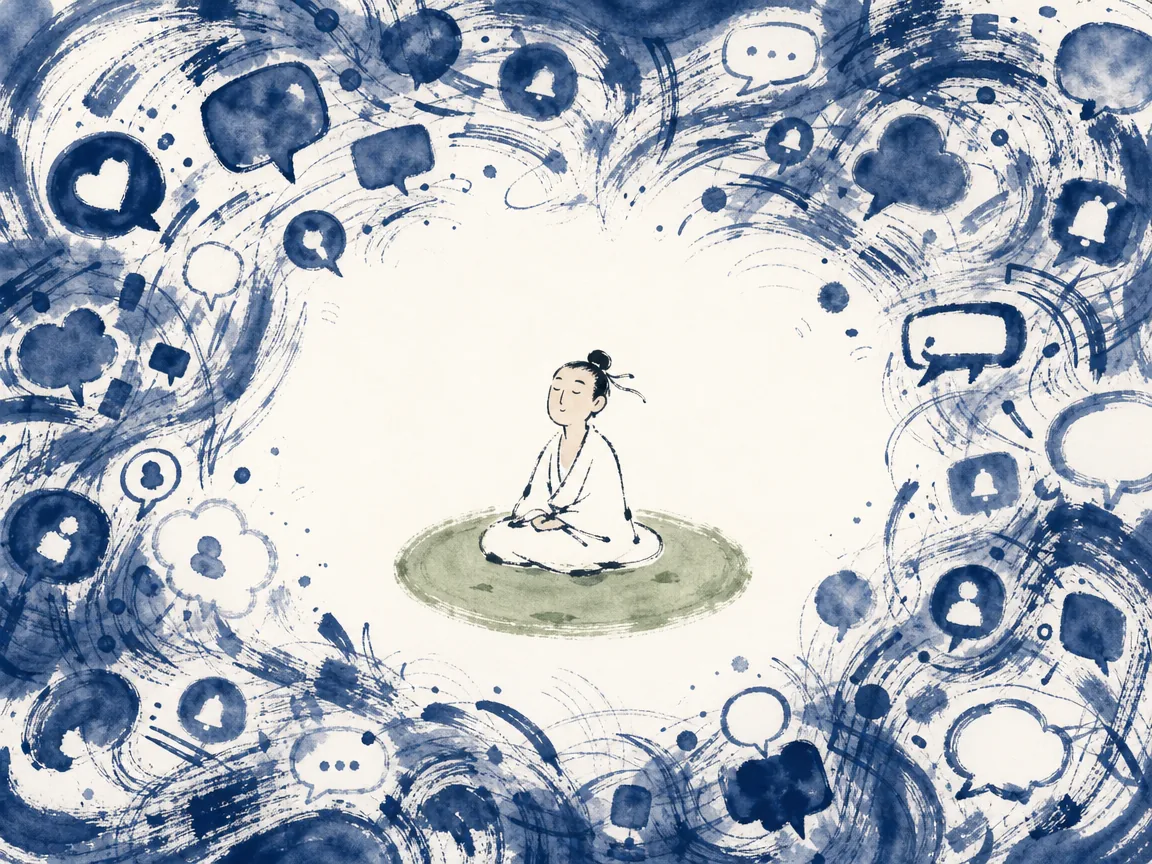
Subtitle: Laozi's third chapter of the Dao De Jing reads like a warning about the modern attention economy — two and a half millennia before the internet existed.
You open your phone. A ranking appears. Another lifestyle you have not yet achieved. A peer promotion you did not expect. A curated perfection that makes your own life look, by comparison, inadequate. You close the app. You breathe. And then you open it again—a foundational perspective explored in Daodejing Chapter 3.
This is not weakness. This is design. The conditions around you are engineered to provoke wanting, and the resulting chaos inside your mind is less a personal failing than a predictable response to an environment that refuses to let you look away.
The Chinese philosopher traditionally known as Laozi understood something about this mechanism long before the word "algorithm" existed. In the third chapter of a text attributed to him — the Dao De Jing, or Classic of the Way and Its Power — three warnings appear that map surprisingly well onto the architecture of modern life. They are not moral complaints about human nature. They are observations about the conditions that manufacture restless desire. And they point toward a different kind of remedy: not trying harder to want less, but changing the surroundings that make wanting so exhausting in the first place.
Daodejing Chapter 3: Why You Feel Behind Even When You Have Enough
If your basic needs are met — shelter, food, connection, a degree of security — why does modern life still produce such a pervasive sense of falling short? The answer may not lie in your character. It may lie in what a culture chooses to display, how it defines success, and what it makes constantly visible to your senses.
Scholarly discussions of the Dao De Jing note that its authorship and composition remain contested, with many scholars viewing the received text as a composite work that developed over time rather than as the product of a single author [3]. Traditional accounts attribute the work to a figure named Laozi, but the precise dates, the relationships between different manuscript traditions, and the extent to which later layers were added are all subjects of ongoing scholarship. What is more consistently recognized is that the text concerns itself with value distinctions, human striving, and the consequences of organizing society around competition and visibility.
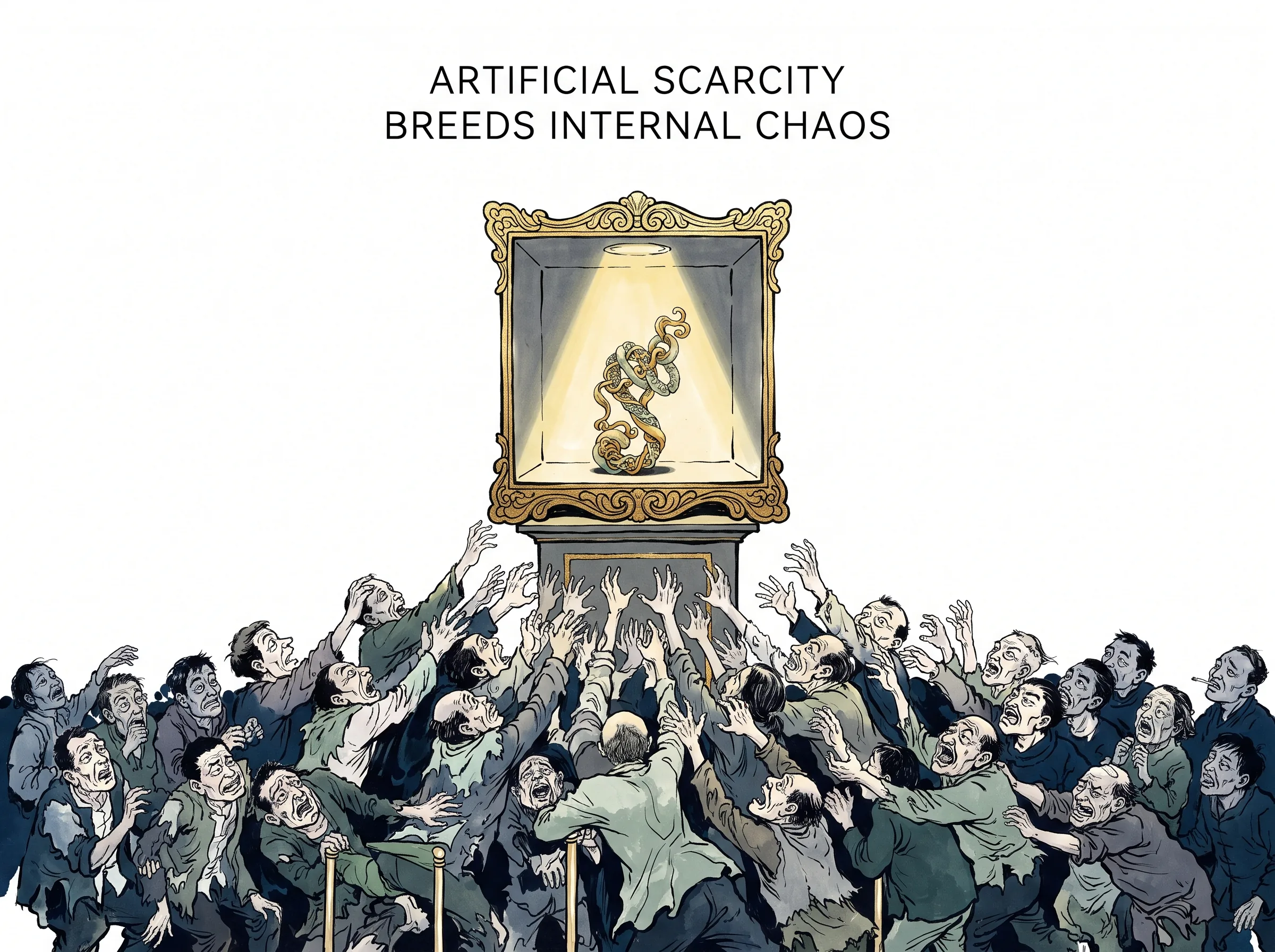
This matters because it means we can engage with the chapter's insights without requiring a single authoritative version or a settled biography. The ideas themselves — about how external markers shape internal disorder — are what carry relevance across time.
Three Warnings from the Dao De Jing
The third chapter opens with three observations that, read together, form a diagnosis of engineered discontent. The classical Chinese phrasing varies across manuscript traditions, and translations differ accordingly. A commonly cited version of the relevant passage reads:
Do not exalt the worthy, so the people will not contend. Do not value rare goods, so the people will not become thieves. Do not display what arouses desire, so the hearts of the people will not be disturbed.
These lines are traditionally interpreted as advice for governance, addressed to rulers and administrators. Yet the logic extends far beyond political theory. Each line describes a mechanism by which desire is provoked, amplified, and ultimately turned against the person experiencing it.
"Do Not Exalt the Worthy" — When Comparison Is Manufactured
The first warning targets the practice of publicly elevating certain symbols of success — rankings, titles, admired figures — until they become standards by which everyone measures themselves. The character often translated as "worthy" or "worthy people" can refer to socially constructed ideals of excellence rather than genuine virtue. When a culture insists on displaying a narrow set of achievements as the only forms of worth, it creates a landscape of permanent comparison.
Modern life is saturated with these displays. Social media feeds, professional networks, advertising, and even casual conversation circulate edited fragments of other people's lives — peaks without the valleys, highlights without the hours of mundane effort behind them. A study published in PMC found that exposure to ability-related social comparisons on social media platforms caused measurable reductions in psychological well-being compared with opinion-related comparisons, suggesting that upward comparison in achievement-oriented environments carries distinct emotional costs.
The harm is not that comparison exists. It is that comparison becomes systematic, unavoidable, and tied to identity. When people measure themselves against curated fragments rather than living their own lives, the result is not motivation — it is chronic exhaustion.
"Do Not Value Rare Goods" — When Scarcity Becomes Identity
The second warning addresses what happens when objects are elevated beyond their practical use and turned into vessels for status. The phrase about "rare goods" does not merely describe material luxury. It describes any system in which possessions become markers of social rank — school districts, professional titles, lifestyle aesthetics, branded goods. For the word-for-word source text and commentary, consult the complete classical translation and commentary of Pacifying the People: Quieting Ambition and Emptying the Mind.
The danger lies in what gets traded. People do not always want the object itself. They want the recognition, belonging, or status that the object is presumed to bring. When that presumption is widespread, individuals may sacrifice peace, time, health, or integrity in pursuit of symbols that promise to resolve a deeper sense of inadequacy. The cycle repeats because the void the symbol is supposed to fill is not actually filled by the symbol — it is reproduced by the system that sells it.
"Do Not Display What Arouses Desire" — When the Environment Refuses to Let You Look Away
The third warning is perhaps the most striking in a contemporary context. The phrase about not displaying what arouses desire describes an environment in which stimulating objects and images are not kept constantly before the senses. In a pre-modern setting, this might have referred to courtly displays, public ceremonies, or market practices. In today's world, it maps onto an infrastructure that is precisely engineered to do the opposite.
Digital platforms use personalized data, social proof cues, countdown timers, and targeted content to keep attention engaged. The U.S. Federal Trade Commission has documented that these practices — including disguised advertisements, difficult-to-cancel subscriptions, buried terms, and manipulative data-gathering techniques — have increased in sophistication and are designed to influence consumer behavior [4]. Whether or not one accepts the label "dark patterns," the observable effect is the same: the environment is optimized to keep you looking, clicking, comparing, and wanting.
What Laozi calls "not displaying what arouses desire" might sound, in modern terms, like attention hygiene or digital minimalism. But the underlying insight is deeper than a productivity tip. It is a structural observation: the mind becomes agitated not primarily because it is weak, but because it is constantly provoked.
The Sage's Four Moves for Inner Order
Laozi does not stop at critique. The chapter moves from diagnosis to a practical model — four movements that together describe a foundation for inner stability. These lines, too, are rendered differently across translations and commentarial traditions, but the general structure is widely recognized:
Therefore the sage governs by emptying the mind, filling the belly, weakening the ambition, and strengthening the bones.
Each phrase has been interpreted in various ways throughout the history of Chinese thought. What follows is one readings consistent with the broader philosophical context of the text.
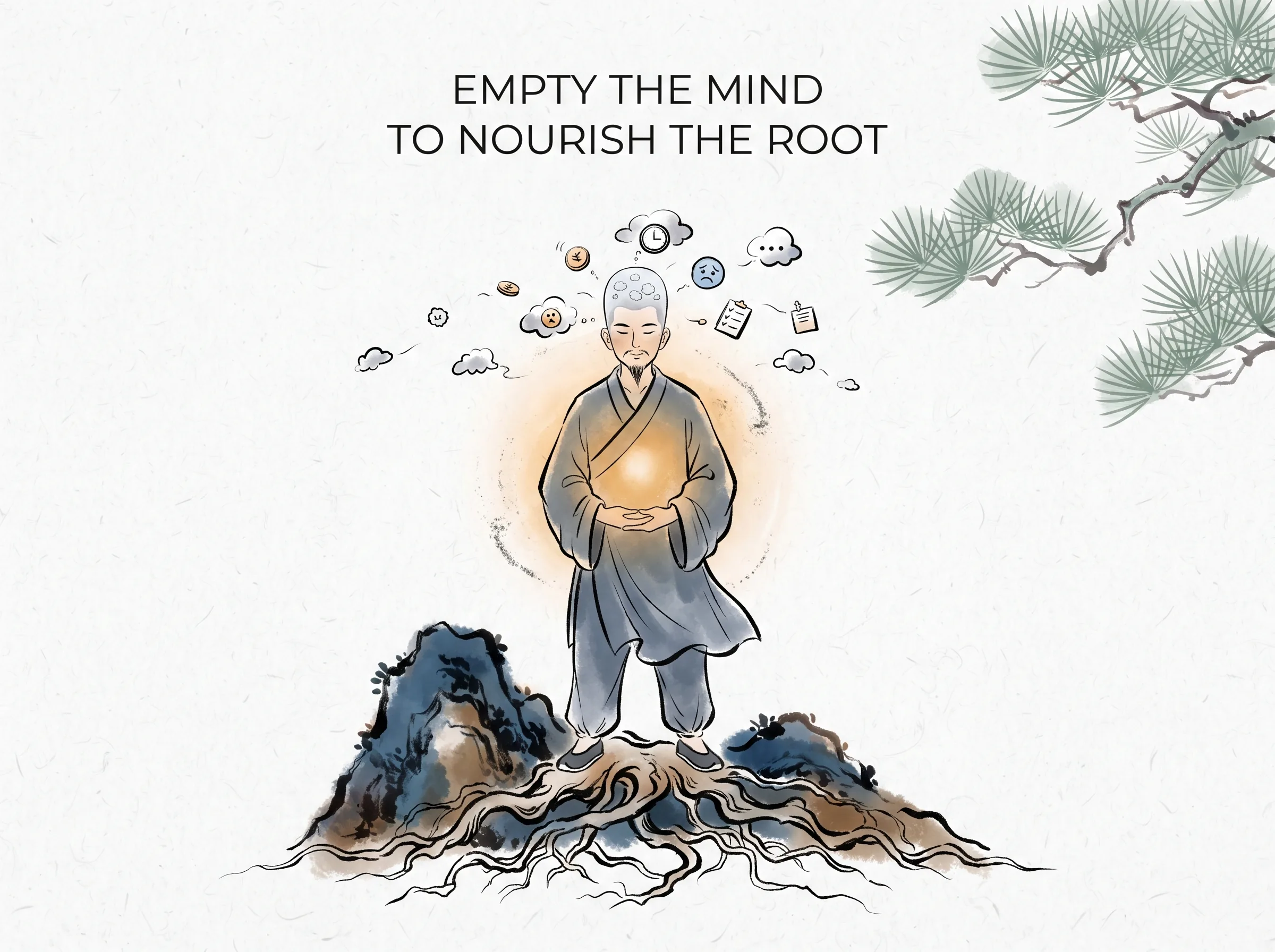
Empty the cluttered mind. This is not a call toward ignorance or mental blankness. It is a call toward spaciousness — clearing the noise of constant comparison, external valuation, and manufactured urgency so that the genuine self can be heard. A mind full of other people's standards has no room for its own.
Fulfill the basic belly. Spiritual or psychological stability requires a material foundation. Laozi was not advocating asceticism; he understood that bodily needs — food, sleep, rest, rhythm — are not obstacles to wisdom but prerequisites for it. When basic security is absent, no amount of philosophical insight can compensate.
Soften the forced ambition. This does not mean eliminating direction or purpose. It means distinguishing between desires that arise from within and those that are implanted by external pressure. The ambition to prove oneself, to outperform others, to accumulate more as proof of worth — these are the kinds of driving forces that Laozi would question. True aspiration, in this view, does not require constant validation from the outside.
Strengthen the inner backbone. Resilience that does not depend on applause, comparison, or external confirmation is the opposite of fragility. A strong inner structure is one that can withstand setbacks without collapsing, that can remain steady when others are rushing, and that does not mistake speed for progress.
Together, these four movements form a coherent approach: reduce the mental clutter, secure the physical foundation, untangle ambition from external validation, and build resilience from the inside out.
Non-Action (Wúwéi, 无为) as the Deepest Action
The chapter concludes with a phrase that is central to the entire Dao De Jing: "Practice non-action, and nothing will be out of order."
The term often translated as wuwei — non-action, effortless action, non-coercive action — is frequently misunderstood. Academic scholars of Daoist philosophy note that it does not mean total inaction [3]. Rather, it describes a mode of engagement that avoids forcing, manipulating, or imposing external will on processes that already know how to develop. Some translators render it as "non-assertive action" or "effortless action," emphasizing that the concept involves discernment rather than passivity [3].
Applied to modern life, this principle suggests something counterintuitive: the way to calm a chaotic mind is not to add more inputs, strategies, or optimizations, but to remove the machines that manufacture input in the first place. It is the difference between treating a symptom and changing the environment that produces it.
This insight applies beyond individual psychology. In leadership, education, and social design, wuwei points toward shaping conditions rather than controlling outcomes. A child placed in an environment of constant comparison will struggle to develop inner calm, regardless of parenting techniques. An employee immersed in performance metrics and rankings will experience burnout even with excellent time-management skills. A society that amplifies scarcity, status competition, and manufactured desire will produce anxious citizens — and then blame them for being anxious.
Non-action, in this sense, is not surrender. It is the decision to stop reinforcing the very mechanisms that created the problem.
What This Means for You This Week
The chapter offers a framework, not a prescription. But a framework can guide small, practical choices.
Audit your stimuli. For one week, notice what you allow constantly before your senses. How many apps, feeds, notifications, or content streams are designed to provoke wanting? You do not need to eliminate all of them. But awareness is the first step toward choice.
Separate your desires from planted ones. When a want arises — a product, a lifestyle, a career move, a relationship milestone — ask: does this belong to me, or was it placed here by someone who benefits from my pursuit? The question is not always easy to answer, and not all external influence is harmful. But the habit of inquiry creates space.
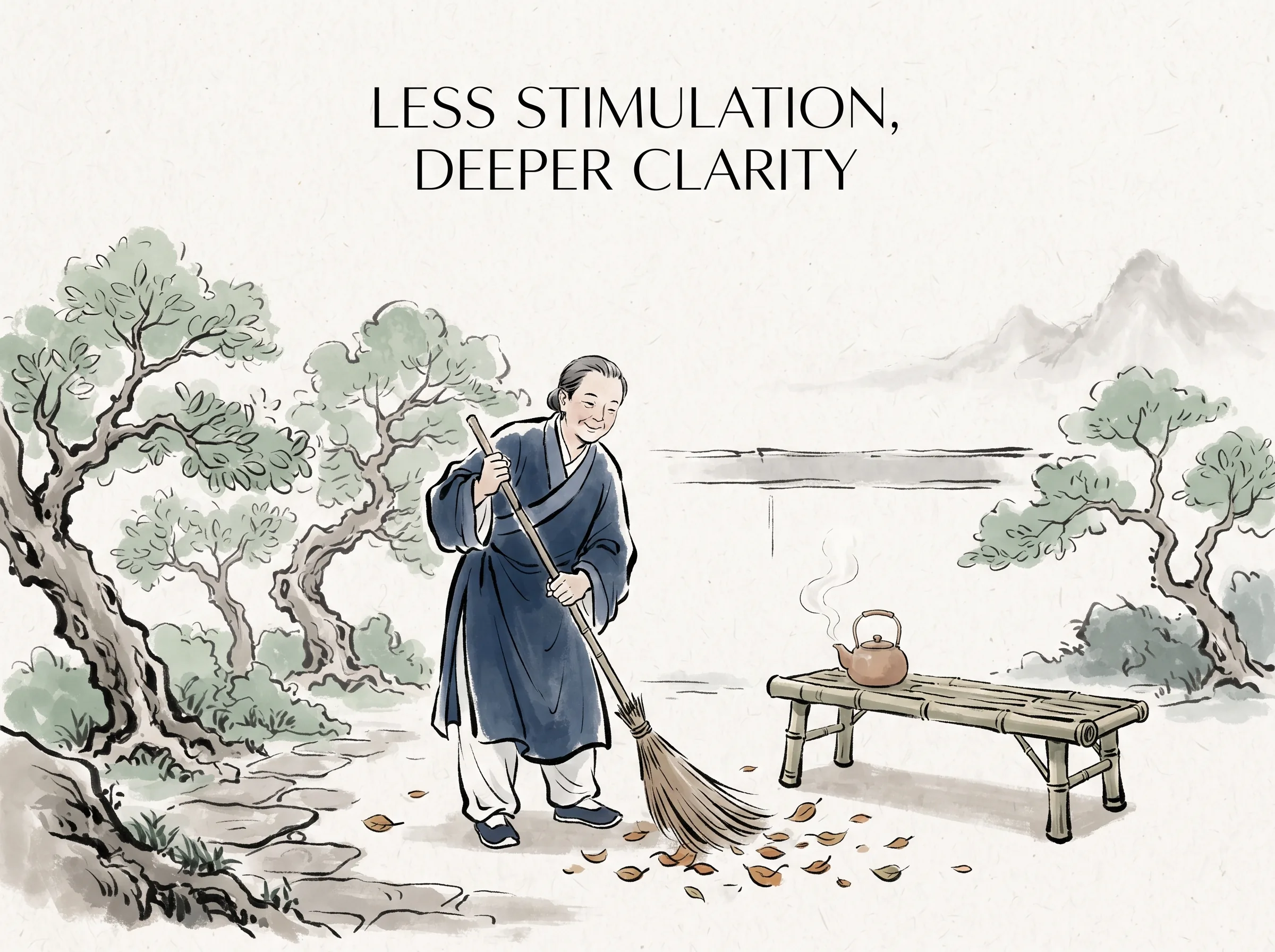
Protect your basic rhythms. Sleep, food, unhurried presence, movement — these are not trivial. They are the foundation upon which mental clarity rests. When the body is depleted, the mind is far more vulnerable to manufactured desire. Securing the basics is itself a radical act of self-governance.
A life no longer running on borrowed longing is not a life without desire. It is a life in which desire has room to be examined, questioned, and — if it survives that examination — freely chosen.
FAQ
Is the Dao De Jing really by one person named Laozi? Scholarly opinion is divided. Traditional accounts attribute the text to a figure called Laozi, but many modern scholars treat it as a composite work shaped over time rather than the product of a single author. The Stanford Encyclopedia of Philosophy notes that few scholars today accept the traditional biographical account without qualification [3]. What matters for contemporary readers is not the biography but the ideas.
Does "non-action" mean I should do nothing? No. The concept of wuwei is widely understood in academic literature as non-coercive or non-forced action, not as total inaction [3]. It refers to acting in alignment with natural processes rather than against them — a distinction that has practical implications for how we approach personal habits, leadership, and social design.
Can ancient philosophy really address modern problems like social media and algorithmic feeds? The Dao De Jing was written in a very different world, and it does not mention digital technology. However, the mechanisms it describes — manufactured comparison, status competition, constant stimulation — operate through principles that are not time-bound. What the text offers is a lens for diagnosing structural conditions, not a manual for app design. Modern research on social comparison and well-being provides independent support for the idea that certain online environments can harm psychological health.
How do I know which desires are truly mine and which were planted by the environment? There is no definitive test. The chapter suggests a starting point: slow down enough to notice the difference between a want that arises from genuine need and one that feels urgent because it was recently displayed to you. Regular reflection, reduced stimulation, and attention to basic rhythms all create the conditions in which this distinction becomes easier to see.
The chaos inside your mind may feel personal. But Laozi's third chapter invites you to look outward as well as inward — to see that much of what drives you is not native to your own desires but imported, amplified, and sustained by the world around you. The remedy is not to fight harder against want. It is to change the conditions that make want so relentless.
Start small. Notice one stimulus you can step away from. Protect one rhythm you can refuse to break. Ask one question you have been avoiding: Whose desire is this, really? This is the lasting lesson of Daodejing Chapter 3.
To explore these themes from another angle, read our related reflection on Why You Keep Fixing What Only Needs Space.
Deepen your understanding of these principles in our reflection on Why the Highest Things Look Opposite to Everything We Know.
Sources & Further Reading
[1] Laozi (Stanford Encyclopedia of Philosophy) — Scholarly overview of Laozi's philosophy, including discussion of wuwei, authorship debates, and textual traditions.
[2] FTC Report Shows Rise in Sophisticated Dark Patterns Designed to Trick and Trap Consumers — Federal Trade Commission analysis of manipulative digital design practices affecting consumer behavior.
[3] The Impact of Social Comparisons More Related to Ability vs. More Related to Opinion on Well-Being: An Instagram Study — Experimental research on how ability-based social comparisons on social media affect psychological well-being.
Further Reading
- Dao De Jing — Various English translations, including those by D.C. Lau, Stephen Mitchell, and Roger Ames & David Hall, offer different interpretive approaches to the classical text.
- The Stanford Encyclopedia of Philosophy entry on Daoism — Provides additional context on Daoist philosophical traditions and their engagement with modern questions.







[…] For a deeper comparative examination of these ideas, explore our related study on Laozi on Desire: Why Your Restless Mind Isn’t Your Fault. […]