
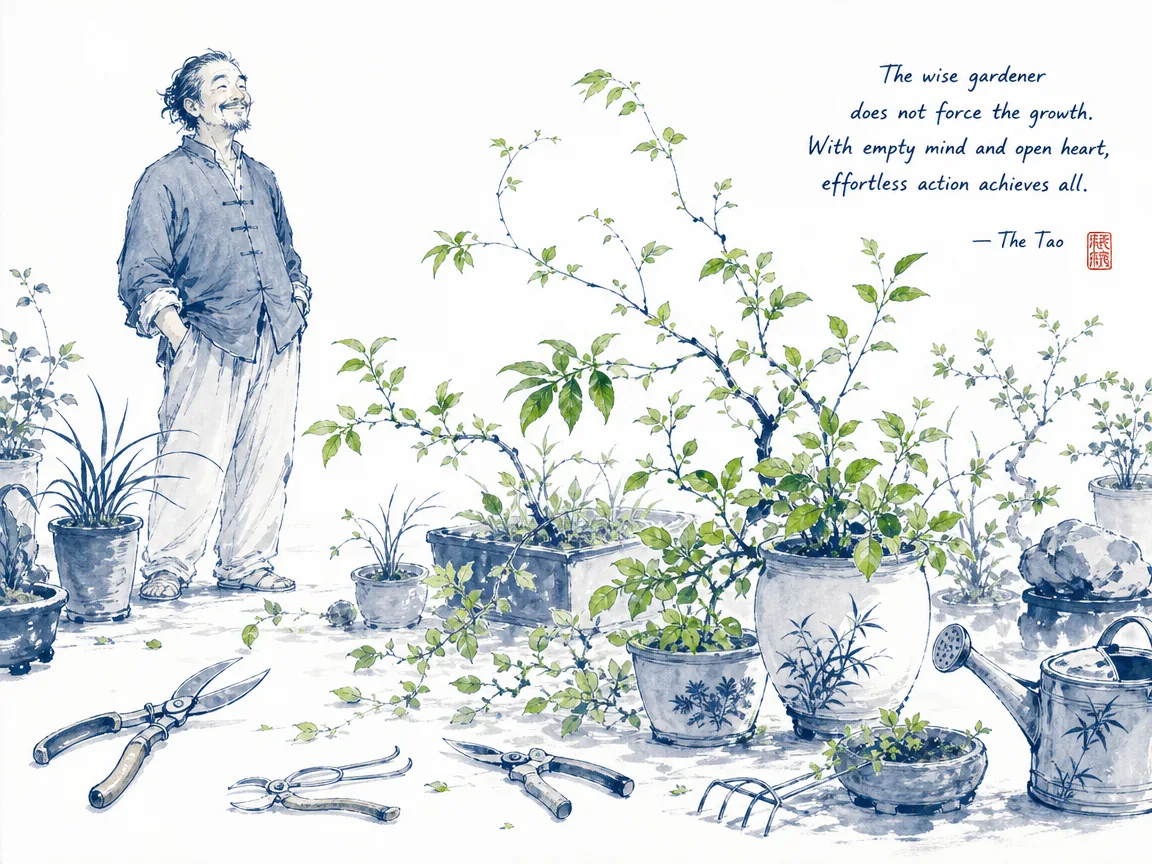
You've been there. A child scores poorly on a test, and instead of letting it sit as one data point, the family restructures their entire evening around new schedules, extra tutoring, and daily check-ins. A team initiative slows, so a manager adds another reporting tool, another review meeting, another approval gate. A friendship feels distant, and you begin checking in with the frequency of a project manager tracking deliverables. Something is supposed to be wrong—yet the more you do, the heavier it gets.
This is the modern instinct: when a problem persists, assume you haven't acted enough. Self-help culture reinforces it daily. Routines, systems, interventions — the prescription is always to add. But what if the real issue isn't insufficient effort, but persistent interference in something that was already moving? This principle is central to Daodejing Chapter 37.
Laozi's Daodejing Chapter 37 distills this insight into perhaps its most compact and structurally pivotal passage. The chapter closes the first half of the text — the "Dao" section — gathering its recurring themes into a single, challenging question: how do we know when our action is helping and when it is suffocating? The answer, counterintuitively, may require less doing, not more — but only after we learn to tell the difference between acting and overacting.
Daodejing Chapter 37: What Laozi Actually Means by Non-Action
Daodejing Chapter 37 opens with the famous line: Dao chang wuwei er wu buwei — "The Dao is always non-action, yet nothing goes unfinished." This is the most frequently misread sentence in the entire text.
In modern academic discussion, wu-wei is described as "non-assertive action" or "non-coercive action" rather than literal inaction [1]. The concept stands in contrast to action driven by self-serving desire and ego — precisely the kind of action we are most often urged to increase.
Think about the natural world. Seasons change without a ministry of climate. Rivers find their course without a chief engineer. Seeds sprout according to their own rhythm, not a daily performance review. The cosmos runs without a manager issuing hourly orders. Human systems — families, teams, relationships, your own habits — operate on a similar principle when they are not chronically disrupted by anxious interference.
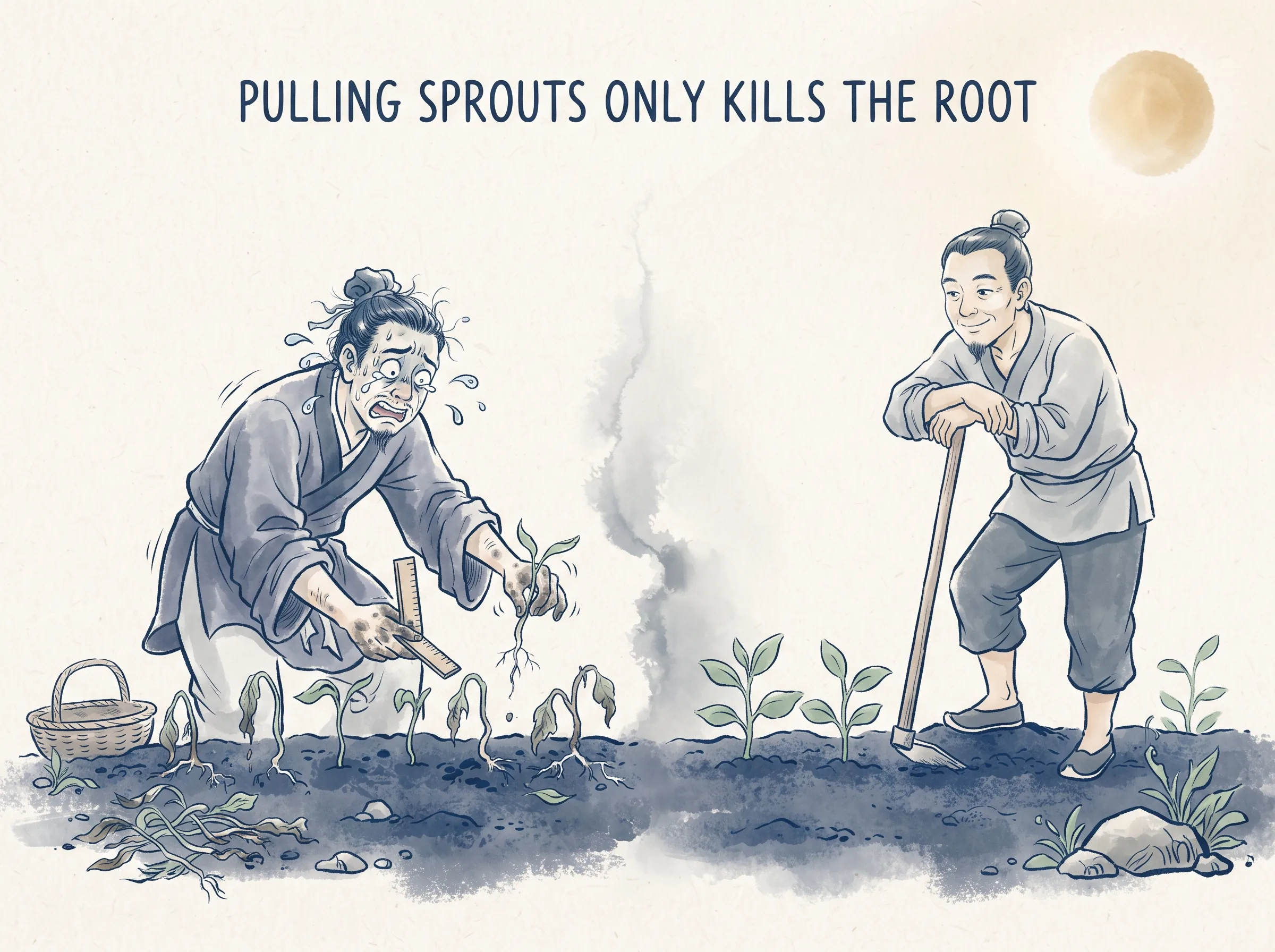
This is what Laozi means by wu-wei: acting only what the situation truly requires, adding no extra interference. It is not laziness. It is not surrender. It is the discernment to recognize when something is already self-regulating and your "help" is actually a form of noise.
Four States We Confuse With Each Other
One reason we keep overdoing things is that we cannot easily distinguish between four states that look similar from the outside:
Wu-wei — act only what the situation truly requires; add no extra interference.
Inaction — avoiding responsibility out of fear or apathy.
Wang-wei (妄为) — forcing outcomes driven by anxiety, ambition, or the need to prove control.
Necessary action — meeting real danger or duty with direct, proportionate response.
A child who trips on the playground does not need to be rescued every time — wu-wei. A child running toward a busy street does need to be stopped immediately — necessary action. A parent who refuses to engage at all because they find the effort exhausting — inaction. A parent who redesigns the child's entire schedule because of one bad grade — wang-wei.
The difference between these states is invisible until you examine the motivation behind the action. Are you responding to what is actually happening, or to a fear of what might happen? Are you solving a problem, or soothing your own discomfort with uncertainty?
Continue with the deeper interpretation and practical application.
ChiDestiny members get access to the full analysis, modern applications, and the growing Chinese Wisdom Library.
FAQ
Is wu-wei just another word for doing nothing? No. In academic understanding, wu-wei is better translated as "non-coercive action" or "non-assertive action" — acting in alignment with the natural flow of a situation rather than imposing force upon it [1]. It is a disciplined form of action, not an abandonment of it.
Does Laozi mean we should stop helping people altogether? No. The chapter distinguishes between necessary action — responding to real danger or duty — and wang-wei, the kind of overreach driven by anxiety or the need to control. A child in danger should be rescued. A child learning to walk should be allowed to stumble. The text asks us to tell the difference, not to eliminate help entirely.
Can this approach work in high-stakes environments like business or leadership? Laozi specifically addresses rulers and leaders, arguing that power magnifies the cost of misapplied action. The principle scales upward: the greater your capacity to intervene, the more valuable restraint becomes. A leader who builds a system that functions without them is practicing a form of wu-wei at the organizational level. The alternative — a system that collapses without constant personal intervention — is a sign that the leader has replaced the organization's own capacity with their own.
To explore these themes from another angle, read our related reflection on Laozi on Desire: Why Your Restless Mind Isn’t Your Fault.
Deepen your understanding of these principles in our reflection on Less Stimulating, More Substantial: What Laozi Knew About the Things That Last.
Sources & Further Reading
[1] Laozi (Stanford Encyclopedia of Philosophy)
[2] The Project Gutenberg eBook of Dao De Jing, by Lao Zi
Further Reading
- Daodejing translations by Robert Henricks and Wang Bi editions for comparative textual study
- The Cambridge History of Ancient China for context on the composite authorship debates surrounding the Daodejing
- Contemporary works on systems theory and self-organization, which offer parallel frameworks for understanding how complex systems regulate themselves without central control






