
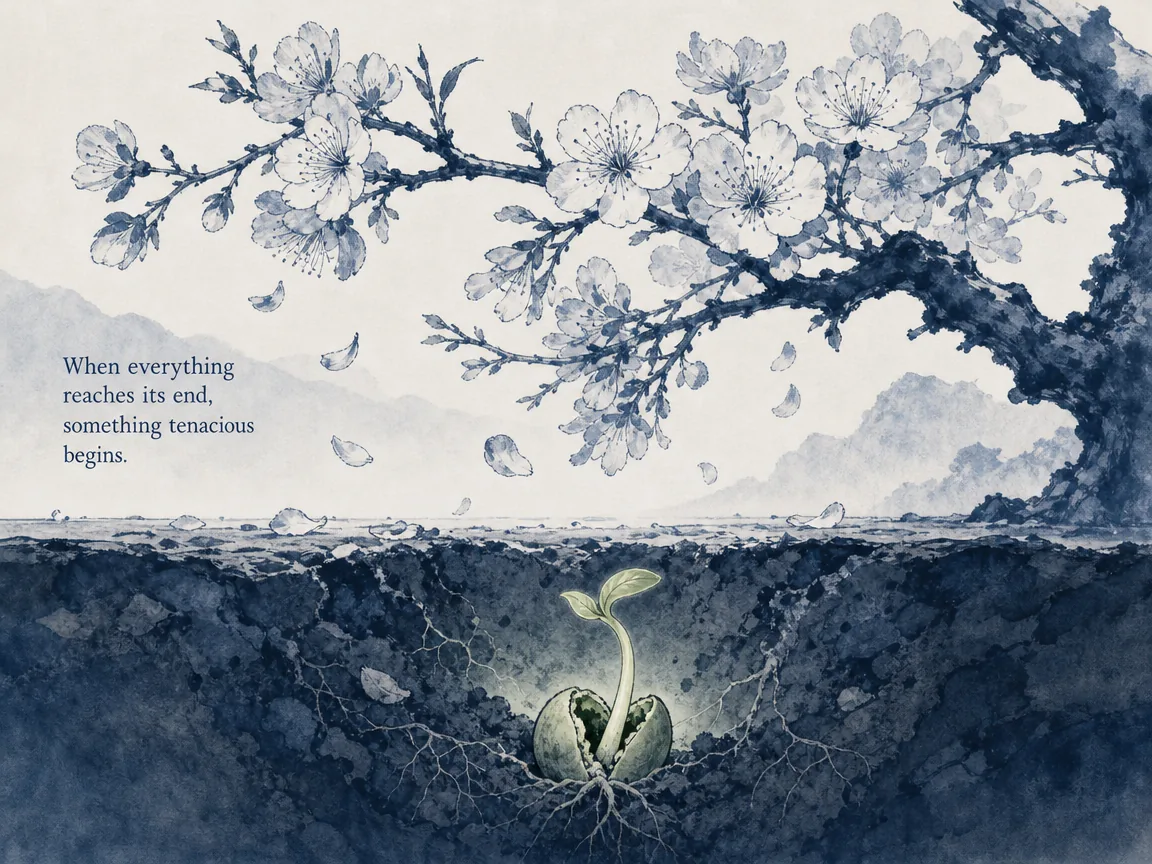
One of the hardest truths to accept is that your greatest danger may not arrive when you are struggling, but when everything is working. You are at the peak. Your career is moving forward. Your relationships feel secure. People confirm that you are doing the right thing. In these moments, it is easy to believe that success is proof of permanence—that the pattern which brought you here will continue to carry you forward. But the oldest traditions of Chinese thought offer a different warning: the moment you feel most powerful is often the moment you are furthest from seeing what is quietly changing around you.
The Tao Te Ching, attributed to Laozi, contains one of the clearest and most practical frameworks for this insight. In Daodejing Chapter 36 moves through a series of reversals—suggesting that what expands also plants the seeds of contraction, what strengthens also draws the conditions of its own weakening. The chapter does not end with cynicism. Instead, it introduces a disciplined way of seeing called subtle clarity (wēimíng, 微明), which means perceiving the subtle forces that shape the future while the present still looks stable. This is not a philosophy of paranoia. It is a practice of clarity.
What follows is an exploration of that practice—not as abstract theory, but as something you can bring into how you read your own life, your work, and your relationships.
Daodejing Chapter 36: The Four Paradoxes of Laozi
Daodejing Chapter 36 of the Tao Te Ching opens with four paired reversals that are among the most widely discussed lines in the entire text:
What you wish to draw together, first let it expand; what you wish to weaken, first let it strengthen; what you wish to discard, first let it flourish; what you wish to take, first let it give [1]).
Read in isolation, these lines can sound like advice for manipulation. Some historical commentators have indeed read them as strategic or political, interpreting the passage as a guide to weakening opponents by first allowing them to grow overconfident or overextended [2]. But if that were the only meaning, the rest of the chapter would not make sense. The reversals are immediately followed by statements about gentleness overcoming rigidity (róuruò shèng gāngqiáng, 柔弱胜刚强) and a reminder that true strength depends on hidden conditions. The point is not to trick others—it is to recognize how systems behave.
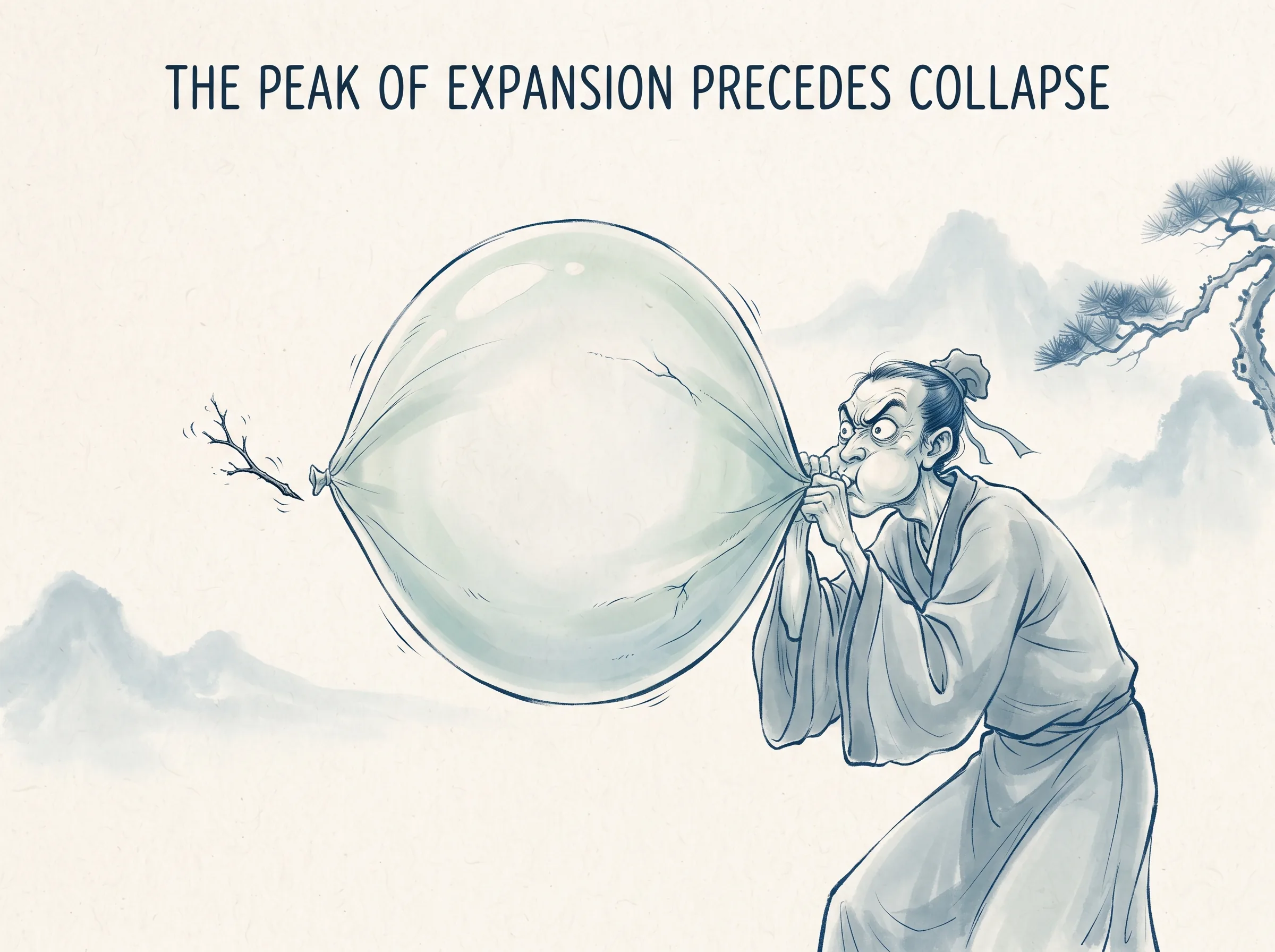
In modern terms, the paradoxes describe a structural pattern. When a company grows rapidly, it does not simply become a bigger version of itself. It acquires new layers of complexity: departments, reporting lines, budgets, internal politics. The decision-making that was fast and direct at ten people slows at a thousand. Success builds infrastructure that eventually requires more and more maintenance. Growth is real, but so is the growing cost of sustaining it. The expansion itself is quietly reshaping the conditions that made expansion possible in the first place.
This is what the Wang Bi commentary captures when it describes the passage as following the nature of things (yīn wù zhī xìng, 因物之性)—following the nature of things so that imbalances resolve themselves, rather than forcing correction through external pressure [1]). The lesson is not that you should engineer decline in others. It is that decline often engineers itself, long before anyone notices.
Continue with the deeper interpretation and practical application.
ChiDestiny members get access to the full analysis, modern applications, and the growing Chinese Wisdom Library.
FAQ
Q: Does the Tao Te Ching say that success always leads to failure?
No. The text does not claim that everything automatically reverses once it reaches a peak. What it describes is a structural tendency: when a system grows, it changes the conditions that supported its growth, and those changes may create new vulnerabilities. Recognizing this is not fatalism—it is attention.
Q: Isn't this just a sophisticated form of worrying?
It is the opposite. Worry projects fear into the future without examining the present. Subtle clarity (wēimíng, 微明) examines the present with enough detail to see where it is heading. The practice is calm, not anxious. It replaces speculation with observation.
Q: Can subtle clarity (wēimíng, 微明) be used to manipulate others?
The text itself resists that reading. While some historical commentators did apply the chapter to political strategy, the broader structure of the Tao Te Ching frames these insights as observations about how things work, not as techniques for controlling them. Using the chapter as a manipulation manual misses the point and contradicts the surrounding teachings about simplicity and natural alignment.
Q: How is this different from simply being cautious or risk-averse?
Caution is about avoiding loss. Subtle clarity (wēimíng, 微明) is about understanding transformation. A cautious person asks, "What could go wrong?" A person practicing subtle clarity (wēimíng, 微明) asks, "What is this doing to itself over time?" The first looks for threats. The second looks for patterns.
Summary and Next Steps
The deepest insight of Chapter 36 is not that strong people should fear their own strength. It is that strength, like everything else, exists in relationship to conditions—and those conditions are always shifting. The person who mistakes a moment of alignment for permanent security is the one most likely to be surprised when alignment ends.
Subtle clarity (wēimíng, 微明) is the discipline of staying awake inside success. It asks you to look past the surface of today and notice what today is building for tomorrow. It does not require you to abandon ambition or preparation. It asks only that you widen your vision long enough to see the full picture.
If this resonates with you, consider starting with a simple practice: once a week, choose one area of your life where things are going well, and ask the six questions from Section 6. Do not look for problems. Look for patterns. Over time, this habit sharpens your perception in ways that pure caution never will.
For further reflection, the Tao Te Ching offers a remarkable amount of practical guidance on change, strength, and adaptation. Chapter 2 establishes the relational nature of opposites. Chapter 22 reflects on how yielding can preserve wholeness. Chapter 40 distills the movement of change into a single principle. Chapter 76 uses the contrast between living and dead bodies to illustrate the value of flexibility. Each of these passages deepens the intuition introduced in Chapter 36.
To explore these themes from another angle, read our related reflection on Why Great Achievement Looks Imperfect — Laozi’s Lesson for Modern Success.
For a deeper comparative examination of these ideas, explore our related study on Returning to the Root: Attaining Utmost Emptiness and Observing the Cycle.
Sources & Further Reading
[1] Primary sources referenced
[2] Daodejing (Wang Bi Edition, 道德經/王弼本) – Wikisource (维基文库) — ) — Standard Wang Bi text of the Tao Te Ching, including Chapter 36 and Chapter 40, with Wang Bi's commentary on subtle discernment (wēimíng, 微明) and softness overcoming hardness (róuruò shèng gāngqiáng, 柔弱胜刚强).
[3] Laozi Heshang Gong Commentary: Part 1 (老子河上公章句/上) – Wikisource (維基文庫) — He Shanggong commentary on the Tao Te Ching, offering an alternative classical interpretation of the third chapter's opening passage.
[4] D.C. Lau’s Translation — D.C. Lau's English translation of the Tao Te Ching, including the rendering of subtle discernment (wēimíng, 微明) as "subtle discernment."
Further reading
- Stanford Encyclopedia of Philosophy, Chinese Ethics — Scholarly overview of ethical concepts in classical Chinese thought, including discussions of Daoist perspectives on power and virtue.






