
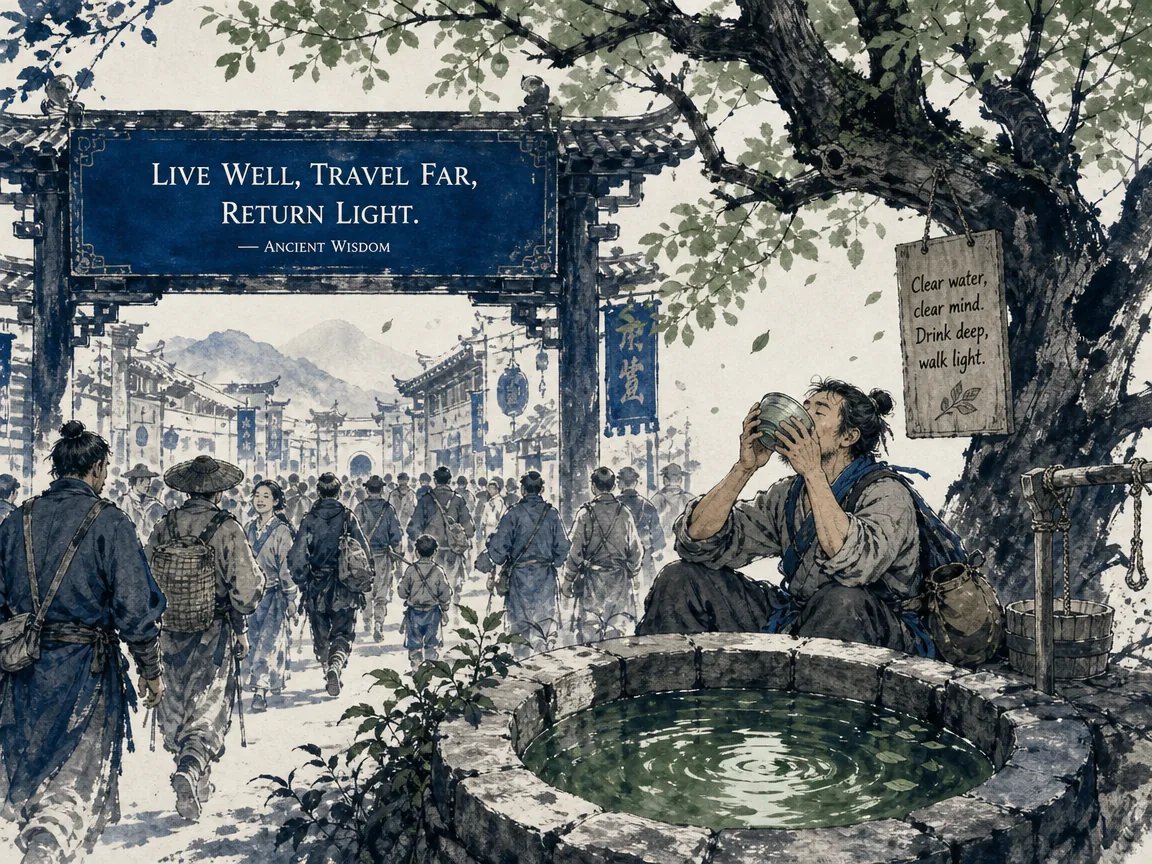
We live in an age with more entertainment, information, and stimulation than any previous generation. Yet an increasing number of people report feeling simultaneously overstimulated and deeply empty. Short videos command attention in seconds. News feeds are engineered to keep us scrolling. Relationships, careers, and even leisure activities are increasingly judged by whether they deliver an immediate hit of feeling. When something doesn't produce a quick sense of reward, we tend to dismiss it as unimportant — or worse, we move on to the next thing that might.
The result is a quiet kind of exhaustion. We are constantly stopping, checking, clicking, tasting, consuming. But few of those stops feel like they actually carry us anywhere. We accumulate experiences without accumulating depth. This paradox — more stimulation, less sustenance — is not simply a modern inconvenience. It points to a structural problem in how we evaluate what is valuable—a foundational perspective explored in Daodejing Chapter 35.
Over two thousand years ago, the author of the Dao De Jing (道德经) observed the same dynamic and offered a remarkably precise diagnosis. In Chapter 35, he draws a sharp line between two kinds of attraction: the kind that makes a passerby stop, and the kind that actually settles a life. The first relies on music and food — sensory hooks designed to capture attention. The second is described as pale, tasteless, nearly invisible. Yet, the chapter suggests, it is the second that can never be exhausted [2]). Understanding this distinction may be one of the most practical pieces of ancient wisdom available to us today.
Daodejing Chapter 35: What Makes You Stop vs. What Makes You Stay
The opening movement of Daodejing Chapter 35 presents a simple but consequential observation:
"Hold to the Great Image, and all under heaven will come. Coming without harm, they find peace, calm, and security. Music and delicacies make passing travelers stop." (Zhí dàxiàng, tiānxià wǎng. Wǎng ér bù hài, ān píng tài. Yuè yǔ ěr, guòkè zhǐ, 执大象,天下往。往而不害,安平太。乐与饵,过客止。)
Holding to the Great Form, all things come naturally. Going forth without harm: peace, equilibrium, ease. Music and food — a passerby stops [2]).
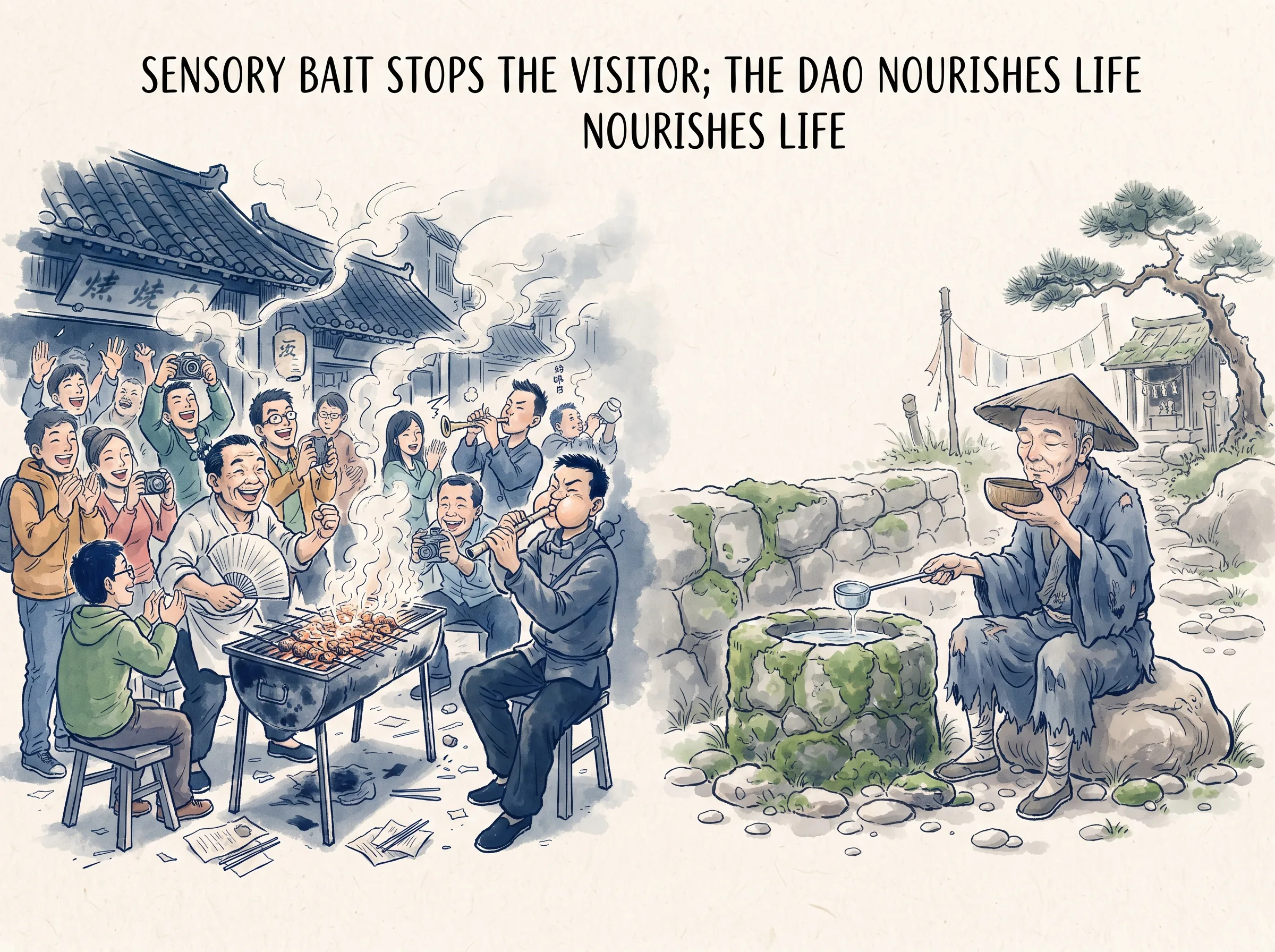
The second half of that sentence — "Music and delicacies make passersby halt" (Yuè yǔ ěr, guòkè zhǐ, 乐与饵,过客止) — is perhaps the most instantly recognizable image in the entire chapter. Music plays. Food smells good. Someone walking down the road pauses. This is not presented as a moral failure. Laozi is describing a force, not judging a weakness. Sensory stimulation has real power. It works.
The critical question the chapter invites us to ask is not whether music and food are bad. The question is whether stopping is the same thing as arriving. A passerby stops, yes — but the text does not say the passerby settles. The word Laozi uses is deliberate: guoke (过客), meaning a temporary visitor, someone passing through. This is a key distinction. Something can arrest your attention without providing what your life actually needs.
Modern product design understands this better than most philosophical traditions. Every notification, thumbnail, autoplay sequence, and infinite scroll is an engineered version of enticing bait (yuè yǔ ěr, 乐与饵). It is not designed to settle you. It is designed to make you stop — so that something else can happen while you are stopped. That is not inherently evil. But it is structurally different from what sustains a life over years.
The shift Laozi proposes is a shift in the question we ask ourselves. Instead of does this feel good right now? the more useful question is: does this sustain me over time? This is not a call to austerity. It is a call to discrimination — to distinguish between attraction engineering and structural value. And this distinction shows up everywhere: in how we choose relationships, how we approach work, how we spend our attention, and how we understand success itself.
Holding the Bigger Picture
The first line of the chapter — "Hold to the Great Image and all will come" (Zhí dàxiàng, tiānxià wǎng, 执大象,天下往) — introduces a concept that requires some unpacking. The phrase Great Image (dàxiàng, 大象) does not refer to the animal. In the context of the Dao De Jing, the character for image (xiàng, 象) typically denotes form, pattern, or manifestation. The "Great Form" is the overarching pattern or order behind phenomena — the principle that holds a system together without being reducible to any single part of it.
Wang Bi (Wáng Bì, 王弼), the influential third-century commentator, explained the Great Image (dàxiàng, 大象) as "the mother of all images, neither cold nor warm nor hot, and therefore able to encompass and preserve all things" [2]). Different interpretive traditions have offered other readings, and scholarly disagreement about the precise meaning of key terms in the Dao De Jing remains active [3]. But across most commentaries, the Great Image (dàxiàng, 大象) points to the whole rather than the part, the structure rather than the event.
To hold the Great Form is to see the larger pattern before reacting to the immediate signal. It is the difference between responding to a single wave and understanding the tide. This is difficult because human perception is naturally drawn to what is immediate, loud, and concrete. A flashing notification is easier to notice than a slow-building skill. A dramatic conflict is more vivid than a steady routine. The exciting is always louder than the essential.
Consider career decisions. How often do we choose a path because it looks impressive today — a title, a salary bump, a trendy industry — without asking whether it fits into a larger direction? Or consider daily habits. We chase new productivity systems, diet plans, and self-improvement frameworks with the same intensity, only to abandon them when they stop delivering novelty. Each new thing makes us stop. None of them necessarily make us arrive.
Holding the Great Form means refusing to let the loudest option in the room become the deciding factor. It asks: what is the larger pattern here? what am I building toward, not just reacting to? This is not a luxury of meditation retreats. It is a practical discipline for anyone navigating a world that rewards quick attention over deep commitment.
Continue with the deeper interpretation and practical application.
ChiDestiny members get access to the full analysis, modern applications, and the growing Chinese Wisdom Library.
FAQ
Is Laozi's Chapter 35 saying that pleasure and entertainment are bad?
No. The chapter acknowledges that music and food naturally attract attention — they make passersby stop. Laozi is not condemning enjoyment. He is pointing out that stopping is not the same as settling. The danger is not pleasure itself but the mistake of treating temporary attraction as lasting value.
What does the Great Image (dàxiàng, 大象) actually mean in this chapter?
The term Great Image (dàxiàng, 大象) refers to the overarching pattern or order behind phenomena, not a physical shape. Wang Bi, the third-century commentator, described it as "the mother of all images" that encompasses all things [2]). Scholarly interpretations vary, and debates about key terms in the Dao De Jing continue among researchers [3]. In practical terms, the Great Image (dàxiàng, 大象) points to the larger structure or principle behind surface-level events.
Does blandness without flavor (dànhū qí wúwèi, 淡乎其无味) mean the Dao is meaningless or empty?
No. Blandness (dàn, 淡) describes the absence of addictive intensity, not the absence of value. The chapter contrasts the Dao with music and food — things that are immediately noticeable but temporary. The Dao is described as tasteless precisely because it does not rely on sensory stimulation to be effective. Water is tasteless but essential. Air is invisible but irreplaceable. The Dao operates on the same principle.
Can this ancient text really help with modern problems like social media addiction or burnout?
The chapter addresses a structural pattern — the confusion between what captures attention and what sustains a life — that predates any specific technology. While the Dao De Jing was composed in an ancient context and its exact dating and authorship are debated among scholars [3], the distinction it draws between temporary attraction and long-term value remains applicable to any era in which stimulation is abundant and attention is scarce.
Discover the historical and philosophical roots in the classical foundation in Honoring Agreements: Reconciling Great Enmities Leaves Lingering Resentment.
For a deeper comparative examination of these ideas, explore our related study on Why Your Good Habits Keep Failing (A Taoist Explanation).
Sources & Further Reading
[1] Daodejing (Wang Bi Edition, 道德经/王弼本) – Wikisource (维基文库)
[2] Laozi (Stanford Encyclopedia of Philosophy/Spring 2026 Edition)Laozi (Stanford Encyclopedia of Philosophy/Spring 2026 Edition)
[3] A Model of Mood as Integrated Advantage (PMC)A Model of Mood as Integrated Advantage (PMC)
Further Reading
- The Dao De Jing, Chapter 35 — primary classical source (Wáng Bì text)
- The Dao De Jing, Chapter 14 and Chapter 41 — for related discussions of the archetypal image (xiàng, 象)
- Stanford Encyclopedia of Philosophy entry on Laozi — for contemporary scholarly perspectives on interpretation debates






