
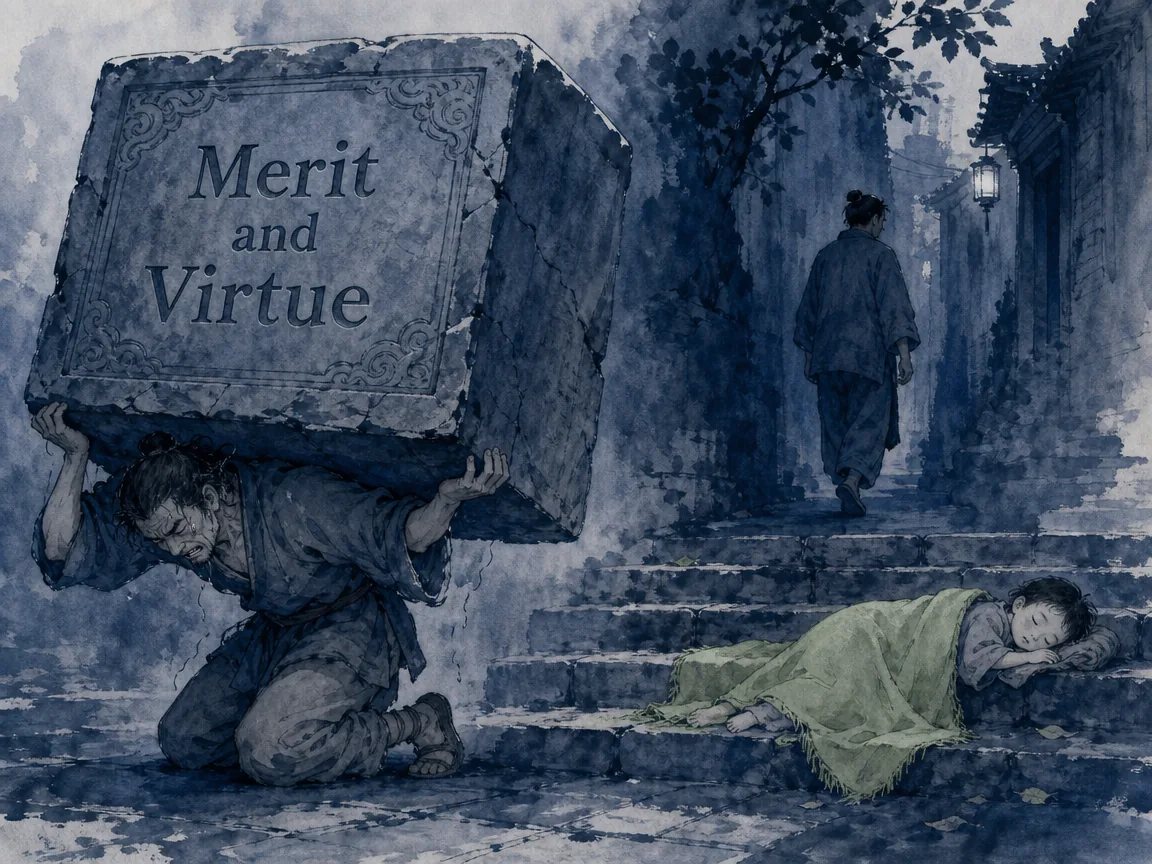
Daodejing Chapter 38: The Paradox We All Recognize
You've probably met them — the people who seem incapable of going more than a few sentences without declaring their own goodness. They're the colleagues who announce their generosity at every opportunity, the friends who turn every conversation into a moral lecture, the acquaintances who signal their virtue like badges to be worn and displayed. And you know exactly what your instincts are telling you: something doesn't add up.
This isn't a new observation. Two thousand years ago, Laozi identified the same pattern and gave it one of the sharpest diagnoses in all of Chinese philosophy. In Daodejing Chapter 38 of the Daodejing — widely regarded as the opening of the text's second half, the section scholars call the De Jing or "Classic of Virtue" — he draws a distinction that cuts directly to the bone: "True power does not grasp for power; thus, it holds genuine power. Lesser power does not lose power; thus, it has no power" [2]. In other words, the highest form of virtue is so thoroughly absorbed that it ceases to be a project, a performance, or an identity. It simply is.
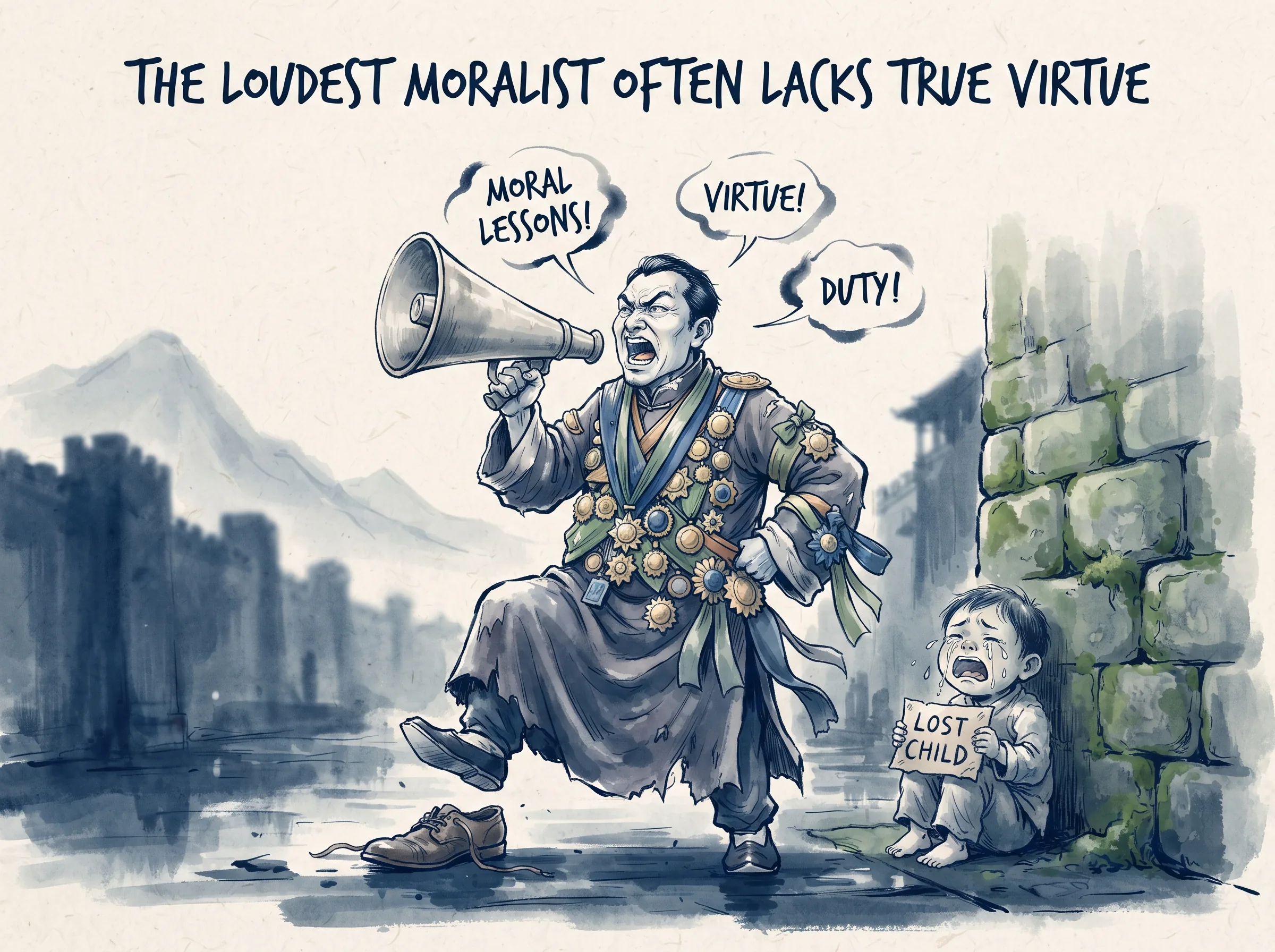
What happens when virtue stops being something you are and starts being something you do — or worse, something you announce? Laozi's answer is both clearer and more unsettling than most modern treatments of the subject allow.
When Virtue Becomes Identity
The chapter begins by separating two kinds of virtue, which the available texts describe as upper virtue and lower virtue. Upper virtue — shang de — is virtue that has been so completely integrated into a person that it no longer requires self-monitoring, self-congratulation, or public proof. Lower virtue — xia de — is virtue that is constantly being maintained, defended, and displayed, because it has become a project rather than a structure of being.
The difference is not merely behavioral. It is structural. A person whose respect for others has become genuine does not wake up each morning and consciously decide to be respectful. Respect is already how they move through the world. The effort that defines lower virtue — the effort to appear virtuous, to prove oneself virtuous, to ensure that others recognize one's virtue — is precisely the evidence that something vital has not yet been fully internalized.
This insight extends far beyond personal character. Laozi describes the same dynamic at the level of institutions, communities, and cultures. When a family begins to endlessly remind itself that it is a loving family, the very need for such reminders suggests that the natural warmth once present has begun to thin. When an organization covers its walls with mission statements and values — and then measures whether employees can recite them — it may be performing the kind of virtue that signals a deeper shortage. The more visible the declaration, the more likely it is that what the declaration is meant to describe has already started to recede.
The psychological mechanism behind this is straightforward enough, even if it is rarely named: virtue that must be constantly demonstrated has become an identity rather than a disposition. And identity, by its nature, demands maintenance. Once you have labeled yourself as a good person, you must protect that label against contradiction. You become defensive when challenged. You collect evidence of your goodness. You distance yourself from those who threaten your self-image. In the process, what was once a natural way of being hardens into a set of performances — and performances are always vulnerable to the same suspicion that makes us doubt the loud claimants in the first place.
Continue with the deeper interpretation and practical application.
ChiDestiny members get access to the full analysis, modern applications, and the growing Chinese Wisdom Library.
FAQ
Does Laozi think virtue is bad? No. Chapter 38 distinguishes between two kinds of virtue — one that is natural and integrated, and one that is performed and managed. Laozi criticizes the second, not the first. Genuine virtue, in his view, is closer to the foundation than to the problem.
Is ritual always a sign of moral decay? Not always. Ritual and procedure serve real functions in complex societies. Laozi's point is that ritual becomes problematic when it replaces genuine feeling rather than expressing it. The issue is not the existence of rules but the condition that makes them increasingly necessary.
How can I tell whether my own moral efforts are genuine or performative? Laozi's criterion is practical: observe whether your actions correspond to your declarations when no audience is present. If your virtue requires an audience to feel real, it may be functioning as identity rather than disposition.
Does this mean I should stop talking about my values? Not at all. Public expression of values can be authentic and meaningful. The distinction lies in whether that expression accompanies action or substitutes for it. Values spoken without follow-through become performance. Values spoken alongside action remain integrity.
To explore these themes from another angle, read our related reflection on When Society Gets Smarter, People Grow Farther From Themselves.
For a deeper comparative examination of these ideas, explore our related study on Why the Desperate Need for Safety Can Become a Trap — Ancient Chinese Wisdom for Modern Life.
Sources & Further Reading
[1] Laozi — Stanford Encyclopedia of Philosophy. Academic overview of Laozi's thought, including the standard interpretation of wuwei as natural action rather than total inaction.
[2] Tao Te Ching — Section 38 — Primary source text for Chapter 38, including the opening distinction between upper and lower virtue, the sequence from Dao through li, and the closing directive to abide in substance rather than ornament. Note: The passage numbering and chapter divisions discussed in this article reflect the received text tradition. Early manuscript discoveries, including the Mawangdui silk texts, confirm the existence of variant arrangements and provide important syntactic clarification, though the core sequence described in Chapter 38 remains consistent across editions.







[…] Deepen your understanding of these principles in our reflection on Why the Most Virtuous People Stop Talking About Virtue. […]