
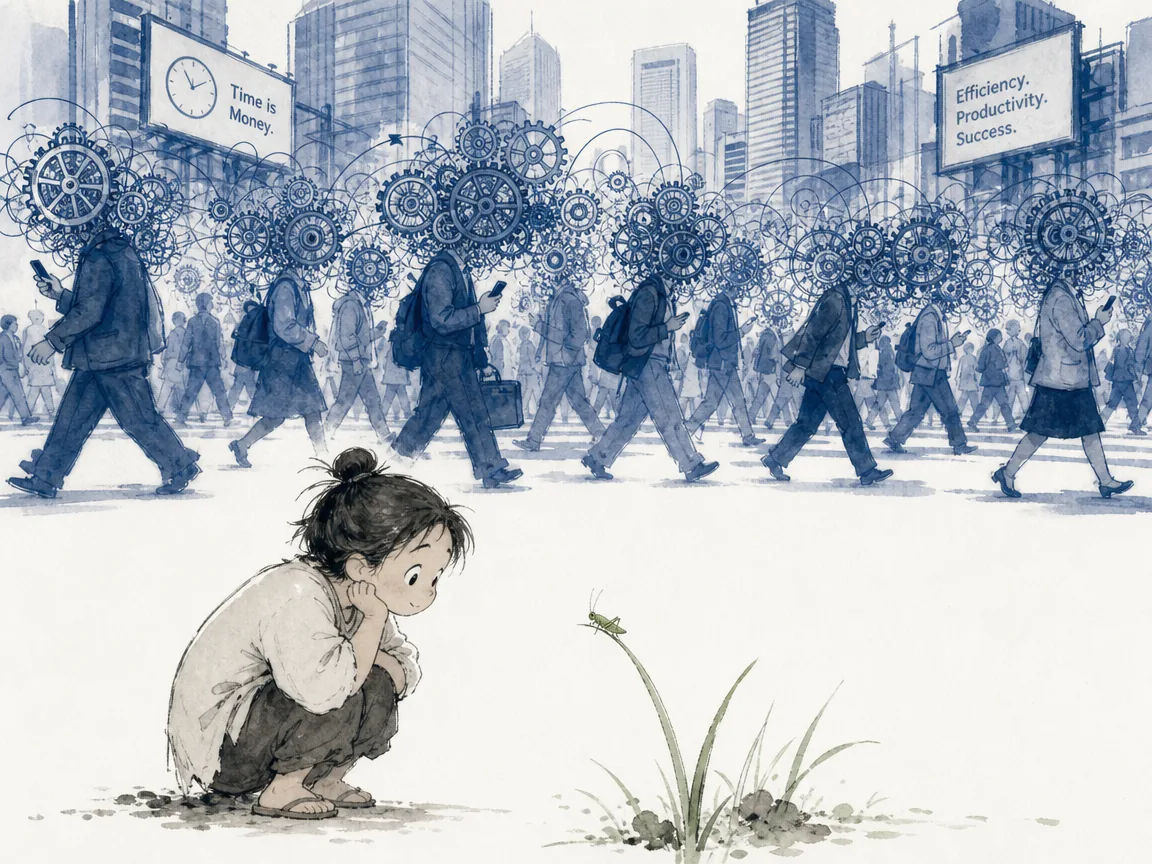
Many people today work harder, study more, and optimize every part of their lives—yet report higher levels of anxiety, exhaustion, and a persistent sense that something essential is missing. Social media amplifies a constant background hum of comparison. Academic and workplace cultures reward achievement measured in visible metrics. And still, the sense of inner peace that many hoped success would bring seems to recede rather than appear.
This is not a new observation. Over two thousand years ago, Laozi diagnosed something similar in Dao De Jing In Daodejing Chapter 20, one of the most frequently misunderstood passages in the entire text. On the surface, the chapter sounds radical: "Discard wisdom and people will benefit a hundredfold. Discard benevolence and people will return to filial piety and kindness. Discard utility and thieves and robbers will disappear" [1]. It continues with "See plainness. Embrace simplicity. Reduce desires and demands. Abandon learning and there will be no anxiety." If read literally, this appears to be a call for ignorance, moral indifference, and cultural regression. But that reading misses the point entirely.
Laozi is not opposing (fǎnduì, 反对) knowledge, virtue, or skill. He is offering a diagnosis: when a society must constantly promote wisdom, benevolence, and achievement as external standards, it signals that what was once natural has already been lost. The real question his chapter poses is not how to accumulate more—more success, more learning, more moral credentials—but how to strip away what obscures what was already enough.
Daodejing Chapter 20: More Achievement, Less Peace
There is a growing body of research suggesting a link between social media use and mental health concerns. A systematic review found that negative interactions and social comparison on social networking sites were related to higher levels of depression and anxiety, while positive interactions and social support were consistently associated with lower levels [2]. The findings for sheer frequency of use were mixed, but the qualitative dimension—how people relate to one another online—appeared to matter more than time spent.
This aligns with a broader pattern: as societies become more competitive and more focused on measurable achievement, people often feel less anchored. The problem is not that effort is insufficient. The problem, in Laozi's framing, is that effort becomes attached to external standards that are themselves unstable. When your sense of worth depends on ranking, on likes, on titles, on being recognized as exceptional—you have handed your inner peace to something outside yourself. And that something can always be taken away or surpassed.
Abandon Sageness and Discard Wisdom (Jué Shèng Qì Zhì, 绝圣弃智): When Smart Becomes a Performance
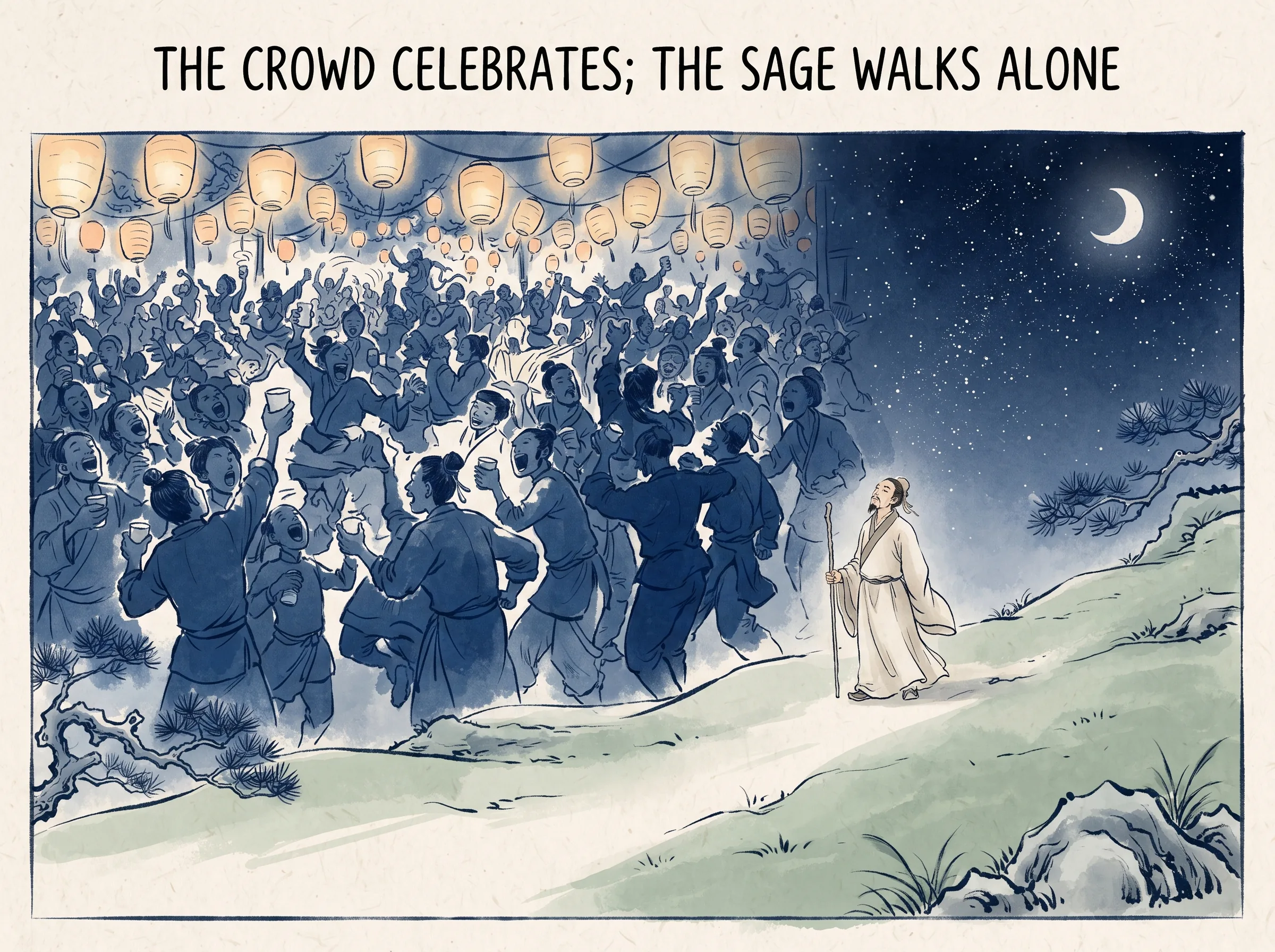
The phrase "discarding wisdom" (绝圣弃智) is the most provocative line in the chapter, and the most easily misunderstood. The Laozi does not simply reject the figure of the sage; in other chapters, the ideal ruler is described precisely as one who follows the Dao naturally [3]. What Daodejing Chapter 20 critiques is not genuine understanding but a specific kind of intelligence—one that serves competition rather than clarity, that divides people into hierarchies of superiority and inferiority, that turns knowledge into a tool for standing above others rather than seeing more clearly.
In modern life, this dynamic is everywhere. Social media rewards cleverness measured by engagement. Academic and professional cultures elevate those who can perform intelligence most visibly. A child's curiosity can slowly shift from wanting to understand the world to wanting to rank within it. The more learning becomes about proving something rather than discovering something, the more it produces anxiety. Someone will always know more, score higher, speak more persuasively. The competition is structurally endless.
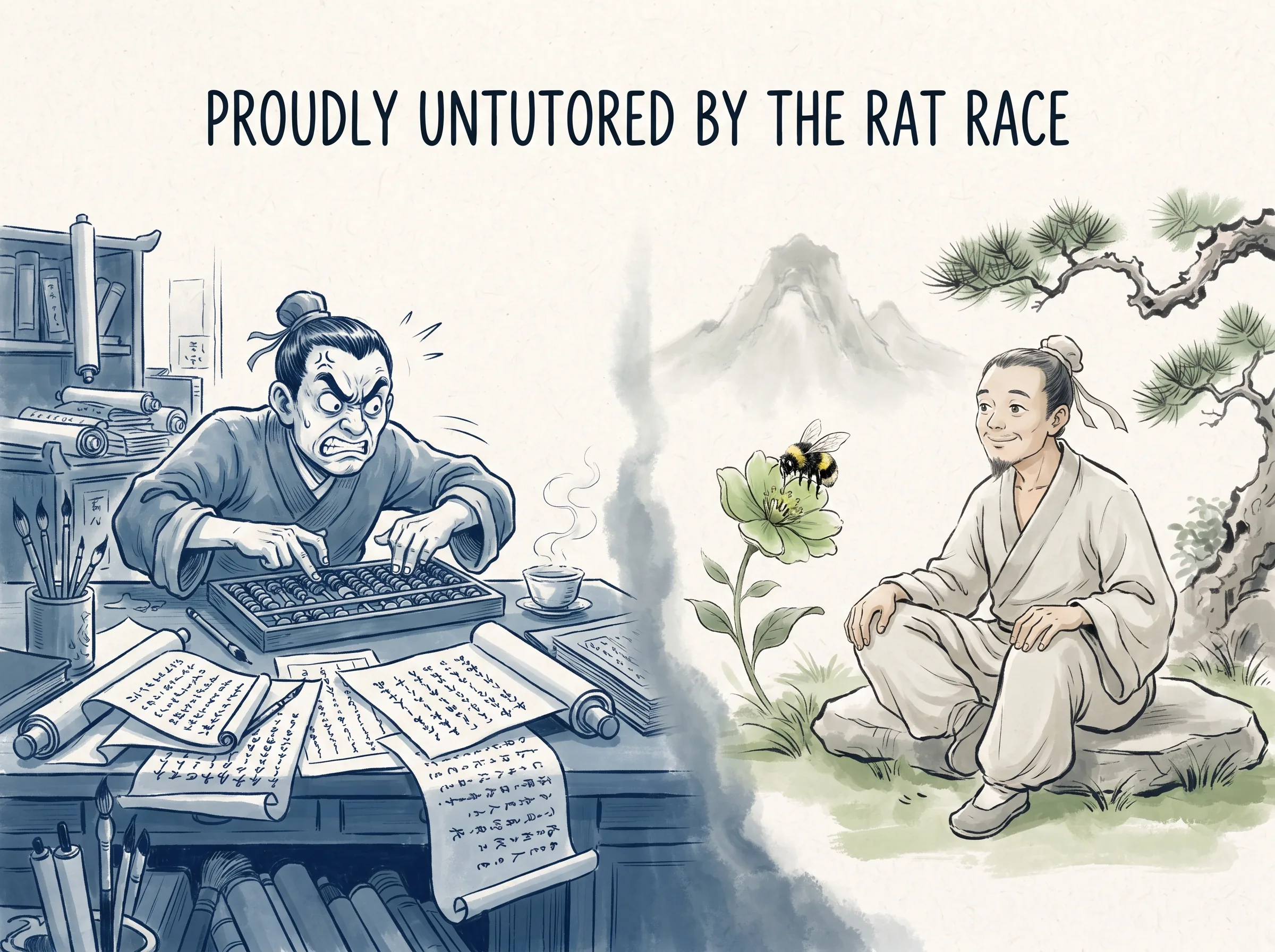
A practical reflection: Consider one area where your pursuit of knowledge or achievement serves genuine understanding, and one area where it feeds comparison. Ask yourself whether you are learning to see more clearly—or learning to feel superior. The distinction matters, because one leads toward peace and the other toward a treadmill that never stops.
Continue with the deeper interpretation and practical application.
ChiDestiny members get access to the full analysis, modern applications, and the growing Chinese Wisdom Library.
FAQ
Q1: Does Laozi really oppose wisdom and learning? No. The Laozi praises the sage in multiple chapters and presents its own text as a guide to understanding Chapter 19 critiques a specific kind of intelligence—one that serves competition, comparison, and self-promotion rather than genuine understanding. The distinction is between wisdom that clarifies and wisdom that divides.
Q2: Isn't "reducing desires" impractical in a modern economy? Laozi is not calling for economic collapse but for personal and cultural recalibration. The chapter distinguishes between natural needs, which have natural limits, and artificially stimulated desires, which do not [8]. The practical question is not whether you should reject everything but whether you can identify which of your desires are genuinely yours and which were installed by external systems.
Q3: How does Chapter 19 relate to Chapter 18? Chapter 18 observes that when the great Dao is abandoned, benevolence and righteousness appear—a passage that many scholars interpret as suggesting that moral projects arise as compensations for something already lost [4]. Chapter 19 extends this diagnostic logic: the appearance of explicit moral standards, like the pursuit of artificial wisdom, signals that a more natural order has already been disrupted.
Q4: Is there any scientific evidence connecting social comparison to anxiety? Research suggests that negative social interactions and social comparison on social networking sites are associated with higher levels of depression and anxiety, while positive social support is linked to lower levels [2]. The relationship is correlational rather than strictly causal, and findings on overall usage frequency are mixed, but the qualitative dimension of online interaction appears significant.
Discover the historical and philosophical roots in the classical foundation in Anticipating Difficulties: Doing by Non-Doing and Savoring the Flavorless.
For a deeper comparative examination of these ideas, explore our related study on Independent Simplicity: A Small Country with Few Inhabitants.
Sources & Further Reading
[1] Chinese Text Project — Laozi, Dao De Jing Chapter 19. Text based on the standard received version, accessible through the Note: transmitted versions contain textual variants, particularly regarding the phrase "these three matters" (cǐ sān zhě, 此三者), and readers should be aware of these differences when studying the chapter in depth.
[2] Read more — "Social Networking Sites, Depression, and Anxiety: A Systematic Review," PMC (PubMed Central). This systematic review found that negative interactions and social comparisons on social networking sites were related to higher levels of depression and anxiety, while positive interactions and social support were consistently related to lower levels. Findings were mixed for frequency of SNS use.
[3] Read more — "Laozi," Stanford Encyclopedia of Philosophy (Spring 2026 Edition). This entry discusses the Laozi's positive depiction of the ideal sage-ruler who understands and follows ziran (naturalness), and notes that commentarial intervention is necessary to bring out the full meaning of key concepts like nonaction.
[4] Read more — "Laozi," Stanford Encyclopedia of Philosophy (Spring 2026 Edition). The entry notes that the Confucian project is interpreted by some scholars as symptomatic of the decline of the rule of Dao, supporting readings that connect Chapter 18's observation about the emergence of benevolence and righteousness to the diagnostic framework of Chapter 19.
[5] Read more — "Laozi," Stanford Encyclopedia of Philosophy (Spring 2026 Edition). This entry describes wuwei (nonaction) as contrasting sharply with action driven by self-serving desire, profit motives, and calculated steps, and notes that nonaction entails simplicity and quietude naturally following from having few desires.
[6] Read more — "Laozi," Stanford Encyclopedia of Philosophy (Spring 2026 Edition). The entry discusses how stealing and cheating are incompatible with the ideal realm of naturalness in the Laozi, though it notes that extending the concept of thieves and robbers (dàozéi, 盗贼) in Chapter 19 to encompass all forms of manipulation and deception represents a modern interpretive expansion rather than a settled textual fact.
[7] Read more — "Laozi," Stanford Encyclopedia of Philosophy (Spring 2026 Edition). This entry describes pu (朴) as the "utterly simple, unaffected, and seemingly valueless" plain uncarved block of wood, a central Daoist metaphor for natural integrity that contrasts with artificially shaped and valued forms.
[8] Read more — "Laozi," Stanford Encyclopedia of Philosophy (Spring 2026 Edition). The entry distinguishes between naturalness encompassing basic human needs and desire that fuels self-gratification, noting that the latter knows no end and that nonaction naturally follows from having few desires.
Further Reading
- Dao De Jing (Daodejing), various scholarly translations by Robert Henricks, James Legge, and Arthur Waley offer different interpretive approaches to Chapter 19 and its most debated phrases.
- "Laozi," Stanford Encyclopedia of Philosophy (Spring 2026 Edition)
- Dao De Jing text and commentary
- "Social Networking Sites, Depression, and Anxiety: A Systematic Review"







[…] To explore these themes from another angle, read our related reflection on When Society Gets Smarter, People Grow Farther From Themselves. […]