
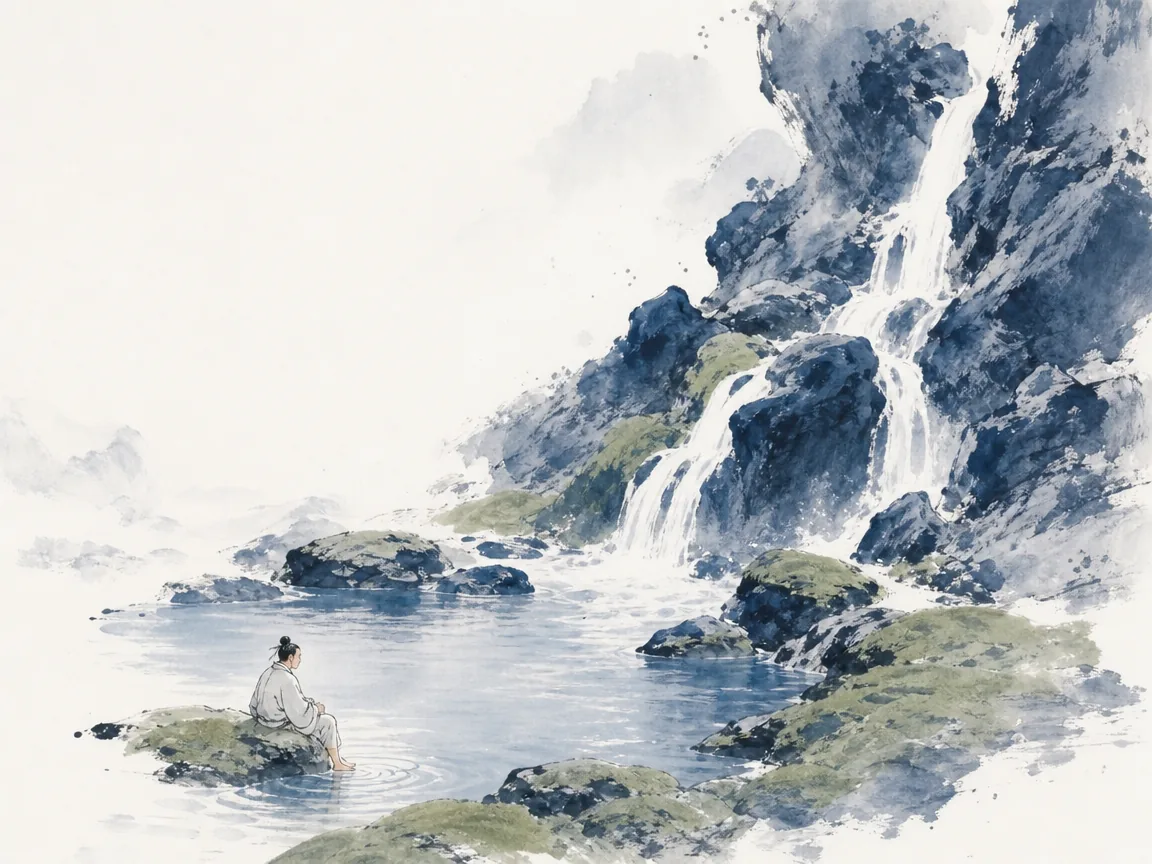
Daodejing Chapter 8: The Trap We Built
There is a quiet exhaustion that defines much of modern life. We are trained from an early age to compete for visibility, rank, validation, and advantage. We climb. We push. We perform. And yet the higher we rise, the more we fear falling. The more we occupy, the more we lose our center. Relationships become transactions. Ambition becomes anxiety. Success feels like standing on a narrow ledge, one slip away from everything collapsing.
Laozi, the ancient Chinese thinker traditionally associated with the Tao Te Ching, did not write in response to hustle culture or algorithmic pressure. Yet his insights cut straight through the modern condition. He does not offer a new strategy for winning at the game we already play. Instead, he redefines what winning means — and points us toward something far quieter, far deeper, and far more enduring.
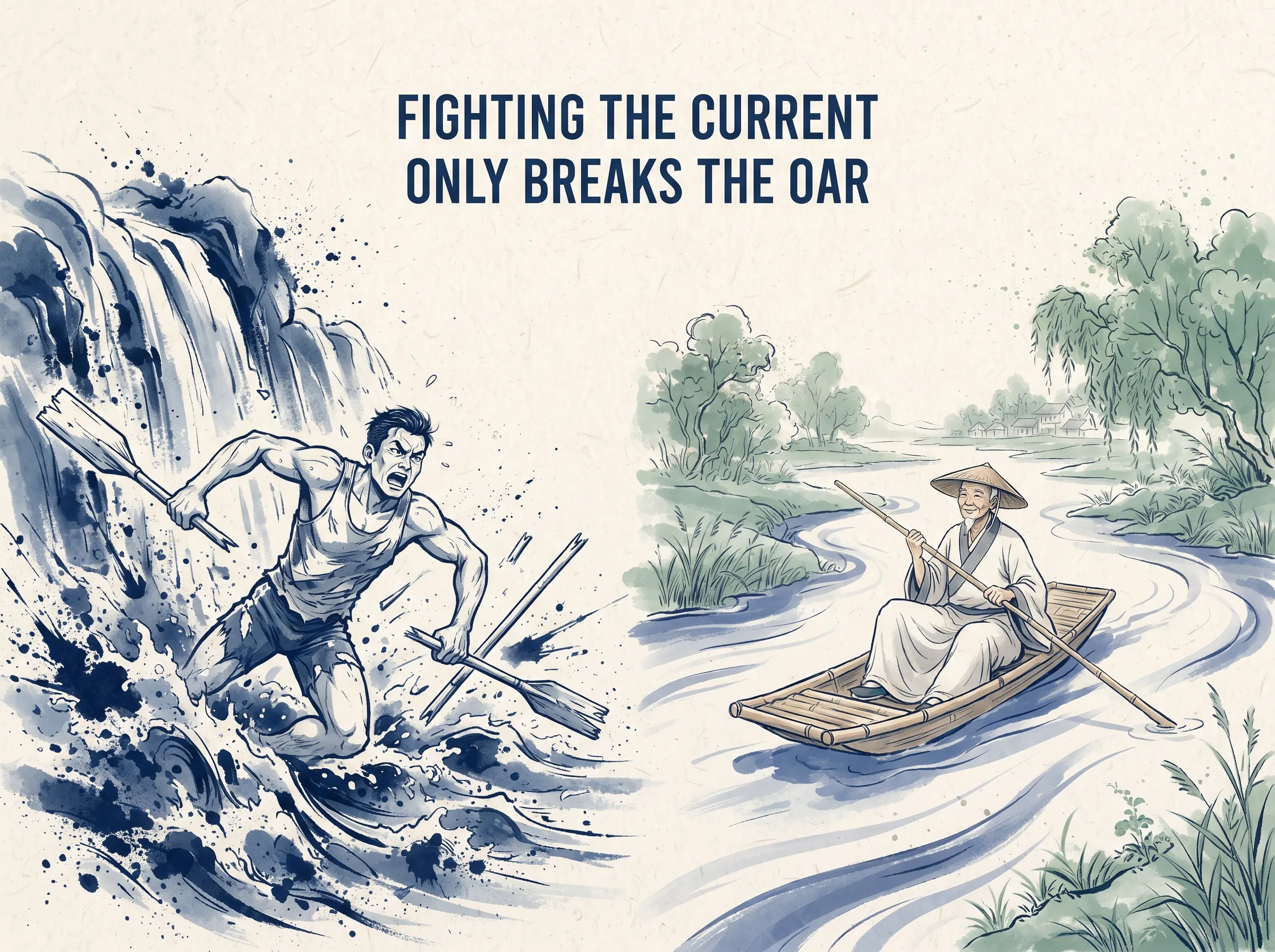
The key image is water.
The Wisdom of Water
The eighth chapter of the Tao Te Ching opens with one of the most distilled statements in the history of Chinese philosophy: the highest good is like water. Water benefits all things without competing. It flows to the low places that others avoid. Because it does not contend, it incurs no blame.
These few lines carry an entire philosophy.
Water nourishes — soil, plants, rivers, bodies — without demanding recognition or credit. This quality aligns with what the tradition calls wuwei, a concept often translated as "non-action" but which scholars clarify does not mean total inaction. Rather, wuwei refers to action that is not driven by self-serving desire, not coercive, not forcing the world to conform to ego. It is action that moves through things without disrupting their natural order. A parent who nurtures without controlling. A leader who serves without dominating. Water embodies this precisely: it enters the world without demanding to be seen.
Water also dwells in low places — valleys, depressions, basins — the very ground others overlook. Lowliness here is not weakness. It is capacity. It is the foundation that holds everything else. There is a reason rivers carve canyons and oceans collect at the lowest points. Positioning yourself too high too fast creates instability. Building from below—from the places others avoid—develops the capacity to bear weight: a depth of character that can sustain responsibility over time.
Perhaps most remarkably, water has no fixed form. It takes the shape of whatever vessel contains it. It adapts to terrain, season, and obstacle without losing its essential nature. This flexibility connects to the Daoist concept of ziran, which the Stanford Encyclopedia of Philosophy notes extends beyond the natural world into the spiritual and social realms. Ziran suggests a mode of being that follows its own nature rather than imposing an external design. Water does not force itself into a shape; it allows form to emerge from the conditions it encounters. Flexibility is not the absence of principle — it is the ability to move without breaking.
And then there is water's softness, which carries a hidden penetration. A single drop, repeated over time, can wear through stone. A calm current can erode entire riverbanks. Laozi returns again and again to the idea that the soft overcomes the hard, that weakness outlasts strength. This is not passivity. It is a different architecture of power — one that accumulates through persistence rather than force.
What This Says About the Modern Mind
Hustle culture is, at its core, a rejection of water virtue. It demands constant upward motion. It treats rest as laziness and stillness as failure. It trains people to be shallow, reactive, and perpetually exposed — the opposite of the deep, patient, adaptive posture water models.
Consider the anxiety epidemic that characterizes so many contemporary lives. A society of people standing on slippery heights, afraid to look down, is a society without foundations. Every achievement becomes a new platform to defend. Every relationship becomes a ledger to balance. Every expression becomes content to optimize.
Laozi's remedy is not to stop acting but to act with timing — what the chapter calls acting at the right time (dòng shàn shí, 动善时). Knowing when to wait is itself a skill. Acting before conditions are ripe creates disorder. Hesitating when the moment has arrived creates loss. Water does not force its way through rock; it finds the path, returns when needed, and persists without rush. For the word-for-word source text and commentary, consult the complete classical translation and commentary of The Nature of Adaptability: The Highest Good Resembles Water.
His other guidance is equally practical: dwelling in the right place (jū shàn dì, 居善地) — know where to place yourself. keeping the heart profound like an abyss (xīn shàn yuān, 心善渊) — let your mind be deep like an abyss. These are not poetic ornaments. They are operational instructions for a life that has lost its bearings.
Water Virtue in Everyday Life
The question is not whether ancient philosophy applies to modern problems. The question is whether we have the patience to practice what it teaches.
In work: Substantive work does not require visible effort. Building a reputation through reliability and consistency — rather than self-promotion and performative busyness — is a water-like approach. The person who solves problems without claiming credit often proves more indispensable than the one who dominates every meeting.
In relationships: Nourishing others without demanding they conform to your image is an act of water virtue. Holding space instead of controlling outcomes. Offering presence without attaching conditions. Many relationships fracture not from a lack of love but from a surplus of expectation.
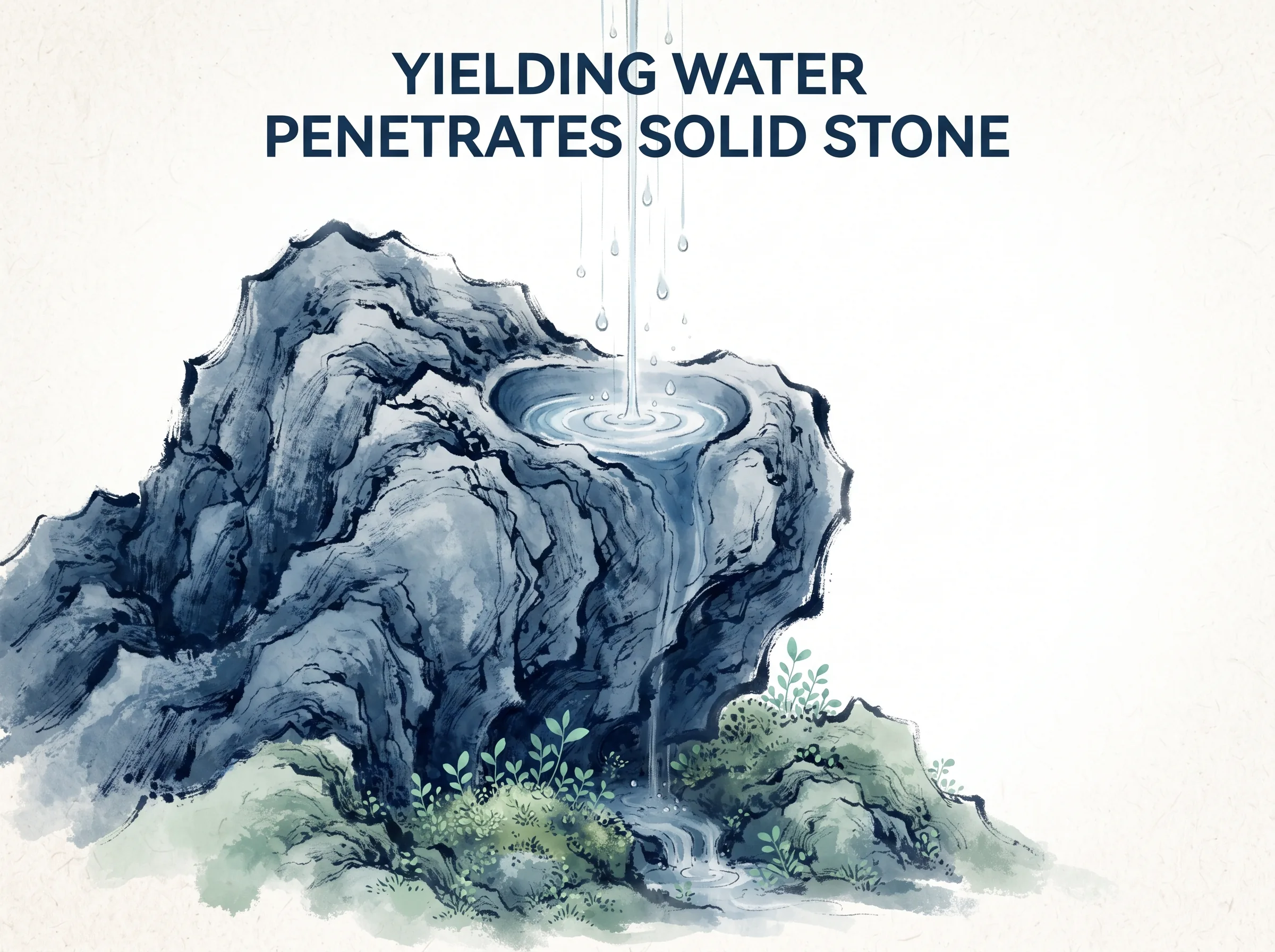
In self-cultivation: Cultivating stillness (静) and depth (深) is perhaps the most neglected practice of modern life. The ability to remain undisturbed by external noise — a harsh comment, a failed plan, a comparison to someone else's highlight reel — is not indifference. It is discipline. A shallow mind is easily ruffled. A deep mind absorbs disturbance at the surface while remaining unmoved below.
In decision-making: acting at the right time (dòng shàn shí, 动善时) — acting with timing, not force — is a skill that separates wisdom from impulsivity. The person who waits for the right conditions, who reads the landscape before committing, often achieves more with less friction than the one who charges ahead. Waiting is not weakness. It is strategy.
A crucial caveat: this path is not "lying flat" (tǎngpíng, 躺平) — the nihilistic withdrawal sometimes conflated with Daoist thought. Wuwei does not mean doing nothing It means acting without making life a battlefield of self-proof. Water does not refuse to move. It moves without violence.
What Laozi Does Not Say
The water metaphor is easily distorted. Two common misreadings deserve explicit correction.
First, water virtue is not an excuse for weakness, people-pleasing, or passive acceptance of injustice. Water has boundaries. It nourishes, but it also erodes. It flows, but it also dams. The virtue lies in discernment, not submission. A philosophy that reduces water to "be nice and stay small" has missed the point entirely.
Second, non-contending (bù zhēng, 不争) does not mean inaction (bù zuòwéi, 不作为). It means acting without turning existence into a zero-sum competition. The person who cultivates water virtue still has position, still has preferences, still has convictions. They simply refuse to make their identity depend on defeating others.
Laozi is not anti-ambition. He is anti-frantic, anti-extractive, anti-self-centered ambition. There is a difference between a life driven by the need to prove oneself and a life driven by the desire to contribute. Water chooses the latter without hesitation.
Returning to the Sea
Laozi's vision is not quietism. It is a deeper kind of power — one that accumulates by dispersing, grows by lowering, endures by adapting. The water that reaches the sea does not fight every stone in its path. It persists. It finds the way. It never stops.
The question this tradition poses is not how to rise above others but how to become deep enough to hold everything. How to build a life that does not depend on constant external validation. How to act with force that does not exhaust the actor. How to move through the world without leaving wreckage behind.
Water offers no shortcuts. It offers something rarer: a model for living that does not require you to shrink yourself to fit, or to expand yourself to dominate. It asks only that you flow.
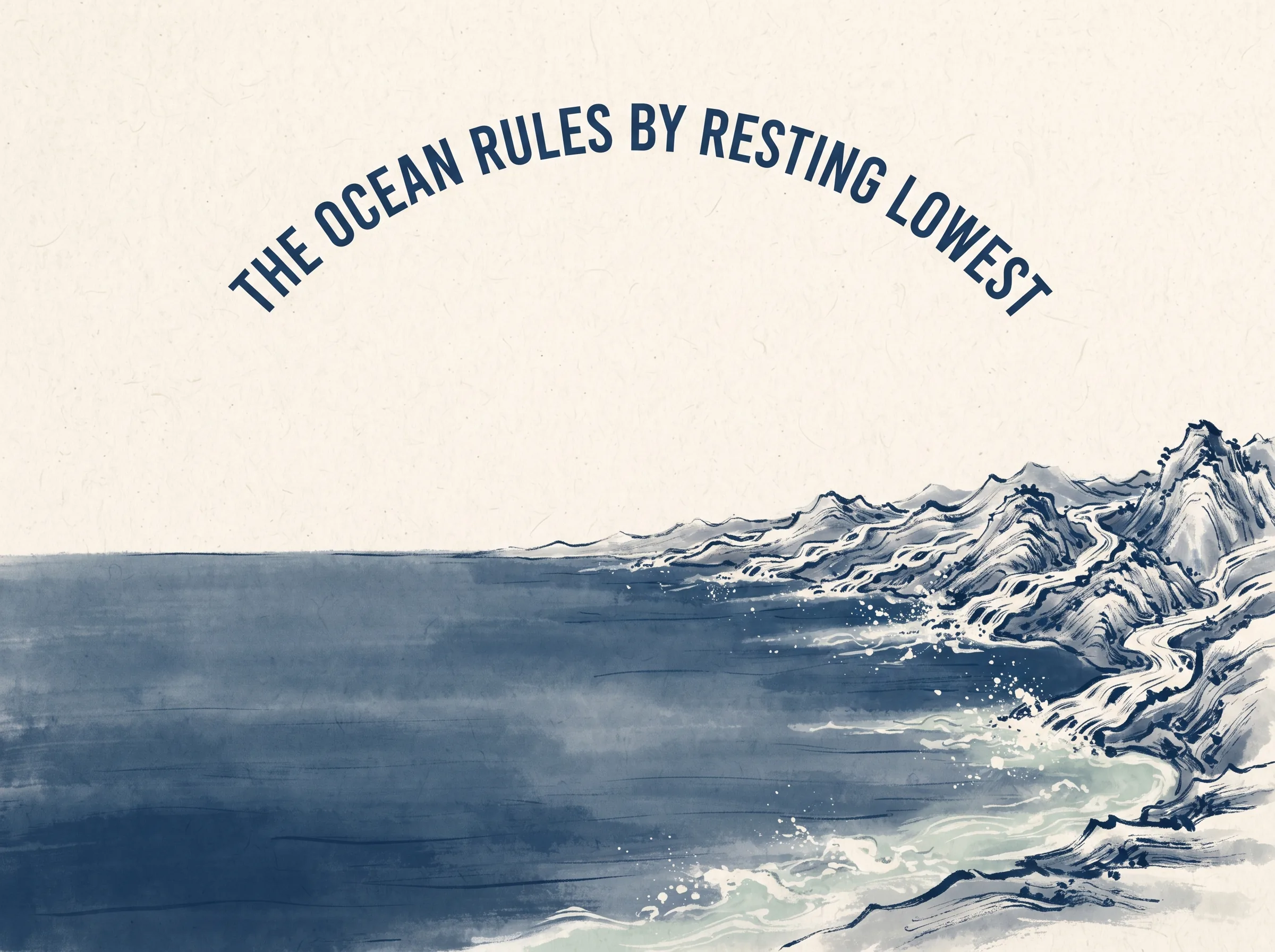
If this resonates, the next step is not to read more but to practice — starting with a single question: where in your life are you climbing when you could be deepening?
FAQ
Is Daoism a religion or a philosophy? Daoism encompasses both philosophical and religious dimensions. The Tao Te Ching is primarily a philosophical text, though it has been interpreted and practiced in diverse ways throughout history.
Does "non-action" mean doing nothing? No. Scholarly interpretations clarify that wuwei does not mean total inaction. It refers to action not driven by self-serving desire, often translated as non-assertive or non-coercive action.
Is the Tao Te Ching attributed to a single author? The text is traditionally associated with Laozi, but scholars note that the historical figure's identity and the text's composition remain subjects of ongoing debate
How is water's "softness" different from weakness? Water's softness is strategic, not submissive. It penetrates through persistence rather than force, adapts rather than breaks, and accumulates power through alignment with natural conditions rather than opposition to them, reflecting the enduring wisdom of Daodejing Chapter 8.
To explore these themes from another angle, read our related reflection on The Art of Not Proving: What Laozi Can Teach Us About Silence in the Age of Performance.
Deepen your understanding of these principles in our reflection on Why the Most Virtuous People Stop Talking About Virtue.
Sources & Further Reading
[1] Laozi (Stanford Encyclopedia of Philosophy/Spring 2026 Edition)
[2] Chinese Text Project — Tao Te Ching (English)
[3] Chinese Text Project — Tao Te Ching, Chapter 51 (English)
[4] Chinese Text Project — Tao Te Ching, Chapter 78 (English)
Further Reading
- Tao Te Ching, translations by David Hawkes, Stephen Mitchell, and Gia-Fu Feng & Jane English — accessible entry points into the text
- The World of Thought in Ancient China by Benjamin Schwartz — broader context for Daoist philosophy
- Stanford Encyclopedia of Philosophy entries on Daoism and Chinese philosophy — scholarly overviews with bibliographic guidance






