
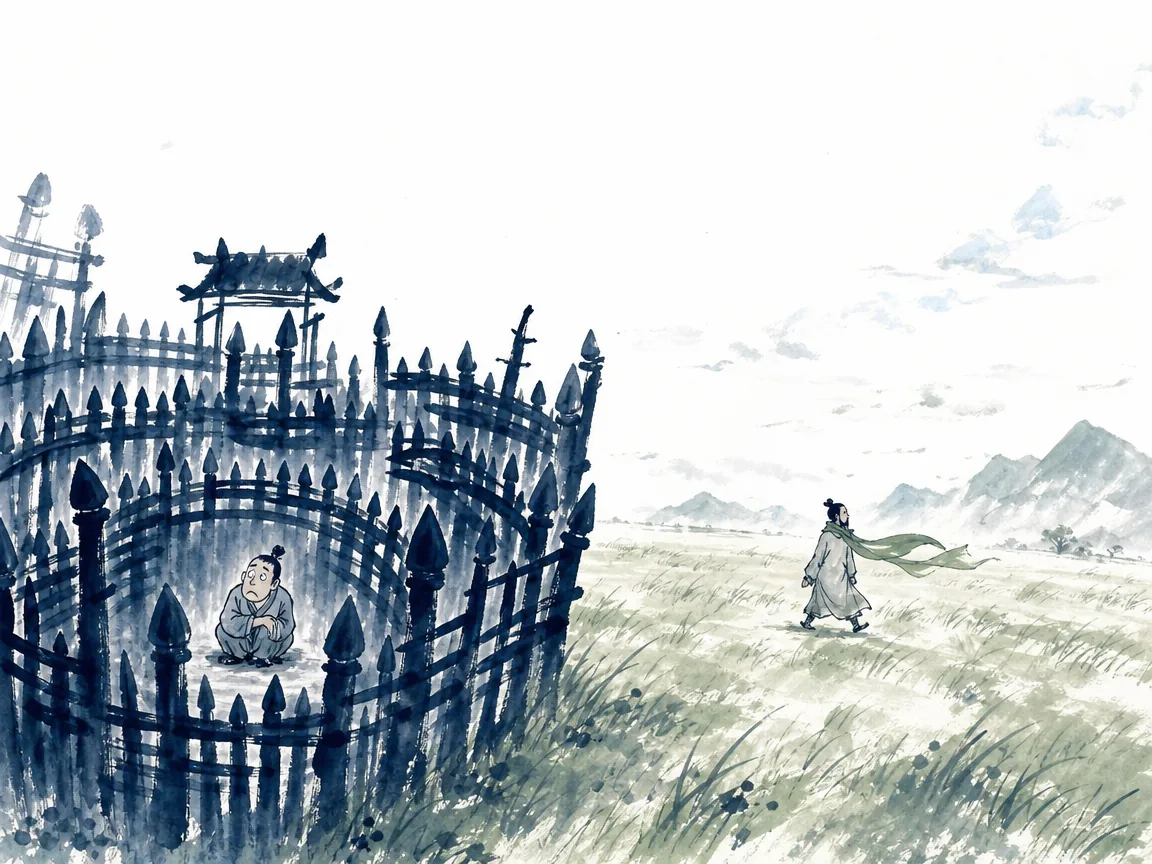
Daodejing Chapter 7: The Anxiety of Always Defending Yourself
You know the feeling: the constant mental soundtrack that runs beneath almost everything you do. Did I say the right thing in that meeting? How did they perceive my reply? Am I being taken seriously? You replay conversations, adjust your tone, monitor your image — not because something is actually threatened, but because the sense of threat has become your default setting. The result is not safety. It is exhaustion.
This kind of chronic self-protection is so common that many people mistake it for normal adult life. We are told to build a strong personal brand, to guard our reputation, to be strategic about relationships and careers. And yet, across clinical psychology, there is a consistent finding: the very behaviours people adopt to feel safer often keep anxiety alive. Safety behaviours — the mental and social strategies we use to prevent feared outcomes — do not resolve the underlying fear; they reinforce it by blocking the natural disconfirmation of anxious beliefs [2]. When you spend most of your energy defending yourself, you are not living lightly. You are carrying an invisible armour all day long.

The question this essay explores is not how to protect yourself better. It is why the instinct to protect yourself so intensely may be the source of the fragility you are trying to avoid — and what an ancient Chinese text, written over two thousand years ago, suggests instead.
Laozi's Starting Point: Look Up at the Sky and Earth
The seventh chapter of the Daodejing (often called the Laozi or Classic of the Way and Its Power) does not begin with advice about human behaviour. It begins with the sky and the earth.
Heaven and Earth endure.
Because Heaven and Earth do not live solely for themselves, they can endure for long.
This opening is deliberate. Laozi is not offering a moral lesson about being good. He is pointing to an observation about how things last. The sky does not wake up each morning and declare, “I must protect my status as sky.” It does not hoard its light or compete with the moon. Rain falls, seasons turn, plants grow — all of it happens without self-obsession. And precisely because it is not trapped in a narrow agenda of self-maintenance, the natural world persists.
Scholars note that the exact wording of this chapter is preserved in the Wang Bi edition of the received text, though minor variant characters appear across transmitted versions [8]. The philosophical tradition, beginning with Wang Bi’s commentary, interprets “not living for oneself” as not competing with other things for self-advantage — a reading that supports the interpretation that enduring strength comes from loosening, not tightening, the grip on the small self [8]. Whether this was the only possible interpretation is debated, but the tradition is clear: Laozi moves from cosmic observation to human practice by analogy.
The chapter then turns from heaven and earth to the person Laozi calls the shengren — often translated as “the sage” or “the accomplished person.” The key lines are:
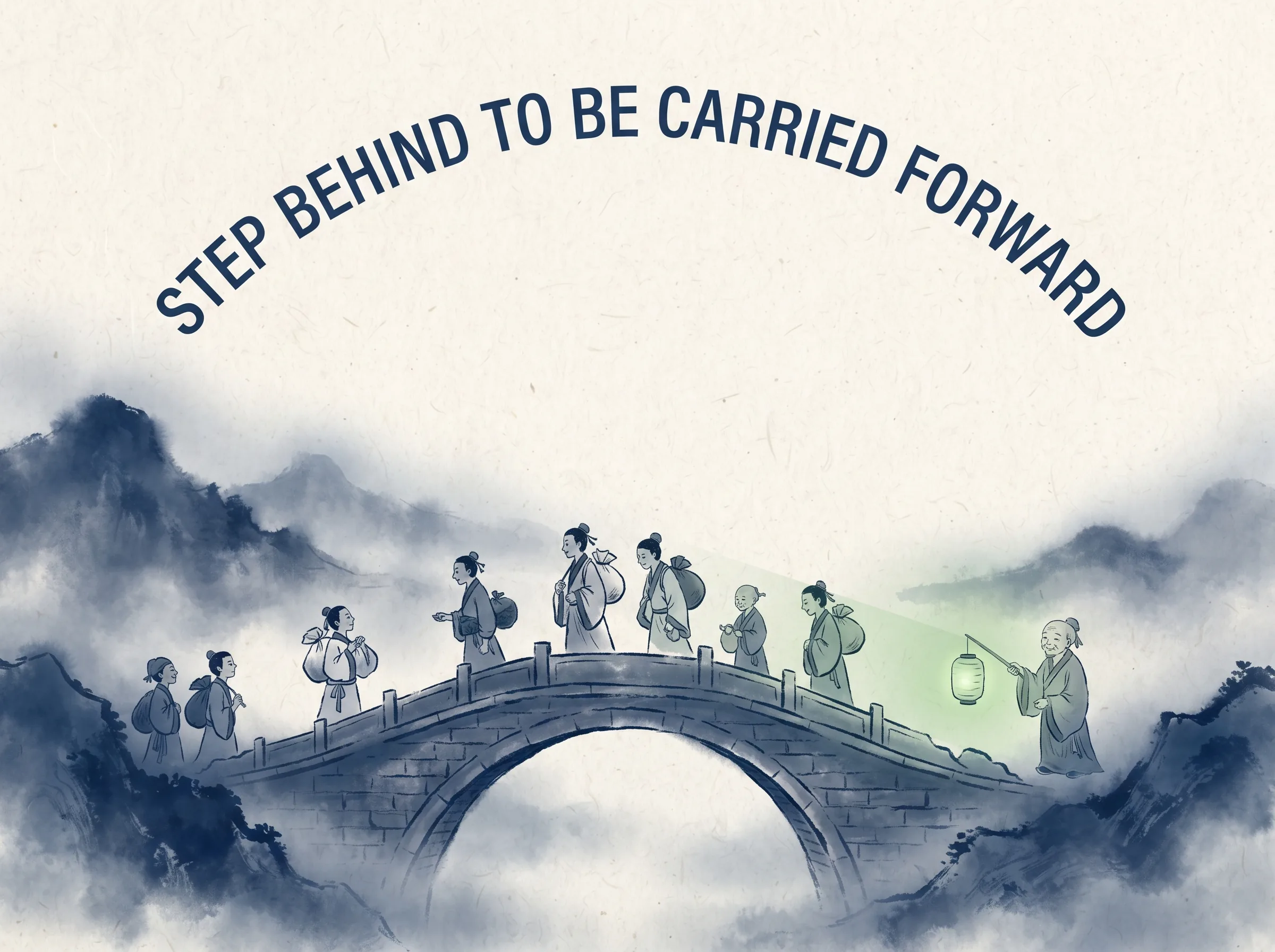
Therefore the sage places himself behind, and yet finds himself ahead.
He treats his body as external, and yet his body is preserved.
Is it not precisely because he is selfless that he accomplishes what is his?
These lines are compact, layered, and frequently misunderstood. They are not instructions for self-effacement or passive resignation. They are an observation about a different kind of strength — one that does not arise from constant self-defence.
The Paradox of Stepping Back
The most common misreading of “places himself behind” is that Laozi is advocating humility in the ordinary sense: be modest, don’t boast, let others take the spotlight. But that reduces a philosophical observation to a courtesy rule. What Laozi is describing is structural, not moral.
When a person makes “me” the centre of every calculation — every word, every decision, every interaction — the world becomes a series of threats to that “me.” Praise is something to secure. Criticism is something to deflect. Silence is something to interpret. Opportunity is something to grab before someone else does. This posture feels productive. In practice, it is exhausting, and it is also fragile. The more you clutch, the more easily you are shaken.
The phrase “treats his body as external” is similarly misread as self-neglect. It does not mean ignoring your health or accepting harm. Traditional commentaries understand it as loosening the grip of self-centred anxiety — not erasing the self, but stopping the habit of treating everything as a potential wound to “me.” When that chronic defensive posture relaxes, two things tend to happen. First, judgment improves, because the lens is no longer narrowed by fear. Second, others respond differently, because people generally sense when someone is operating from urgency rather than clarity. For the word-for-word source text and commentary, consult the complete classical translation and commentary of Sheathing the Light: Selfless Endurance and the Enduring Universe.
Modern psychological research on social anxiety offers a parallel, though it is important not to conflate the two. Studies show that both avoidance-based and impression-management safety behaviours tend to increase the anxiety of the person performing them [2]. Experiential avoidance — the attempt to control or escape unpleasant inner states — is linked to higher momentary anxiety during social interactions, especially for people already prone to social anxiety [3]. None of this proves that the Daodejing is a psychology textbook. But it does suggest that an intuition Laozi voiced long ago — that tightening your grip on yourself increases your fragility — has a echo in contemporary findings about how self-protective strategies can inadvertently sustain the very distress they aim to reduce.
The Hidden Logic of Selflessness (Wúsī, 无私)
The chapter’s final line is perhaps the most provocative: “Is it not precisely because he is selfless that he accomplishes what is his?”
This is where the passage is most often exploited. In modern contexts, “be selfless to succeed” sounds like a cunning strategy — a way to game people by pretending not to care about winning. But that reading collapses the paradox back into ordinary calculation. If you are being selfless in order to get ahead, you are not practicing selflessness. You are practicing a longer game of self-interest.
What Laozi seems to be describing is a pattern: when the narrow agenda of “what do I gain from this?” is removed, actions tend to be clearer, timing tends to be better, and trust tends to accumulate. The person who calculates every move often repels cooperation. The person who acts from patience and alignment tends to attract it. This is not a moral claim that selfless people are nicer. It is an empirical observation about how systems — social, professional, personal — respond to different kinds of motivation.
It is also worth noting that scholars caution against treating the Laozi as the uninterrupted product of a single historical figure. The Shiji biography of Laozi is regarded with skepticism, and contemporary scholars outside China rarely accept it uncritically [1]. The text likely emerged from a tradition of reflection rather than one author’s life work. That means the chapter’s insights are best read as part of a philosophical conversation, not as the recorded utterances of a single prophet. Their value lies in coherence and usefulness, not in authority alone.
What This Has to Do With Your Life Right Now
The relevance of this chapter does not require adopting an ancient worldview. It only requires noticing where self-protection has become a habit rather than a response.
In work, the difference is visible between someone who performs competence and someone who builds it. The first is always monitoring whether they are seen as capable. The second is absorbed in the work itself. Over time, the second person tends to accumulate genuine standing, while the first person accumulates fatigue.
In relationships, love disguised as control is common. “I need to know where you are” is often fear of abandonment wearing the mask of care. “I need to explain myself constantly” is often fear of being misunderstood. The result is not closeness. It is surveillance — of the other person, and of oneself.
On social media, the pattern is even more visible. A meta-analysis of over 250,000 participants across 209 studies found a moderate positive association between problematic social networking use and anxiety symptoms, including social anxiety and fear of missing out [4]. The data does not prove that posting causes anxiety, but it does show that a lifestyle centred on constant self-presentation correlates with higher anxiety. That correlation is consistent with Laozi’s broader observation: the more you make yourself the project, the more you become your own taskmaster.
The alternative is not indifference. It is alignment. Acting from clarity rather than fear produces different decisions. You still set boundaries. You still pursue goals. But you are not fighting yourself in every interaction. That distinction matters more than it sounds.
Clarifying What Laozi Does Not Say
A chapter this short invites overextension. Several misunderstandings are worth naming explicitly.
Laozi is not advocating the absence of boundaries. “Placing yourself behind” is not the same as allowing yourself to be harmed. “Treating your body as external” is not the same as neglecting your health or endurance. The distinction lies in motivation: are you stepping back because you see clearly, or because you are afraid of conflict? The former is restraint. The latter is often avoidance dressed as virtue.
Laozi is not praising passivity. “Not contending” does not mean refusing to act. It means not being driven by the impulse to win every small battle. The Daodejing repeatedly warns against rigidity and excess, not against purposeful action. A river is not passive. It moves with the terrain, yes — but it also wears down stone.
There is also a difference between wise letting-go and learned helplessness. One is chosen from strength. The other is surrendered from exhaustion. Laozi’s point is about the first. The criterion, repeated throughout the tradition, is this: is your action coming from clarity or from fear of losing?
A Practical Takeaway: Knowing Where to Pause
The practical lesson of this chapter can be stated simply: cultivate the habit of noticing when you are clutching.
You do not need to meditate for hours or adopt a philosophical system. You only need to pause, once or twice a day, and ask yourself: where am I defending myself right now? Is this response proportional to the situation, or is it coming from a older, deeper alarm? Is this about the task, or about protecting “me”?
This kind of attention does not eliminate ambition. It separates healthy ambition from anxious grip. A person who knows when to stop (zhī zhǐ, 知止) is not necessarily less driven. They are more durable. They do not burn out from constant internal combat. They also tend to make better decisions, because their judgment is not hijacked by the need to secure an outcome.
If you want a single practice, try this: for one week, notice moments when you feel the urge to explain, justify, correct, or compete — and ask whether the situation actually requires it. You will not always be right to hold back. But you will often be surprised by how much noise was unnecessary.
FAQ
Q: Does Laozi mean I should never protect myself or set boundaries?
No. The chapter is not a prescription for passivity. It distinguishes between acting from clarity and acting from fear. Healthy boundaries are compatible with this teaching; chronic self-defence is not.
Q: Is “selflessness” just a smarter form of selfishness?
That depends on your motive. If you are being accommodating in order to manipulate outcomes, you are still operating from narrow self-interest. Laozi’s point is that genuine release of the self-agenda tends to produce better results than calculation — not because the universe rewards goodness, but because systems respond differently to different kinds of motivation.
Q: Does modern psychology support this idea?
Partially. Research on safety behaviours and experiential avoidance shows that strategies designed to reduce anxiety can sometimes maintain it [2] [3]. This does not prove Laozi right, but it shows that his intuition about the costs of over-defending yourself has resonances in contemporary findings.
Q: Should I read this chapter as a guide to success?
Not if you mean success as accumulation of status, wealth, or approval. The chapter is better read as a guide to durability — to a way of living that does not burn itself out. What you do with that durability is your own question.
Summary
The instinct to protect yourself is not wrong. It becomes problematic when it turns into a default mode — when every interaction is filtered through the question “how does this affect me?” Laozi’s seventh chapter offers a different frame: look at the sky and the earth. They endure because they are not trapped in self-obsession. The person who loosens that grip does not disappear. They tend to stand more steadily, act more clearly, and carry less inner fatigue.
You do not need to abandon ambition or neglect your needs. You only need to notice where your drive is coming from — fear or clarity — and adjust accordingly. The next step is simple: pick one area of your life where you feel chronically defensive, and experiment with stepping back just enough to see what changes. You may find that the ground holds without your constant grip, reflecting the enduring wisdom of Daodejing Chapter 7.
To explore these themes from another angle, read our related reflection on Why Victory Can Be Your Greatest Trap: Ancient Chinese Wisdom on the Danger of Conquest.
Deepen your understanding of these principles in our reflection on Why Knowledge Grows but Wisdom Starts with Less.
Sources & Further Reading
[1] Laozi (Stanford Encyclopedia of Philosophy)
[2] Sub-types of safety behaviours and their effects on social anxiety disorder – PMC
[3] A Contextual Approach to Experiential Avoidance and Social Anxiety — Evidence from an Experimental Interaction and Daily Interactions of People with Social Anxiety Disorder – PMC
[4] Association between problematic social networking use and anxiety symptoms — a systematic review and meta-analysis – PMC
[5] Further reading (not cited in the body):
[6] Idiom Dictionary E-Book (成語典/電子書, on traditional interpretations of Chapter 7 themes)
[7] The Bilibili clip source referenced in the project brief (unverified transcript) — included for contextual reference only and not used as an evidence source.
[8] Daodejing (Wang Bi Edition, 道德经/王弼本) – Wikisource (维基文库)






