
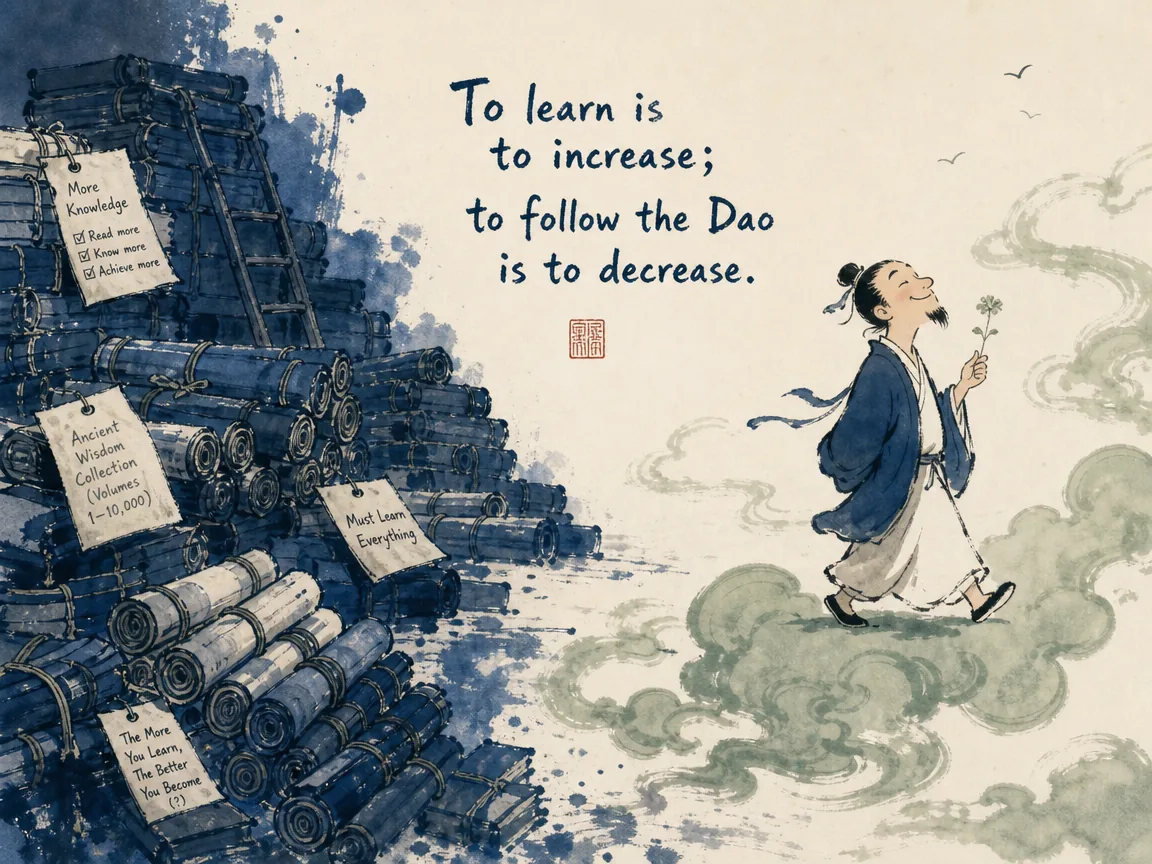
We live in an age that equates growth with accumulation. More information, more skills, more frameworks, more tools — we are told that if we just keep collecting, we will eventually arrive at clarity. And yet many people feel the opposite. The more we know, the harder it sometimes seems to act with genuine judgment. We optimize our days, fill our inboxes, complete course after course, and still, when the real question arises, we do not know what to do. The problem is not a shortage of knowledge. The problem may be that we have not learned what to release.
Two thousand five hundred years ago, the Chinese philosopher Laozi wrote a sentence that cuts directly through this modern paradox. In Daodejing Chapter 48 of the Tao Te Ching — one of the most concise and consequential chapters in the entire text — he draws a sharp line between two kinds of practice. "For learning, one adds day by day," he writes. "For the Way, one subtracts day by day." The first sentence sounds like a description of anything we normally call education. The second sentence is far more unsettling. It suggests that wisdom does not come from knowing more. It comes from knowing what to stop carrying.
This is not a call to abandon learning. Laozi is not arguing against education, study, or skill-building. His point is subtler and more practical: once you have knowledge, what do you do with it? What must you let go of so that your knowledge does not become a cage? How do you distinguish between the accumulation that serves you and the accumulation that controls you? These are the questions that matter most in a world that rarely asks us to stop adding.
Daodejing Chapter 48: The Modern Trap of Always Adding
Almost every structure in modern life rewards addition. We are taught to collect credentials, to expand our networks, to read more books, to learn more languages, to adopt more habits. Productivity culture turns the word "more" into a moral good. If you are not adding, you are falling behind. The result is not a smarter or freer population. It is a population that is overwhelmed, anxious, and increasingly unsure how to think for itself.
Consider a common scene. A professional reads three books on leadership. They attend a workshop on decision-making. They download a new planning app. They add five new routines to their morning. Six months later, they are more busy than before, and they still do not feel confident when a real crisis appears. The knowledge was real. The tools were useful. But something essential was missing — the ability to see which actions actually mattered and which were just noise dressed as progress.
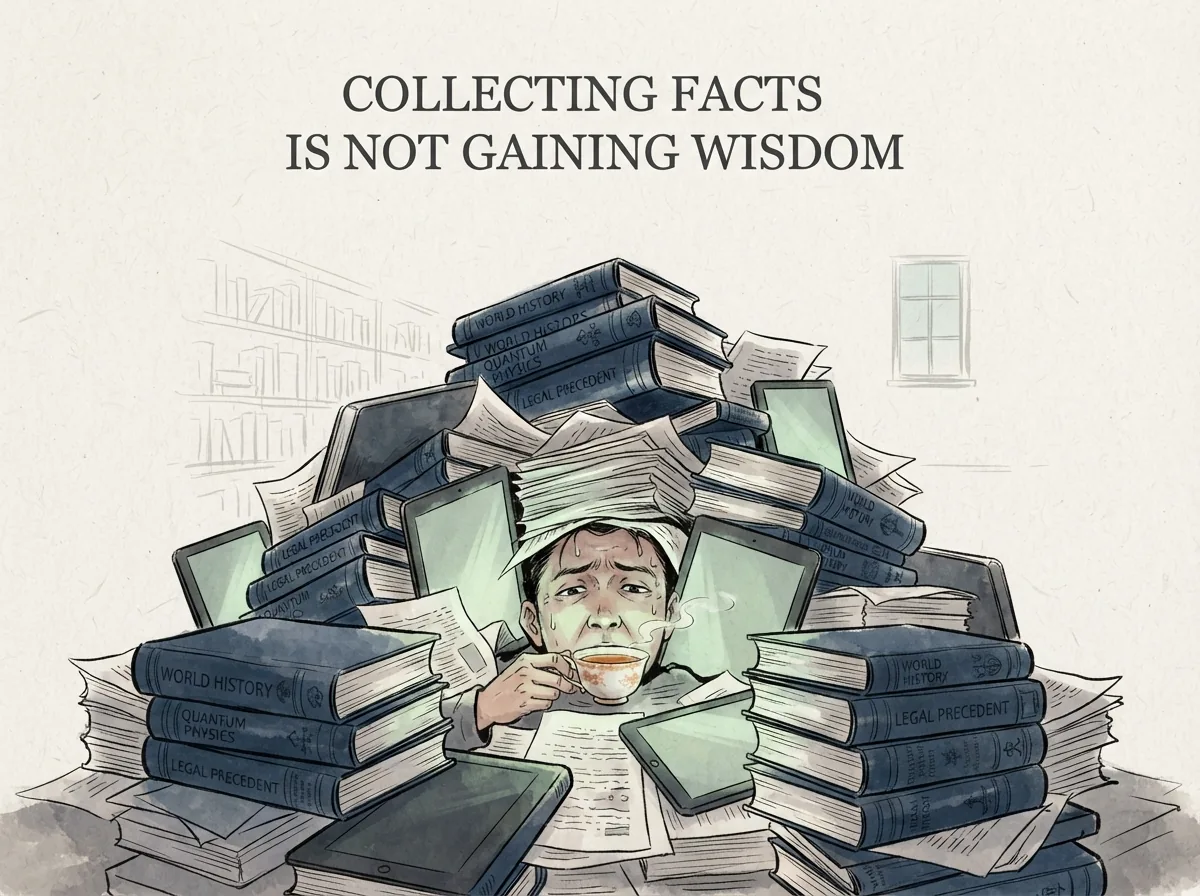
This is the trap of relentless addition. It feels like growth. It often produces visible results. But it also trains us to reach for another method whenever uncertainty appears, instead of developing the inner discipline that lets us recognize when a method is unnecessary. Laozi noticed this pattern long before the internet. His warning was not that knowledge is bad. It was that knowledge without subtraction creates a person who can only add, and therefore cannot tell the difference between acting and performing action.
Laozi's Distinction — Two Kinds of Movement
Daodejing Chapter 48 of the Tao Te Ching opens with a deceptively simple contrast. In the received tradition, the text reads:
"In pursuing study, something is gained every day; in pursuing the Dao, something is dropped every day." (Wéi xué rì yì, wéi Dào rì sǔn, 为学日益,为道日损。)
For learning, one adds day by day. For the Way, one subtracts day by day.
This is not a rejection of learning. It is a clarification of direction. "Learning" in the classical Chinese context refers broadly to the cultivation of skills, texts, rituals, and practical knowledge. It is cumulative by nature. You learn a language by acquiring vocabulary. You learn medicine by studying anatomy. You learn governance by understanding history and law. There is no way around this. Without accumulation, there is nothing to build on.
"The Way," however, moves in the opposite direction. It is not about collecting more concepts. It is about removing what blocks clear perception and appropriate action. Laozi is describing a shift from external acquisition to internal clarification. The danger is not knowledge itself. The danger is believing that knowing more automatically makes you wiser.
Scholars of early Chinese thought note that the Laozi repeatedly addresses rulers and administrators, urging them to govern by following natural patterns rather than by imposing constant interventions [2]. This political dimension matters here because Laozi is not only talking about personal mindfulness. He is describing a discipline that scales from individual judgment to institutional practice. What happens when a society teaches people only how to add — more rules, more metrics, more oversight — without also teaching them how to subtract? The result, he suggests, is a system that grows heavier without becoming better.
Continue with the deeper interpretation and practical application.
ChiDestiny members get access to the full analysis, modern applications, and the growing Chinese Wisdom Library.
FAQ
Does Laozi think we should stop learning?
No. Laozi explicitly acknowledges that learning is cumulative — "for learning, one adds day by day." He is not anti-education. He is warning that accumulation without subtraction leads to distortion. Knowledge expands your capacity, but it does not automatically improve your judgment. The two practices must move together.
What is the difference between "learning" and "the Way" in this chapter?
"Learning" refers to the acquisition of skills, knowledge, and techniques — anything that grows through addition. "The Way" refers to the practice of aligning your actions with reality as it is, rather than imposing your preferences upon it. The first requires accumulation. The second requires release. Laozi argues that wisdom depends on the second, even as it builds upon the first.
Is wuwei the same as doing nothing?
No. Wuwei is not total inaction. It is action stripped of compulsive interference, self-serving desire, and unnecessary control. A skilled practitioner acts when action is needed and refrains when it is not. The difference lies in motivation and discernment, not in the quantity of movement.
How can I tell whether I’m practicing wise subtraction or simply avoiding responsibility?
Laozi's chapter moves from personal practice to governance, precisely because subtraction must be tested at scale. Ask whether your reduction leaves real responsibilities unaddressed, whether it harms others by removing protection, and whether it is driven by genuine discernment or by fatigue, avoidance, or discomfort with effort. Subtraction is wise when it clears obstruction. It becomes negligence when it abandons necessary care.
Discover the historical and philosophical roots in the classical foundation in Guarding the Subtle: A Tree of Giant Girth Begins as a Tiny Shoot.
For a deeper comparative examination of these ideas, explore our related study on Why the Fiercest Fire Burns Out Fastest: Laozi’s Secret to Lasting Vitality.
Sources & Further Reading
[1] Daodejing Chapter 48: Daily Gain in Study, Daily Loss in the Way (《道德经》第48章·为学日益,为道日损) — Open publication and basic interpretation of Tao Te Ching Chapter 48, including version comparison between the Mawangdui silk texts and the received Wang Bi edition. Discusses the structural progression from personal practice to political governance.
[2] Laozi. — Stanford Encyclopedia of Philosophy entry providing scholarly overview of Laozi's thought, including the concept of wuwei as action contrasting with self-serving desire, and the application of natural governance principles to rulers and political order.
Further Reading
- Tao Te Ching, Chapter 37 — on the Way's constant non-action yet nothing left undone.
- Tao Te Ching, Chapter 41 — on the upper scholar hearing the Way and diligently practicing it.
- Tao Te Ching, Chapter 47 — on knowing without striving and seeing without traveling.






