

It feels like common sense that knowing more should lead to understanding more. We scroll endlessly through news feeds, fill dashboards with metrics, read article after article, and collect advice from every direction. Yet despite having access to more information than any generation in history, many of us feel more confused, more polarized, and less capable of making clear decisions. Well-informed people sometimes make worse choices. Data-rich organizations still suffer from embarrassing blind spots. The more we consume, the more uncertain we seem to become.
This is the paradox that Laozi pointed to over two thousand years ago. In Daodejing Chapter 47 of the Dao De Jing, he wrote something that sounds almost absurd on first reading: "He who does not go out his door knows the world; he who does not look through his window sees the Dao. The further one goes out, the less one knows." Taken at face value, this appears to contradict everything we believe about learning, travel, research, and experience. But Laozi is not advocating literal isolation, nor is he dismissing evidence and observation. He is addressing a deeper and still very modern problem: the confusion between collecting information and achieving understanding.
In an age of algorithmic feeds, corporate data dashboards, and the constant pressure to "stay informed," Laozi's warning carries urgent relevance. His chapter invites us to examine not just what we know, but how we know it — and whether the way we chase knowledge might actually be standing in the way of genuine insight.
Daodejing Chapter 47: The Text and What It Actually Says
The most widely circulated version of Daodejing Chapter 47 reads: "Not going outside one's door, one knows the world; not looking through one's window, one perceives the Dao. The farther one goes out, the less one knows. Therefore the sage knows without traveling, perceives without seeing, and accomplishes without doing." The exact wording varies among manuscript traditions. Some early versions use characters that scholars translate as "perceive and discern" rather than "perceive and understand," which subtly shifts the emphasis from inner clarity to the ability to classify and describe what one encounters [1]. Both readings point in the same general direction: genuine knowing involves something more than mere sensory exposure.
To understand what Laozi is doing here, it helps to distinguish between types of knowledge rather than treating "knowledge" as one undifferentiated thing. Specific factual knowledge — whether it is raining in a particular city, what a specific historical figure said, or whether a particular treatment works for a particular condition — requires direct evidence. No amount of inward reflection will tell you these things. Structural or pattern knowledge — understanding why information distorts as it moves up organizational hierarchies, why unbounded expansion tends to increase maintenance costs, or why systems under certain incentives tend to produce certain behaviors — can be recognized from limited experience combined with careful reasoning. Value and action judgment — deciding what is worth pursuing, what trade-offs are acceptable, where to place your energy — requires ethical reflection and self-awareness.
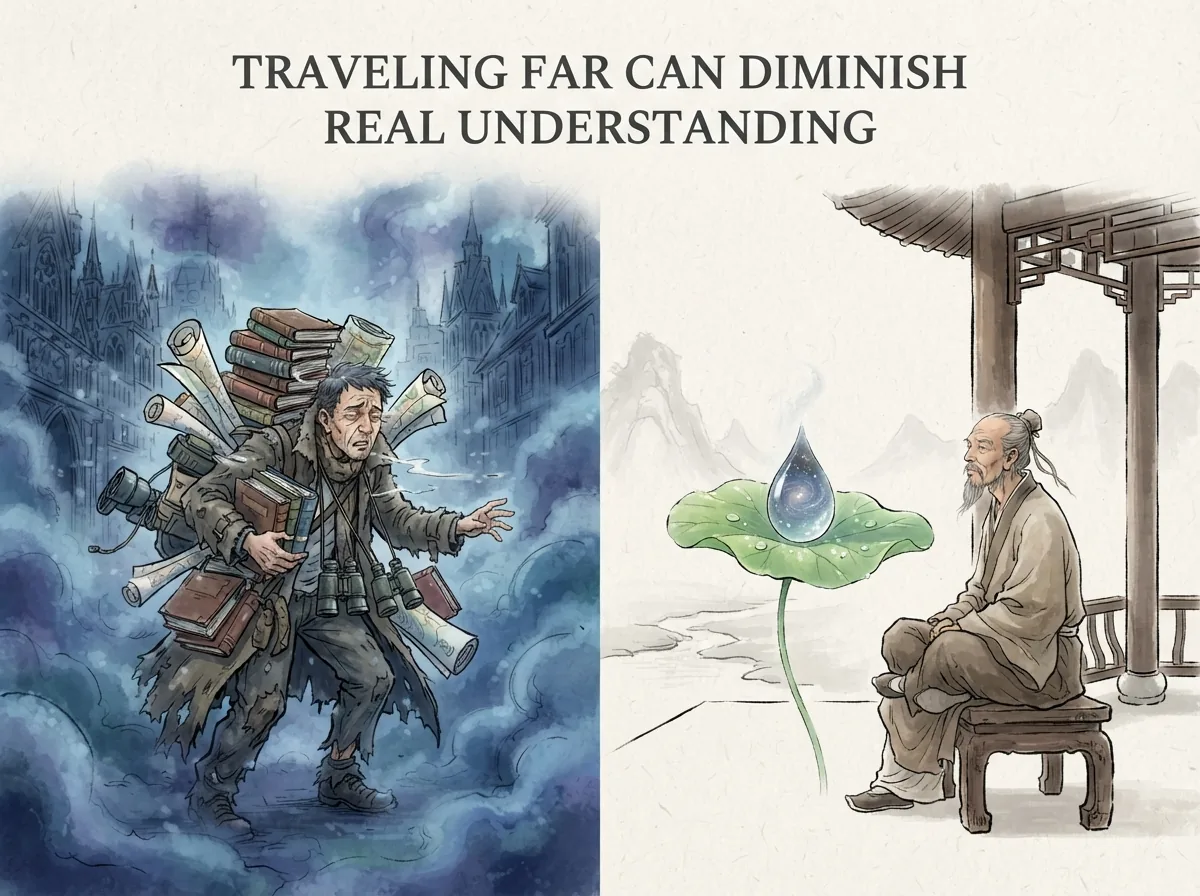
Laozi's chapter is primarily concerned with the second and third categories. The warning is not against gathering facts, but against mistaking the accumulation of facts for the development of understanding. When we confuse a larger file of information with a clearer mind, we set ourselves up for exactly the confusion the chapter describes.
Continue with the deeper interpretation and practical application.
ChiDestiny members get access to the full analysis, modern applications, and the growing Chinese Wisdom Library.
FAQ
Does Laozi really mean we should never leave home or gather information? No. The chapter is not a literal injunction against travel or observation. It is a critique of the assumption that more sensory input automatically produces better understanding. Specific facts about particular events still require specific evidence. What Laozi questions is the belief that hoarding information substitutes for structural comprehension.
How does Chapter 47 relate to the idea of wu wei? The chapter moves from epistemology to action by concluding that the sage "accomplishes without doing." This connects to the broader Daoist understanding of wu wei as action aligned with the natural dynamics of a situation rather than forceful interference. Acting without understanding a system's structure often leads to well-intentioned but counterproductive intervention. Understanding the structure makes appropriate action possible.
Can this chapter be used to reject scientific methods or empirical evidence? Not responsibly. The Dao De Jing contains numerous observations drawn from nature and social life, and it does not dismiss experience. What it warns against is treating experience as complete knowledge simply because it has been accumulated. Modern scientific practice combines observation with structural modeling and testing — a process that itself requires both outward inquiry and inward reflection.
What is the difference between the "seeing clearly without looking" (bù jiàn ér míng, 不见而明) and "naming without seeing" (bù jiàn ér míng, 不见而名) textual variants? Some manuscript traditions read the character for "understand" (ming), emphasizing insight into patterns and trends. Others read the character for "name" or "discern" (ming), emphasizing the ability to classify and describe phenomena accurately. Both readings point toward a form of knowing that goes beyond surface perception, though they highlight different aspects of that knowing.
To explore these themes from another angle, read our related reflection on Beyond Success: What If the Price Is You?.
For a deeper comparative examination of these ideas, explore our related study on Forgetting Intellectual Conceit: Gaining Daily vs. Decreasing Daily.
Sources & Further Reading
[1] Laozi (Stanford Encyclopedia of Philosophy/Spring 2026 Edition)
[2] Client Challenge (Springer)
Further Reading
- Dao De Jing, various scholarly translations and commentaries, including editions based on the Wang Bi text and earlier bamboo-slip manuscripts.
- Entries on Chinese philosophy and epistemology in reference works such as the Stanford Encyclopedia of Philosophy.
- Contemporary discussions of information overload, algorithmic bias, and organizational signaling in management and psychology literature.






