
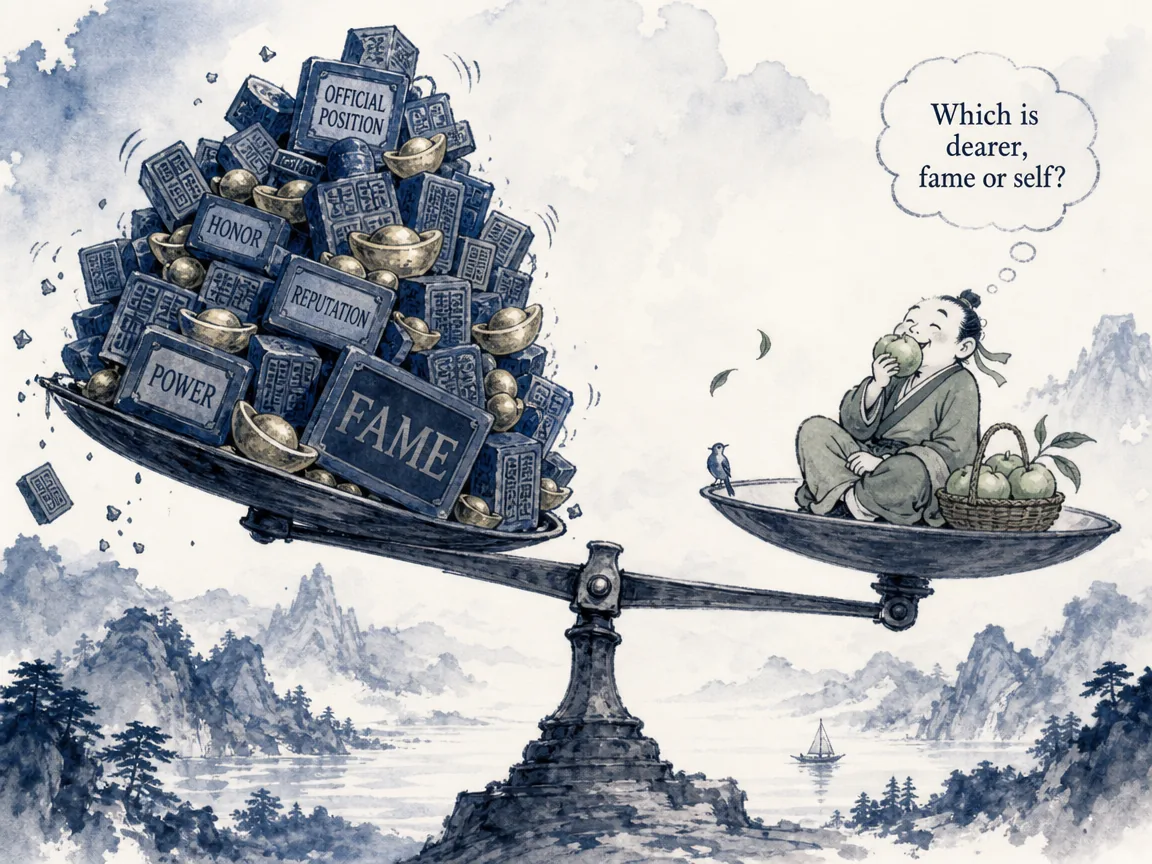
You know the feeling. There's a moment—usually late at night, when the notifications stop and the house goes quiet—when you pause and ask yourself: Is this it? You have the title. The income. The visibility. The version of a life that looks right from the outside. And yet something vital feels absent, as though a part of you has been quietly traded away in installments, unnoticed until the bill came due.
Many people sense this without being able to name it. Success, by conventional measures, is supposed to add. But sometimes it subtracts—quietly, incrementally, until the subtraction is the whole story. The body grows thinner. Time becomes a currency you can no longer spend on anything that isn't work. The sense of who you are starts to depend on things outside yourself: titles, accounts, the opinions of people you barely know. You haven't lost everything. You've just lost what makes everything worth having—a foundational perspective explored in Daodejing Chapter 44.
Over two thousand years ago, a thinker attributed to Laozi asked three questions in what is now the forty-fourth chapter of the Daodejing. They were not meant to comfort. They were meant to cut through the noise: Name and body, which is dearer? Body and wealth, which is more valuable? Gaining and losing, which is the greater harm? These questions do not offer easy answers. They expose a problem most of us recognize in ourselves but avoid articulating: that the things we are most driven to gain may be the very things that drain us dry.
Daodejing Chapter 44: The Three Questions That Uncover Hidden Trade-offs
The opening of Daodejing Chapter 44 does not begin with a command. It begins with questions, and the questions themselves are the intervention. Nearly everyone would answer quickly: the body, of course; life, obviously. The problem is that most lives are organized in ways that contradict those answers. Laozi is not testing knowledge. He is forcing a confrontation between what we say we value and what our choices reveal.
Name and body, which is dearer? The term here often translated as "name" (名) refers to reputation, social identity, the roles and recognition a person accumulates in the public eye. It is not merely fame—it is the curated self. In a world of professional branding, LinkedIn profiles, and algorithmic visibility, the gap between the role and the person has never been wider. When reputation becomes the primary lens through which you see yourself, every setback ceases to be an event and becomes an identity crisis. You are not failing; you are disappearing.
Body and wealth, which is more valuable? This shifts the comparison from external approval to material possession. "Wealth" here is not simply money but everything that can be owned, stored, and accumulated. The ancient question remains sharp: does wealth serve your life, or has your life been reorganized to serve wealth? The warning is not against having but against the inversion—when income growth buys time-saving services but consumes every waking hour, and "enough" retreats further with every raise.
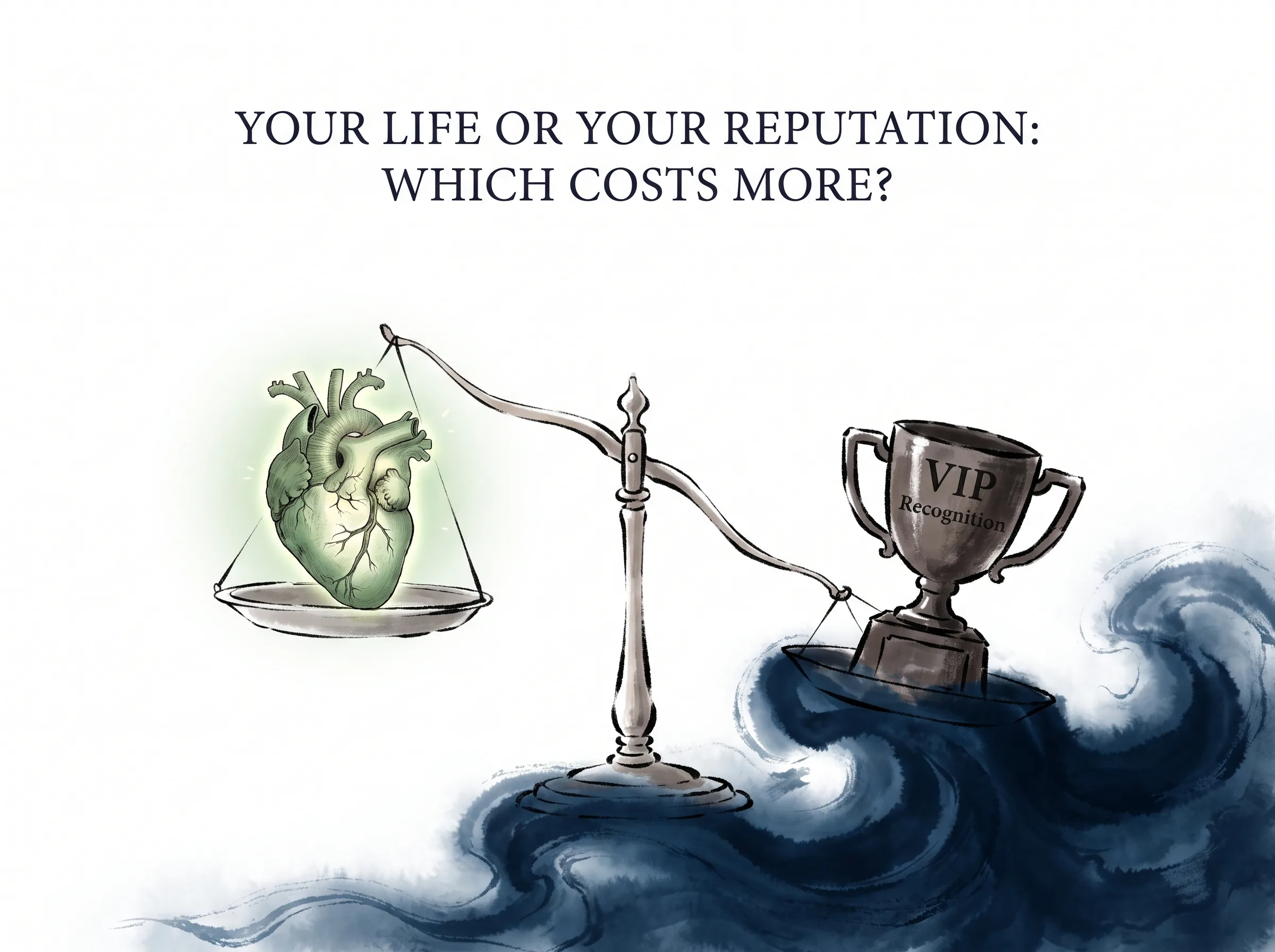
Gaining and losing, which is the greater harm? This is the most counterintuitive question. We assume gaining is good and losing is bad. Laozi suggests the relationship is more entangled. Every gain carries maintenance costs, vulnerability, and dependency. A promotion brings status and may destroy health. Wealth may secure comfort but erode freedom. The deeper insight is that gaining and losing are not separate events but parts of the same process. What you acquire begins to acquire you.
Continue with the deeper interpretation and practical application.
ChiDestiny members get access to the full analysis, modern applications, and the growing Chinese Wisdom Library.
FAQ
Does this mean I should give up on ambition entirely? No. The chapter does not oppose action, growth, or achievement. It opposes the unexamined assumption that more is always better and that the cost of more can be ignored. Ambition is fine when it serves a life. It becomes dangerous when your life is reorganized to serve ambition.
Is "contentment" the same as settling for less? Contentment is not the absence of desire but the presence of judgment. It asks: Is this actually enough for what I need, or am I pursuing it because I cannot imagine stopping? A person can be ambitious and content at the same time—provided ambition does not override the well-being it was supposed to support.
What if I am in a situation where I cannot simply "stop" or "be content"? The principle applies most clearly to those with sufficient agency to make choices. If someone is fighting for basic survival, fairness, or escape from oppression, this philosophy is not relevant to their circumstances. The warning in Chapter 44 is aimed at excess, not at the reasonable pursuit of security and dignity.
How does this connect to the rest of the Daodejing? Chapter 44 follows naturally from earlier themes, particularly the caution against overreach found in Chapter 9 ("Who can keep a cup filled to the brim? It is better to stop while you are still full"). The concern throughout the text is consistent: actions that ignore limits create their own undoing. Contentment and boundaries are not isolated (gūlì de, 孤立的) advice—they are part of a coherent framework for living sustainably within a finite life.
Closing: Who Is Driving?
The question at the beginning was simple: When your success costs your health, time, or sense of self, have you actually won—or lost something more important? Laozi's answer, rendered across forty-four characters, is that success measured only by external accumulation is a category error. The thing being accumulated is not the life; it is the cost of the life.
The three questions—name or body? wealth or life? gaining or losing?—are not rhetorical. They are accounting tools. Every choice you make is a transaction between what you gain and what you surrender. Most of us do the math on the wrong side. We count the title, the balance, the visibility. We forget to count the sleep, the relationships, the moments of unperformed authenticity, the ability to sit quietly without producing something valuable.
The remedy is not to abandon the world. It is to rearrange your priorities so the world serves you rather than you serving the world. Ask yourself this week: What am I maintaining that no longer serves me? Not what you want to stop—what you are already paying too much for and haven't admitted. The answer, however uncomfortable, is the beginning of a longer life.
To explore these themes from another angle, read our related reflection on Why Your Best Plans Keep Unraveling (and What Laozi Suggests Instead).
Deepen your understanding of these principles in our reflection on The Paradox of Knowledge: Why “Seeing More” Can Mean “Understanding Less”.
Sources & Further Reading
[1] The Project Gutenberg eBook of Dao De Jing, by Lao Zi — discussed the textual tradition, authorship debates, and translation conventions for key terms such as self/body (shēn, 身)
[2] Laozi (Stanford Encyclopedia of Philosophy/Fall 2024 Edition) — provided context on the development of the text and its place within philosophical tradition
Further Reading
- Chapter 9 of the Daodejing (on the danger of overfilling and the wisdom of stopping)
- Chapter 13 of the Daodejing (on the relationship between self, reputation, and suffering)
- David Hinton, Lao Tzu: Te-Tao Ching — contemporary translation with philosophical commentary
- Red Pine (Bill Porter), Tao Te Ching: The Book of the Way and Its Power — translation with extensive variant-reading notes
- Susan Blum, Laozi: A Guide for the Perplexed — modern introduction to the text and its interpretations






