

Does having more connections, more information, and more options make us stronger? Modern life seems to say yes. We are encouraged to network aggressively, keep every channel open, respond to every notification, and treat availability as a virtue. The assumption is simple: the wider your reach, the more capable you are. But many people living this way report something puzzling. They are more connected than ever, yet more fragmented, more exhausted, and increasingly unsure of what they actually want to do. If expansion were truly strength, the logic suggests that more entry points should mean more power. Something is off.
An ancient Chinese philosopher anticipated this exact confusion. In Daodejing Chapter 52 of the Daodejing, attributed to Laozi, the text offers a strikingly counterintuitive claim: real strength does not consist in endlessly opening doors. It consists in knowing your root, understanding what emerges from it, and having the discipline to close certain passages when they begin to consume you. This is not a call to isolation. It is a practical account of how a mind can enter the world fully and still carry its center with it.
The question this chapter raises is not whether connection is bad. The question is what happens when connection becomes indiscriminate.
Daodejing Chapter 52: The Root Behind Everything
Laozi opens Daodejing Chapter 52 with a deceptively simple statement: "The world has a beginning—take it as the mother of the world" [1]. In Chinese, the term used is mu, which literally means mother. This is not a casual metaphor. Laozi deliberately chooses a word that describes generative origin rather than political control. A ruler commands. A parent generates, sustains, and allows the child to become its own person.
What matters here is that the "mother" is not a distant historical starting point. It is the ongoing source that keeps the world coherent. Laozi describes this source elsewhere as giving birth without possessing, acting without claiming credit, and guiding without dominating [1]. If the root functions this way, then strength cannot simply mean expanding your contact with everything. That would confuse motion with direction.
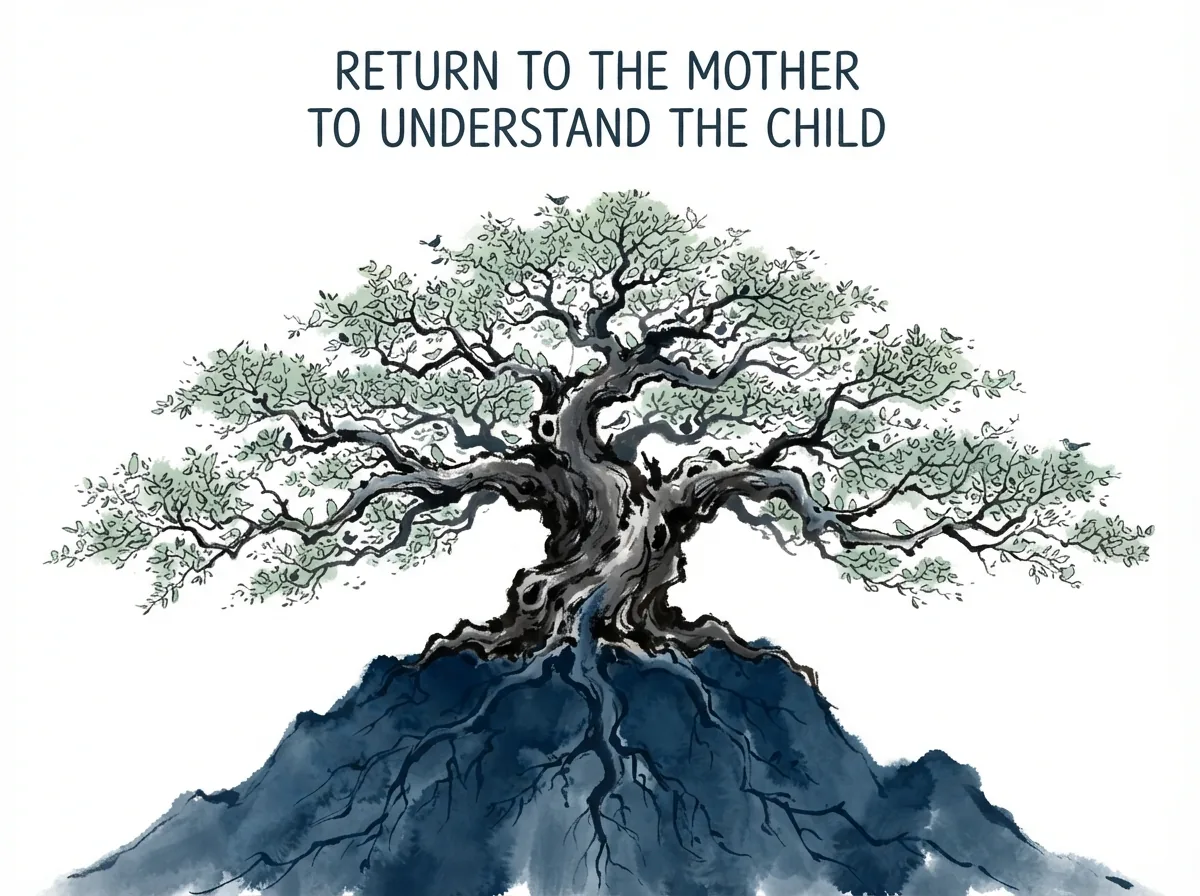
Understanding the root changes how you approach what comes from it. When you know the origin, you can recognize patterns without needing to collect every single detail. This does not replace careful investigation. It gives investigation a place to land.
Continue with the deeper interpretation and practical application.
ChiDestiny members get access to the full analysis, modern applications, and the growing Chinese Wisdom Library.
FAQ
Does Laozi really oppose connection and information?
No. He opposes indiscriminate access. Entering the world, learning, and acting are all part of his framework. The warning is aimed at unbounded openness that leaves you unable to distinguish what matters from what merely demands attention.
How is "closing the doors" different from ignoring problems?
Closing doors means setting intentional boundaries on what enters your attention, not pretending difficulties do not exist. Laozi explicitly values using your light to engage the world. The difference is whether engagement is chosen or defaulted.
What does "returning to brightness" look like in daily life?
It looks like regular reflection on whether your actions still serve your original purpose. After solving a problem, ask whether you now depend on the problem existing to justify your role. After achieving something, ask whether the achievement is strengthening your judgment or simply inflating your self-image.
Can this advice apply to organizations, not just individuals?
Yes. Teams and companies that maintain every communication channel, metric, and meeting often become exhausted by their own infrastructure. Intentional boundaries—deciding what not to track, what not to discuss, what not to prioritize—can restore focus and reduce wasted effort.
Final Thought
The ancient text does not promise that closing doors will make life easier. It promises that it will make life clearer. Strength is not the absence of limits. Strength is the presence of discernment. When you know your root, you can enter the world without losing yourself in it. You can use your light without being blinded by it. And you can open doors again when it matters, because the choice to close was always yours.
To explore these themes from another angle, read our related reflection on Why the Invisible Dao Is More Real Than What We Can See.
For a deeper comparative examination of these ideas, explore our related study on Why the Best Leaders Don’t Play Favorites — Ancient Wisdom for Modern Life.
Sources & Further Reading
[1] Digital Classic Portal (數位經典) / Laozi Daodejing Full Text (老子道德經全文 / 王弼注) — Wang Bi received text and commentary on Chapter 52, focusing on closing the apertures and knowing the mother to know the child.
[2] Labor/leisure decisions in their natural context: The case of the smartphone — Empirical research examining how continuous digital connection and smartphone availability alter the boundary between work and restorative leisure.
Further Reading
- Daodejing, Chapter 47 — on knowing without exhausting oneself through endless observation
- Daodejing, Chapter 48 — on the practice of reduction in the pursuit of the Way
- Daodejing, Chapter 51 — on the non-dominating nature of creative source
- Daodejing, Chapter 56 — on blending light and dust, avoiding the sharpening of edges
- Chinese Text Project (ctext.org) — digital editions and parallel texts of the Daodejing for scholarly comparison across versions






