
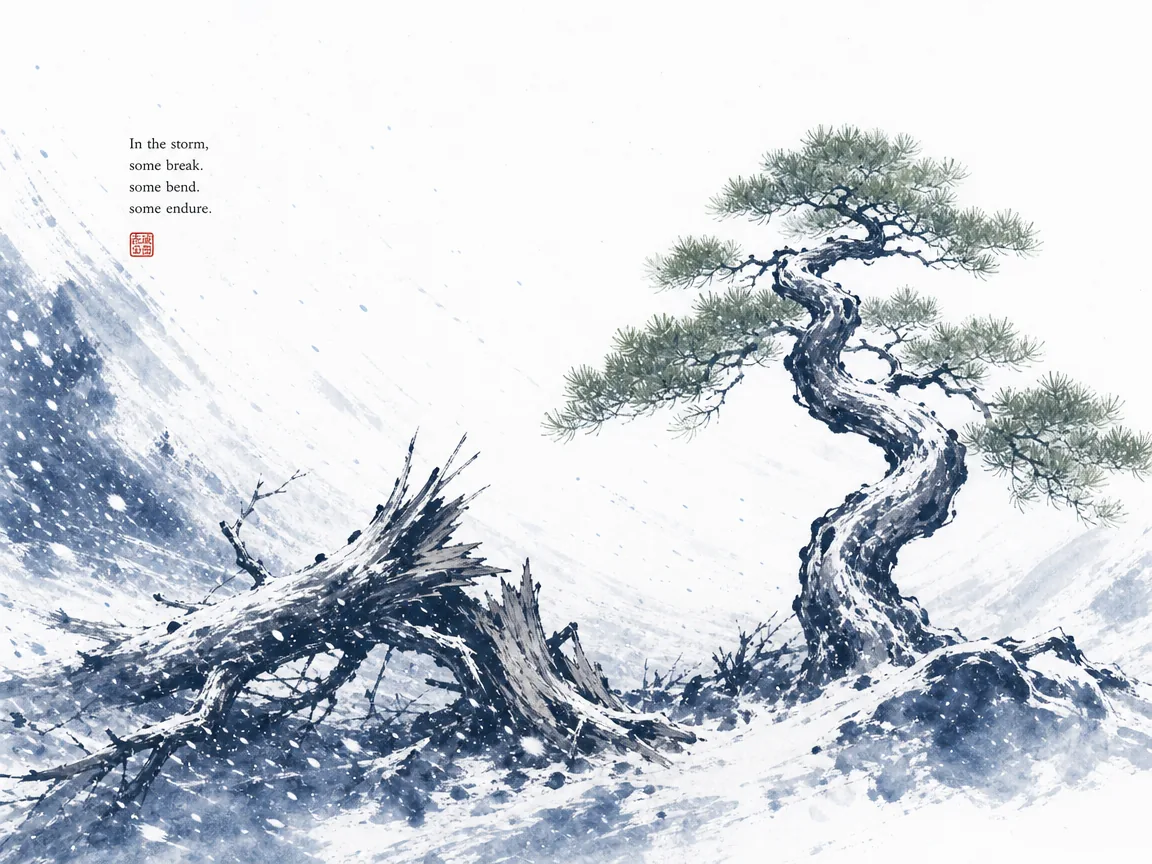
We live in an age that confuses visibility with reality. We trust a building only after it cracks, an organization only after it collapses, a relationship only after it fractures beyond repair. Our culture rewards dashboards, metrics, and immediate results. What has not yet hardened into something observable is easily dismissed as unreal, irrelevant, or merely potential. Yet beneath every visible outcome lies a longer, quieter process — one that has been shaping the world long before it appears on any screen.
Laozi recognized this trap two thousand five hundred years ago, though the text that bears his name was likely compiled over time by multiple hands rather than produced by a single author in any straightforward sense [1]. In Daodejing Chapter 22 of the Daodejing does not ask readers to believe blindly in something hidden. Instead, it offers a method of perception: observe how things arise, develop, transform, and return, and you begin to see that an unseen generative ground — what the text calls Dao — is what makes all visible phenomena possible. The invisible, in this framework, is not the opposite of real. It is what makes reality itself work.
This is not a call to mysticism or abstract speculation. It is an invitation to look more carefully at the world we already inhabit — to notice that the conditions producing outcomes are almost always present long before the outcomes themselves become obvious.
Daodejing Chapter 22: The Modern Trap of Visible Evidence
The habit of equating real with measurable is so familiar that we rarely notice it. In business, we celebrate quarterly results without asking which structural decisions made those results possible — or impossible. In relationships, we respond to the argument that breaks everything rather than noticing the years of small neglect that preceded it. In personal health, we address symptoms after they have become undeniable instead of tracing them back to patterns that were forming long before.
What appears last in visibility is often what was forming longest in the unseen. And yet our attention operates on the opposite schedule. We react to endings without attending to beginnings.
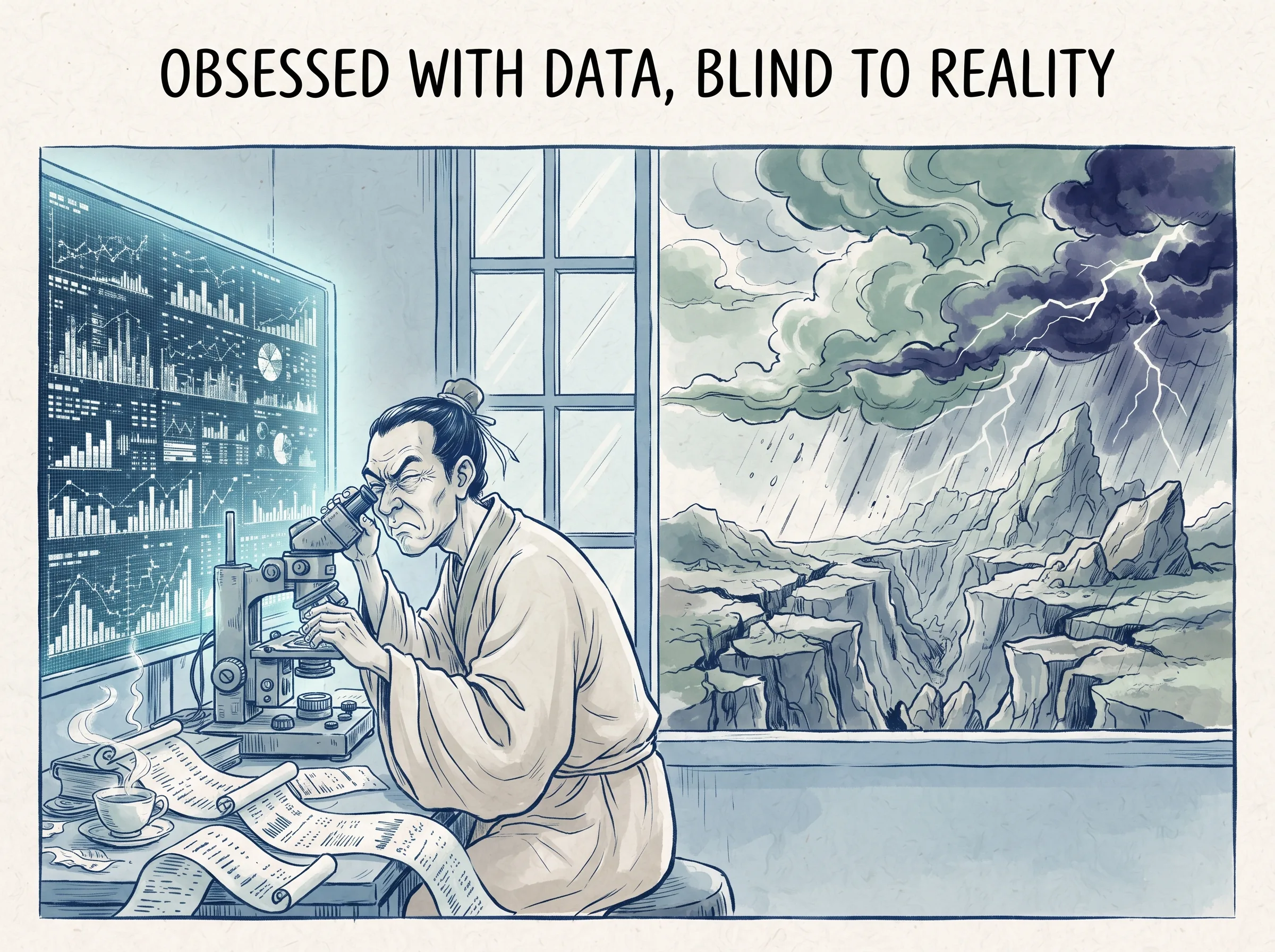
This is not a failure of individual perception alone. It is a structural feature of modern systems that privilege speed, visibility, and immediate feedback. When organizations, markets, and media reward quick answers, the slow, invisible processes that actually determine outcomes get systematically overlooked. Laozi’s Daodejing Chapter 22 emerges from a different intellectual environment, one less obsessed with controlling and quantifying the world, but the insight it offers speaks directly to a condition that has only intensified since.
Continue with the deeper interpretation and practical application.
ChiDestiny members get access to the full analysis, modern applications, and the growing Chinese Wisdom Library.
FAQ
Is the Dao really more real than visible things, or is this just poetic language?
The Daodejing does not make the literal claim that the invisible Dao is "more real" than visible things in a straightforward empirical sense. Rather, it argues that what is visible depends on what is invisible for its existence and functioning. The text describes Dao as the generative ground of all phenomena — elusive, unnamed, and beyond fixed form — while also insisting that within this elusiveness there are potential forms, real content, essential generative substance, and reliable patterns [1]. The claim is ontological and epistemological, not mystical: visible things are real, but they are not the whole reality.
Does Chapter 21 require religious faith or belief in something supernatural?
No. The chapter explicitly grounds its claims in observable patterns rather than in faith, revelation, or authority. The "reliability" mentioned in the text — often translated as trustworthiness (xìn, 信) — refers to the consistent, non-arbitrary way things follow patterns that operate independently of human opinion. The regularity of the seasons and the plenitude of nature are offered as evidence of Dao's presence [1]. This is an empirical stance, however broadly "empirical" is understood in classical Chinese thought.
What is the relationship between De and Dao in this chapter?
De is what Laozi calls the "countenance" or manifested state of profound virtue — not moral virtue in the Western ethical sense, but the specific way each thing fully realizes its own nature. Scholarly sources describe De as a latent power obtained from the Dao, by virtue of which any being becomes what it is [1]. Dao is the root; De is the root's expression in particular things. We cannot observe Dao directly, but we can observe De — the visible traces of Dao at work in everything that is allowed to flourish according to its own nature.
Was this chapter written by a single author named Laozi?
The authorship of the Daodejing is a subject of ongoing scholarly debate. Current Western scholarship is virtually unanimous in asserting that there was no single historical figure named Laozi who authored the entire text [2]. The text as we have it likely took shape over time, with some key chapters dealing with the nature of Dao not even appearing in earlier archaeological discoveries such as the Guodian corpus [1]. The ideas in Chapter 21 are attributed to the Daodejing tradition rather than to a biographical individual.
Conclusion
Chapter 21 of the Daodejing does not ask us to abandon the visible world in favor of some hidden realm. It asks us to see the visible world more clearly — to notice that every outcome we observe rests on conditions that formed long before it appeared. The Dao is not a secret object waiting to be discovered behind the curtain of reality. It is the generative ground that makes reality itself possible, present in the way water flows, grain grows, seasons turn, and structures hold — or fail to hold.
The practical takeaway is simple and demanding: train your attention to look earlier, deeper, and more patiently. Do not mistake the visible for the complete. Do not confuse the map for the territory. And do not assume that what you cannot currently see is nothing at all.
A good next step is to pick one area of your life — a project at work, a relationship, your own health — and trace it backward. Not to assign blame, but to identify the invisible conditions that shaped the visible outcome. What was forming long before the result appeared? What patterns have been operating beneath the surface? You may not find answers immediately. But the practice of looking this way changes what you are able to see.
To explore these themes from another angle, read our related reflection on Why the Fiercest Fire Burns Out Fastest: Laozi’s Secret to Lasting Vitality.
For a deeper comparative examination of these ideas, explore our related study on Transcending Favor and Disgrace: Accepting Misfortune as Part of Having a Self.
Sources & Further Reading
[1] Laozi — Stanford Encyclopedia of Philosophy (Spring 2024 Edition). Discusses De as latent power obtained from Dao, the relationship between Dao and particular beings, and the textual history of the Daodejing.
[2] Religious Daoism — Stanford Encyclopedia of Philosophy (Spring 2019 Edition). Describes the Dao as devoid of fixed definition, form, or name, yet as the transcendent unity and origin of all multiplicity.
Further Reading
- Chinese Text Project, Daodejing Chapter 21 Parallel Text Edition
- Chinese Text Project, Daodejing Chapter 1
- Chinese Text Project, Daodejing Chapter 14






