

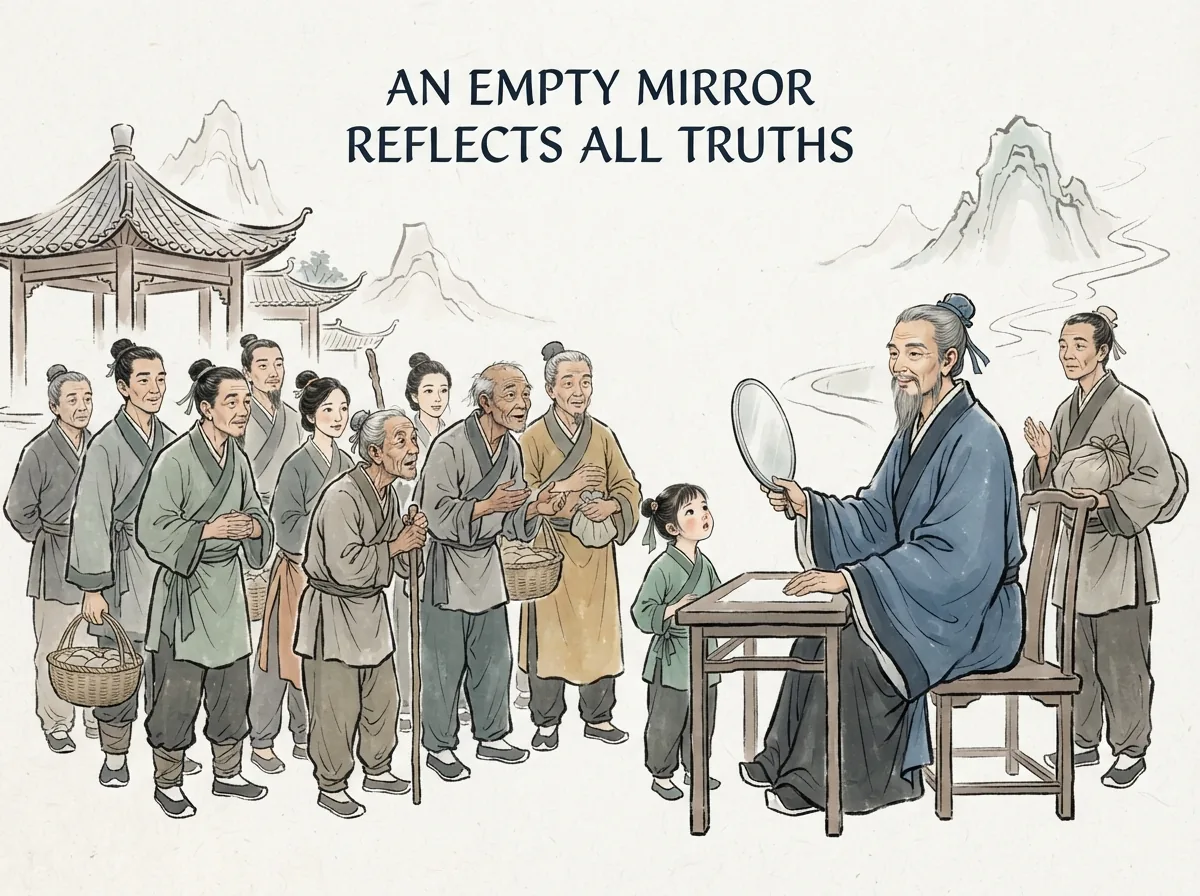
In most political and organizational imagination, strong leadership looks like unwavering conviction — clear goals, stable judgment, and a plan that does not bend to pressure. A leader who says they have no fixed opinion is easily read as weak, indecisive, or irresponsible. But one of the most precise ancient accounts of this paradox comes from a counter-intuitive opening in the Dao De Jing [2], traditionally attributed to Laozi: The sage has no fixed mind; he takes the people's mind as his own (Shèngrén wú cháng xīn, yǐ bǎixìng xīn wéi xīn, 圣人无常心,以百姓心为心) [3].
This is not a call for chaos or constant flip-flopping. It is an observation about what blocks perception when power holds a single blueprint too tightly. A leader who refuses to let personal preference, past success, or ideological certainty become the universal standard is not directionless. They are making room — structurally — for the real lives, costs, and voices of the people they serve to enter the room—a foundational perspective explored in Daodejing Chapter 49.
Daodejing Chapter 49: What "No Fixed Mind" Actually Means
"No fixed mind" (wú cháng xīn, 无常心) does not mean having no principles at all. It means refusing to let a pre-set opinion stand above lived reality, and refusing to let the self occupy infinite priority in governing decisions. The Chinese character for constancy (cháng, 常) here can mean "constant" or "fixed," so the phrase points to something stable only in the narrow sense of stubbornness — a single agenda treated as permanently centered [3].
Two linked dimensions are at work. The first is cognitive openness: do not place a ready-made answer above the complexity of what is actually happening. The second is what we might call axiological restraint: the leader's own desires, ambitions, and aesthetic tastes do not get automatic priority over everyone else's needs.
A leader who abandons principles whenever public opinion shifts is not practicing this kind of openness. They are abandoning responsible judgment. Laozi is opposing rigid personal scales, not all standards. The distinction matters. A responsible leader can hold firm boundaries — on harm, on fairness, on basic dignity — while remaining flexible about methods, timelines, and the distribution of trade-offs.
It is also worth noting that textual scholars have observed a variant in some early manuscript traditions, including the Mawangdui silk texts, where the phrase appears as "no permanent mind" (héng wú xīn, 恒无心) rather than "no fixed mind" (wú cháng xīn, 无常心), shifting the emphasis slightly toward the idea of governing without a permanently centered private interest. The received texts, which include the Wang Bi edition commonly circulated since the third century, preserve the "no fixed mind" (wú cháng xīn, 无常心) reading [3]. Both readings, whatever their exact wording, support the same general point: the sage does not govern from a locked-in version of self.
The Link to Chapter 48: Reducing the Self Before Opening to Others
Daodejing Chapter 49 of the Dao De Jing states: In pursuing the Way, each day something is dropped [3]. The practice is subtraction — dropping prejudice, performance, and the impulse to control. Chapter 49 picks up immediately after and answers the natural question: once the self is reduced, toward what does governance open?
The answer is not an abstract doctrine, nor mystical revelation. It is the actual conditions of the people. This connection between the two chapters is a scholarly reading rather than an explicit statement in the text, but it helps explain why the sequence matters. Subtracted self is not emptiness. It is the clearing of space for other lives to enter.
Think of it this way. A leader whose mind is already full — full of their own strategy, their reputation, their need to be right — has very little room for anyone else. The people become material to move into place, not subjects with their own reasons. When the leader reduces their own footprint, the world becomes legible in a different way. Problems that were invisible before suddenly appear. Costs that were hidden behind target metrics come into focus.
Continue with the deeper interpretation and practical application.
ChiDestiny members get access to the full analysis, modern applications, and the growing Chinese Wisdom Library.
FAQ
Does "no fixed mind" mean a leader should have no principles? No. It means principles should not be locked into a single personal blueprint that refuses to adjust to reality. Boundaries on harm, fairness, and dignity can remain firm. Methods, timelines, and trade-offs should remain open to correction from the ground up.
Is Laozi saying leaders should trust everyone blindly? No. The chapter distinguishes between trust as a relational baseline and trust as belief in every statement. Evidence, verification, contracts, and accountability mechanisms remain necessary. What changes is the assumption that past broken trust (shīxìn, 失信) earns permanent exclusion. The demand for trustworthiness falls most heavily on those in authority.
How does this connect to the idea of non-action (wúwéi, 无为)? Chapter 48 frames non-action (wúwéi, 无为) as subtracting excess action and self-centered projection. Chapter 49 shows what fills the space afterward: not emptiness, but attention to the actual conditions of the people. Non-action is not inaction. It is action that stops mistaking the leader's preferences for the world's needs.
Is this approach naive in the real world? Not necessarily. Systems that rely only on fixed blueprints often produce fragile outcomes — plans that look correct on paper but collapse under the weight of unrecorded costs. Systems that build in correction, transparency, and pathways for repair tend to be more resilient. That resilience is not sentimental. It is structural.
To explore these themes from another angle, read our related reflection on Why the Best Leaders Don’t Play Favorites — Ancient Wisdom for Modern Life.
For a deeper comparative examination of these ideas, explore our related study on Why Victory Can Be Your Greatest Trap: Ancient Chinese Wisdom on the Danger of Conquest.
Sources & Further Reading
[1] Next step: — If you want to go further with this theme, a useful companion reading is Chapter 48 of the Dao De Jing, which introduces the practice of diminishing the self as the prerequisite for the kind of leadership described in Chapter 49. Exploring how subtraction and openness work together can deepen your understanding of wu-wei as a practical discipline rather than a vague ideal.
[2] Wang Bi Commentary on Laozi Daodejing (王弼《老子道德經注》) – Dingren Daoist Institute
[3] Daodejing (Wang Bi Edition, 道德经/王弼本) – Wikisource (维基文库)






