
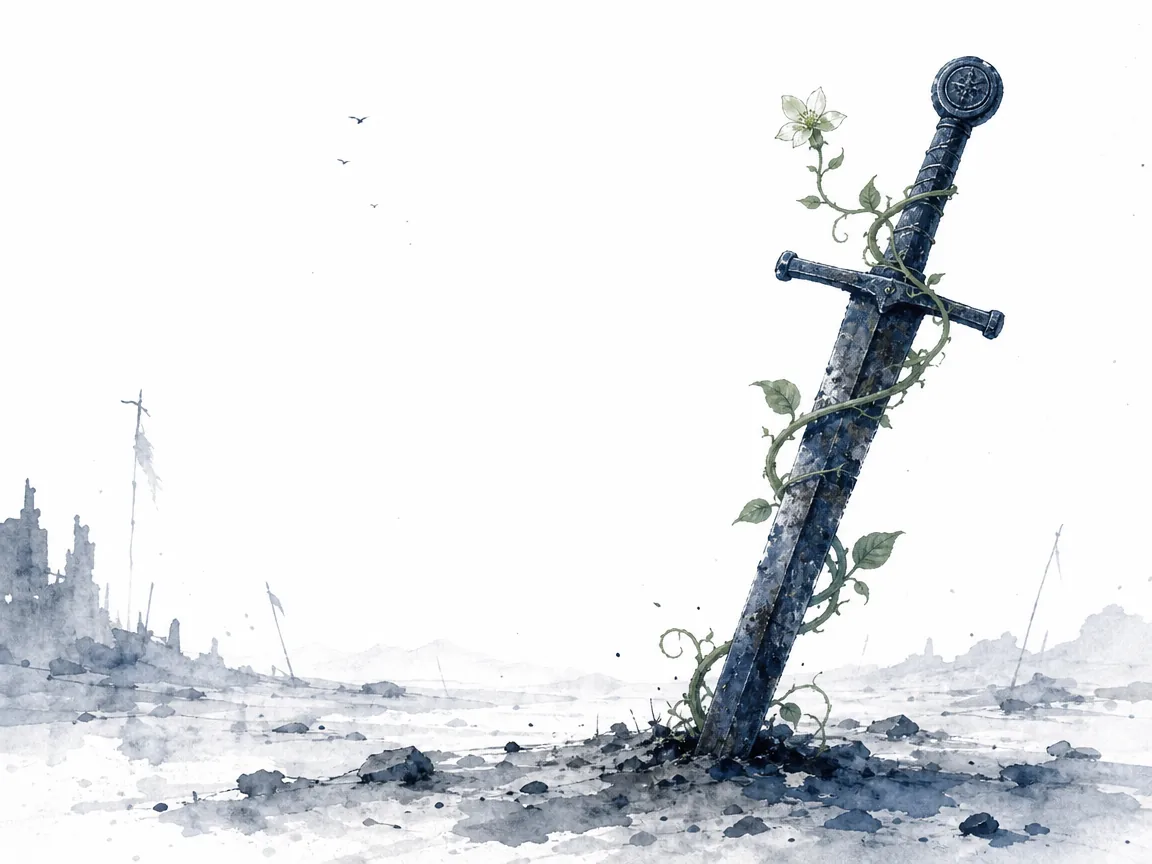
There is a quiet paradox that haunts high-performing people and high-growth organizations alike: the moment after a major win is often when the real danger begins. You have spent months or years pushing toward a goal. You crossed the finish line. And yet, almost immediately, something shifts. The strategies that brought you success suddenly feel insufficient. New threats appear where none existed before. The energy that once drove forward now feels like it is pulling you into territory you do not recognize. The victory that was supposed to solve your problems starts generating new ones.
This pattern is not a personal failing. It is a structural one. When force, control, or relentless expansion becomes your default way of moving through the world, success does not liberate you—it traps you. The logic that won the battle demands that you keep fighting, even when the war is over. You tell yourself that stopping would mean wasting what you have gained. So you push further. And further. Until the cost of maintaining your position exceeds the value of the position itself—a foundational perspective explored in Daodejing Chapter 30.
Two and a half thousand years ago, a teacher known as Laozi observed this pattern with remarkable clarity. In the Tao Te Ching, he wrote about rulers who wielded power, about armies that won battles and left devastation in their wake, about the subtle way that conquest corrupts the conqueror. His central insight was not that strength is evil or that success should be avoided. It was something more precise and more unsettling: the greatest threat to your success is not failure. It is the addictive logic of expansion itself. Understanding this distinction may be the most practical lesson available to anyone who has ever won something they were afraid of losing.
Daodejing Chapter 30: Why Winners Keep Losing
Consider the patterns that repeat across different domains. A company doubles its revenue through aggressive expansion, acquires competitors, and saturates every market segment. Two years later, it is drowning in debt, its culture is toxic, and its best people have left. An individual adopts a regime of extreme discipline—waking at dawn, optimizing every hour, treating rest as a weakness to be conquered. Within eighteen months, they are burned out, their relationships have frayed, and the very goals they pursued now feel empty. A manager resolves workplace conflict by asserting authority, silencing dissent, and demanding compliance. Short-term order follows. Long-term innovation evaporates, and the team eventually fractures under the weight of unspoken resentment.
In each case, the initial victory was real. The strategies worked. The problem is that winning changes the conditions that made winning possible. Every application of force reshapes the environment, and the reshaped environment demands more force to manage. Fear-based management destroys honest communication, which means the manager must rely on surveillance and control, which destroys communication further. Aggressive growth creates fragility, which demands even more aggressive growth to survive the consequences. Relentless self-discipline exhausts the body and mind, which requires even more extreme measures to maintain performance.
Modern research on organizational behavior captures something closely related under the term "escalation of commitment"—the tendency to invest additional resources into an endeavor even when doing so is no longer rational [2]. Previous expenditures of time, money, and effort create psychological and social pressures that make stepping back feel like admission of failure. Overconfidence, sunk costs, reputational concerns, and the need for self-justification all feed the spiral. The person or organization that won most recently is often the one least able to stop, precisely because stopping would require reevaluating everything that led to the win.
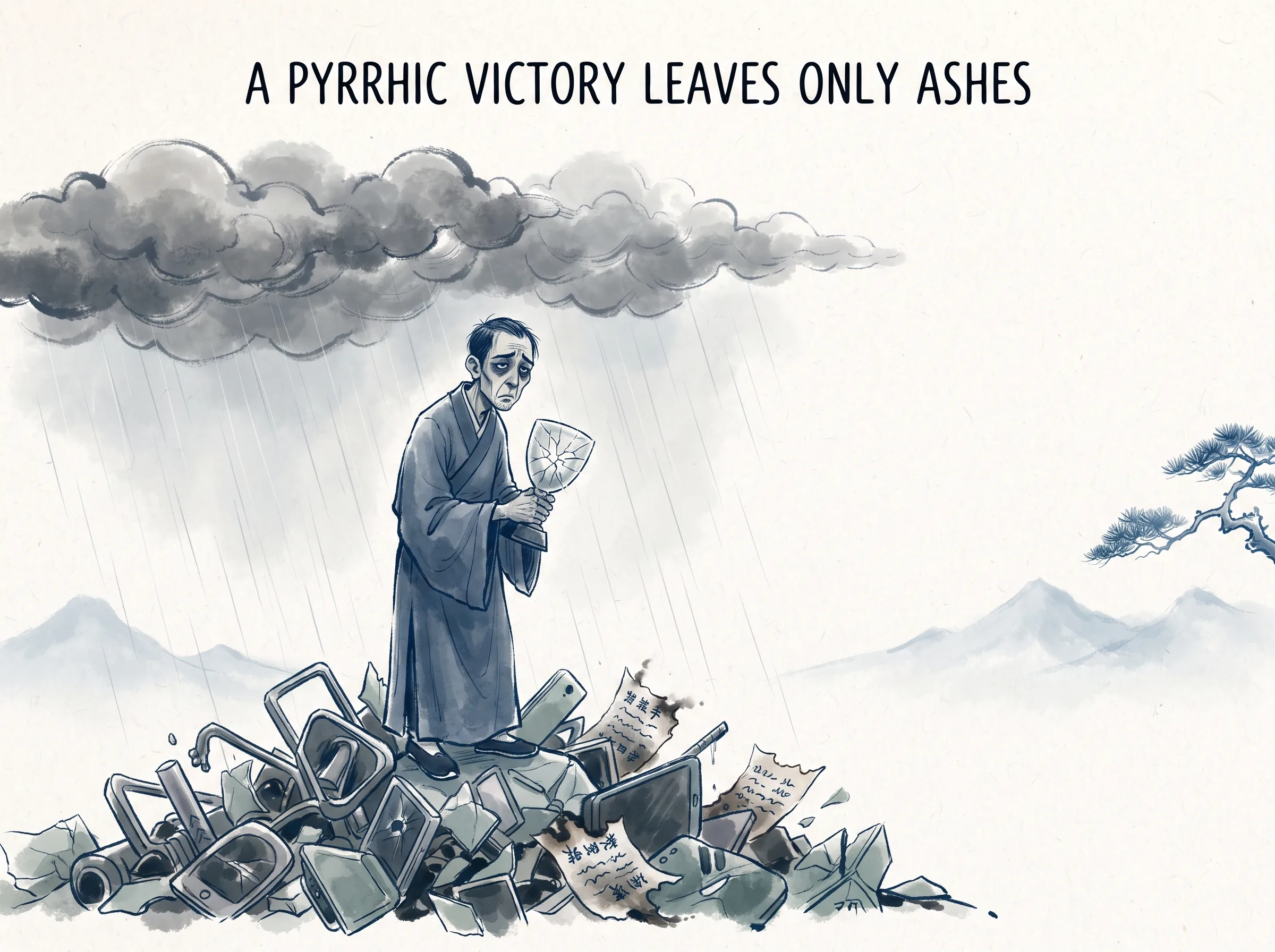
Laozi observed this dynamics long before organizational psychology had a name for it. His point was not that action is bad or that results should be dismissed. His point was that the moment after results are achieved is the most dangerous moment—because that is when the mind most easily (zuì róngyì, 最容易) slips from "I have solved this problem" into "I must keep solving problems to prove I am powerful."
Continue with the deeper interpretation and practical application.
ChiDestiny members get access to the full analysis, modern applications, and the growing Chinese Wisdom Library.
FAQ
Is the Tao Te Ching saying we should never use force or take decisive action?
No. The traditional interpretation acknowledges that some situations require force—defense against aggression, protection of others, resolution of immediate danger. The teaching is about the relationship to force, not its absolute prohibition. The key distinction is whether force is used as a temporary tool for a specific purpose or adopted as a permanent way of relating to the world.
How do I know when I have achieved "enough" and should stop expanding?
One practical indicator is whether your actions are restoring capacity to others or creating dependency. If your result leaves people more autonomous, more capable, and more willing to engage voluntarily, you have likely reached the right stopping point. If your result requires continuous monitoring, enforcement, and escalation to maintain, you have probably gone beyond necessity.
Can this framework apply to personal goals, not just leadership or organizational contexts?
Yes. The same dynamics appear in individual lives. A person who pursues self-improvement through self-flagellation may achieve impressive short-term (duǎnqī, 短期) results but will eventually burn out. The Tao Te Ching's guidance applies equally to how we relate to our own ambitions: pursue what is necessary, achieve the result, and do not let the strategy become an identity that demands permanent escalation.
What should I do if I am already caught in a cycle of overreach?
The first step is recognition. The cycle of expansion is addictive precisely because it feels productive. Acknowledging that you are expanding beyond necessity rather than responding to genuine need is often sufficient to create the pause that allows a different path to emerge. From there, the question becomes: what would it look like to solve this problem with less force, not more? This is the lasting lesson of Daodejing Chapter 30.
To explore these themes from another angle, read our related reflection on True Longevity: Why Protecting Yourself Too Much Backfires.
Deepen your understanding of these principles in our reflection on Beyond Hustle: Why Overexertion Destroys What It Tries to Build.
Sources & Further Reading
[1] Laozi (Stanford Encyclopedia of Philosophy/Spring 2026 Edition)
[3] Future of Food — Building Stronger Food Systems in Fragility, Conflict, and Violence Settings
Further Reading
- The Tao Te Ching, various translations (D.C. Lau, Stephen Mitchell, Robert Henricks) — for comparative readings of Chapter 30 across textual traditions
- Research on escalation of commitment in organizational behavior — for modern psychological frameworks that parallel Laozi's observations about the logic of expansion
- Studies on conflict, fragility, and long-term societal development — for empirical support of the structural relationships between force, stability, and sustainable prosperity






