
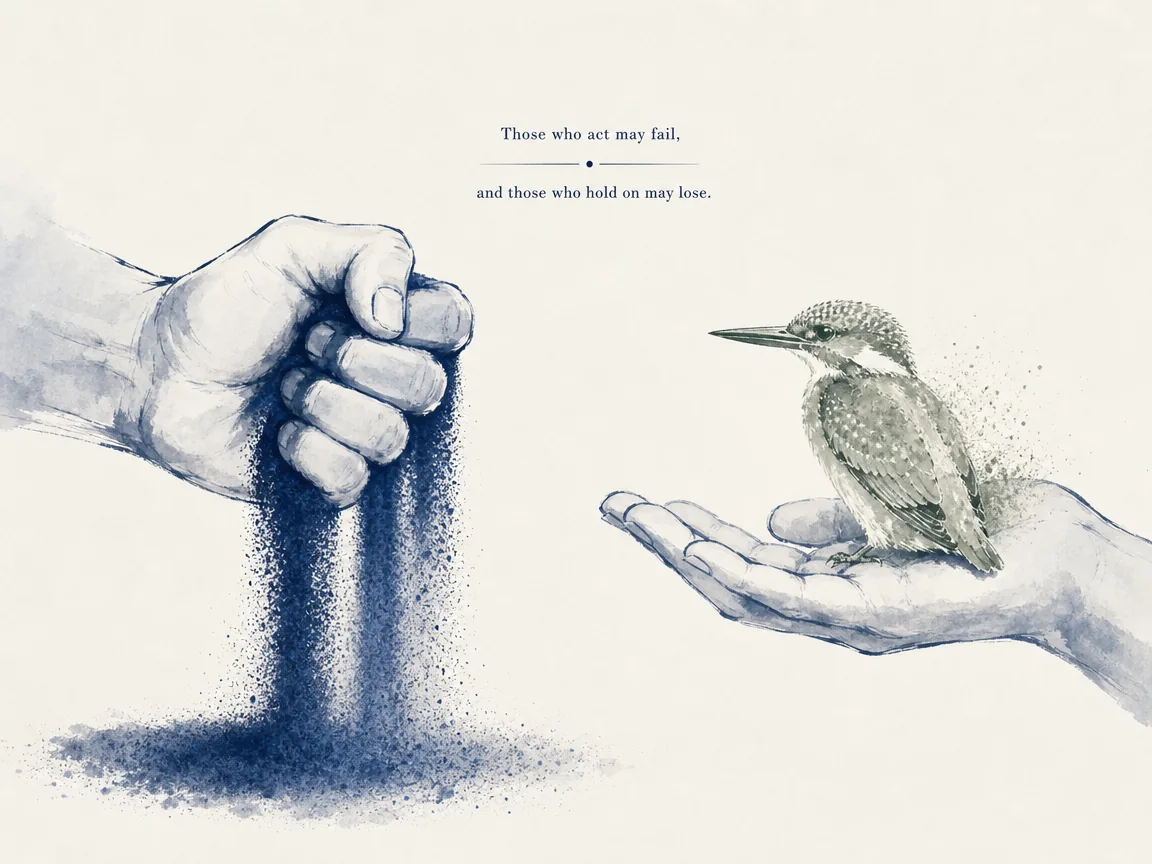
You have probably noticed the pattern. The tighter you grip, the faster things slip away. The more you try to force a relationship to stay close, the more distant it becomes. The more you plan every detail of your career, the more anxious you feel when reality diverges from the script. The more you demand perfection from yourself, the more likely you are to collapse under the weight of your own standards. This is not a personal failing. It is a structural problem — one that arises whenever we confuse our will with the way the world actually works.
Two and a half millennia ago, a text attributed to Laozi wrote what many people are only now rediscovering through experience: the harder you try to impose your vision on a complex, living world, the more you break the very things you want to preserve. The Tao Te Ching — traditionally dated to around the fourth century BCE, though its authorship and composition remain debated among scholars — contains a chapter, often numbered twenty-nine, that describes this dynamic with striking clarity [1]. The passage warns against trying to "take the world and work on it," observing that the world is not raw material to be shaped by individual will. "Who manipulates them fails; who grasps them loses," the text says. The insight is simple, counterintuitive, and deeply relevant to how we live now—a foundational perspective explored in Daodejing Chapter 29.
This is not a call to passivity. Laozi does not advise surrender. Rather, he asks us to examine a question we rarely pause to consider: when does our action serve the situation itself, and when does it merely serve our need to feel in control? The difference between the two is often the difference between lasting effectiveness and quiet destruction.
Daodejing Chapter 29: Why We Think We Can Shape Everything
The compulsion to plan, optimize, and manage is one of the defining features of modern life. We build schedules for our days, performance systems for our teams, curricula for our children, and routines for our emotions and bodies. The language we use reveals the underlying assumption: we speak of "managing" relationships, "controlling" outcomes, and "disciplining" ourselves as though life were a machine waiting for the right operator.
There is nothing wrong with planning. There is nothing wrong with care. But the need for certainty often disguises itself as responsibility. A manager who micromanages does so because unpredictability feels dangerous. A parent who schedules every hour does so because letting a child choose feels like risk. A person who suppresses rest or monitors their moods constantly does so because imperfection feels like failure. In each case, the surface motivation is love or duty. The deeper motive is the elimination of uncertainty — the belief that if we just hold on tight enough, nothing bad will happen.
Modern organizational research offers a surprisingly parallel observation. An experimental study comparing preventive controls — rules and monitoring designed to restrict autonomy before problems occur — with detective controls — systems that provide timely feedback after actions are taken — found that preventive controls did not improve performance beyond what feedback alone achieved, but they significantly reduced employee motivation [2]. Restricting autonomy in the name of control did not make the system safer or more efficient. It made it less alive. The employees responded not with greater compliance but with diminished engagement. The control itself became the problem.
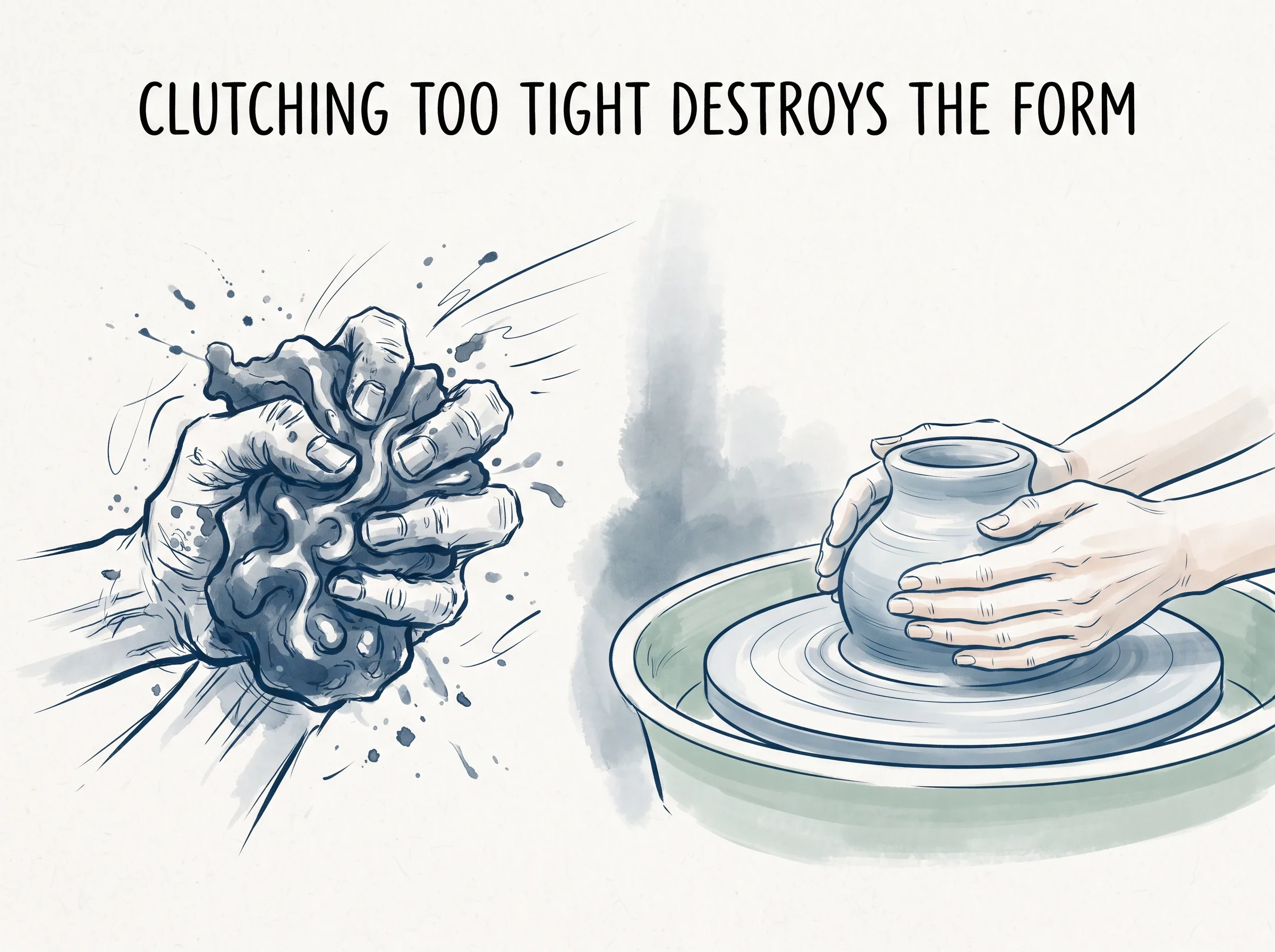
Laozi reached a similar conclusion through observation rather than experiment. He saw that when someone tries to make the world conform entirely to a single design, the result is not order — it is fragility. The more you force a system to look a certain way, the less able it becomes to adapt when conditions change.
"The World Is a Sacred Vessel" — What Laozi Actually Meant
The famous phrase from Daodejing Chapter 29 — "The world is a sacred vessel; it cannot be forced, it cannot be held" (Tiānxià shénqì, bù kě wéi yě, bù kě zhí yě, 天下神器,不可为也,不可执也) — is one of the most frequently cited lines in the Tao Te Ching, though its meaning is often misunderstood. The traditional translation renders it as "Heaven and earth are sacred vessels; they cannot be manipulated, they cannot be grasped." The exact wording varies slightly across manuscript traditions and scholarly editions, and the dating of the text itself remains a subject of academic discussion [1]. What is clearer is the direction of the argument.
Sacred vessel (shénqì, 神器) is commonly translated as "sacred vessel." The word does not carry a specifically religious connotation in this context. Rather, it points to something profound about the nature of the world: it is not a passive object. A vessel can be held, turned, and shaped — but only if it is inert material. The world, Laozi suggests, is different. It has its own rhythms, its own intelligence, its own limits. It responds to pressure in ways that the presser cannot fully predict.
This is not mysticism. It is a recognition of complexity. Every relationship involves two independent beings with their own histories, needs, and trajectories. Every organization contains feedback loops no single person can track. Every body has its own intelligence — it heals, adapts, and sometimes breaks under strain that the mind considers reasonable. None of these systems can be reduced to the will of one operator.
The chapter continues by describing this diversity: some move forward, some follow; some push, some draw back; some are strong, some are weakened; some rise, some fall [1]. The point is not that the world is chaotic, but that it is irreducibly varied. Order does not require uniformity. In fact, order that demands uniformity is usually the order of a cage, not the order of a living system.
Continue with the deeper interpretation and practical application.
ChiDestiny members get access to the full analysis, modern applications, and the growing Chinese Wisdom Library.
FAQ
Does Laozi say we should never try to influence outcomes? No. Laozi distinguishes between action that works with the nature of things and action that forces things against their nature. He critiques the latter, not action itself. The Stanford Encyclopedia of Philosophy notes that wuwei is not total inaction but rather action free from self-serving desire and coercion [1].
Is "the world is a sacred vessel" a religious claim? Not in the context of the Tao Te Ching. The term "sacred vessel" (神器) refers to the world's irreducible complexity and intrinsic order — its capacity to self-organize in ways no single will can fully command. It is a philosophical observation about complexity, not a theological doctrine.
How do I know when I am controlling versus caring? A useful question is whether your action serves the other person's actual needs or your own need for certainty. Control seeks to eliminate variation. Care seeks to support growth, even when growth looks different from what you imagined. If you would withdraw your intervention if the other person was already thriving, your action is likely driven by your anxiety rather than their need.
Can wuwei be applied to professional leadership? Yes. The experimental evidence on organizational controls suggests that restricting autonomy through preventive controls reduces motivation without improving performance [2]. Effective leadership often involves setting clear boundaries and providing feedback — allowing teams to find their own paths within those boundaries — rather than micromanaging every decision.
To explore these themes from another angle, read our related reflection on True Greatness: How to Nurture Without Possessing.
For a deeper comparative examination of these ideas, explore our related study on Why the Empty Center Is What Makes the Wheel Turn — and Why Your Full Life Might Be What’s Keeping You Stuck.
Sources & Further Reading
[1] Stanford Encyclopedia of Philosophy, "Laozi"
[3] "Intrusive Parenting and Adolescent Internalizing and Externalizing Symptoms — Three-level Meta-analytic Reviews Considering Parenting Concepts and Methodology"
Further Reading
- Tao Te Ching, Chapter 29 — various translations, including those by David Hawkes, Stephen Mitchell, and Robert Henricks
- The Stanford Encyclopedia of Philosophy entry on Daoism and Daoist philosophy for broader context on wuwei and related concepts






