
You reach for your phone before you've even opened your eyes. Your calendar is color-coded, your inbox has a number, and when a gap appears between meetings, you fill it before you can even feel the emptiness. This is not laziness. It is a very modern condition: we have become exceptionally good at filling space, and remarkably unsure what to do with the fullness we've created.
When everything is full, why do we feel stuck? It is a question that seems to demand more optimization — another system, another app, another strategy to reclaim time. But two thousand years ago, a text called the Daodejing offered a different kind of answer. It did not come from cosmic theory or abstract mysticism. It came from looking at three ordinary objects sitting in any workshop, courtyard, or kitchen. The answer was built from a wheel, a pot, and a room—a foundational perspective explored in Daodejing Chapter 11.
Daodejing Chapter 11: and What They Share
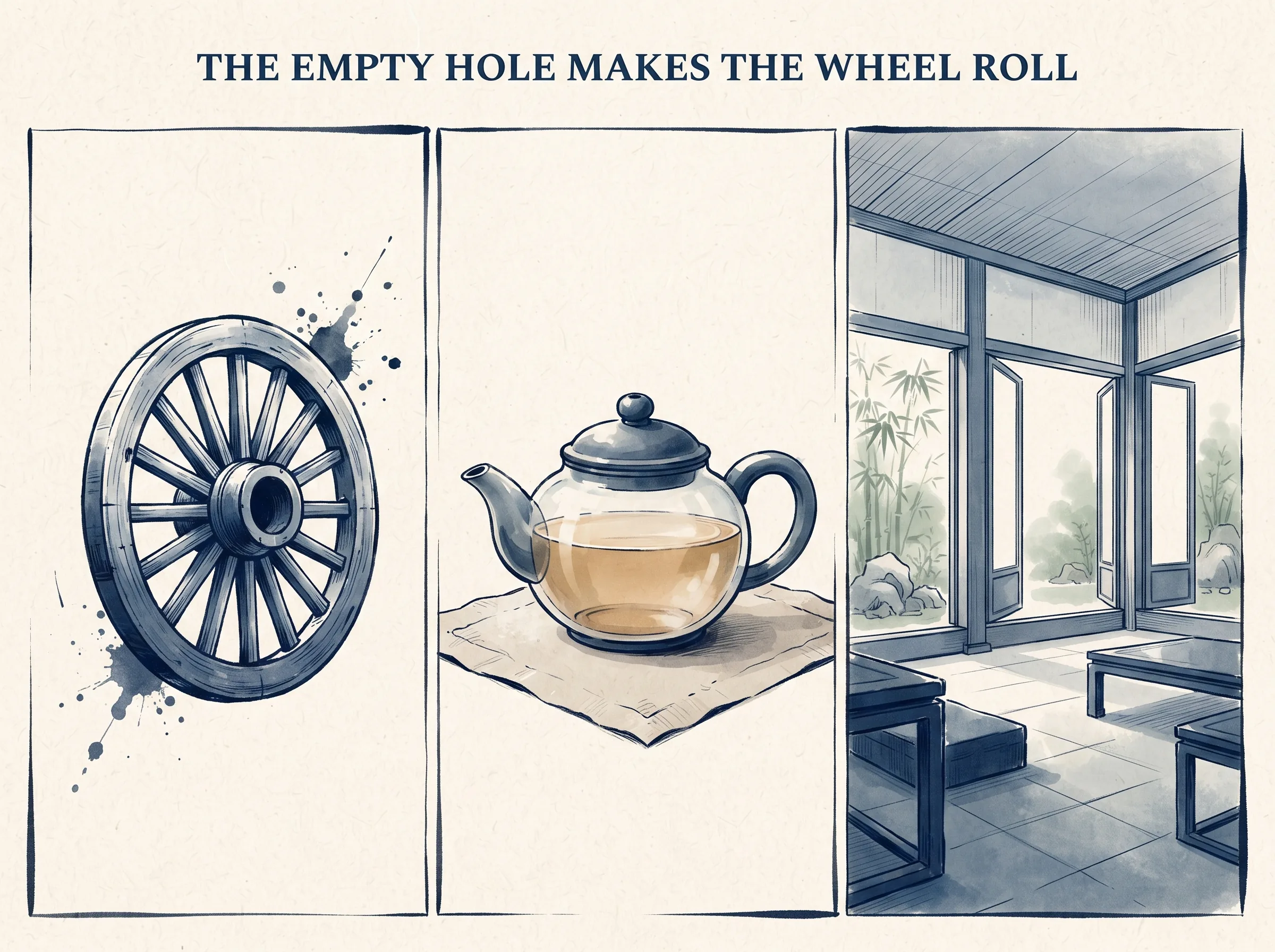
The eleventh chapter of the Daodejing opens with three images that any reader in ancient China would have recognized immediately. The first is a wheel: thirty spokes gathered around a hub, held together by wood and pegs. The second is a vessel: clay shaped by hands, fired in a kiln, becoming a bowl or jar. The third is a room: walls raised, a roof set, doors and windows cut into the structure.
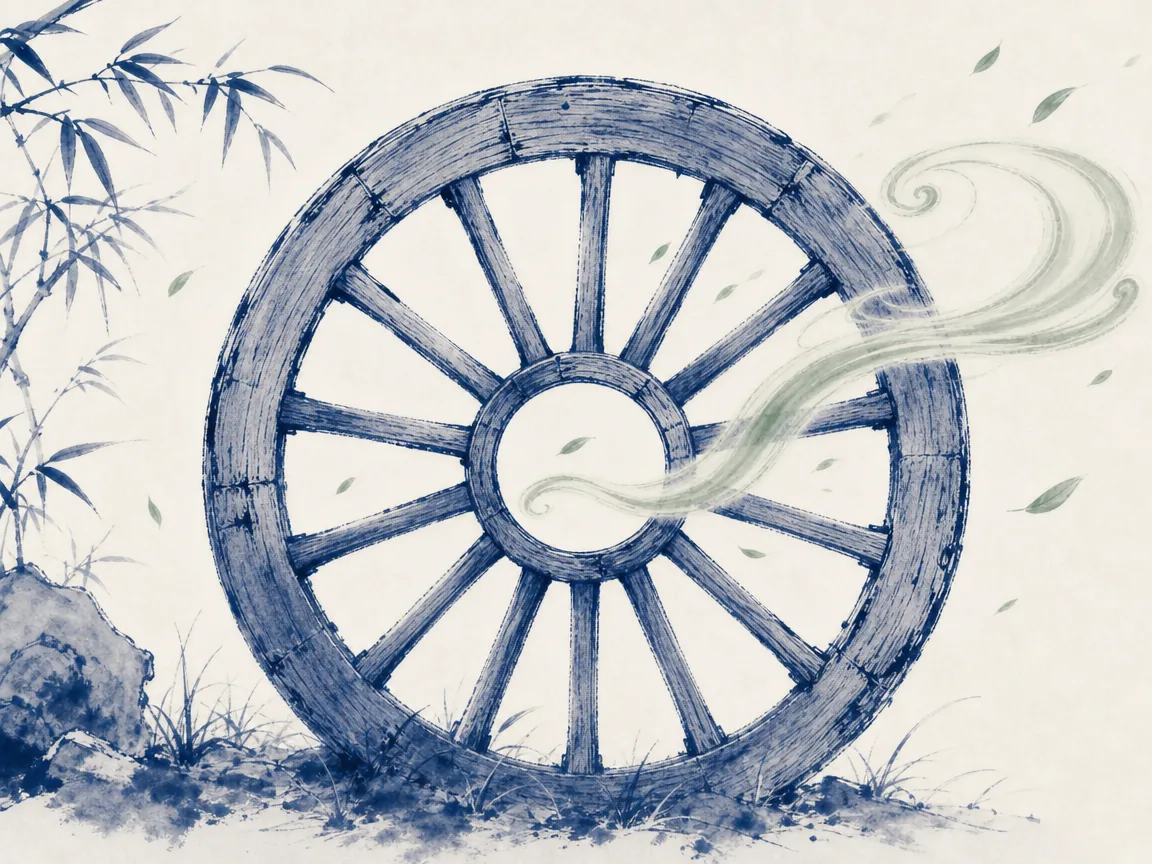
In each case, Laozi draws the reader's attention to what is missing. The wheel turns not because of the spokes or the rim but because of the empty hole in the center where the axle fits. A solid block of wood would be heavy but useless as a wheel. The vessel holds water not because of the clay's thickness but because of the cavity inside. A lump of solid clay has weight and form but no function. The room shelters people not because of the bricks but because of the space between them. A room filled solid with stone cannot house anyone.
The chapter closes with a line that has become one of the most widely discussed in all of Chinese philosophy: "What is there provides advantage; what is not there provides utility" (Yǒu zhī yǐ wéi lì, wú zhī yǐ wéi yòng, 有之以为利,无之以为用) [1]. Laozi is not arguing that nothing is better than something. He is observing that function and life require what is left empty. The solid parts provide boundary and structure. The empty parts provide use. This is a structural claim about how things work, not a moral claim about what to value.
Whether the specific numbers and details in this chapter reflect the exact words Laozi spoke is debated among scholars. The received text of the Daodejing, which is the version most translations are based on, was transmitted through commentaries by Wang Bi and Heshang Gong, and it bears the imprint of later alteration [2]. Earlier manuscript traditions, such as the Mawangdui silk texts and the Guodian bamboo slips, preserve overlapping but differently ordered material [1]. The chapter's core observation — that utility depends on the empty space within a structure — remains recognizable across these traditions even as the exact phrasing and chapter numbering vary.
Continue with the deeper interpretation and practical application.
ChiDestiny members get access to the full analysis, modern applications, and the growing Chinese Wisdom Library.
FAQ
Does Laozi mean we should avoid owning things or building structures?
No. The chapter explicitly acknowledges that the solid parts — the spokes, the clay, the walls — are necessary. Without them there is no form, no boundary, no place to begin. Laozi's point is that solidity alone is insufficient. Structure and emptiness work together. One provides the condition for convenience; the other provides the utility.
Is "emptiness" the same as emptiness in Buddhism or minimalism?
The concept shares surface similarities with later Buddhist ideas of emptiness (śūnyatā) and with modern minimalism, but it is not identical to either. In the Daodejing, the emphasis is structural and practical — what makes a thing function — rather than metaphysical or ethical. Minimalism, as a lifestyle movement, tends to focus on material reduction. Laozi's observation is deeper: even if you keep everything, you still need empty space for it to work.
Can this idea be applied to physical health and mental well-being?
The chapter itself does not address health directly. However, the structural insight — that function requires space — aligns with what we know about rest, recovery, and mental space. Studies suggest that allowing the mind to wander rather than maintaining constant focused attention may support creativity and future planning, though the evidence is limited and conditional [3]. Similarly, research indicates that even the mere presence of a smartphone can reduce available cognitive capacity [4]. These findings are preliminary and specific; they do not prove that emptiness is universally therapeutic, but they point in a direction consistent with Laozi's observation.
Why does this chapter matter today when most of us have never worked with wheels or pottery?
The chapter does not depend on familiarity with ancient craft. Its examples are chosen precisely because they are universal: any civilization that builds anything understands that a container is useful only because it holds empty space. The insight transfers because the structure of the problem is the same. We live in an age of constant addition — more information, more obligations, more stimulation — and the chapter asks a simple, disruptive question: what are you filling that you should leave empty?
To explore these themes from another angle, read our related reflection on Why the Fiercest Fire Burns Out Fastest: Laozi’s Secret to Lasting Vitality.
Deepen your understanding of these principles in our reflection on Why the Desperate Need for Safety Can Become a Trap — Ancient Chinese Wisdom for Modern Life.
Sources & Further Reading
[1] Daode jing — From The Encyclopedia of Taoism — Provides scholarly context on the mutual dependence of opposites in the Daodejing, the chapter structure, manuscript traditions (Mawangdui, Guodian), and the interpretation of the empty center in Chapter 11
[2] Laozi — Stanford Encyclopedia of Philosophy (Spring 2026 Edition) — Discusses the transmission of the Daodejing text through Wang Bi and Heshang Gong commentaries, the uncertainty around authorship and dating, and the concept of wuwei as non-coercive rather than inactive
[3] Mind Wandering Simultaneously Prolongs Reactions and Promotes Creative Incubation — PMC — Experimental research on the trade-off between focused attention and creative incubation during mind wandering, with noted limitations on statistical significance
[4] The Mere Presence of Your Smartphone Reduces Brain Power, Study Shows — UT News — Study of nearly 800 participants showing that smartphone proximity, even when unused, reduces available cognitive capacity
[5] Chinese Text Project — Dao De Jing — Digital access to classical Chinese texts including the Daodejing in multiple versions. (Full chapter text access restricted at time of verification.)
Extended Reading
- The Bilibili commentary on Laozi Chapter 11 · bilibili.com — An interpretive discussion of the chapter's structure and modern relevance. Used as background context only; claims are not independently verified in this article.
- Scholarly translations of the Daodejing by Robert Henricks, Roger T. Ames, and David Hall — for readers interested in comparing how different translators render the key line on having and non-having.







[…] To explore these themes from another angle, read our related reflection on Why the Empty Center Is What Makes the Wheel Turn — and Why Your Full Life Might Be What’s K…. […]
[…] For a deeper comparative examination of these ideas, explore our related study on Why the Empty Center Is What Makes the Wheel Turn — and Why Your Full Life Might Be What’s K…. […]