
A parent who watches their child choose a path they never envisioned may feel a quiet sense of failure, as if something they invested in has slipped beyond their reach. A manager whose team suddenly stalls without their daily input may wonder whether they truly built something lasting or simply created a structure that collapses the moment the center is removed. A friend who offered help during a difficult season may find themselves surprised when gratitude doesn't translate into ongoing loyalty. In each of these situations, the person acting has usually done no wrong. They have given, supported, led, and cared with genuine intention. And yet somewhere along the way, the relationship has shifted from nurturing into something tighter, something that demands return rather than celebrating independence.
We live in a culture that rewards indispensability. Success is measured by how many people depend on us, how many achievements carry our name, how rarely we are replaceable. This is not a new human tendency, but it is one that ancient Chinese philosophy challenges directly. More than two thousand years ago, a text traditionally attributed to Laozi explored a different definition of greatness — one not based on control, possession, or the need to remain at the center, but on the capacity to nurture without owning [1]. The question this tradition raises remains urgently modern: How do we tell the difference between support that frees and support that subtly binds? This principle is central to Daodejing Chapter 34.
Daodejing Chapter 34: Laozi's Redefinition of Greatness
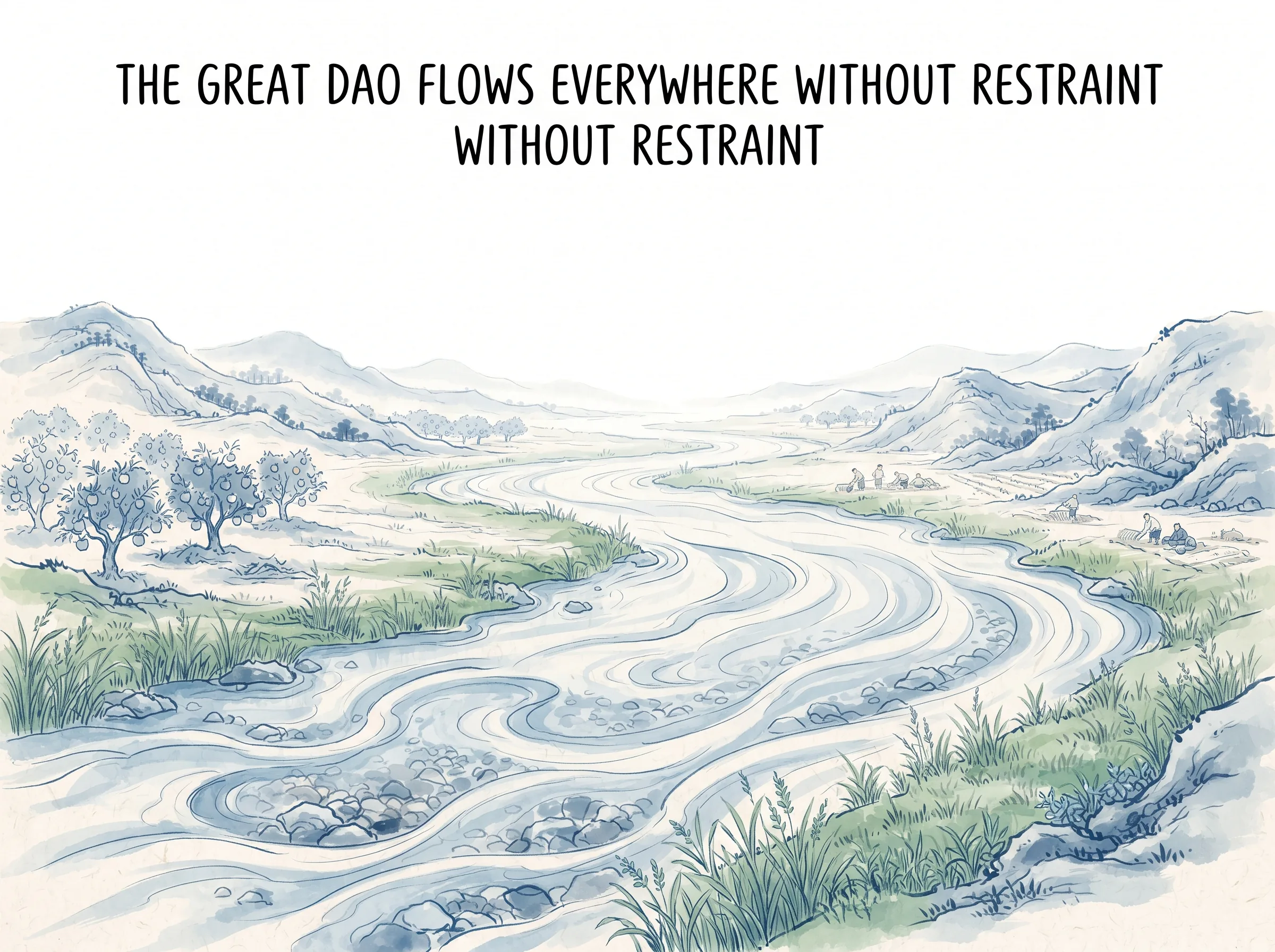
The thirty-fourth chapter of the Daodejing contains one of the most compressed and provocative passages in the Chinese philosophical tradition. Its core vision can be rendered in plain language: the Dao — the fundamental order underlying all things — nourishes everything without claiming ownership, accomplishes without demanding credit, and sustains all life without becoming master over it. A widely referenced translation captures this as "It accomplishes its tasks successfully, Yet does not possess a name. It clothes and supports the ten thousand creatures, But does not act as their master" [1]. The chapter closes with a statement that inverts ordinary thinking: because the Dao never positions itself as great, it truly becomes great [1].
This is not simply an invitation to humility. It is a structural claim about the nature of effective influence. The Dao does not stand outside the world commanding it. It is not a distant ruler dispensing approval or withholding favor. Rather, it operates as the condition through which all things are able to develop according to their own nature. A seed grows because its internal structure meets the right conditions of soil, water, and light. The Dao is that underlying capacity for growth, not a separate agent pulling strings from above. And crucially, it does not stop the seed from growing into whatever it is meant to become — a pine tree, not a rose.
Modern culture tends to conflate importance with centrality. We assume that if someone is truly valuable, they must be constantly present, visibly directing outcomes, and irreplaceable in their role. Laozi's framework suggests the opposite. The most enduring forms of influence are often invisible precisely because they succeed. A teacher who produces independent thinkers has done their work so well that those thinkers no longer need the teacher's authority to justify their own. A leader who builds resilient systems leaves behind an organization that can function without constant direction. Both forms of influence are genuine. Both are also far more difficult to recognize, because recognition requires visibility, and true support often aims to make itself unnecessary.
It is worth noting that scholars have long questioned whether the Daodejing was written by a single historical figure, and the precise wording of individual chapters varies across manuscript traditions [1]****[2]. These are important scholarly caveats. But the conceptual structure of the third-fourth chapter — nurturing without dominating, acting without claiming, achieving greatness through non-egocentric action — is coherent and internally consistent across the major textual witnesses. Whether or not we can pin it to one author, the argument it makes about the nature of mature influence remains philosophically substantive.
Continue with the deeper interpretation and practical application.
ChiDestiny members get access to the full analysis, modern applications, and the growing Chinese Wisdom Library.
FAQ
Q: Does Laozi's teaching mean we should never take credit for our work? No. The Daodejing does not argue that attribution should be abandoned or that contributions should be hidden. It distinguishes between acknowledging what we have done and treating that contribution as permanent ownership over others' lives. Recognizing collaboration and sharing credit are compatible with — and in fact required by — a mature understanding of influence.
Q: How can I tell if my help is actually controlling? One practical indicator is your emotional response when the person you are helping becomes more independent. If their growing self-sufficiency brings you genuine relief and happiness, your support is likely grounded in care. If it brings anxiety, resentment, or a sense of loss, your support may be entangled with a need for continued relevance or control. Another sign is whether you keep score — mentally or explicitly — of what you have done for someone.
Q: Is this philosophy relevant outside of parenting and leadership? Yes. The dynamics of possession and support appear in friendships, romantic relationships, mentoring, creative collaboration, and even our relationship to our own aspirations. Any context in which one person influences another can benefit from asking whether the goal is the other person's flourishing or the preservation of the influencer's central role.
Q: Does "not acting as master" mean I should avoid taking responsibility? No. The Daodejing explicitly describes the Dao as actively sustaining all things. Not acting as master means leading without dominating, guiding without demanding obedience, and taking responsibility without conflating responsibility with control. Accountability and autonomy are not opposites — they can coexist when influence is exercised with respect for the other's capacity to grow, reflecting the enduring wisdom of Daodejing Chapter 34.
To explore these themes from another angle, read our related reflection on The More You Try to Control Everything, the More You Lose It All — Laozi’s Warning for Modern Life.
For a deeper comparative examination of these ideas, explore our related study on Why You Keep Fixing What Only Needs Space.
Sources & Further Reading
[1] The Project Gutenberg eBook of Dao De Jing, by Lao Zi
[2] Laozi (Stanford Encyclopedia of Philosophy/Spring 2026 Edition)
[3] Leader autonomy support in the workplace — A meta-analytic review
Further Reading
- Waley, Arthur. The Way and Its Power: A Translation of the Tao Te Ching — a widely read English translation that provides accessible commentary alongside the text.
- Henricks, Robert G. Lao Tzu: Te-Tao Ching: A New Translation Based on the Recently Discovered Ma-wang-tui Texts — offers comparative analysis of different manuscript traditions.
- Self-Determination Theory resources on autonomy-supportive leadership







[…] The wisdom of Daodejing Chapter 34 Translation addresses a fundamental human dynamic: how we navigate ambition, quietude, and the natural flow of existence. In the classical tradition, this passage serves as both a metaphysical mirror and a practical compass for daily living and leadership. Explore how this principle translates into contemporary daily life in our guide to True Greatness: How to Nurture Without Possessing. […]