
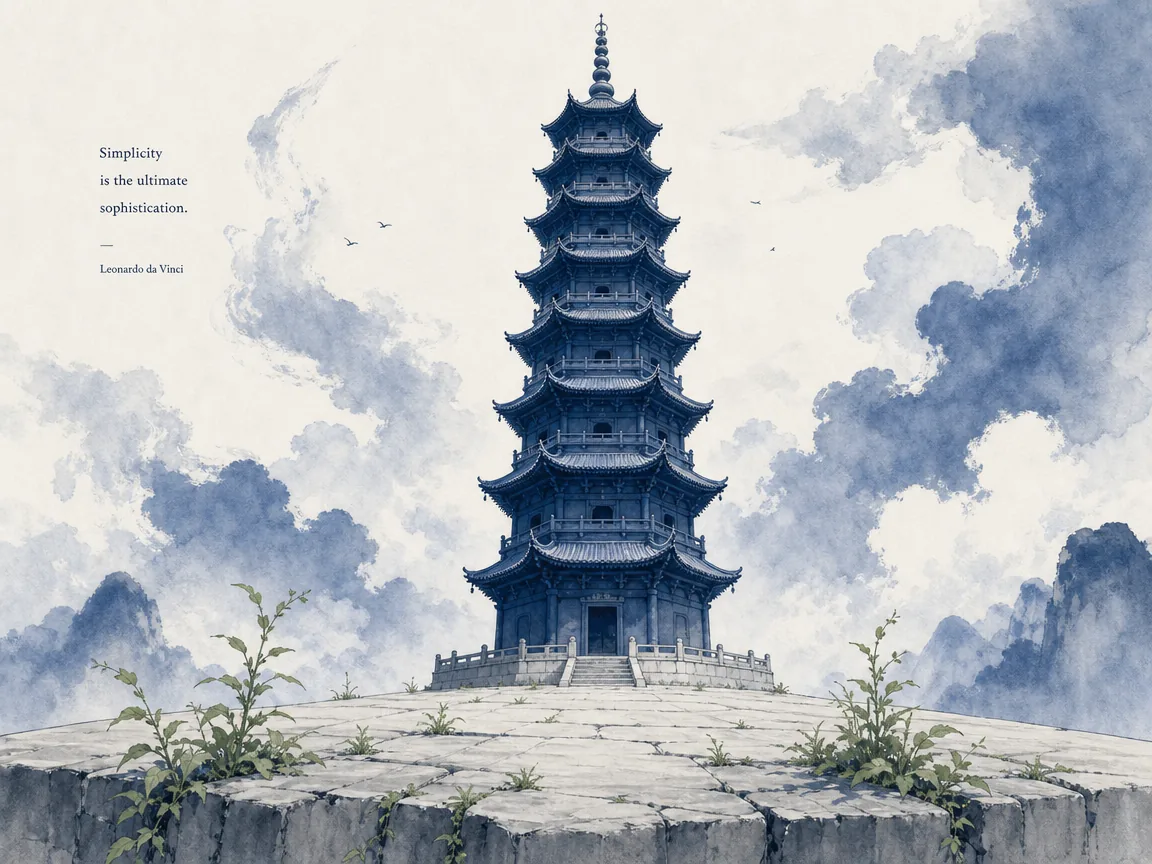
Most people who experience a crisis of confidence do not see it coming. They are climbing. Their job title is advancing, their income is rising, their social circle is expanding, and the external signals all point in the same direction. And yet, deep down, something feels increasingly unstable—as if they are standing on ground that was never properly examined. The disappointment, when it arrives, rarely feels like surprise. It feels like recognition. The person who suddenly finds themselves exhausted after years of burnout, the founder who watches a promising company collapse under its own weight, the relationship that unravels despite appearing perfectly intact—these are not random failures. They are structural ones.
The pattern appears again and again across lives and organizations. Something seems solid from the outside, but the conditions that make that solidity possible are quietly eroding. A career built on momentum without developing real skill. A business scaling faster than its culture or product quality. A reputation sustained by attention rather than character. What collapses is not the visible structure itself. What collapses is the hidden infrastructure holding it up. And the tragedy is not simply that things fall apart. The tragedy is that we often mistake the falling apart for the first sign of trouble, when the real problem began much earlier—a foundational perspective explored in Daodejing Chapter 39.
This is precisely the question that Laozi raises in the thirty-ninth chapter of the Daodejing (Laozi / Daodejing). Rather than begin with individual behavior or moral advice, he moves outward—to heaven, to earth, to spirit, to valleys, to all living things, and only then to human rulers. The reason is deliberate. He is asking something foundational: what actually makes any existence possible? Not what looks impressive. Not what appears successful. What holds it together in the first place. And the answer he offers is both simpler and more unsettling than most of us want to hear. True stability does not come from what you accumulate. It comes from whether you are still tending the conditions that make your accumulation sustainable.
Daodejing Chapter 39: What Holds Anything Together
The chapter begins with a deceptively simple structure. It speaks of heaven, earth, spirit, valleys, all things, and rulers—but always in the same pattern: each one is described as dependent on something deeper. Heaven is not simply "up there." It requires clarity. Earth is not simply "below." It requires stillness. Rulers are not simply powerful. They require legitimacy rooted in something they did not create themselves.
In classical Chinese thought, the term often translated as "the One" does not refer to abstract mysticism or vague spiritual energy. It refers to structural coherence. A thing holds together because it maintains a unified condition that allows its parts to function as an integrated whole rather than as scattered fragments. When a body becomes ill, it is not because one organ separately stopped working. It is because the deeper coordination that makes an organism an organism has begun to fail. When a company loses its direction, it is rarely because the revenue stopped first. It is because the internal alignment between strategy, culture, and execution had already drifted.
What matters is not the result we see. What matters is the underlying condition that makes the result possible in the first place.
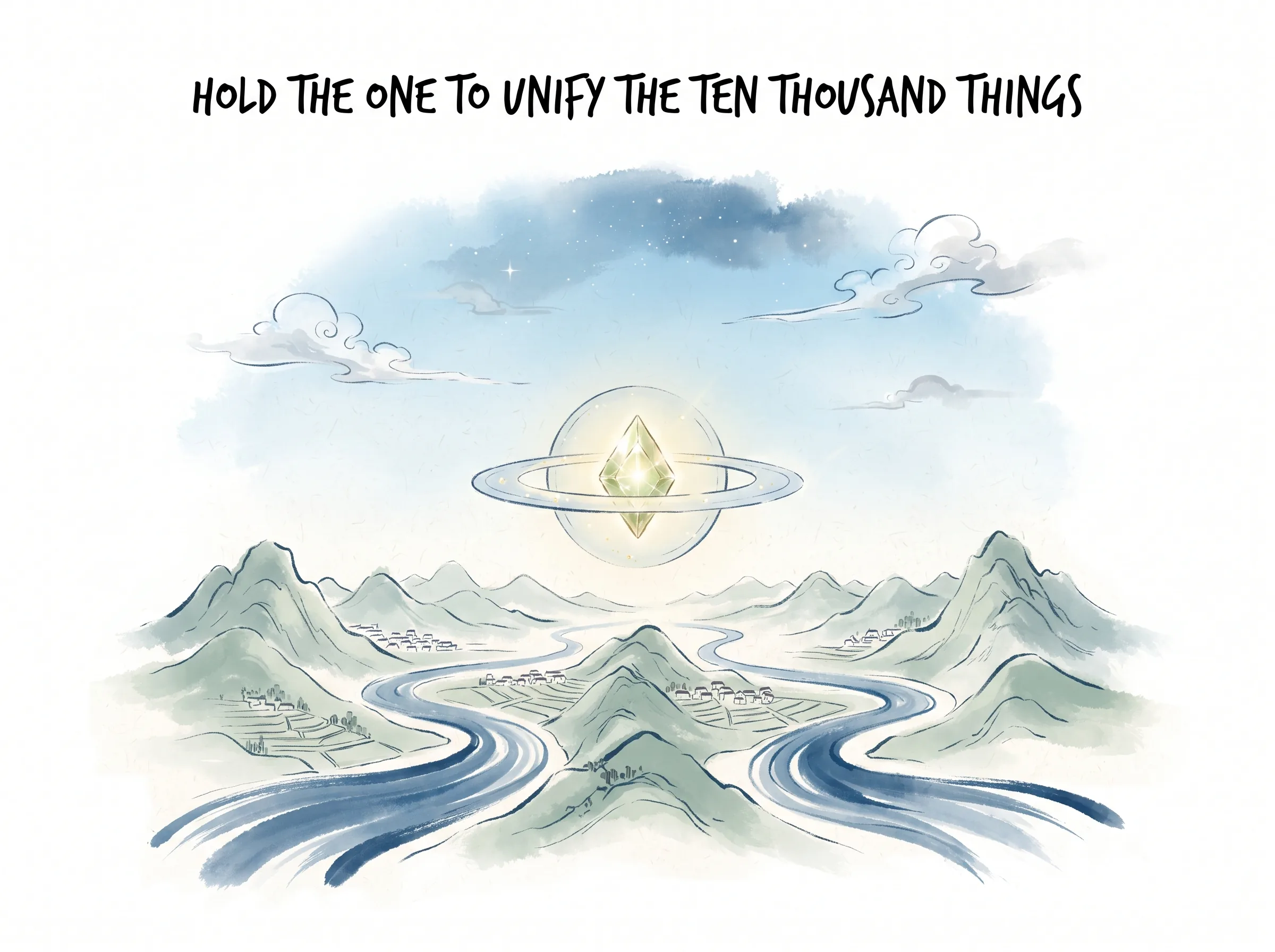
This framing reframes success entirely. We tend to look at achievements as self-generated accomplishments. A promotion feels earned through personal brilliance. Wealth feels like proof of superior intelligence. Influence feels like confirmation of inherent worth. But the text points in another direction. Every visible outcome rests on invisible supports. Health, time, relationships, basic habits, attention, emotional regulation, creditworthiness, genuine skill—these are rarely glamorous. They do not appear on organizational charts or social media profiles. Yet they are what actually sustain everything else.
A Stanford Encyclopedia of Philosophy entry notes that what scholars generally call the Laozi survives through textual traditions that were shaped by centuries of transmission, copying, and commentary [1]. In other words, even the version of the text we read today is itself the product of layers of stewardship. The visible text depends on invisible conditions. That observation applies equally to our lives.
The Danger of Losing the Root
The second half of the chapter shifts tone sharply. Instead of describing what happens when a thing preserves its foundation, it describes what happens when that foundation is lost. Heaven without clarity risks fracture. Earth without stillness risks shaking. Spirit without grounding risks extinction. All things without nourishment risk dying. Leaders without legitimate basis risk severance.
The sequence is deliberately cumulative. It does not begin with rulers. It begins with heaven. That order matters. Laozi is showing that collapse is not a human problem alone. It is a structural problem. When the deepest conditions are compromised, everything built on top of them becomes vulnerable—even if the surface still looks intact.
What makes this pattern especially dangerous is that the erosion is invisible during the early stages. The building is still standing. The business is still profitable. The person is still productive. The relationship is still functional on paper. But the foundation is no longer being maintained. Resources are diverted. Attention shifts away from what matters most. The system begins consuming its own support structures to sustain its visible growth.
This is why failure often feels sudden even when it was never truly unexpected. Collapse rarely begins at the moment of visible breakdown. It begins long before, when the conditions for sustainability are quietly abandoned in favor of maintaining appearance. An employee who stops developing real competence while chasing titles. A founder who optimizes for valuation instead of product quality. A person who sacrifices sleep, integrity, or attention to relationships in exchange for short-term performance. The outer world keeps rewarding the strategy, which makes it harder to notice that the internal structure is hollowing out. For the word-for-word source text and commentary, consult the complete classical translation and commentary of The Root of Order: Attaining the One to Sustain Clarity and Life.
The urgent warning in this chapter is not about failure. It is about premature confidence. The most precarious position is not the one that has already fallen. It is the one that looks strong while losing its root.
Continue with the deeper interpretation and practical application.
ChiDestiny members get access to the full analysis, modern applications, and the growing Chinese Wisdom Library.
Sources & Further Reading
[1] "Laozi" — Stanford Encyclopedia of Philosophy, Spring 2026 Edition. Discusses the textual transmission of the Daodejing, including the Wang Bi and Heshang Gong traditions, variant readings, and the history of the received text.
Further Reading (Yánshēn Yuèdú, 延伸阅读)
- The Daodejing (Laozi) in multiple English translations, including those by Robert Henricks, Walter Welch, and Roger Ames and David Hall, each offering different interpretations of key passages such as Chapter 39.
- Studies on textual variation in early Chinese manuscripts, including the Mawangdui silk texts and their implications for understanding the development of the Daodejing.






