
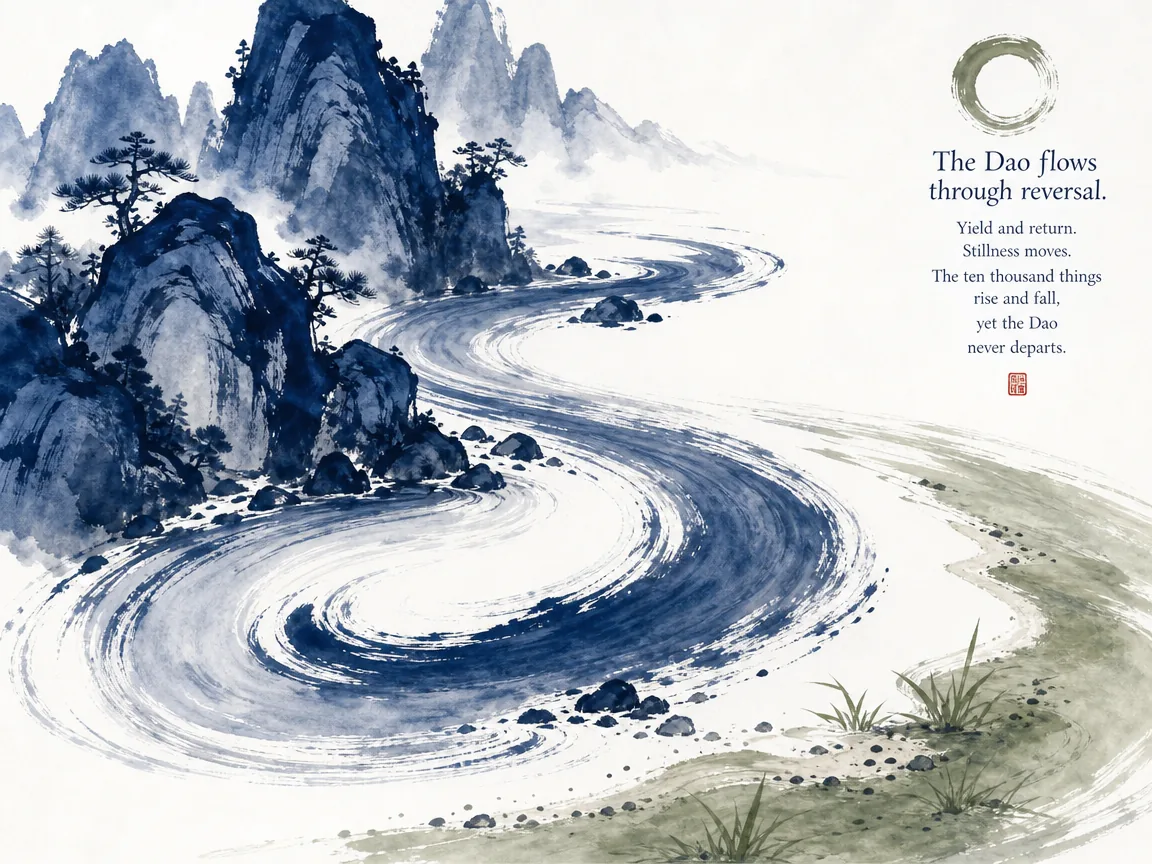
There is a cultural script that most of us have absorbed without noticing. When something feels off — a project stalled, a relationship strained, a sense of exhaustion creeping in — the default response is to push harder. Work longer. Move faster. Do more. This logic feels obvious because it is everywhere: in corporate culture, in social media, in the quiet voice that tells us we are never quite doing enough. Yet for all that effort, many people find themselves running in place, drained and uncertain.
Ancient Chinese philosophy offers a different answer. Rather than seeing forward motion as the only path to change, one of its most enduring traditions suggests that real transformation often comes from going back — returning to what is fundamental, stepping out of the cycle of constant striving, and allowing clarity to emerge from stillness instead of force—a foundational perspective explored in Daodejing Chapter 40.
This idea appears most clearly in the writings attributed to Laozi, a figure whose Tao Te Ching has guided readers for over two millennia. Though the exact authorship and composition of the text remain debated among scholars, the philosophical core that emerges is remarkably consistent: the natural world operates through cycles of return, and human life follows the same pattern [1]. What looks like retreat from the outside may, in fact, be the most honest form of progress.
Daodejing Chapter 40: Running Faster, Getting Nowhere
The message is relentless. More hours. More output. More ambition. The equation seems simple: if you are not getting results, you are not trying hard enough. But the experience of so many people tells a different story. Burnout is not a personal failure; it is a structural one. The World Health Organization recognises burn-out as an occupational phenomenon resulting from chronic workplace stress that has not been successfully managed [2]. It is not classified as a medical condition, which is telling — the problem is not inside the individual, but in the conditions that exhaust them.
Consider the typical pattern. A professional takes on more responsibilities, answering emails late into the night, attending back-to-back meetings, saying yes to everything because saying no feels like falling behind. A student piles on extra courses, side projects, and certifications, convinced that each additional item will somehow close the gap between where they are and where they think they should be. A person in a strained relationship keeps trying harder to fix it — more conversations, more apologies, more effort — while the underlying disconnection grows.
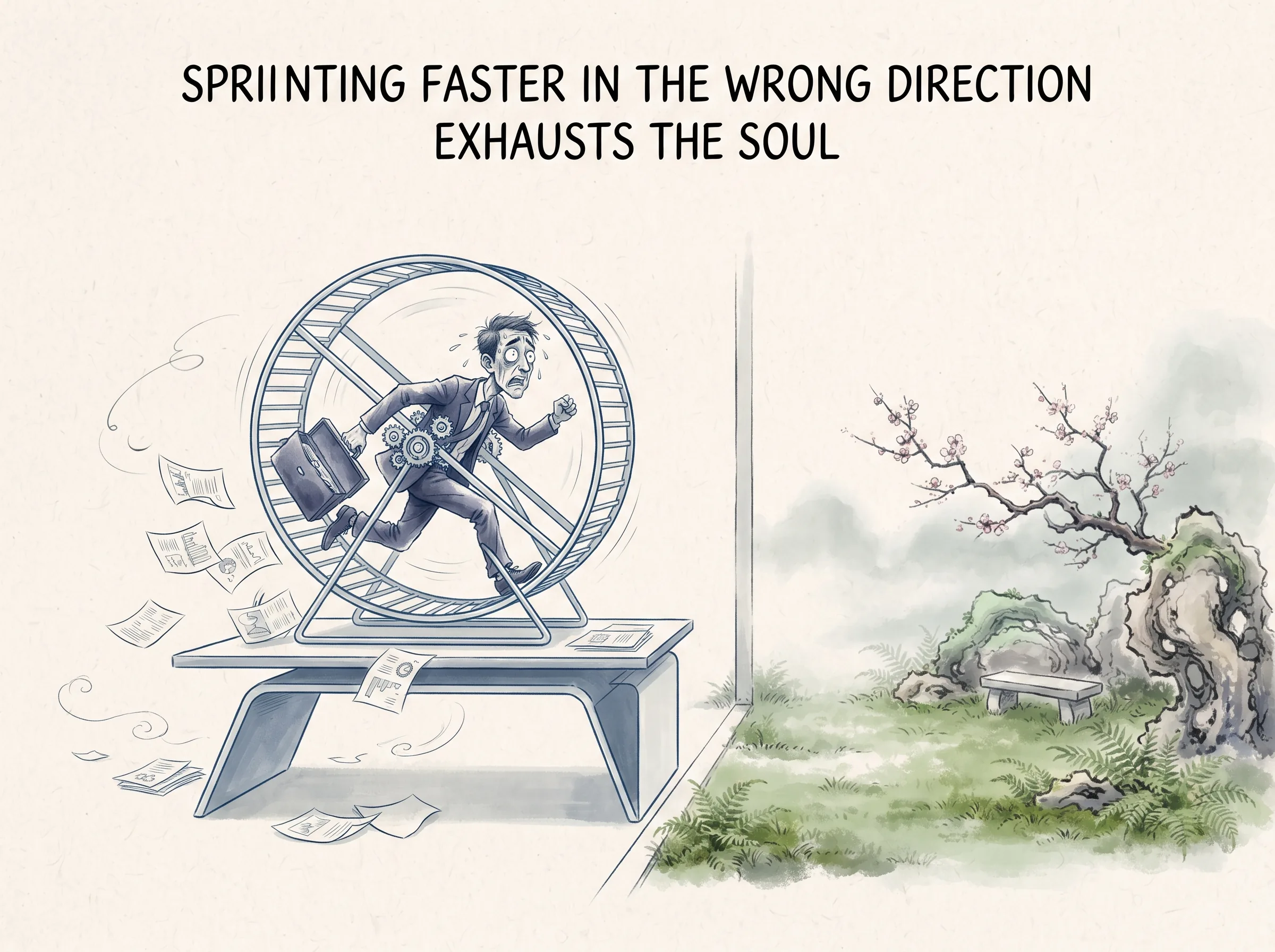
The paradox is that the harder we push, the less grounded we become. We confuse activity with progress. We mistake speed for direction. And when the expected results do not arrive, we respond by pushing even harder, deepening the cycle. This is not a matter of willpower. It is a matter of understanding what actually produces change.
Continue with the deeper interpretation and practical application.
ChiDestiny members get access to the full analysis, modern applications, and the growing Chinese Wisdom Library.
FAQ
Is "returning to the root" the same as giving up? No. Returning is a deliberate strategy, not surrender. It means redirecting energy toward what sustains you rather than exhausting yourself against what is not working. Giving up abandons the situation. Returning changes the approach.
Does this mean I should never work hard or strive for goals? No. The teaching is not anti-effort. It is anti-force. There is a difference between committed action and compulsive striving. The former is chosen; the latter is reactive. Laozi's point is that the most effective action often comes from a place of clarity and stillness, not from panic and hurry.
How is this different from Western self-help advice about slowing down? The distinction is subtle but important. Many Western approaches frame slowing down as a productivity tactic — rest so you can perform better. The ancient Chinese wisdom frames returning as a philosophical stance about how reality actually works. It is not a technique to optimise output; it is an understanding of where change comes from. The practical effect may look similar, but the foundation is different.
Where can I learn more about this idea in the original texts? The Tao Te Ching contains multiple passages on returning, simplicity, and non-forcing. Different translations and scholarly editions vary in wording and interpretation. For readers interested in exploring further, academic commentaries and comparative translations can provide helpful context for understanding how these ideas have been read across different periods and traditions.
What Comes Next
The idea that real change comes from returning to the root is not a quick fix. It is a shift in orientation — from believing that forward is the only direction to recognising that backward, inward, and downward are also paths toward transformation. In a world that rewards speed, choosing slowness is radical. In a culture that values more, choosing less is revolutionary.
If this resonates with you, the next step is not to read more. It is to try one thing. Identify the area where you are pushing hardest, and experiment with stepping back — even for a day, even for an hour. See what emerges. You may find that the root was closer than you thought, and that returning was always part of the way forward.
Discover the historical and philosophical roots in the classical foundation in Returning to the Root: Attaining Utmost Emptiness and Observing the Cycle.
For a deeper comparative examination of these ideas, explore our related study on Why Great Achievement Looks Imperfect — Laozi’s Lesson for Modern Success.
Sources & Further Reading
[1] Laozi (Stanford Encyclopedia of Philosophy/Summer 2017 Edition).
[2] Burn-out an occupational phenomenon. World Health Organization.






