
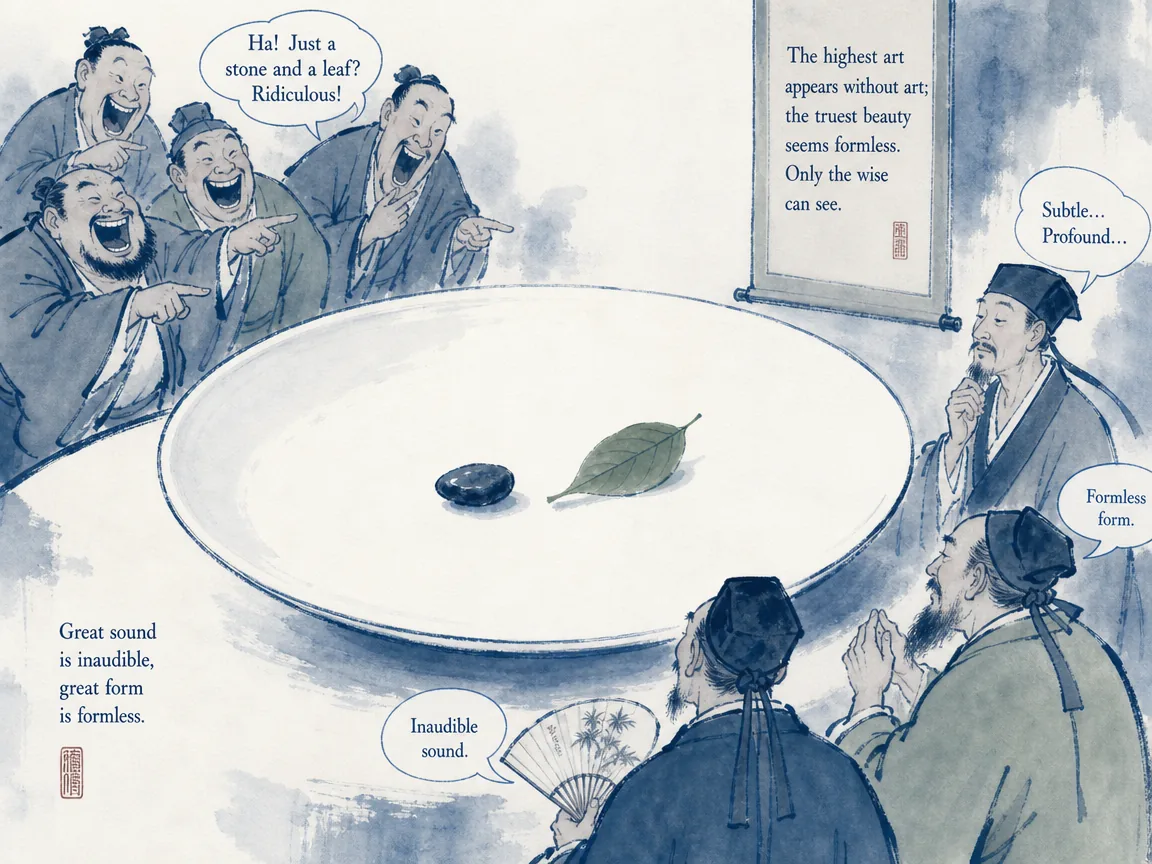
We grow up learning a simple rule: if something is true, it should look like something true. The strong should appear powerful. The wise should sound clear. The valuable should be visible. Progress should be measurable. This is a practical instinct — our brains need categories to navigate the world, and labels help us move through it efficiently. But every once in a while, we encounter an idea so deeply contrary to that instinct that our first reaction is dismissal, or worse, laughter.
Laozi wrote nearly 2,500 years ago about exactly this phenomenon. In the 41st chapter of the Daodejing, he does not begin with mystical declarations or abstract cosmology. He begins with a question that still divides how people receive insight: when someone hears a principle that overturns their deepest assumptions about success, what happens next? Some act on it immediately. Some hesitate. Some laugh. The difference, Laozi suggests, is not primarily about intelligence. It is about how much of their existing value system they are willing to let change—a foundational perspective explored in Daodejing Chapter 41.
This matters more today than ever. We live in an age obsessed with metrics — follower counts, growth rates, visible achievements, immediate results. The loudest voices seem the most credible. The fastest-moving projects appear the most promising. But Laozi's 41st chapter insists that the world often works in ways that deliberately refuse to announce themselves loudly. What looks like a step backward may be the only honest forward move available. What appears dim may be the clearest way. And the wisdom that sounds most absurd to our current measure may be the one that matches reality most closely.
Daodejing Chapter 41: The Three Kinds of Listeners
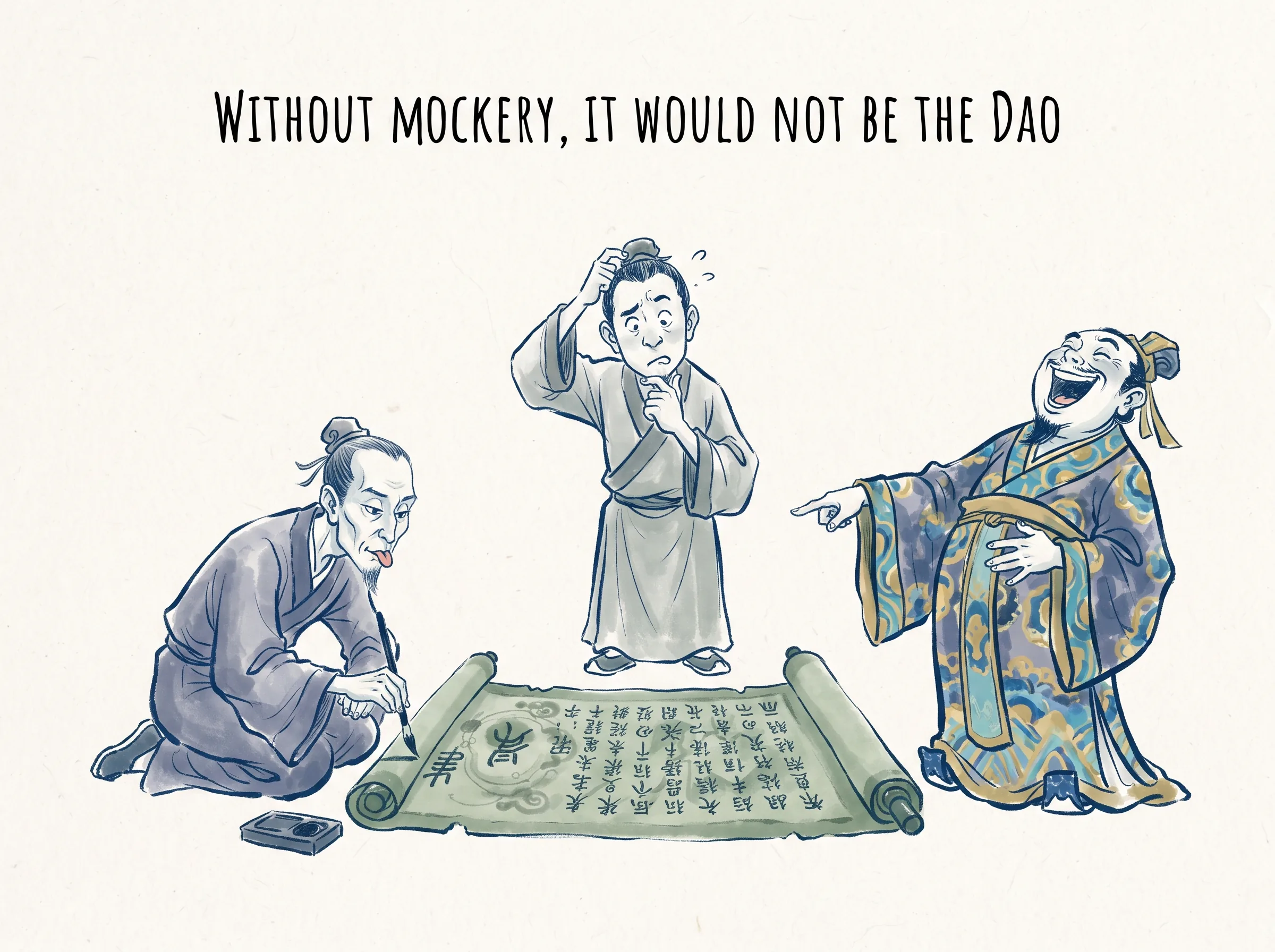
Laozi opens the 41st chapter with one of his most compact portraits of human nature: "The superior person hears the Way and diligently acts on it. The average person hears the Way and treats it as if it exists and does not exist. The inferior person hears the Way and laughs loudly at it. If it were not laughed at, it would not be the Way" [1].
These three types are not simply a hierarchy of intelligence. They are a map of how deeply an idea can penetrate a person's life system. The superior listener is rare not because understanding is difficult, but because genuine action on principle requires acting against one's own conditioning when real pressure arrives. The average listener understands something in calm moments but falls back into old patterns when circumstances shift. This "as if it exists and does not exist" state describes a person whose new insight has entered their awareness but has not yet reorganized their behavior. The inferior listener's laughter is not mockery of wisdom itself — it is proof that the wisdom threatens their entire framework.
The gap between hearing and doing is where most insight dies. Many people can recite dozens of useful ideas — long-term thinking, emotional regulation, the value of slowness — yet live exactly as before. The problem is not that the ideas are false. The problem is that the person's deeper value system was formed over years of feedback from family, school, culture, and reward structures. A single principle entering the mind does not instantly dismantle that architecture. This is why Laozi describes the average listener with four precise words: the insight is present one moment and absent the next, depending on whether the environment supports it or challenges it.
Continue with the deeper interpretation and practical application.
ChiDestiny members get access to the full analysis, modern applications, and the growing Chinese Wisdom Library.
FAQ
Is Laozi saying we should intentionally act against common sense? No. Laozi is not advising contrarianism — treating the opposite of what everyone believes as automatically correct. That would simply flip the binary without transcending it. The chapter asks us to examine the scale we are using, not to reverse every conventional judgment. Sometimes going forward really is the right move. Sometimes retreating really is wise. The point is to judge from a structure wider than the immediate appearance, not to adopt an opposite set of rules.
Does "the inferior person laughs loudly" mean foolish people should not read philosophy? Not at all. The "inferior listener" is not a permanent identity but a momentary state anyone can occupy. When a new idea threatens your deepest assumptions, the defensive laugh is a natural first response. Laozi's point is diagnostic, not exclusionary. The real question is what happens after the laugh — do you close the door, or do you let yourself reconsider the scale you were using?
How does this apply to decision-making in business or leadership? Many organizational failures come from mistaking short-term visibility for long-term health. A company that expands rapidly to meet quarterly targets may look successful until structural strain becomes undeniable. A leader who centralizes every decision appears in control until the system cannot function without them. Laozi's framework encourages leaders to ask: am I building something that depends on my constant presence, or something that can grow autonomously? The former feels like power. The latter is closer to what the chapter calls "nourishing and bringing to completion."
What about the textual variants in this chapter — does it matter which version I read? The variants, particularly around "late completion" (dà qì wǎn chéng, 大器晚成) versus variants (dà qì miǎn chéng / màn chéng, 大器免成/曼成), are real and noted by scholars [7]. They matter for textual accuracy and reveal how the tradition understood the passage differently over time. But for the reader's purpose, both readings point toward the same insight: what is genuinely great resists quick formation and fixed definition. Whether the vessel is "late completed" or "never finally completed," the implication is that depth cannot be rushed.
The 41st chapter of the Daodejing does not offer a new set of rules to replace the old ones. It offers something more demanding: a way of seeing that refuses to confuse the map with the territory. When the wisest principles appear to contradict everything we have been taught about success, progress, and strength, the first response should not be dismissal — nor should it be eager adoption. The more disciplined response is to ask what scale we are using, whether that scale is wide enough, and whether what we are seeing is the whole structure or only its surface.
The next step is not to memorize the chapter's statements but to practice the pause. The next time something looks like failure, ask whether it might be recalibration. The next time something looks like the truth, ask whether your categories are ready for it. The next time you feel the urge to laugh at an idea that contradicts your assumptions, consider — however briefly — that the laugh might be the measure, not the idea, reflecting the enduring wisdom of Daodejing Chapter 41.
To explore these themes from another angle, read our related reflection on The Surprising Power of Going Back: What Laozi Knew About Real Change.
For a deeper comparative examination of these ideas, explore our related study on Subtle Radiance: The Soft and Yielding Overcoming the Hard and Strong.
Sources & Further Reading
[1] Digital Classic Website / Laozi Daodejing (數位經典網站/老子道德經) — Chapter 41 (Wang Bi Commentary) [2] Guodian Bamboo Slip Laozi Research (郭店简书《老子》研究) — jianbo.net [3]: Laozi, Daodejing Chapter 41, Wang Bi edition, as cited in Chinese Classic Website. [4]: Guodian Bamboo Slips research, as discussed in jianbo.net forum thread on Guodian Laozi studies. [5]: Scholarly discussion on textual variants of "late completion" (dà qì wǎn chéng, 大器晚成) vs. variants (dà qì miǎn chéng / màn chéng, 大器免成/曼成), referenced in Guodian research materials. [6]: Wang Bi's commentary on Daodejing Chapter 41, as preserved in Chinese Classic Website edition. [7]: Comparative textual notes on Mawangdui silk texts and Guodian bamboo slips, as referenced in academic discussions of Laozi variants.







[…] The wisdom of Daodejing Chapter 41 Translation addresses a fundamental human dynamic: how we navigate ambition, quietude, and the natural flow of existence. In the classical tradition, this passage serves as both a metaphysical mirror and a practical compass for daily living and leadership. Explore how this principle translates into contemporary daily life in our guide to Why the Highest Things Look Opposite to Everything We Know. […]