
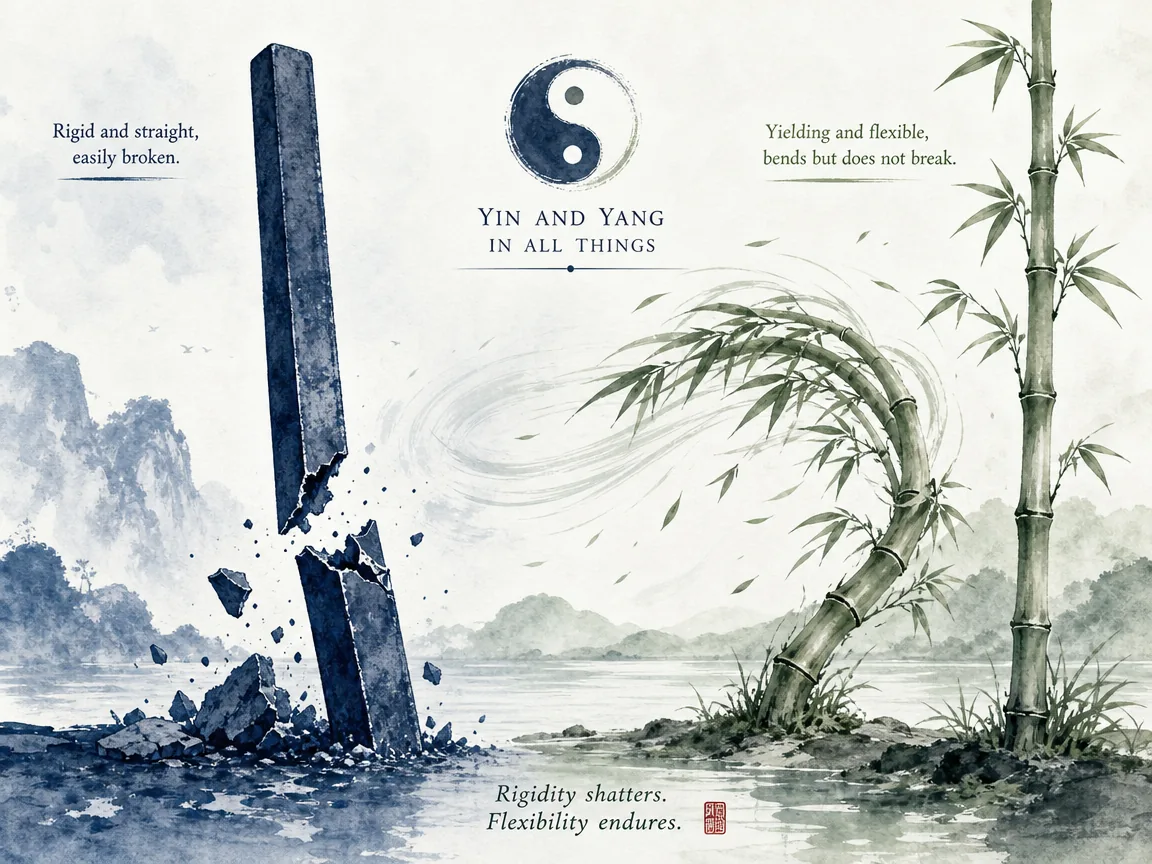
There is a quiet contradiction that appears again and again in human affairs. The most aggressive expansions — of power, of territory, of market share, of influence — tend to carry within them the seeds of their own undoing. Speed creates blind spots. Centralization silences corrective feedback. Dominance breeds resistance. This is not a moral warning about hubris; it is a structural observation about how systems behave when one pole monopolizes the space that once held them in relationship.
Ancient Chinese philosophy offers some of the sharpest articulations of this pattern, and none is as concentrated or as counterintuitive as In Daodejing Chapter 42 of the Daodejing (often translated as the Classic of the Way and Its Power). At first reading, the chapter looks like a collection of five separate sayings: a cosmological opening about the origin of the cosmos, a note about yin and yang, a political gesture by rulers who call themselves "the orphan, the poor, the insufficient," a remark on the nonlinear logic of gain and loss, and a stark closing line — "The forceful do not meet a natural end." Many readers treat each sentence as an independent pearl of wisdom. But the chapter works differently when read as a single argument. It moves from cosmology to social observation to political warning as one logical chain, asking the same question at every level: what allows something to keep generating, and what destroys that condition?
For modern readers — whether managing organizations, building ventures, navigating relationships, or simply trying to live with a clearer sense of what sustains rather than what exhausts — the central insight is practical. Sustainable strength requires maintaining relationship, not eliminating it.
Daodejing Chapter 42: From Unity to Difference to Relationship
The chapter opens with one of the most discussed passages in all of Chinese philosophy: "The Way produces One, One produces Two, Two produces Three, Three produces all things." These lines are easy to misread if we approach them as a cosmic recipe — as though the text is describing a sequence of objects coming into existence in order. But the passage is not about manufacture; it is about generation. The Chinese term for "produces" (sheng) does not imply a creator bringing objects into being like a craftsman assembling parts. It means something closer to "gives rise to" or "makes possible."
The difficulty with reading "One, Two, Three" as literal numbers becomes clear almost immediately. If the Dao (often translated as "Way" or "Path") were simply another object in a sequence — the first thing produced before everything else — we would have to ask what produced the Dao. And if One, Two, and Three were distinct substances, we would need to explain how a third substance could serve as a universal generative matrix for the infinite variety of the world. The text offers no such account, precisely because it is not offering a material genealogy. It is mapping a structure of dependence.
What allows us to move past the literal reading is the rest of the chapter itself. The next line — "All things carry yin and embrace yang, and through the interaction of their energies they achieve harmony" — already reframes what "Two" means. The "Two" is not a mysterious second object; it is differentiation. The passage is saying that unity, if it remains absolutely undifferentiated, produces nothing concrete. Something becomes something specific only when distinctions emerge. Cold requires heat to be noticed. Pressure requires release. A boundary requires what it is not.
But difference alone is not enough. Two extremes can simply sit opposite each other in mutual exclusion or mutual destruction. That is why the text does not say "One produces Two, Two produces all things." It inserts "Three" between them. And "Three" is the hardest word in the chapter to pin down precisely.
Scholars have offered several interpretive traditions. One reads "Three" as the harmony produced by the interaction of yin and yang — the qi (vital energy) that flows between opposing tendencies and creates a workable whole. Another tradition identifies "Three" as heaven, earth, and humanity — a triad deeply embedded in later Chinese thought. A third approach notes that in classical Chinese, "Three" can function as an indeterminate plural, signaling the move from simple structure to complex multiplicity rather than pointing to any specific set of three entities. None of these readings can claim to be the single correct one, and the text itself does not resolve the ambiguity. What they share is the recognition that between differentiation and diversity, something must happen — a relationship, a channel, a space of exchange. Without that third term, the system stalls.
This is where the chapter's philosophical depth meets something surprisingly close to what modern systems thinking calls emergence. A team's capacity is not the sum of individual talents. An ecosystem depends not on species count alone but on interaction patterns — predation, pollination, decomposition, symbiosis. Two companies with resources do not automatically create a market; a market emerges only when exchange rules, feedback channels, and shared expectations come into being. The point is not that Laozi anticipated systems theory. It is that the structural observation — relation is not reducible to its terms — is independently recognizable across different frameworks.
The insight matters because it reframes how we understand strength. Strength is not a property of isolated entities. It is a property of organized relations. An entity that tries to sustain itself by silencing the very relationships that make it viable is arranging its own fragility, regardless of how impressive it appears on the surface.
Continue with the deeper interpretation and practical application.
ChiDestiny members get access to the full analysis, modern applications, and the growing Chinese Wisdom Library.
Sources & Further Reading
[1] Laozi — Stanford Encyclopedia of Philosophy (Spring 2008 Edition) — Provides the scholarly overview of the Daodejing's authorship, dating, and textual history, noting the lack of consensus among researchers on key questions about the work's origins and composition.
Further Reading
- Translations of the Daodejing by Roger T. Ames and David L. Hall, Heinrich Zimmer, and D.C. Lau offer accessible entry points into different interpretive traditions.
- The Zhuangzi extends many of the relational themes explored in the Daodejing, particularly in its critiques of fixed categories and its emphasis on spontaneous adaptation.
- Modern systems theory and complexity science provide parallel frameworks for understanding emergence, feedback loops, and the structural risks of centralization — not as verification (yànzhèng, 验证) of ancient thought but as independent traditions that converge on similar observations.






