
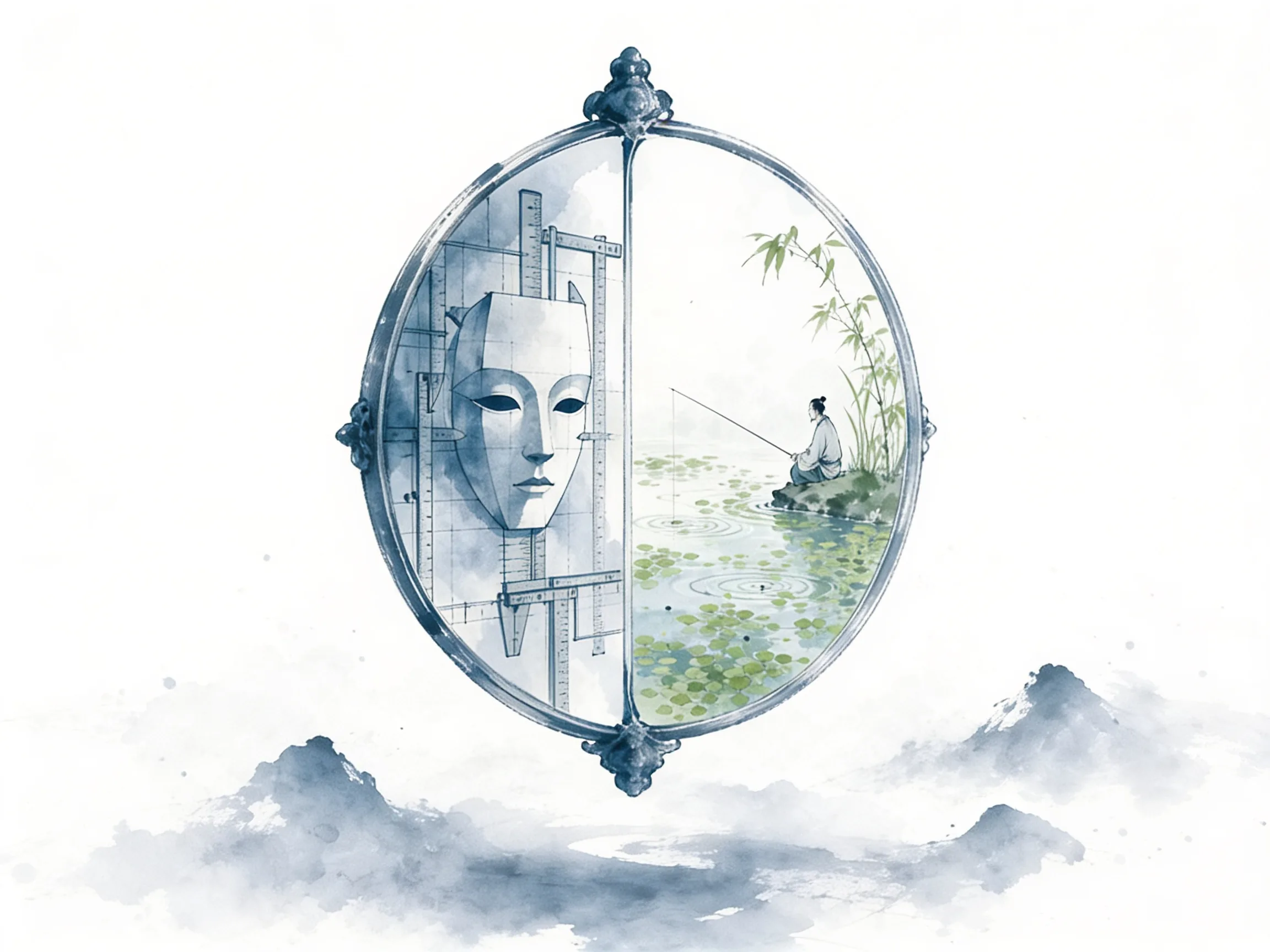
You open your phone. A dozen lives flash by — sharper faces, brighter vacations, smoother careers, calmer routines. By the time you lock the screen, something heavy settles in your chest. Your own life was perfectly ordinary five minutes ago. Now it feels insufficient. You did not cross a line from contentment to want. Someone else's highlight reel simply crossed yours — and your mind translated that meeting into a personal failure.
This is not a modern invention. It is a very old pattern, dressed in new technology. Two millennia ago, Laozi wrote one of the most precise diagnoses of this condition in human history. His observation is simple and devastating: When the whole world recognises beauty as beauty, ugliness comes into being. He was not saying beauty is bad. He was saying that once a standard becomes collective, its shadow is manufactured automatically. Ugliness does not arrive on its own. It is produced by the very act of naming, ranking, and chasing a single version of what counts as beautiful, successful, or good—a foundational perspective explored in Daodejing Chapter 2.
What follows is not a rejection of ambition or taste. It is an invitation to see the machinery behind the mirror. The anxiety that accompanies constant comparison is not proof that your life is inadequate. It is evidence that you are running on someone else's evaluation system — and those systems are designed to never let you finish.
Daodejing Chapter 2: The Relational Nature of All Judgments
Laozi's second chapter does not begin with a prescription. It begins with an anatomy lesson. After the famous opening line about beauty and ugliness, he lists a chain of paired opposites:
Existence and non-existence give rise to each other. Difficulty and ease complement each other. Length and shortness shape each other. Height and lowliness lean toward each other. Sound and voice harmonise with each other. Front and back follow each other.
This is not mere poetic parallelism. It is a structural claim about how meaning works. None of these concepts has independent substance. "High" means nothing without "low." "Long" collapses into nonsense without "short." The moment you accept a single metric — beauty, success, excellence — you have implicitly accepted the entire binary system that comes with it.
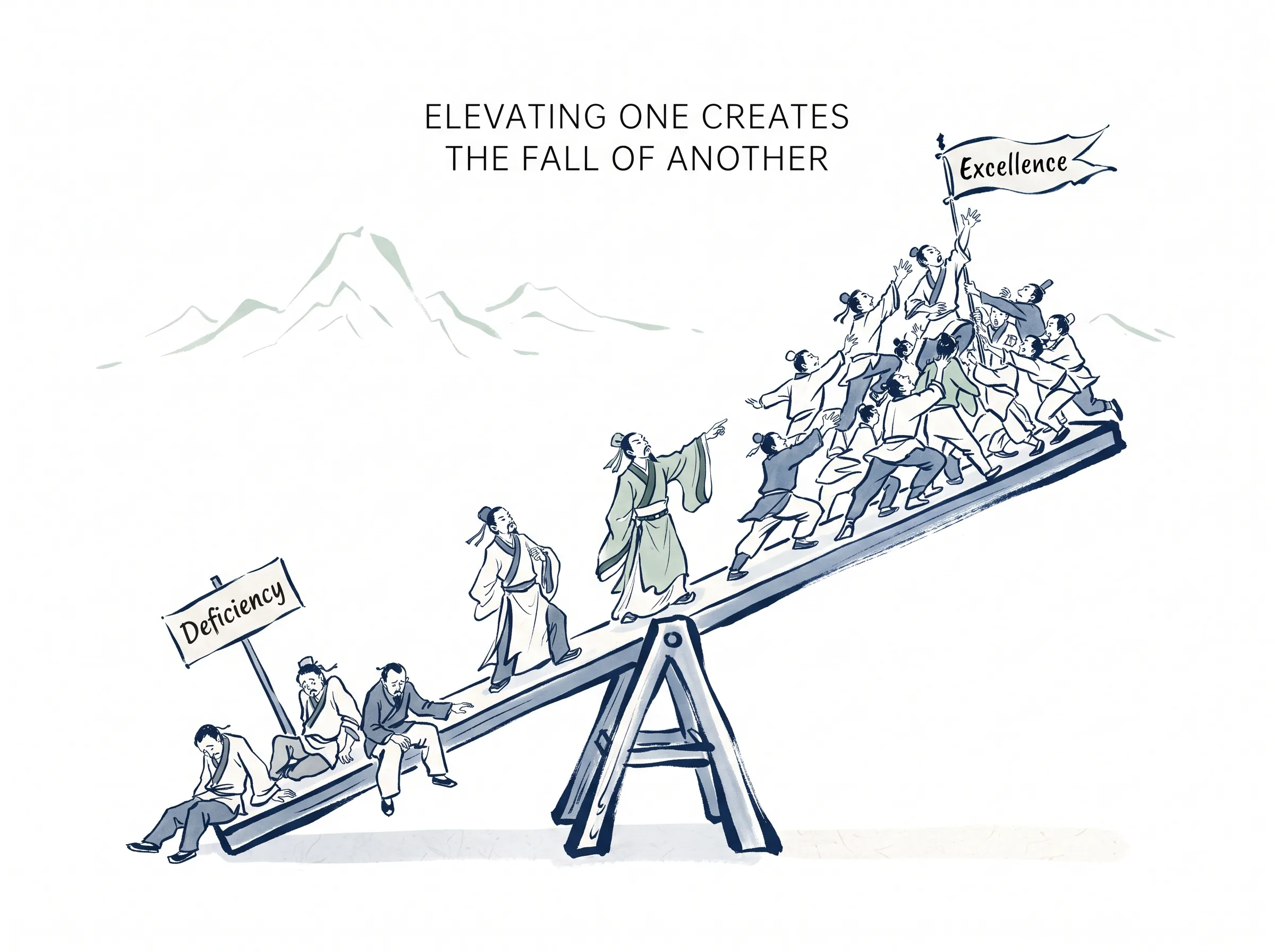
Modern life is saturated with these metrics. Social media platforms are engineering marvels of relational evaluation. Every post is a data point waiting to be ranked. Every profile is a candidate for comparison. What makes this particularly exhausting is that the competition is not between people and reality, but between people and an image of people — a curated, filtered, algorithmically amplified version of the very same thing.
The trap is not that comparison exists. It is that we forget its constructed nature. A ranking is a frame, not a fact. When a platform presents you with someone's best moment alongside your ordinary Tuesday, it is not showing you truth. It is showing you a mismatch of frames — one compressed, one unfiltered. And yet the nervous system responds as though it were real deprivation.
Laozi's contribution was to insist that we remember the frame. When a value is collectively fixed, its opposite is mass-produced. When "success" is standardised, "failure" becomes the default shadow. The solution is not to stop evaluating — no society can function without some sense of order — but to stop mistaking the map for the territory. An evaluation is a tool. It is not the self.
The Shadow Behind Shared Values
Every civilisation builds its towers and its ruins from the same materials. What differs is not the raw stuff, but the blueprint. When a culture agrees on what beauty, success, or goodness looks like, it does not merely create a positive ideal. It simultaneously manufactures everything that falls outside that ideal. The shadow grows in proportion to the light.
Consider aesthetic anxiety. It is not a new condition, but it has acquired an industrial scale. Beauty standards have moved from local customs — passed down through families, reinforced by community elders — to globalised templates, distributed through algorithms that optimise for engagement, not well-being. The result is not simply a narrower range of acceptable appearances. It is a widespread internalisation of the belief that one's natural self is a problem to be solved. The body becomes a project, not a home.
Consider moral performance. When goodness is treated as social capital — something to display, accumulate, and trade for respect — it ceases to be genuine compassion and becomes identity maintenance. The person who performs virtue to avoid suspicion is not living ethically. They are managing perception. Laozi foresaw this dynamic precisely: When the whole world recognises goodness as goodness, ungoodness comes into being. Once goodness becomes a label to be claimed, its opposite — whether real or imagined — becomes a target for displacement.
History offers no shortage of examples where cruelty operated under the banner of virtue. This is not cynical generalisation. It is one of the most consistent patterns in human organisation: the more certain a group is of its own correctness, the more likely it is to treat dissenters, outsiders, or simply different ways of living as threats to be neutralised Laozi's warning is not that virtue is dangerous. It is that virtue, when fused with collective certainty and institutional power, generates its own shadow — and that shadow often suffers far more than anyone opposing it ever would.
The modern reader may find this analysis unsettling, not because it is novel, but because it feels accurate. Social comparison is no longer confined to the village square. It is personalised, quantified, and delivered to your pocket in real time. The anxiety it produces is not a character flaw. It is a rational response to an irrational environment — one engineered to keep you hungry. For the word-for-word source text and commentary, consult the complete classical translation and commentary of Cultivating the Self: The Harmony of Opposites and Wordless Teaching.
Wuwei: Acting Without the Anxiety of Control
The concept of wuwei (无为) is one of the most misunderstood in Chinese philosophy. In casual English rendering, it is often translated as "non-action" or "doing nothing," which invites the impression that Laozi advocated passivity or retreat. The evidence does not support this reading. Scholars such as those contributing to the Stanford Encyclopedia of Philosophy note that wuwei is better understood as "non-coercive action" or "non-assertive action" — action that does not force, dominate, or impose one's will destructively on the natural unfolding of things
What does this look like in practice?
A parent raising a child with wuwei does not abandon guidance. They stop treating the child as an extension of parental ambition. The difference between nourishing and controlling is subtle but consequential. One supports growth within its own rhythm. The other tries to accelerate, shape, and direct according to an external template. Children raised under constant parental projection often learn not who they are, but how to perform for approval — a skill that serves them briefly and imprisons them for decades.
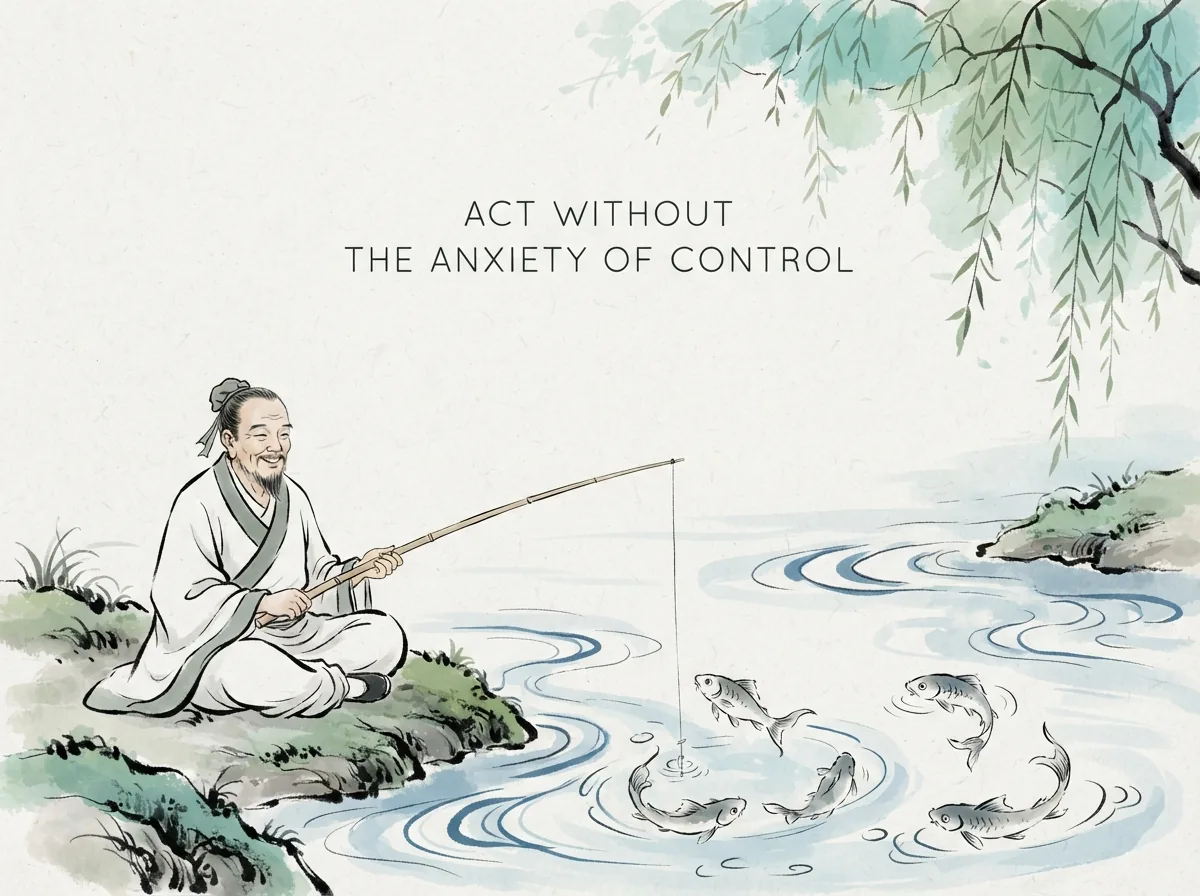
A leader practising wuwei does not absence-manage. They build structure, clarify expectations, and cultivate trust so that people know where to direct their effort without needing surveillance. Low-level management relies on presence, noise, and correction. High-level management creates conditions in which correction becomes unnecessary. The best teams are not the ones most closely watched. They are the ones that know why they are working and feel safe enough to work honestly.
In relationships, wuwei asks us to examine a difficult question: how much of our love is affection, and how much is possession? The desire to hold someone close is not the problem. The problem is the anxiety that says, if I am not constantly securing this person, I will lose them. That anxiety produces behaviours — monitoring, guilt-tripping, over-investing — that are indistinguishable from control. Laozi would not call this love. He would call it fear wearing love's costume.
The principle extends beyond these three domains. Any action driven by anxious forcing — rushing what needs time, performing what should be lived, claiming what should be shared — is a form of wuwei's opposite. Not because the action is wrong, but because the inner state corrupts the outer result. A career built on visibility rather than substance will collapse when the attention fades. A relationship maintained through performance rather than presence will suffocate under its own weight. A life organised around external validation will shatter the moment the validation stops.
Wuwei is not the absence of effort. It is the presence of alignment. It asks not what can I achieve? but what needs doing, and can I do it without demanding the world conform to my anxiety?
Nurturing Without Possessing
The final movement of Laozi's second chapter is perhaps the most psychologically precise passage in the entire Dao De Jing:
Generates but does not possess. Acts but does not rely. Achieves but does not dwell.
Each phrase describes a different failure mode of the modern personality. The first addresses creation without ownership. The second addresses effort without entitlement. The third addresses accomplishment without self-attachment. Together, they form a portrait of maturity that runs counter to nearly every signal our culture sends us.
Consider the first: generates but does not possess. Parents generate children. Teachers generate understanding. Leaders generate organisations. Artists generate work. In each case, the generous impulse is real. But generosity becomes entanglement the moment the generator insists on owning the generated. A child who is treated as a personal project — a reflection of parental success, a vessel for unresolved ambition, a insurance policy against irrelevance — is not loved. They are managed. The same applies to students who are expected to make their teachers look good, to employees who are told that loyalty to the leader matters more than loyalty to the work, to collaborators whose contributions are absorbed into someone else's narrative.
The psychological trap is straightforward: when action is tied to expected return, the actor becomes a slave to outcomes. Everything is conditional. Love depends on performance. Effort depends on recognition. Relationship depends on gratitude. This is not connection. It is transaction disguised as care.
The second phrase — acts but does not rely — warns against making the self dependent on external acknowledgment. A person who needs their effort to be seen, credited, and rewarded is one missed opportunity away from collapse. Their sense of worth oscillates with circumstance. Praise inflates them. Silence deflates them. Criticism destroys them. This is not resilience. It is fragility dressed in productivity.
The third phrase—achieves but does not dwell—is the most countercultural of all. We are taught to regard achievement as the goal. Laozi suggests instead that achievement is a moment, not a mansion. The danger of dwelling on past success—described in the original material as zhi gong (执功), “clinging to merit,” though this may reflect a transcription error—is that we become curators of our own history rather than participants in the present. We measure every new situation against a former high and resist adaptation because it would mean relinquishing an identity that once served us. Past achievements should enrich the depth of a life; when grasped too tightly, however, they become a prison of identity.
This is not ancient wisdom speaking only to ancient problems. It is a diagnosis of the LinkedIn generation — the culture of personal branding, the portfolio self, the individual who cannot distinguish between what they have done and who they are. When self-worth is fused with external markers — title, salary, follower count, reputation — any fluctuation in those markers becomes an existential threat. The capable person, in Laozi's sense, is not the one who accumulates the most achievements. It is the one who can succeed and let go, advance and retreat, be seen and return to obscurity, without losing centre.
Practical Steps Toward Liberation from Comparative Suffering
Laozi does not offer comfort. He offers clarity. The practical work, then, is not to become less ambitious but to become more conscious — of where ambition comes from, what it is serving, and whether the cost is worth the gain. The following steps are distilled from the second chapter's logic, adapted for contemporary life.
1. See through the relativity of value judgments. Beauty, success, and goodness are not natural kinds. They are cultural agreements, and like all agreements, they can be revised. When you feel inadequate, ask: Whose standard is this? The answer is rarely your own. More often, it belongs to a platform, an industry, a generation, or an invisible committee that convenes only in advertising and algorithmic feeds. Recognising this does not make the feeling disappear immediately. It does make it intelligible. And intelligibility is the first step toward freedom.
2. Recognise the constructed nature of comparison structures. High and low, early and late, fast and slow — these are positions within a chosen frame, not properties of reality. A person who appears "behind" in one timeline may be exactly where they need to be in another. The error is not that comparison exists. The error is believing that any single comparison frame is neutral or universal. It is not. It is a lens, and every lens distorts.
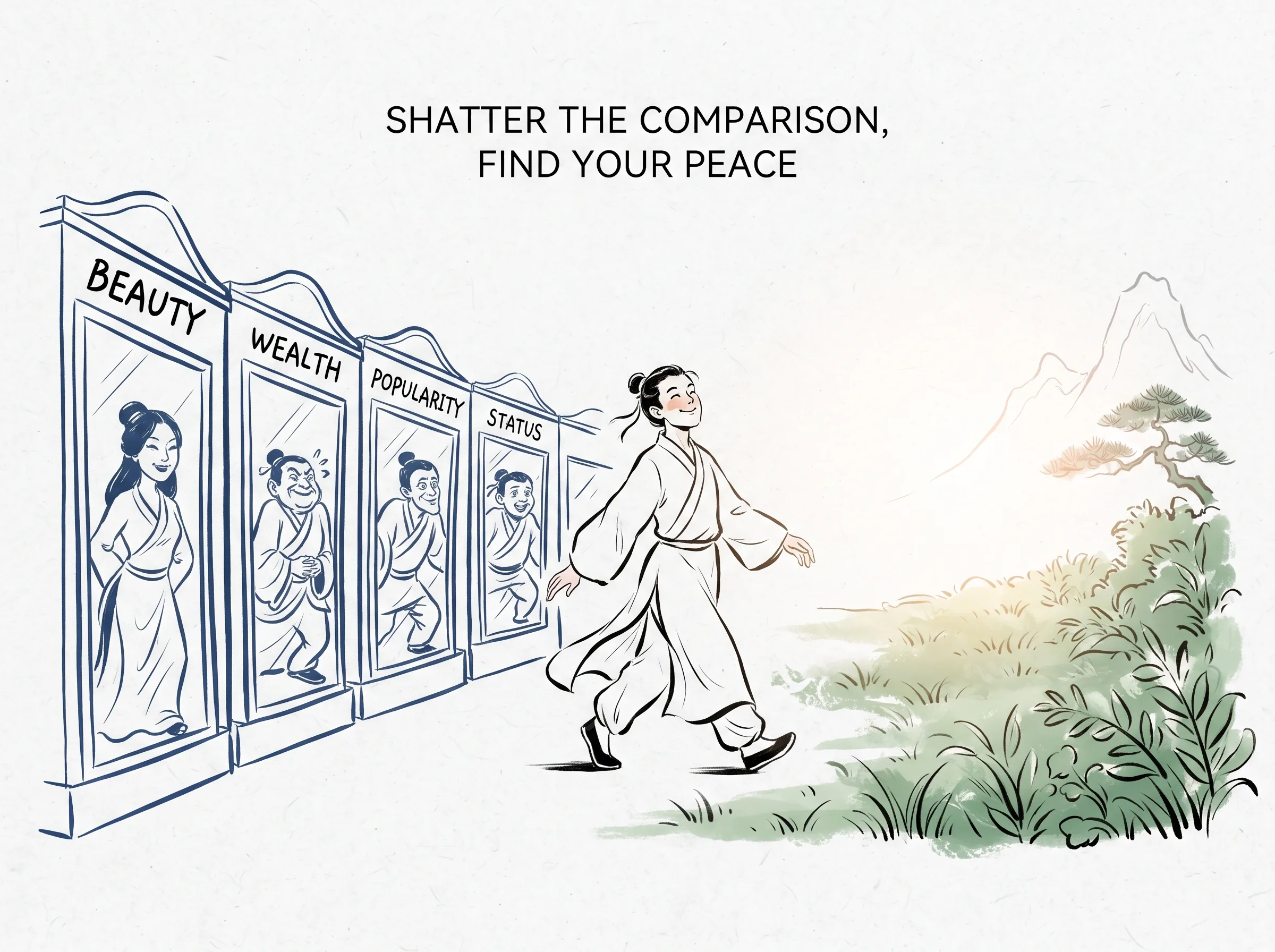
3. Act with reduced coercive will. Do what needs doing. Teach what needs teaching. Lead where leadership is required. But do not rush what grows in its own time. Trees are not accelerated by pulling on their branches. Relationships are not deepened by forcing intimacy. Careers are not secured by performing busyness. The difference between wuwei and passivity is this: wuwei acts, but does not force. It participates in the unfolding rather than attempting to override it.
4. Let results belong to results. When a project is finished, let it be finished. When a relationship changes, let it change. When a chapter closes, close it. The habit of dwelling in past achievement — converting former success into a permanent identity — is one of the most common sources of midlife rigidity. The capable person succeeds, learns, and moves. The stuck person succeeds, freezes, and repeats.
These steps are not a programme. They are an orientation. The goal is not to eliminate ambition but to free it from anxiety. The goal is not to reject comparison entirely — that would be impractical in a social species — but to stop allowing comparison to determine self-worth. You can compete without being consumed. You can strive without mistaking the prize for the person. You can appreciate beauty without weaponising ugliness against yourself.
Laozi's second chapter, read through this lens, is not a relic. It is a manual. Its pages are worn not because the text is old, but because the problem it describes is still unsolved — and still solvable, one clear-headed (qīngxǐng, 清醒) moment at a time.
FAQ
Is wuwei the same as laziness or giving up? No. In classical Daoist thought, wuwei means acting without coercive control, anxious forcing, or the imposition of one's will on the natural unfolding of things. Scholars such as those contributing to the Stanford Encyclopedia of Philosophy describe it as "non-assertive" or "non-coercive action" rather than inaction It is effort without the neurosis of effort.
Does Laozi want us to stop pursuing beauty, success, or goodness altogether? No. Laozi's point is not that these qualities are worthless, but that any quality elevated to an absolute standard generates its opposite. The pursuit is not banned. The blindness to the shadow is. The invitation is to pursue without being consumed by the pursuit.
How do I know whether my anxiety comes from real need or from comparison? A useful test: ask whether the desire persists when no one else is watching. If the desire vanishes when privacy is absolute — when there is no audience, no benchmark, no possibility of recognition — it likely originated in comparison, not in genuine need. This is not a call to reject all social reference. It is a call to notice which desires serve you and which serve the system.
Can these ideas apply to people who are genuinely disadvantaged — not just socially anxious? Yes, and this is where careful reading matters. Laozi's analysis targets the psychological mechanism of comparison, not the material conditions of inequality. Someone facing real poverty, discrimination, or systemic exclusion is not comparing their way into suffering. They are suffering because structural conditions deprive them of resources and opportunity. The Daoist insight applies to the mind's response to those conditions — finding steadiness, acting without desperation, refusing to internalise the hierarchy — but it does not replace the need for material change.
The external definitions of beauty, success, and goodness are not lies. They are partial truths — useful in limited contexts, destructive when mistaken for wholeness. Laozi saw this two thousand years ago. He did not say the world should have no standards. He said standards should serve life, not replace it.
The next step is not to abandon ambition but to audit it. Whose voice is speaking when you feel inadequate? What system am I running right now? Which desires are mine, and which were inherited? These are not easy questions. They are necessary ones. And the answer to each one brings you, however slightly, closer to a life that is yours — not the version others edited, but the one you live, reflecting the enduring wisdom of Daodejing Chapter 2.
To explore these themes from another angle, read our related reflection on Why Trying Harder to Control Everything Backfires — And What Ancient Wisdom Says Instead.
For a deeper comparative examination of these ideas, explore our related study on Why Striving Harder Often Costs Us Everything — And What Water Can Teach Us.
Sources & Further Reading
[1] Stanford Encyclopedia of Philosophy — Laozi — Authoritative scholarly overview of Laozi's thought, including discussion of wuwei and the textual tradition.
[2] Chinese Text Project — Dao De Jing (道德经) — Standard received text of the Dao De Jing, traditionally attributed to Laozi, with parallel manuscript versions.







[…] To explore these themes from another angle, read our related reflection on The Trap of Defined Beauty: How External Standards Steal Our Peace — A Reading of Laozi Chapter 2. […]