
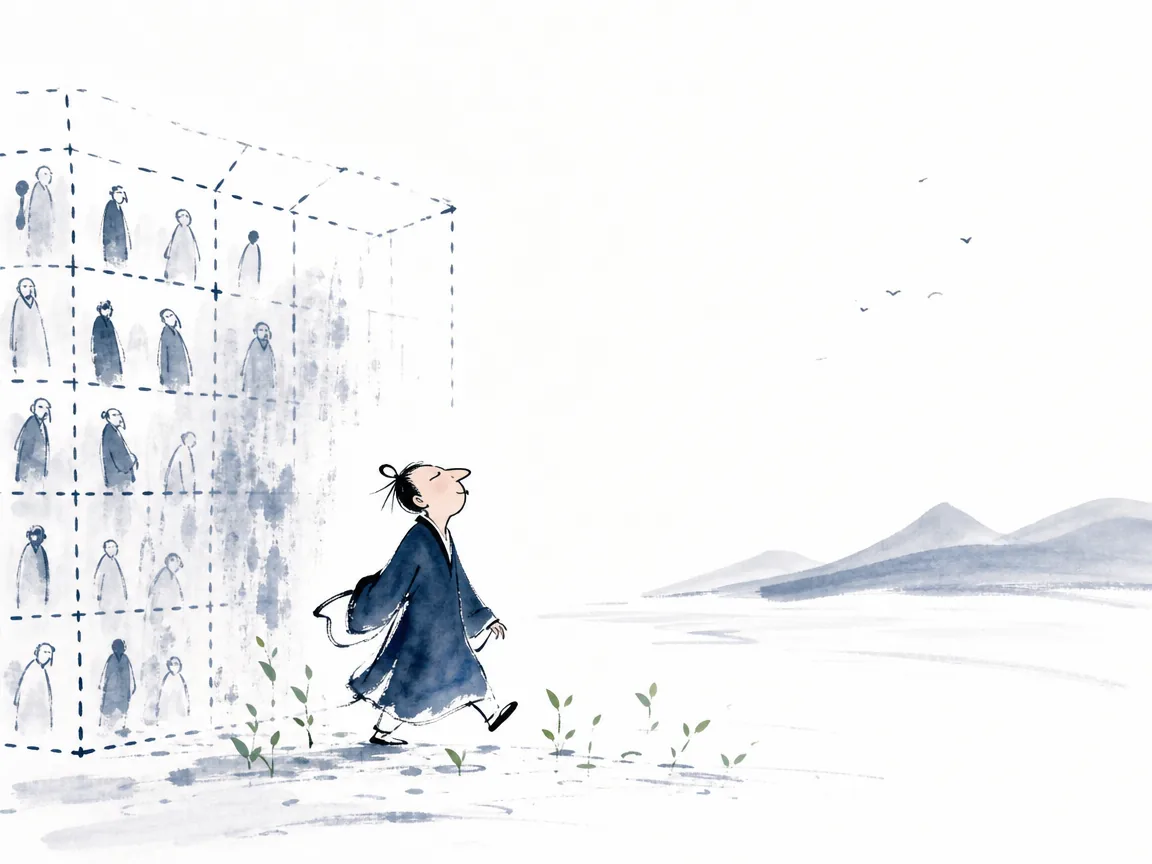
You know the feeling. You open social media and immediately assess yourself: how many followers, how polished is the profile, what does the career headline say, how does it compare to everyone else's? At work, you carry a title that feels like a costume you're afraid to take off. In relationships, you're defined by roles—partner, parent, employee, friend—with expectations attached to each one. The more precisely you are labeled, the more you seem to shrink inside. Somewhere between the name people give you and the name you give yourself, something vital goes missing.
This is not a new problem, though it has acquired new machinery. The Daode jing (Tao Te Ching) is an ancient Chinese text whose authorship and date have been debated by scholars, but which preserves wisdom shaped over centuries [1]. Its opening line—one of the most famous in world philosophy—reads in one common translation: "The Tao that can be spoken is not the eternal Tao; the name that can be named is not the eternal name." What the text points to is strikingly relevant today. The absolute principle described in the Daode jing is beyond description or definition [2]. The result is a quiet but persistent sense of loss: knowing exactly what we are called, while forgetting what we actually are—a foundational perspective explored in Laozi Chapter 1 Meaning.
The good news is that this philosophy does not ask you to abandon your name, quit your job, or retreat from the world. It asks something subtler and far more practical. It asks you to learn how to move through the world of labels without being imprisoned by them. The door to that freedom opens with a single shift in attention.
Laozi Chapter 1 Meaning: Why Language Is a Map, Not the Territory
The opening line of the Daode jing is often treated as a piece of mystical obscurity. "The Way that can be told is not the constant Way," reads another common rendering. Of course it isn't, scholars might reply; nothing finite can capture the infinite. But that reading misses the point. The text makes a far more ordinary, far more dangerous observation about how language works.
When we say "tree," the word collapses a living, breathing, constantly changing system—roots drawing water, leaves trading gases, branches responding to light and wind—into a single convenient sound. The word is useful. Without it, we could not communicate, organize, or survive. But if we mistake the word for the thing itself, we begin to treat the living system as if it were the static concept. The map starts to replace the territory.
We do this constantly with human beings. Someone is labeled "successful," and we assume the entire arc of their life is contained within that verdict. Someone is called "a failure," and we flatten every possibility they might still become into a single, frozen moment. A child is told "you are not smart," and that name begins to shape behavior, choices, and self-perception long after the original words have faded. The label becomes a cage.
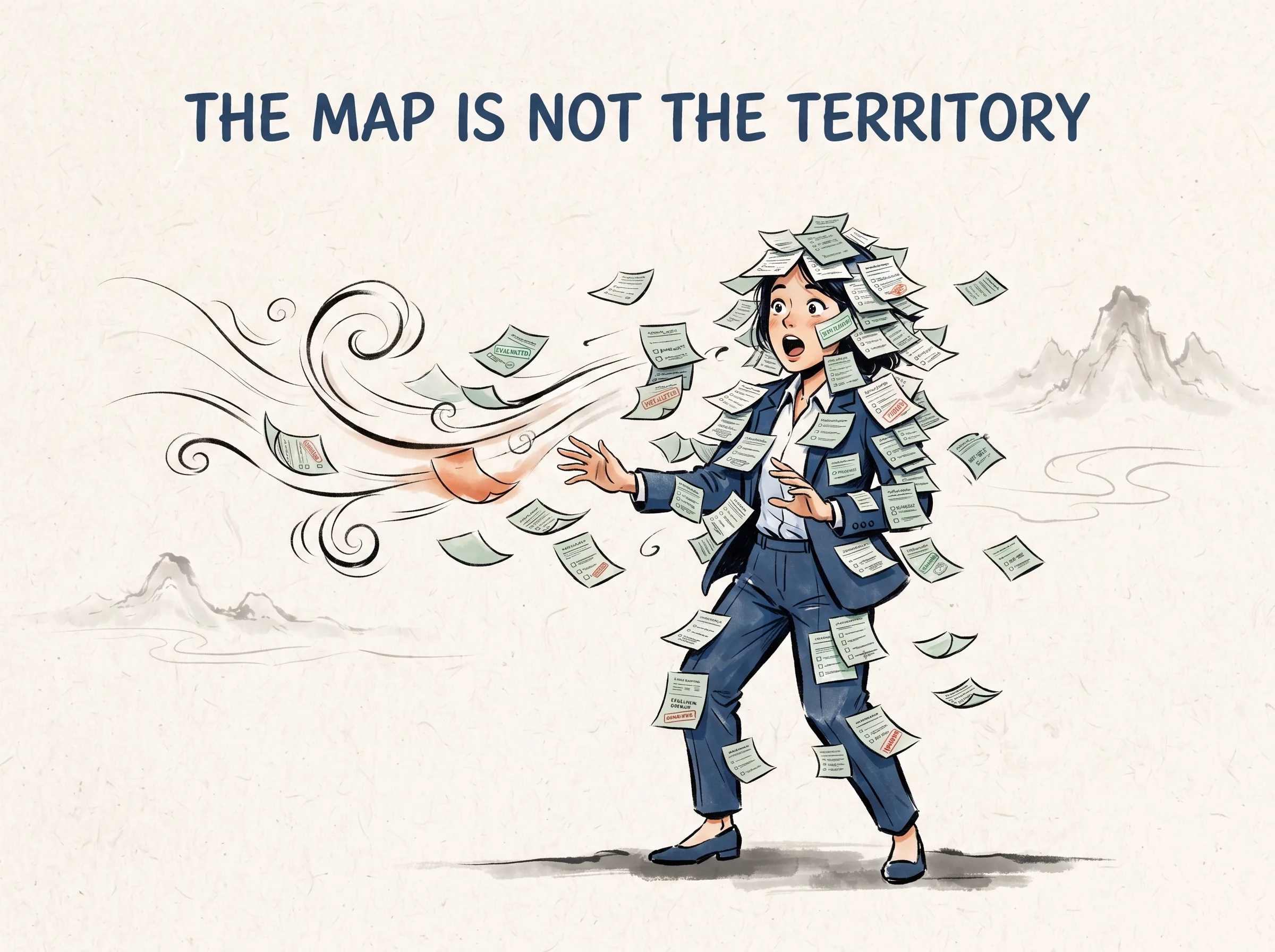
This is not poetry. It is a structural feature of how human cognition works. Naming is the foundation of civilization—without it, there is no shared language, no law, no science. But naming also carries a hidden cost: once something is named, it stops being experienced as something alive and starts being treated as something fixed. The danger is not that language exists. The danger is forgetting that language is a tool, not the truth itself.
The Two Levels of Existence: Nameless and Named
The second movement of the opening passage draws a distinction that is frequently misunderstood. "Nameless is the origin of heaven and earth; named is the mother of all things," the text says. This is not a hierarchy in which namelessness is declared superior to namedness. Laozi is describing two layers of reality that are both necessary.
Namelessness refers to the state before categorization—the undifferentiated ground from which everything emerges. It is not emptiness in the sense of nothingness; it is potential in the sense of possibility. Imagine a blank canvas before any brushstroke has touched it. The painting has not yet happened, but everything it might become is already implied. That is the nameless state.
Namedness is the world that follows: roles, achievements, relationships, careers, reputations, identities. It is the world we must live in. No one navigates life without names. We need them to function, to connect, to build. But the error occurs when the named world is treated as the whole world—and when the person behind the name is mistaken for the name itself.
Modern life intensifies this error at every turn. Algorithms rank us. Resumes quantify us. Social platforms reduce multidimensional human beings to metrics. The more precisely society names a person, the easier it becomes to forget that a person always exceeds any name. Laozi's insight is not that names are bad. It is that names are partial. They are real, useful, and incomplete—and treating them as complete is what produces the hollow feeling beneath the surface of achievement.
Two Ways of Seeing: Desire-Colored Vision and Clear Vision
The third movement of the opening passage introduces a practical observation about attention. "Always free from desire, observe its mysteries; always with desire, observe its boundaries," reads one widely cited rendering. The key word here is desire—not only greed or indulgence, but any strong intention, agenda, or expected outcome that shapes how we look at something. For the word-for-word source text and commentary, consult the complete classical translation and commentary of Contemplating the Mystery: The Nameless Beginning and the Doorway of Wonders.
When we observe through desire, we see only what serves our aims. A relationship becomes a ledger of what we gain and lose. A career becomes a sequence of promotions and setbacks. A problem becomes either an obstacle or an opportunity, rarely anything more complex. Desire-colored vision is not worthless. It is necessary for action. Without it, we cannot navigate the practical world. We need to assess risks, set goals, make decisions, and respond to consequences.
But desire-colored vision narrows the field of perception. It turns everything into a tool or a threat. People become instruments or obstacles. Time becomes either wasted or optimized. Experience becomes either useful or not. The world is flattened into a binary of benefit and harm.
The alternative mode—observing without the pressure of an agenda—does not mean indifference. It means seeing the deeper structure of a situation rather than its surface payoff. A relationship observed without desire might reveal attachment patterns, unspoken needs, or mismatches in rhythm that fear-based vision obscures. A career observed without ambition might show long-term learning curves, shifting contexts, and cumulative growth invisible to short-term metrics.
Neither mode alone is sufficient. The mature observer learns to switch between them. In moments that demand action, desire-colored vision is appropriate. In moments that demand understanding, desire-free observation is necessary. The mistake is living permanently inside one lens and expecting the other to appear when needed.
Beyond Binary Thinking: Holding Both Sides
The fourth movement of the passage resolves the tension between nameless and named, desire and desire-free, by refusing the false choice between them. "These two come from the same source but differ in name," the text states. The "two" can refer to namelessness and namedness, or to the two modes of observation—the philosophical tradition has offered various readings. What remains consistent across interpretations is the refusal of simple opposition.
Laozi is not advocating a retreat into pure abstraction. He is also not endorsing reckless immersion in the world of appearances. The mature stance is something more difficult: entering the world of names and desires when action is required, and returning to namelessness and clarity when reflection is needed. This is the "profound mystery" the text describes—not obscurity for its own sake, but a depth that single frameworks cannot capture.
Consider a professional who builds a career. Entering the world of names means accepting a role, producing work, managing relationships, and responding to performance metrics. Returning to the nameless means periodically asking what lies beneath those roles—the values, intentions, and creative capacities that existed before the title was assigned. The professional who never returns to that deeper ground becomes exhausted by external validation. The professional who never enters the named world remains abstract and ineffective. The practice is the alternation.
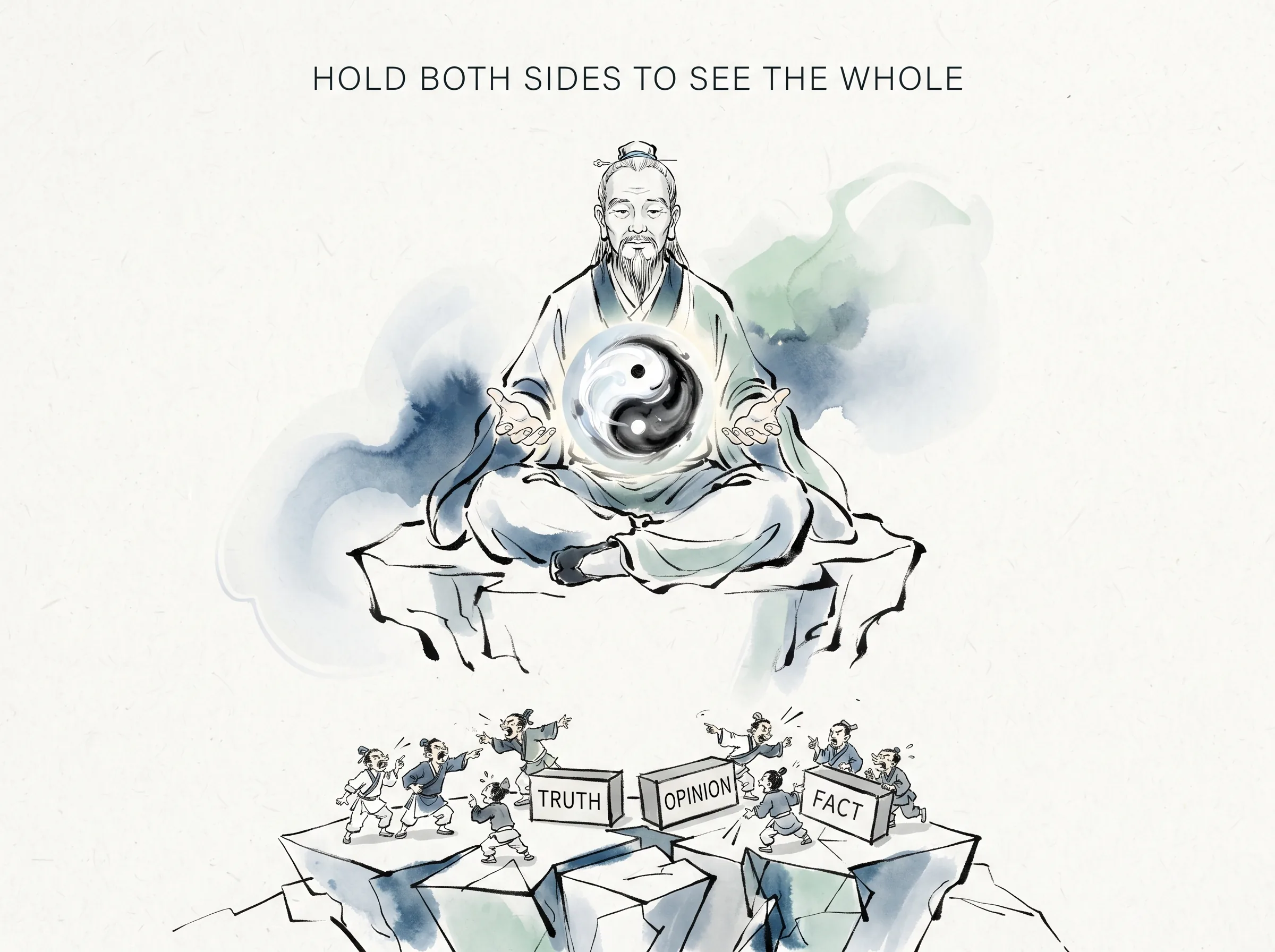
This principle applies equally to personal relationships, creative work, and physical health. In each case, the solution is not to escape the world of forms but to cultivate the ability to move fluidly within it. The label is a tool. The source is the wellspring. Learning to use the tool without confusing it for the source is the work of a lifetime.
Why This Matters Now More Than Ever
Modern society has invented mechanisms for naming that would have been unimaginable even a century ago. Personal branding platforms turn identity into a product. Ranking systems reduce education, work, and social worth to numbers. Algorithms learn our preferences and feed us increasingly narrow reflections of ourselves, reinforcing the sense that we are exactly what the data says we are.
The cost shows up in the texture of daily experience. People report knowing precisely how they rank, how many likes they receive, how far they have advanced on a ladder of external validation—and yet feeling increasingly hollow. The problem is not that labels are absent. The problem is that labels have replaced perception. When you spend enough time being defined by external metrics, you lose touch with the interior life that existed before the first evaluation.
This is precisely why Laozi's framework remains vital. He offers no program for escaping modernity. He offers a discipline for navigating it with clarity. The discipline is simple in principle and demanding in practice: use language, but remember it is language. Take on roles, but do not confuse them with your core self. Pursue goals, but periodically return to the silent ground from which goals arise. See the boundaries, but also observe the patterns that produce the boundaries.
The door Laozi calls "the entrance to all wondrous insights" is not a door out of the world. It is a door through the world—seeing it more clearly, more fully, and more freely than those who mistake the label for the thing itself.
Practical Exercises for Stepping Outside Labels
1. The Naming Audit Once a week, write down three labels you carry—professional, social, or personal. For each one, ask: What does this label capture? What does it obscure? Where did it come from—my own choices, someone else's expectations, or cultural habit? This exercise does not require you to discard the labels. It requires you to see them more clearly.
2. The Desire-Free Observation Choose one situation you encounter regularly—a conversation, a work task, a daily routine. Spend five minutes observing it without asking "What do I get from this?" Instead, notice patterns, rhythms, structures, and conditions. What elements are present even when you are not seeking a result? This practice strengthens the capacity to see beyond utility.
3. The Nameless Pause When feeling trapped by a label, pause and breathe. Sit quietly for two to three minutes and consider what awareness existed before the label was applied. Before the title, before the rating, before the opinion of others—what is still present? This is not escape. It is calibration.
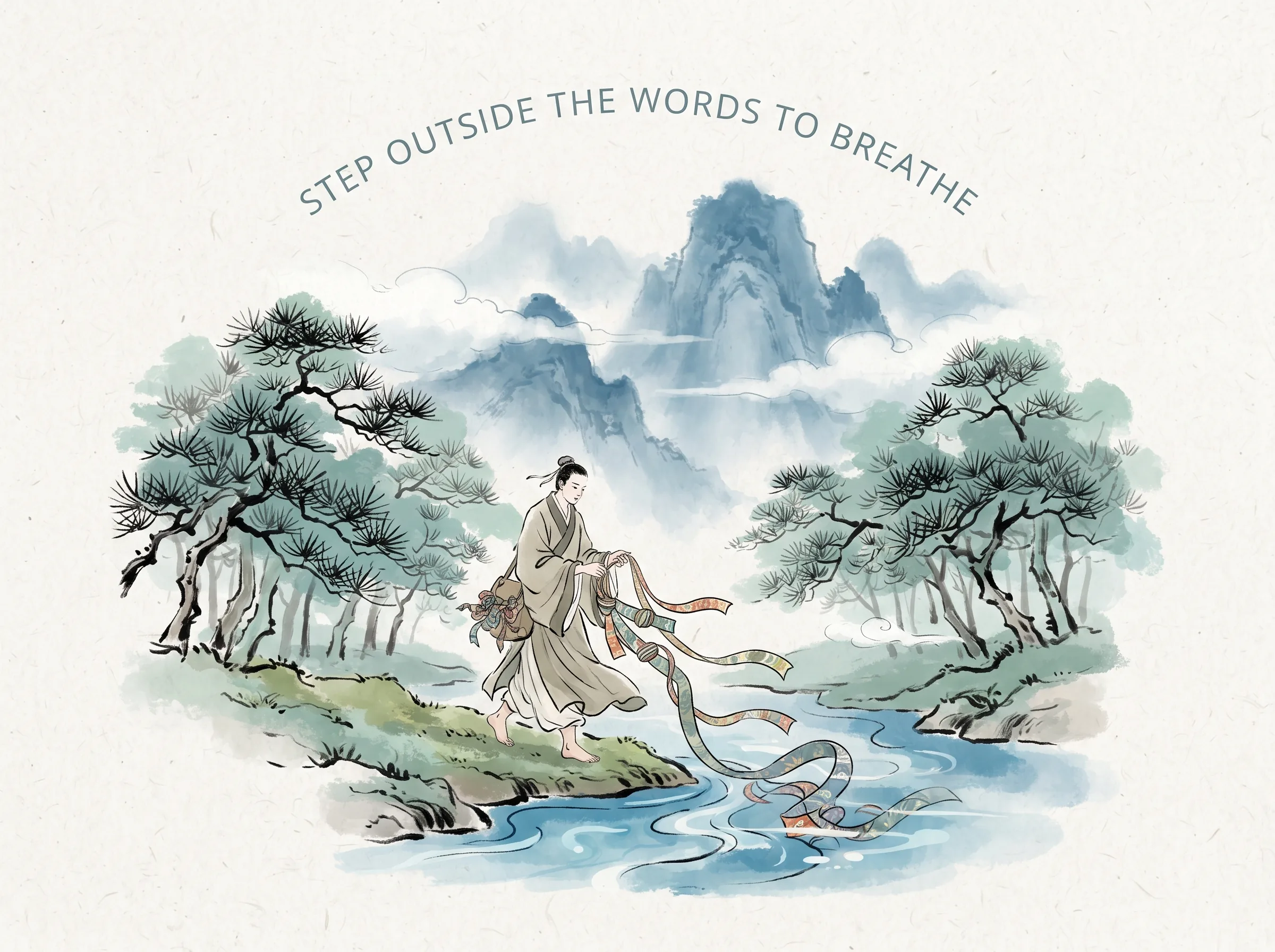
4. The Alternating Gaze During significant decisions, deliberately switch between two questions: "What are the practical consequences?" and "What is the deeper structure at work here?" The first question engages desire-colored vision; the second engages clear vision. Using both prevents either mode from dominating completely.
FAQ
Is Laozi saying we should stop using language and labels entirely? No. Laozi acknowledges that naming is necessary for functioning in the world. The point is to recognize that names are tools, not truths. Using language wisely means employing it without believing it fully.
Does this philosophy require giving up ambition or career goals? No. The teaching distinguishes between acting effectively in the world and being consumed by the world's categories. Ambition becomes harmful only when it replaces self-understanding. A career can be pursued fully while maintaining awareness that the title is not the totality of the person.
How is this different from Western mindfulness or Stoicism? While there are overlaps—such as attention training and detachment from outcomes—the Daode jing's approach is specifically rooted in Chinese cosmological thought, emphasizing the relationship between namelessness and namedness, and the fluid alternation between opposing modes of perception rather than a single disciplined practice.
Can this framework be applied to social media and online identity? Yes. Social media operates almost entirely through labeling: profiles, metrics, followers, rankings. Applying Laozi's distinction means engaging with these tools while remembering that the curated self is a constructed representation, not the full person behind it.
Summary and Next Steps
The feeling of being trapped by labels is not a personal failing. It is a structural feature of living in a world that constantly names, ranks, and categorizes. The ancient wisdom of the Daode jing does not solve this problem by eliminating labels. It offers something more durable: a way of seeing that allows labels to function without dominating.
The core insight is simple and profound. Language is a map, not the territory. Names are useful, but incomplete. Desire-driven vision is necessary for action, but insufficient for understanding. The mature life involves moving between these modes as the situation requires, rather than becoming fixed in any single perspective.
The next step is not to read more or learn more. It is to practice what is already available. Begin with one small observation exercise. Notice when a label feels heavy. Pause. Breathe. Remember the ground beneath the name. Over time, this practice builds a quiet but steady freedom—the kind of freedom that does not depend on escaping the world, but on seeing it more clearly, reflecting the enduring wisdom of Laozi Chapter 1 Meaning.
To explore these themes from another angle, read our related reflection on Why the Center Grows Most Luxurious When the Roots Grow Hollow.
For a deeper comparative examination of these ideas, explore our related study on Why the Invisible Dao Is More Real Than What We Can See.
Sources & Further Reading
[1] Laozi (Stanford Encyclopedia of Philosophy) — Scholarly overview of Laozi's philosophy, including discussion of the Daode jing text, its translation history, key concepts, and interpretive debates.
[2] Religious Daoism (Stanford Encyclopedia of Philosophy) — Analysis of Daoist textual traditions, early manuscript evidence from the Mawangdui and Guodian finds, and the relationship between philosophical and religious interpretations of the Daode jing.
[3] Chinese Text Project — Daode Jing — Original Classical Chinese text of the Daode jing with parallel translations and annotations.
Further Reading
- Henricks, Robert G. (1989). Lao Tzu: Te-Tao Ching — A New Translation Based on the Recently Discovered Ma-wang-tui Texts. — Translation and commentary informed by early manuscript discoveries.







[…] To explore these themes from another angle, read our related reflection on Why You Feel Trapped by Labels—Chinese Wisdom for Modern Life. […]