
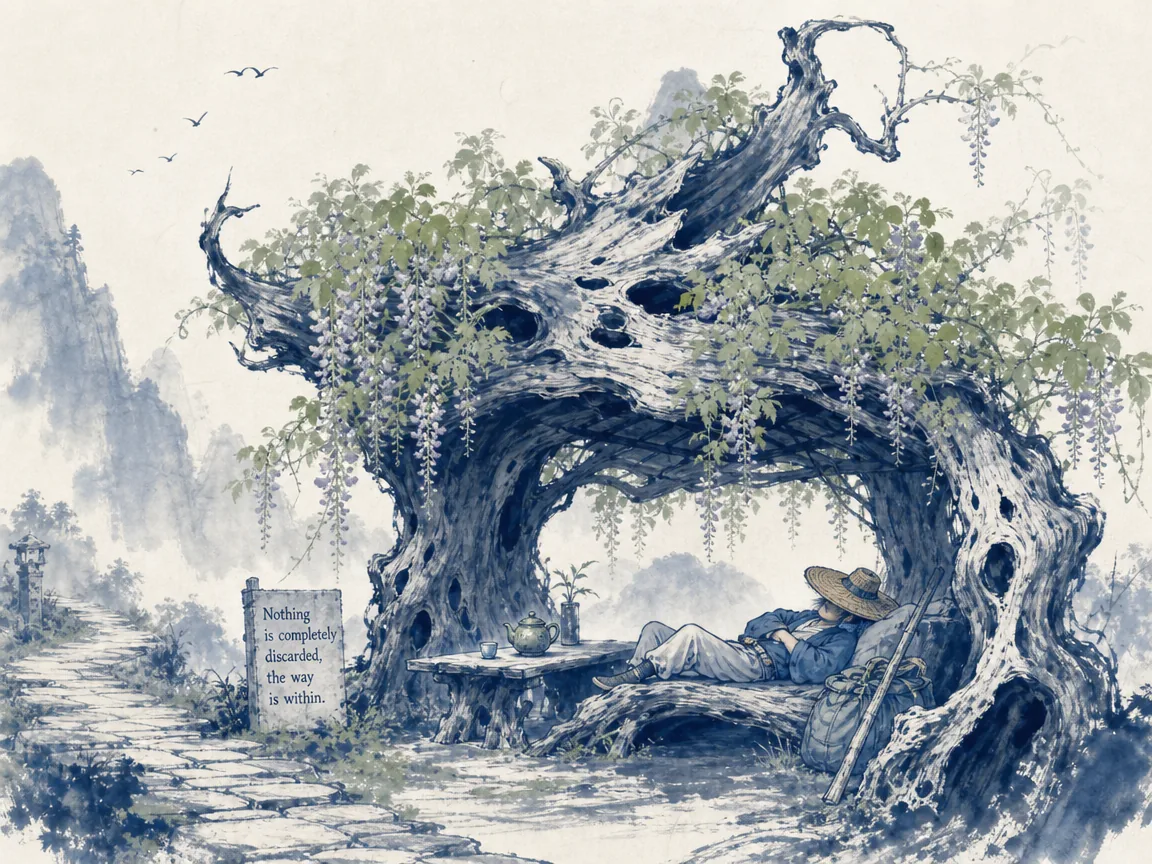
We meet someone new and within minutes we have already decided whether they are worth our time. We try a project and by week two we know whether it will succeed or fail. A colleague struggles in a meeting and we file it away as evidence that they are not leadership material. The habit is so fast that we rarely notice it is happening. We treat a temporary mismatch as a final verdict about a whole person — or a whole thing.
Laozi's Daodejing In Daodejing Chapter 27 offers a different starting point. Rather than asking whether someone or something is useful enough to keep, the chapter asks something quieter: what kind of judgment is this, and what standard is it using? A mature mind, Laozi suggests, stops projecting its own narrow measure onto everything it meets. It learns to distinguish between a local failure and a permanent identity.
This chapter has long been read as a meditation on skill — specifically on five kinds of refined ability. But the five descriptions open onto a larger ethical question. If genuine competence reduces dependence on external proof, then premature judgment is itself a form of incompetence. It is the mind trying to manufacture certainty by collapsing complexity into a single label. The passage that follows the five descriptions — "The sage is always good at saving people, therefore there are no discarded people; always good at saving things, therefore there are no discarded things" — does not contradict that insight. It extends it. What Laozi is describing is not sentimental optimism but a disciplined resistance to hasty finality.
Daodejing Chapter 27: The First Question We Ask Is Usually the Wrong One
Everyday life is full of quick classifications. A student who performs poorly on one exam is called "not smart." An employee who hesitates in meetings is labelled "not leadership material." A friend who withdraws after a conflict is written off as unreliable. In each case we begin with a real observation and end with a total verdict. The gap between observation and conclusion is where the harm happens.
Daodejing Chapter 27 begins not with a moral command but with a description of ability. The five paired statements that open the chapter — traditionally rendered as "The person who acts well leaves no tracks," "The person who speaks well leaves no flaws," and so on — describe a kind of competence that does not depend on outward display. [1] A skilled action does not generate unnecessary chaos. A well-chosen word does not invite pointless rebuttal. A genuine calculation does not require machinery to do the thinking. A proper boundary does not depend on heavy locks. A real connection does not need binding contracts to hold.
What these five statements share is a single pattern: mature ability reduces dependence on external proof. It lets the structure itself carry the weight. The person who truly understands a situation does not need to announce it, force it, or monitor it relentlessly. Their effectiveness is internalised — embedded in the way the situation is arranged rather than in the amount of effort visibly expended.
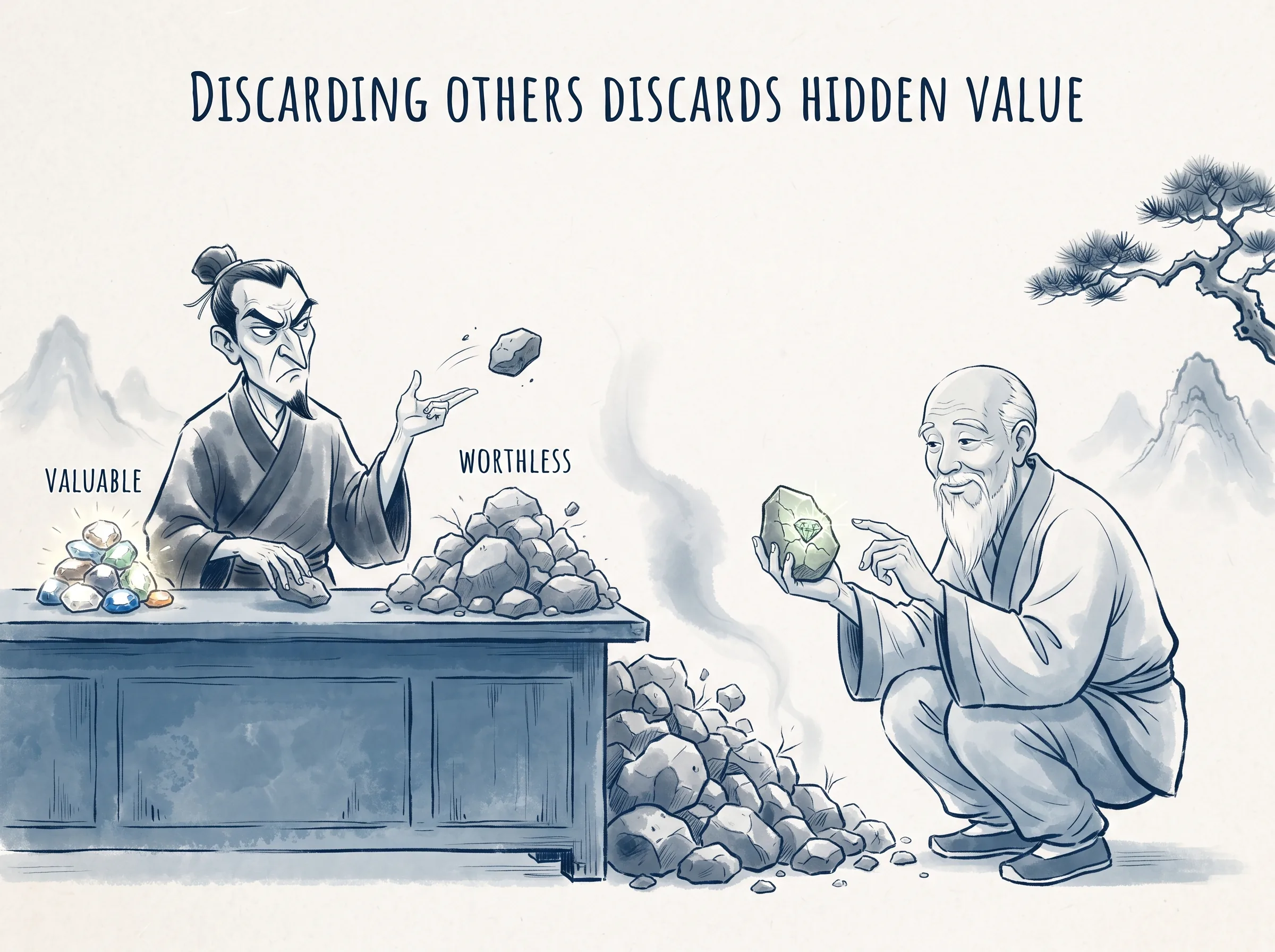
The modern habit of premature judgment operates in the opposite direction. It assumes that what is visible is what matters, and what is absent is what is lacking. A manager who needs to send constant reminders is treated as more "present" than one whose team runs smoothly without supervision. A speaker who fills every silence is rated as more persuasive than one who stops at what can be genuinely held. A relationship that is monitored through checks and promises is mistaken for a stronger one than a relationship that simply endures. In each case the standard is inverted — the sign of weakness is treated as a sign of strength, and the sign of depth is treated as irrelevance.
Laozi's warning is not against all judgement. The chapter does not say that we should suspend every assessment and accept everything equally. It says that the mind trained by limited standards will inevitably confuse a local mismatch with a global failure. A student who cannot perform in one system is not a person without intelligence. A colleague who underperforms in one context is not a person without value. A project that looks like a waste in one setting may become vital when the conditions change. The error is not that we judge at all — it is that we judge too quickly and too finally.
Continue with the deeper interpretation and practical application.
ChiDestiny members get access to the full analysis, modern applications, and the growing Chinese Wisdom Library.
FAQ
Is Chapter 27 of the Daodejing about being kind to everyone? No. The chapter is primarily about skill and judgment. The famous lines about "no discarded person" and "no discarded thing" extend a discussion of refined ability into the realm of how we evaluate people and objects. Laozi is not arguing for unconditional acceptance or the elimination of all standards. He is warning against a specific habit — collapsing a local mismatch into a permanent verdict about a whole person or thing.
Does "no discarded person" mean we should never fire anyone or end any relationship? No. Laozi is not calling for the suspension of all boundaries or the refusal to make practical decisions. The chapter distinguishes between setting a boundary in response to a specific situation and declaring that a person has no value at all. Ending a collaboration, stepping away from a relationship, or letting someone go from a role are all decisions that can be made thoughtfully. The error Laozi identifies is treating a single failure as proof that the person is permanently worthless.
Are the five descriptions in Chapter 27 five separate skills? They are better understood as five expressions of the same underlying pattern — the way mature (chéngshú, 成熟) ability operates without excessive dependence on external tools, displays, or force. Different translations and scholarly editions render the opening phrases with slight variations, and some textual traditions use different characters. The general sense — that genuine competence tends to be quiet, self-sustaining, and minimally dependent on external enforcement — is consistent across the major received versions.
Can Laozi's approach be applied to self-criticism and personal failure? Yes. The chapter's logic applies not only to how we judge others but also to how we judge ourselves. Treating a single failure as a permanent identity — "I am a failure" instead of "this did not work" — is the same cognitive error that Laozi identifies in our treatment of others. Recognising that value is partly relational helps counter the tendency to internalise one missed standard as total self-rejection.
Summary
Chapter 27 of the Daodejing begins with five descriptions of refined ability and ends with a surprising claim about people: the sage never discards anyone. Between these two points runs a single thread — the recognition that mature judgment is patient, contextual, and reluctant to finalise. Premature classification is easy. It gives us the comfort of certainty at the cost of accuracy. Laozi invites us to replace the impulse to discard with the discipline of understanding.
The practical takeaway is not a method but a posture: slow down your verdicts. Distinguish between a local mismatch and a global failure. Ask whether the standard you are applying is the only one available, or merely the most convenient. Treat both success and failure as information rather than as proof. And extend the same restraint to yourself that you would wish others to show you.
A useful next step is simply to notice when you are about to make a final judgment — about a colleague, a project, or yourself — and to pause for one additional question: "What am I missing here?" The answer may not come immediately. But the pause itself is already a form of wisdom.
To explore these themes from another angle, read our related reflection on Moving First: How Ancient Strategy Teaches Us to Shape the Board, Not Just the Battle.
For a deeper comparative examination of these ideas, explore our related study on When Softness Outlasts Hardness: What Laozi’s 43rd Chapter Teaches About Real Power.
Sources & Further Reading
[1] The Project Gutenberg eBook of Dao De Jing, by Lao Zi — includes discussion of textual transmission and authorship debates around the received text. Available at
[2] Laozi (Stanford Encyclopedia of Philosophy, Spring 2026 Edition) — provides scholarly overview of the Daodejing's textual history, including the relationship between the received Wang Bi tradition and earlier manuscript versions such as the Mawangdui silk texts. Available at







[…] To explore these themes from another angle, read our related reflection on How to Stop Deciding Who Is Useful and Who Is Not — Laozi on True Judgment. […]