
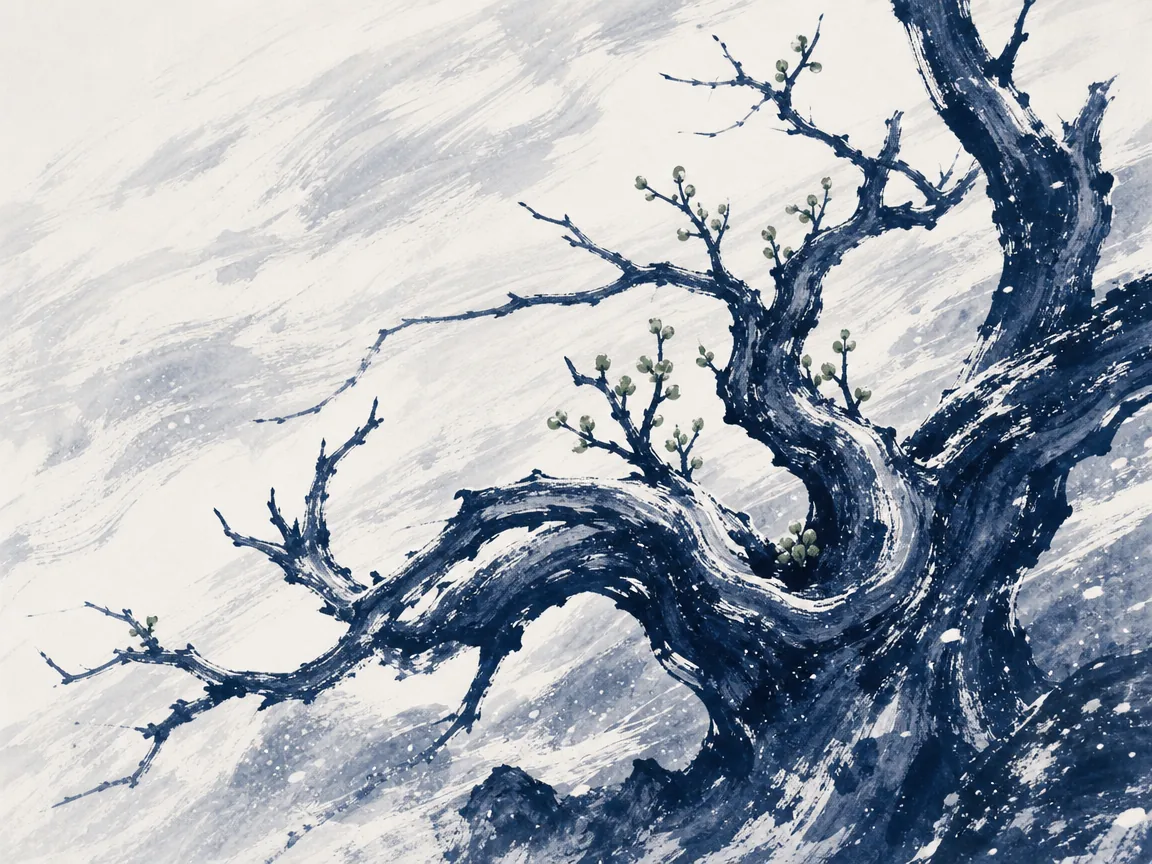
You have probably met someone like this — a person sitting quietly in a corner, wearing nothing distinctive, holding no title you recognize. And yet, the moment they speak or move, you sense something solid beneath the surface. There is a coherence to them that does not depend on packaging. Meanwhile, others dazzle with credentials and polish, but up close the impression thins. You leave the conversation wondering what, exactly, is holding it all together.
This quiet mystery has occupied Chinese thinkers for over a thousand years. They did not call it personality or charisma. They had a different concept for it: bone method (gǔfǎ, 骨法). It refers to an inner structural integrity, the hidden architecture that determines whether a person, a painting, or a way of life remains coherent when everything external is taken away—a foundational perspective explored in Inner Structure in Chinese Aesthetics.
For modern readers navigating identity shifts, career reinvention, loss, and the relentless accumulation of labels, bone method (gǔfǎ, 骨法) offers a different lens. It asks not what you should add to yourself, but what underlying structure can hold when the temporary supports — titles, wealth, relationships, reputation — are stripped away.
Inner Structure in Chinese Aesthetics: Xie He and the Six Principles
The idea originates in a short text from the early sixth century called Gu Hua Pin Lu (Classified Records of Ancient Painters), attributed to the critic Xie He [1]. The text proposed six principles for judging painting, and the second of these is "bone method in brushwork" (gǔfǎ yòngbǐ, 骨法用笔).
On the surface, this sounds like a technical instruction for painters: when you wield the brush, the strokes should carry the quality of bone. But Chinese aesthetic thinkers quickly understood that the principle pointed beyond paint and canvas. The "bone" describes the invisible structure that supports all forms of expression. A painting may be covered in rich color and detailed rendering, yet without bone method (gǔfǎ, 骨法) it collapses under scrutiny. Similarly, a person may accumulate every desirable attribute — status, charm, success — but if there is no inner coherence, the whole impression proves hollow when the noise fades.
The concept was never limited to art criticism. It became a way of thinking about character, conduct, and presence.
The Winter Tree: Structure Revealed
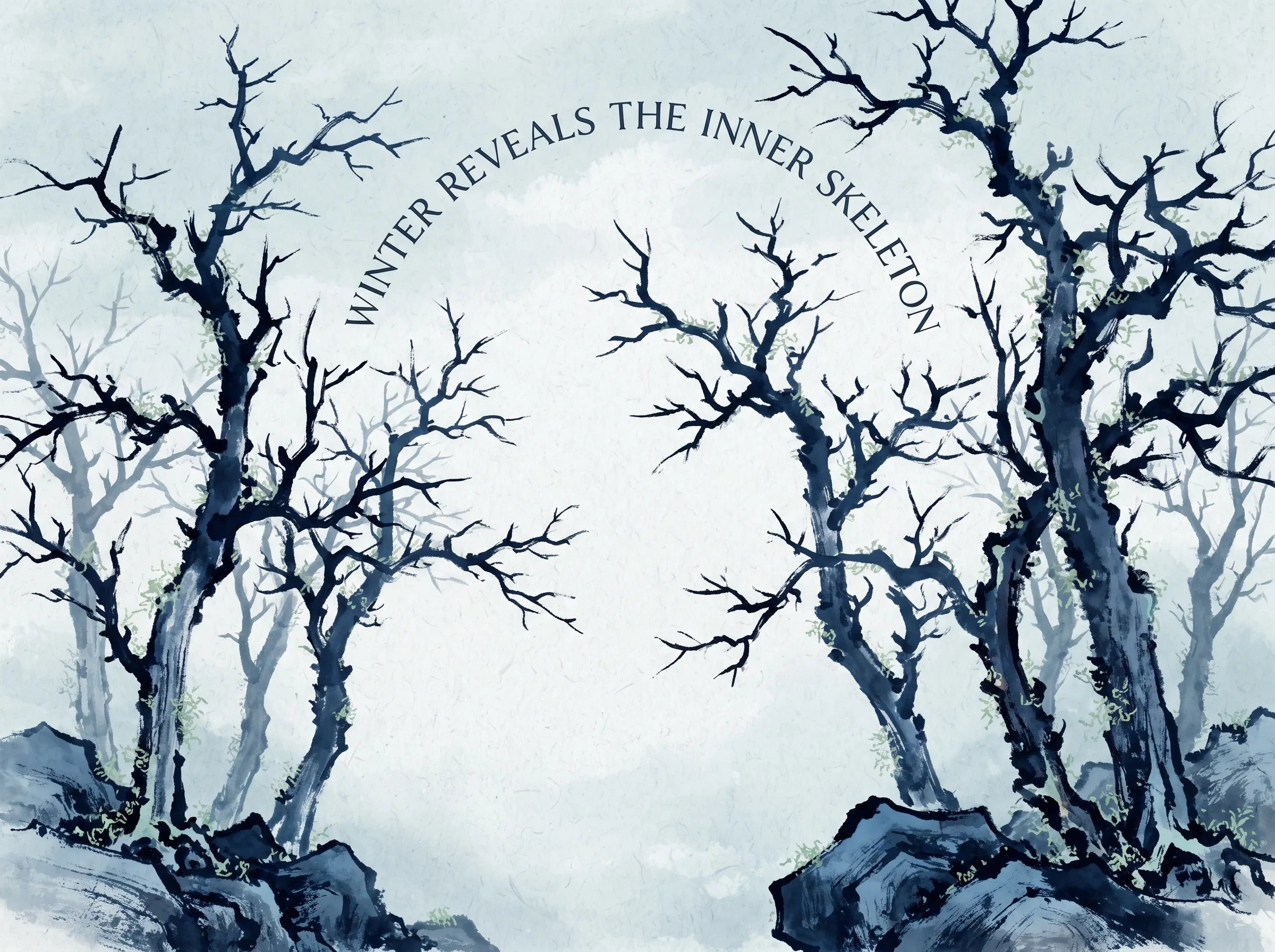
A useful image comes from observing a tree in winter. In summer, the same tree is draped in leaves — lush, colorful, alive. In winter, the foliage is gone. What remains is the skeleton: the angles of the branches, the sweep of the main trunk, the way limbs divide and reach. For some trees, this bare exposure is striking. The structure is elegant even without decoration. For others, the leaves were doing all the work. Without them, the tree looks confused — a tangle of weak growth with no clear direction.
The winter tree is a metaphor that Chinese writers have long returned to. The "bones" of a thing are what make it intelligible when the surface conditions change. A person with bone method (gǔfǎ, 骨法) retains a kind of inner legibility even when roles, possessions, and social proof are removed. They are not impressive because of what they wear or what they own. They are coherent because their choices, actions, and silences all point in the same direction.
The contrast is not between strong and weak people. It is between those who have structure and those who do not. Many people who appear unsure or inconsistent are not inherently fragile — they are unclear. They shift from one context to another because they lack a stable center. They adjust their opinions, adopt the mannerisms of whoever is nearby, and perform the role they think is expected. This is not a moral failing. It is a structural one.
Why Chinese Culture Valued Bone in Calligraphy
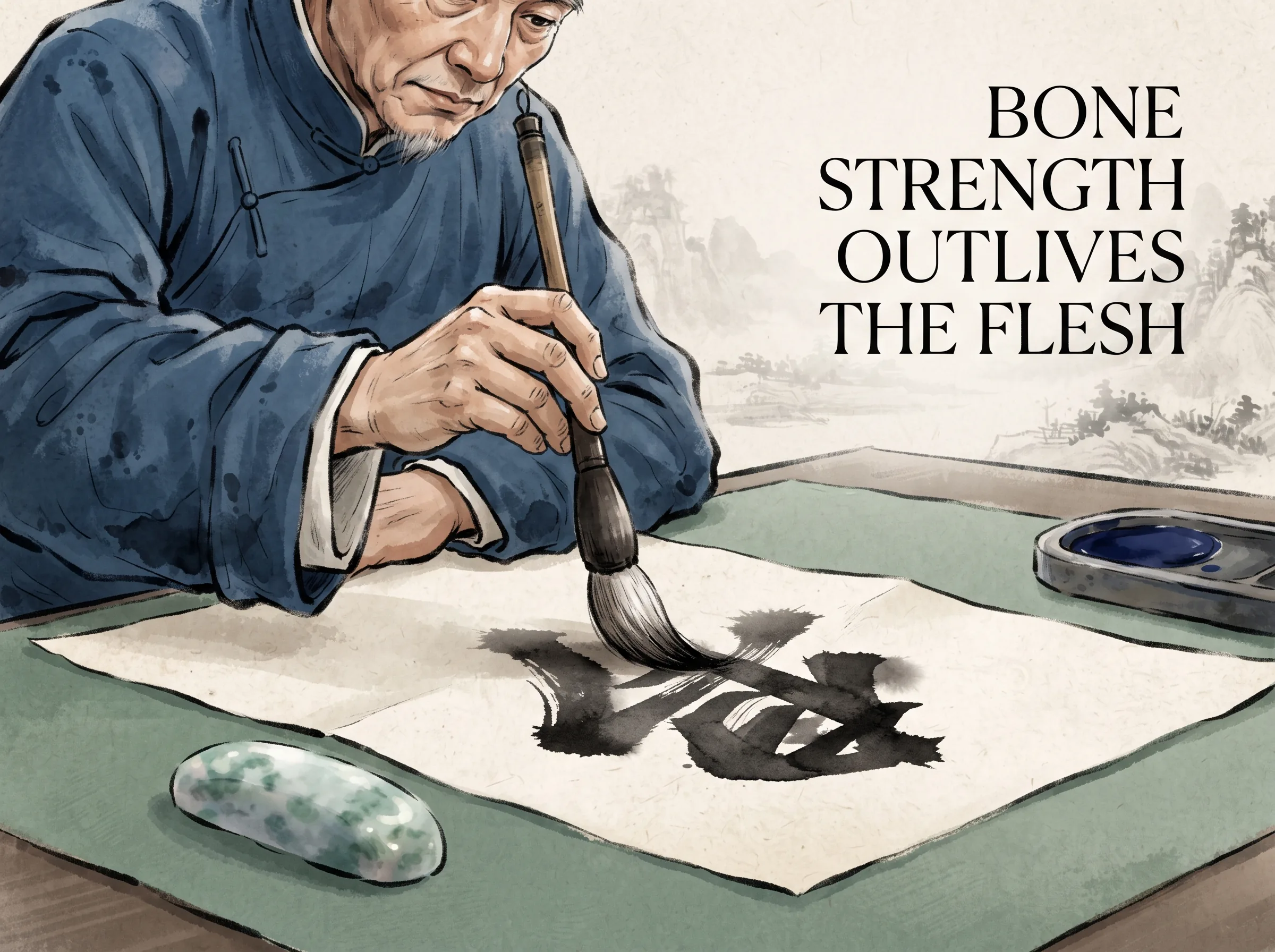
The obsession with the idea of bone (gǔ, 骨) extends deep into Chinese calligraphic tradition, where the quality of a stroke was judged not by its beauty alone but by the force and clarity behind it. A standard formulation appears in a classical text traditionally attributed to the calligrapher Lady Wei (Wèi Fūrén, 卫夫人), teacher of Wang Xizhi: "Those who skillfully wield the brush have more bone; those who do not have more flesh" [2]. The metaphor is physical — bone implies strength, clarity, support — but it was immediately applied far beyond calligraphy.
A character with too much "flesh" feels swollen and directionless. One with proper bone remains vivid even in its simplest form. This distinction shaped how Chinese critics evaluated not only writing but also painting, literature, and human character. A poem might be praised for its "bone" quality (gǔ, 骨) even if its language is spare. A person might be described as having bone method (gǔfǎ, 骨法) even if they are quiet and unadorned.
The idea also produced famous pairings in calligraphy history. The figures of Yan Zhenqing and Liu Gongquan are often discussed together, with later critics characterizing Yan's work in terms of tendon or sinew (jīn, 筋) and Liu's in terms of bone (gǔ, 骨). However, the precise origin of this dichotomy in classical sources is debated among scholars, and the labels may have been applied retroactively rather than coming directly from Tang-period criticism [1]. What remains clear is that the bone-versus-flesh framework became a standard vocabulary for discussing integrity in Chinese aesthetics.
A Story Often Told: The Musician Who Refused to Perform His Own Death
One figure widely associated with bone method (gǔfǎ, 骨法) in Chinese cultural memory is Ji Kang (Jī Kāng, 嵇康; 223–262 CE), a philosopher and musician of the Wei-Jin period. According to accounts preserved in texts such as Shishuo Xinyu (A New Account of the Tales of the World), Ji Kang was sentenced to death in politically charged circumstances. Rather than pleading, renouncing his views, or performing grief to win mercy, he asked for his seven-stringed zither (qin, 琴). He played the piece known as Guangling San and, when the music ended, reportedly said, "The Guangling San is lost from this day forward" (《广陵散》于今绝矣). Then he submitted to execution without further drama.
This story is treated in Chinese tradition as a defining moment of bone method (gǔfǎ, 骨法) because nothing remained to hide behind. There was no audience to persuade, no status to leverage, no future to negotiate. What was left was simply who he was. The moment reveals a quality that cannot be cultivated for display — it emerges only when all performance becomes impossible. Examine this artistic principle further through the classical aesthetic philosophy of The Patina of Time: What Chinese Wisdom Teaches Us About Growing Rich, Not New.
Whether every detail of this narrative is historically verified is uncertain. But the story persists precisely because it captures something many readers recognize: the difference between a person who performs integrity and a person whose coherence is visible even when there is nothing to gain from it.
What Bone Method (gǔfǎ, 骨法) Is Not
It is important to clarify what bone method (gǔfǎ, 骨法) does not mean, because the word itself suggests hardness and rigidity. Bone method (gǔfǎ, 骨法) is not stubbornness. It is not contrarianism. It is not the refusal to compromise on every point.
Bone method (gǔfǎ, 骨法) is clarity. It is the ability to know — calmly and consistently — what you are, what you want, and what you will not do. A person with bone method (gǔfǎ, 骨法) can adapt strategies, yield on details, and shift tactics. But the inner framework does not warp. They are not rigid; they are structural.
This distinction matters because many people confuse flexibility with a lack of bone. True flexibility requires a stable center — just as a wooden bracket in traditional Chinese architecture must be firmly joined before it can flex under seismic pressure. The famous wooden structures of Tang and Song dynasties, such as Foguang Temple, have survived earthquakes and centuries precisely because their mortise-and-tenon frameworks hold even when outer walls crumble and roofs decay. The bones remain. That is the model.
The Path of Cultivation: Liang Kai and the Art of Subtraction
If bone method (gǔfǎ, 骨法) sounds like something you are simply born with, Chinese aesthetic tradition says otherwise. It is cultivated. And the cultivation follows a specific path: first accumulate, then subtract.
The painter Liang Kai (Liáng Kǎi, 梁楷) illustrates this principle. According to records cited by later authorities such as the Yuan-dynasty writer Xia Wenyuan, Liang Kai served as a painter at the Southern Song imperial academy and was honored with a golden sash — the highest recognition available to court artists [3]. By all conventional measures, he had reached the peak of his profession.
Then he left. He did not depart in anger or protest. He simply hung the sash in the academy and walked away. His later works — including paintings attributed to him such as Immortal in Splashed Ink (Pōmò Xiānrén Tú, 《潑墨仙人圖》), though the exact attribution of some surviving pieces remains debated — are startlingly minimal. Ink is applied with apparently casual speed. Faces are suggested rather than rendered. Details are abandoned.
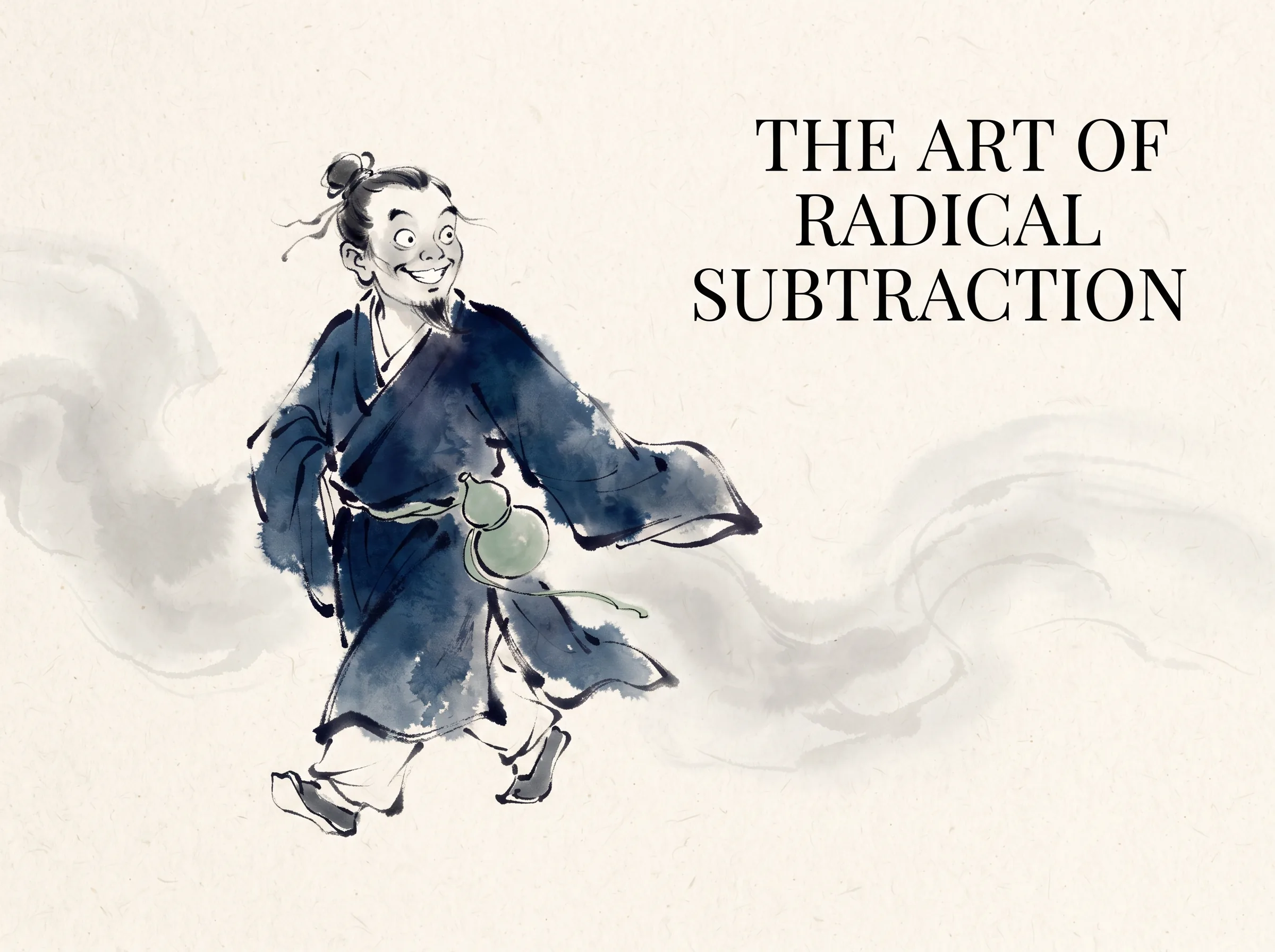
But the simplicity is not ignorance. Anyone who has studied Liang Kai's earlier, more elaborate work can see that the restraint is earned. Every brushmark in the ink-sketch style is placed with precision. The center of gravity (zhòngxīn, 重心), the proportion, the dynamic balance — all are calculated. He had mastered the "flesh" before choosing to release it. This is the process Chinese critics often describe: build the surface, understand it completely, then strip away what is unnecessary until only the structure remains.
The insight applies to more than painting. In life, as in art, you cannot begin with bone alone. That is thinness, not depth. You must first live, learn, accumulate experience, and develop skill. Only after you have built the flesh can you discern what is essential and what was merely decorative. The subtraction is a choice, not a starting condition.
A Practical Framework: What Remains After the Scissors
How do you test whether you have bone method (gǔfǎ, 骨法), or whether you are building it? One approach is to imagine removing the layers that modern life treats as essential and observe what stays.
Wealth is removed first. If you lost your income tomorrow, would your sense of worth collapse entirely, or is there a core of self-recognition that does not depend on your bank balance?
Social circle is removed next. If your closest relationships ended, would you still know who you are, or was much of your identity constructed through reflection in other people's eyes?
Title and role come after that. If your job disappeared and no one knew what you did for a living, could you describe yourself without reaching for a label?
An unfamiliar environment tests the final layer. Placed in a city where no one knows you, with no network to fall back on, would you still feel like yourself — or would you become whoever the new context seemed to require?
The same test can be extended beyond personal identity. In writing, ask whether the argument holds when rhetoric (xiūcí, 修辞) is stripped away. In a relationship, ask whether genuine connection survives when passion, novelty, or utility fade. In aesthetic taste, ask whether you can still judge what is good without external signals — without trends, influencers, or prestige markers to guide you.
Bone method (gǔfǎ, 骨法) is what remains after the scissors can cut no further.
Why This Question Matters Now
Modern life is structured around accumulation. We collect credentials, networks, personal brands, and curated identities. Each layer offers temporary stability — a title confirms your place, a following validates your voice, wealth provides security. But all of these are removable. Careers change. Industries collapse. Relationships end. Platforms disappear. Reputation can shift overnight.
When the external supports are intact, we rarely need to ask what is underneath. That is the luxury of normal times. But identity crises, career pivots, aging, bereavement, and other involuntary transitions are inevitable. The scissors will come whether we are prepared or not.
The Chinese aesthetic tradition does not argue that we should reject wealth, career, or relationships. These are part of the "flesh" that gives life texture and meaning. The tradition simply warns against confusing the flesh with the bone. A building with beautiful walls but no framework will fall. A person with impressive attributes but no inner coherence will fracture when circumstances change.
This perspective resonates with broader currents in Chinese thought — the Daoist appreciation for simplicity, the Confucian emphasis on self-cultivation, the recurring theme of returning to authenticity after experience. But bone method (gǔfǎ, 骨法) itself arises from painting theory and aesthetics, not from any single philosophical school. It is a practical observation about structure, not a moral doctrine.
Closing: The Signature Beneath Every Stroke
Why do some people feel immediately recognizable — not because of style, which can be learned, or personality, which can be performed — but because something consistent runs through every choice they make?
The Chinese answer is bone method (gǔfǎ, 骨法). It is the same coherent structure underlying every action, every silence, every decision. It is what makes a stroke of the brush legible even when the hand is moving quickly. It is what makes a person stand without leaning on anything external.
The question this tradition invites is not whether you already have bone method (gǔfǎ, 骨法). It is whether you are building it — and whether you are willing to distinguish, at some point, between what is essential and what is merely decorative.
You may not need to leave an imperial academy or play a final piece of music to encounter this question. It arrives in smaller forms: a job that ends, a relationship that shifts, a season when old labels no longer fit. In those moments, the practice is simple. Remove one layer. Observe what remains. Ask whether it is structure or surface. Then keep going until you find what holds.
FAQ
Is bone method (gǔfǎ, 骨法) the same as being stubborn or inflexible? No. Bone method (gǔfǎ, 骨法) refers to inner clarity and structural coherence, not rigidity. A person with bone method (gǔfǎ, 骨法) can adapt, compromise on strategy, and change tactics. What does not shift is the underlying framework of who they are and what they will not do.
Do I need artistic training to understand or apply bone method (gǔfǎ, 骨法)? No. Although the concept originated in painting criticism, it was quickly extended to calligraphy, literature, character evaluation, and daily conduct. It is a way of thinking about integrity and coherence, not a technique reserved for artists.
Can bone method (gǔfǎ, 骨法) be developed, or is it something you are born with? Chinese aesthetic tradition treats it as cultivable. The typical path involves accumulating skill and experience first — building the "flesh" — and then learning through reflection what is essential enough to keep. The subtraction is deliberate, not accidental.
How is bone method (gǔfǎ, 骨法) related to Daoism or Confucianism? The concept originates in painting theory rather than in either philosophical tradition. However, it shares thematic resonances with Daoist ideas about simplicity and with Confucian emphasis on self-cultivation. It should not be reduced to either system, reflecting the enduring wisdom of Inner Structure in Chinese Aesthetics.
Gain deeper perspective on weathering adversity through the poetic resilience explored in How a Tang Dynasty Poet Quit the Rat Race Before It Existed—And What His Life Teaches Us About Stepping Off the Grind.
For a deeper comparative examination of these ideas, explore our related study on Can Ancient Chinese Life Aesthetics Teach Us How to Live Beautifully Today?.
Sources & Further Reading
[1] Timeline of Chinese History, Art, and Culture — Smithsonian's National Museum of Asian Art
[2] The Battle Formation of the Brush (Bǐzhèn Tú, 《筆陣圖》), attributed to Lady Wei (Wèi Fūrén, 衛夫人) — Wikisource
[3] Immortal in Splashed Ink (潑墨仙人) — National Palace Museum
Further Reading
- Xie He, Gu Hua Pin Lu (Classified Records of Ancient Painters) — the original text introducing the Six Principles of Chinese painting criticism
- Shishuo Xinyu (A New Account of the Tales of the World) — collection of anecdotes from the Wei-Jin period, including stories about Ji Kang
- Xia Wenyuan, Tu Hui Chengzhi (Familiar References for Painters and Calligraphers, Yuan dynasty) — source for later biographical accounts of painters such as Liang Kai







[…] This does not mean that all wear is valuable. The Zhuangzi story specifically highlights a tree whose particular shape allowed it to escape destruction — not every tree that survives does so through the same mechanism, and not every hardship produces depth. What the tradition suggests is that the accumulation of a life, when met with attention and reflection, tends to produce something more grounded than the pursuit of novelty ever could. Examine this artistic principle further through the classical aesthetic philosophy of When Everything Is Stripped Away: What Chinese Aesthetics Teaches Us About Inner Structure. […]