
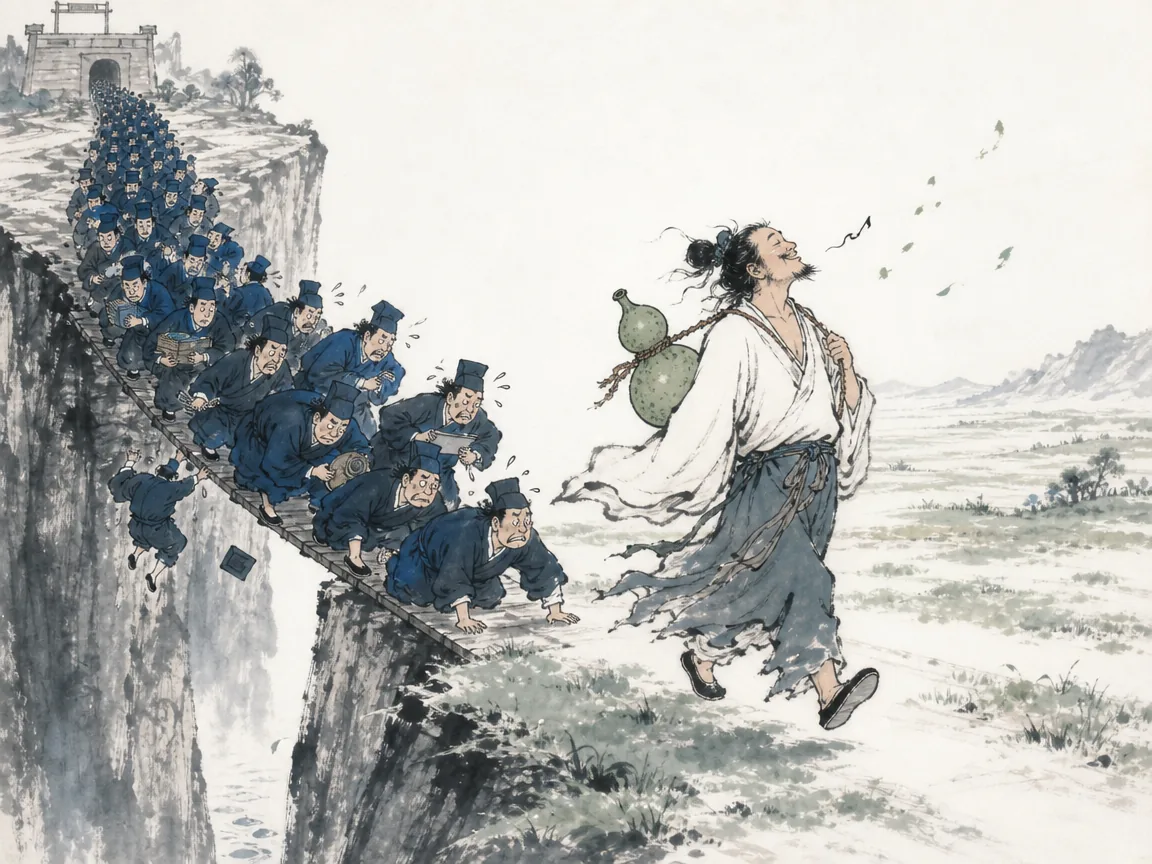
In seventh-century China, every ambitious scholar faced the same narrow corridor: study, take the imperial examination, win office, climb higher. There was no lateral move, no side path, no culturally accepted way out. To refuse the system was not celebrated as wisdom—it was read as failure, or worse, foolishness.
Yet one man chose that path anyway. Meng Haoran (689–740) grew up with every advantage: a distinguished family lineage, wealth, literary talent, and a reputation that would eventually draw admiration from the greatest poets of his age. And still, in his twenties, he walked away from the race that consumed everyone else. He went to the mountains instead—a foundational perspective explored in Tang Poet Quitting the Rat Race.
This is not a story about running away. It is a story about what it means to define success before the world gets to define it for you—and what ancient Chinese thought can teach us about building a life of purpose without guilt, shame, or financial ruin.
Tang Poet Quitting the Rat Race: The Original "Anti-Involvement" Movement
The pressure to climb, optimize, and perform never sleeps. Today we have names for it: hustle culture, burnout, the grind. But the urge to equate busyness with worth is far from modern. In Tang Dynasty China, the imperial examination system created an entire ecosystem of ambition—families bet everything on a single exam, friends competed as rivals, and a man's social standing could rise or fall in a few days of testing.
Meng Haoran did something radical. At a time when scholars were just beginning their preparation for the grueling exam cycle, he had already decided not to play. [2] records that in his youth he "lived in seclusion at Lumen Mountain" and only traveled to the capital at age forty [2]. He didn't reject the system after decades of frustration—he rejected it before he ever entered it.
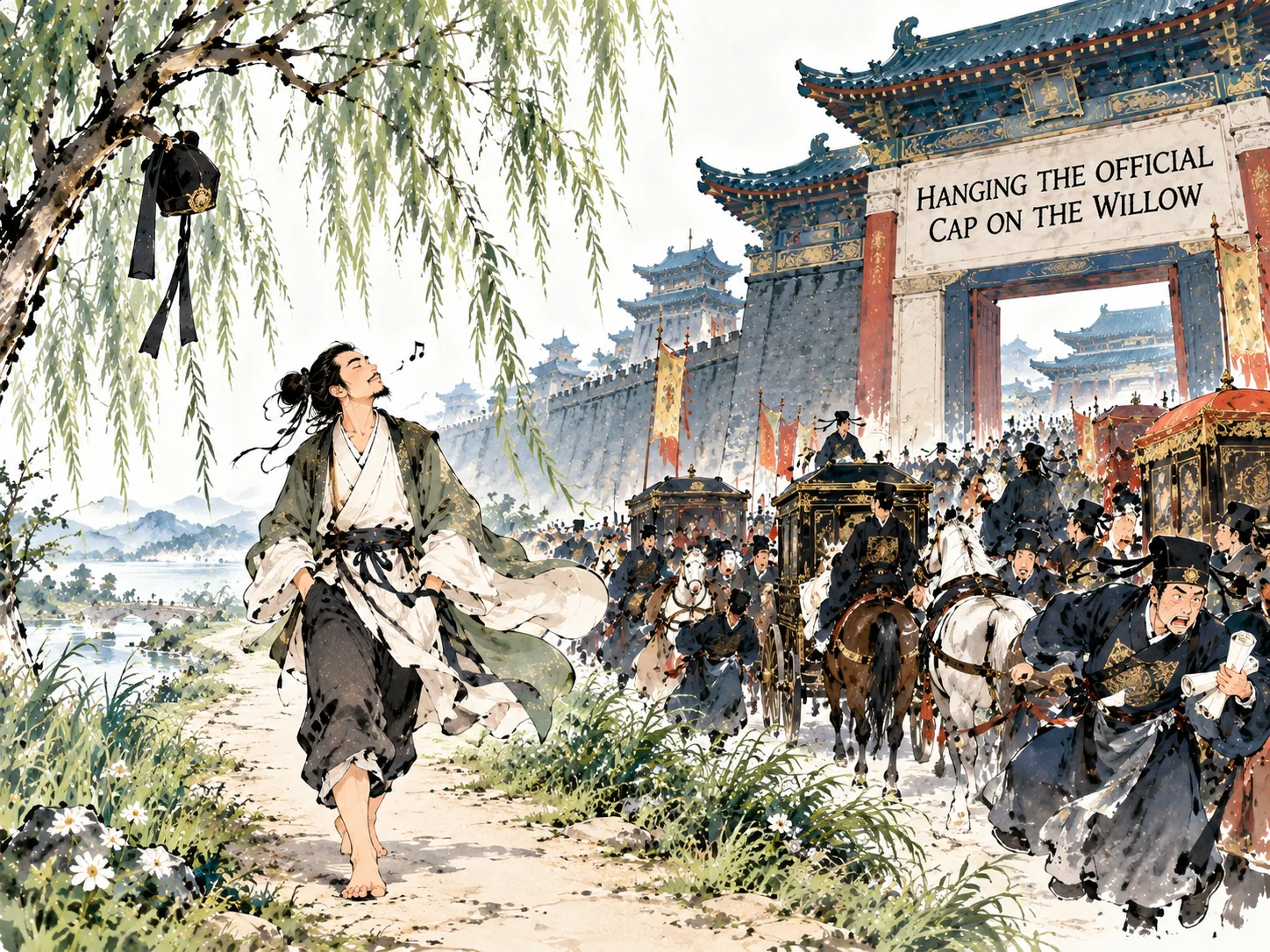
There is something instructive about the timing. Most people who leave high-pressure careers do so after they are broken by them. Meng Haoran stepped off before the machine could grind him down.
A Different Kind of Success
Meng Haoran was born into privilege. His family claimed descent from the great Confucian sage Mencius, and he grew up with the education, resources, and social connections that most scholars could only dream of. By every conventional measure, he was positioned for achievement.
Instead, he chose a different life. He lived among the hills of Lumen Mountain, observed nature closely enough to capture its smallest details in verse, and built relationships that outlasted his lifetime. [3] notes that in his early years he valued loyalty and was known for helping others in times of hardship [3]—qualities that shaped not only his poetry but the way he moved through the world.
What makes his path particularly striking is that he arrived at a place many of his contemporaries only reached after years of disappointment. Poets like Wang Wei and Du Fu eventually turned to withdrawal and nature after navigating the frustrations of official life. For Meng Haoran, that retreat was not a consolation prize—it was the destination from the start.
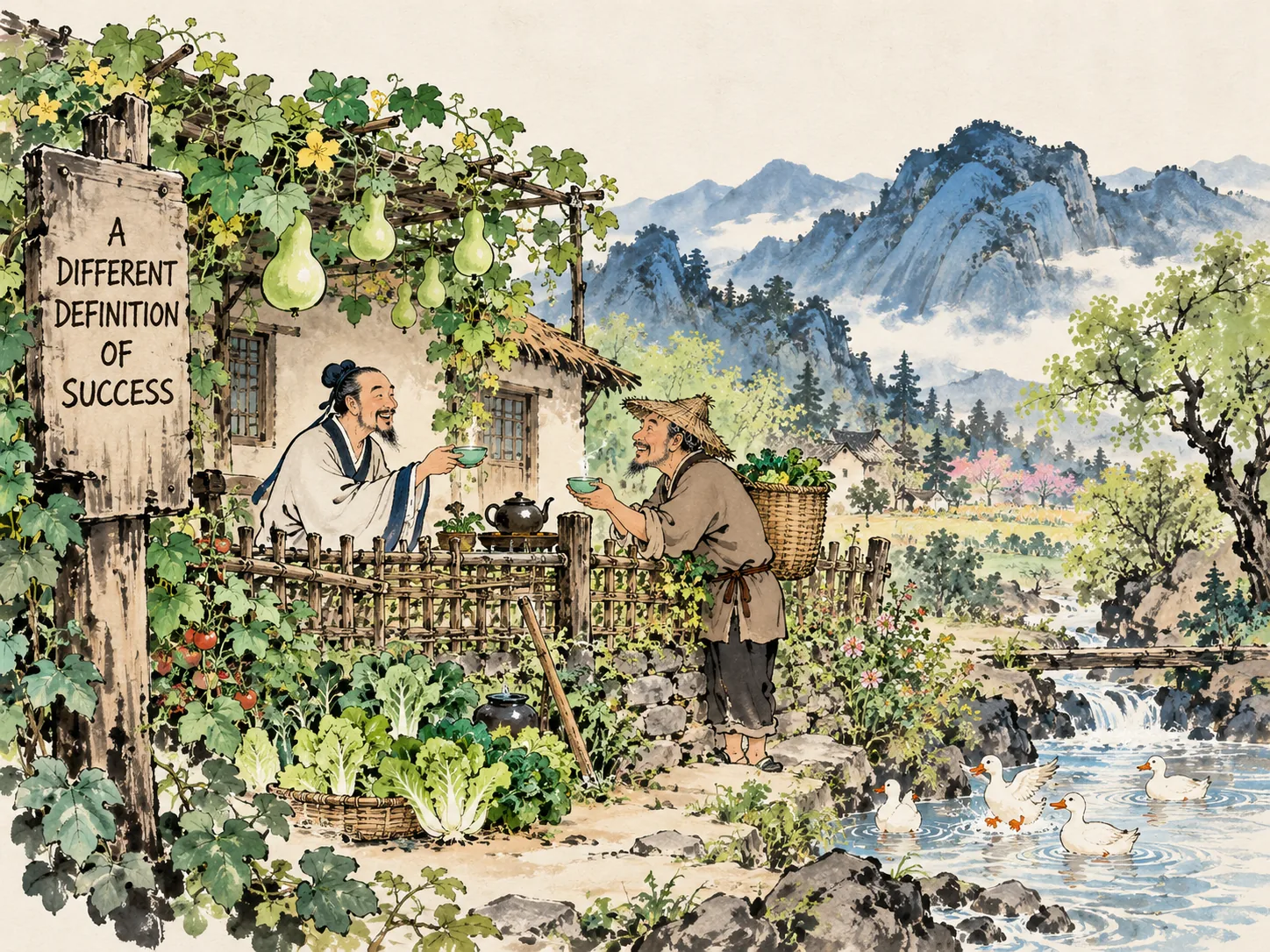
This aligns with a principle found in Daoist thought: wu-wei (无为), often understood as "effortless action" or acting in alignment with the natural flow rather than forcing outcomes against the current. Meng Haoran's life can be read as a practical expression of this idea—not as a calculated philosophy, but as a way of living that happened to resonate with one of China's oldest wisdom traditions.
The Attempt—and the Refusal
Around age thirty-eight, Meng Haoran did enter the capital, Chang'an. He did not go to take the exams in the usual sense; he went with an open door, curious about the world he had long observed from the sidelines. There, he made remarkable connections. His poem about Lake Dongting (Dòngtíng Hú, 洞庭湖) became widely circulated, and he impressed the literary and political circles of the time [3]. He tasted the very world he had previously rejected.
But the system demanded something he could not give: performance. When a poem he wrote—Returning to Southern Mountain at Year's End (Suì Mù Guī Nánshān, 岁暮归南山)—reached the emperor, it contained the lines "I have no talent, so the enlightened sovereign has abandoned me" [2]. The emperor's response was sharp: "You did not seek office; I never abandoned you. How dare you misrepresent me?" and he was sent back home [2]. Gain deeper perspective on weathering adversity through the poetic resilience explored in When All Good Things Fade: What a Prosperous Poet Teaches Us About Letting Go.
Some readings suggest this was a genuine political misstep; others see it as the inevitable collision between an uncompromising personality and a system built on conformity. What is clear is that Meng Haoran could not have succeeded within the rules of the game—he played by a different set of values entirely. Later, he would serve briefly in the office of Zhang Jiuling [2], but the imperial court was never his home.
What His Story Reveals About Leaving the Grind
Stepping Back Requires a Different Vocabulary
Chinese tradition has a word for deliberate withdrawal: yin (隐). It does not mean hiding in shame. It refers to a recognized path of self-cultivation—one that appears throughout Chinese philosophy, from Daoist texts to Confucian discussions of when to advance and when to retreat. In a culture that might otherwise view stepping away as cowardice, yin reframes it as strategy and integrity.
This matters for anyone considering a career change, a sabbatical, or a complete reinvention. The language we use shapes whether we see our choice as failure or as something else entirely.

Withdrawal Doesn't Mean Nothingness
Meng Haoran did not disappear into silence. While outside the imperial system, he produced some of the most enduring poems in the Chinese literary canon—works like Spring Morning (Chūn Xiǎo, 春晓) and Visiting an Old Friend's Estate (Guò Gùrén Zhuāng, 过故人庄) that remain beloved nearly twelve centuries later. His distance from the center of power may have been precisely what allowed him to see clearly enough to write what he wrote.
The lesson is not that withdrawal guarantees great art. It is that a life removed from the machinery of constant competition can still be deeply creative, socially rich, and culturally significant.
Authenticity Has a Cost
Meng Haoran's refusal to perform the role the system demanded cost him status, security, and the kind of institutional recognition available to his peers. But it preserved something rarer: a life that was recognizably his own.
This is the tradeoff that modern burnout culture rarely names. We are told we can have everything—success, meaning, comfort, time. But choosing authenticity usually means letting go of something the world values. The question is whether what you gain in return feels worth the price.
Community Matters
Opting out does not mean opting alone. Meng Haoran's friendships were deep and lasting. [4] records Li Bai's famous lines: "I love Master Meng, renowned throughout the land for his grace and freedom" [4]—a tribute that speaks not just to poetic admiration but to a personal bond. Wang Wei mourned him. His circle included some of the most celebrated minds of the era.
When we imagine leaving the rat race, we often picture solitude. But the people who build meaningful alternative lives tend to do so with community—not in spite of it.
A Modern Takeaway
We live in a culture that measures worth by output and treats rest as laziness. Meng Haoran lived over a thousand years ago, and yet his life points toward something that modern research on burnout and well-being increasingly confirms: sustainable meaning comes not from relentless drive but from alignment—with yourself, with your values, and with a rhythm that does not require you to exhaust yourself to prove you matter.
The question is not whether you have permission to step away. The question is whether you can define success on your own terms before someone else defines it for you.
Practical Suggestions for Building a Life Beyond the Grind
Clarify your values before you make a move. Meng Haoran knew what he was choosing for before he chose what he was choosing away from. Write down what a good life looks like to you—in concrete terms, not abstractions. Then ask whether your current path moves you toward or away from those things.
Redefine withdrawal as strategy, not surrender. The language you use shapes the choices you feel entitled to make. Instead of "I failed at the rat race," try "I chose a different track." This is not positive thinking; it is linguistic accuracy. You made a choice. Own it.
Build relationships outside the competition layer. Meng Haoran's life was enriched by friendships that were not transactional. Identify the people in your current network who value you for who you are, not for what you produce. Invest in those relationships deliberately.
Allow yourself to experiment before you commit. Meng Haoran spent years in the mountains before ever testing the capital. He did not leap blindly. Create small experiments—a sabbatical, a side project, a different way of working—that let you test whether another path is viable before you burn the bridge.
Accept that authenticity has a cost, and budget for it. Leaving the mainstream rarely comes free. Financially, socially, emotionally—there will be tradeoffs. Name them in advance so you are not surprised when they arrive.
FAQ
Was Meng Haoran a failure because he never held significant office? That depends on your definition of success. By the standards of the Tang imperial system, yes—he did not achieve the kind of official rank that defined a scholar's career. But by other measures, he was remarkably successful: his poetry has endured for over a millennium, he was admired by poets like Li Bai, and he lived a life aligned with his own values. Whether one metric outweighs the other is a question each reader must answer for themselves.
Did Meng Haoran ever regret his choice? The historical record does not suggest regret. His poetry from the period of withdrawal is marked by a genuine engagement with nature and friendship, not by lamentation. When he did enter the capital, he seems to have done so with curiosity rather than desperation. Whether this reflects genuine contentment or a temperament that adapted to whatever path he chose is impossible to determine with certainty.
Can someone follow Meng Haoran's model without abandoning all responsibility? Meng Haoran did not live in total isolation. He maintained friendships, served briefly in an official capacity, and engaged with the intellectual and literary world of his time. His "withdrawal" was selective, not absolute. For modern readers, this suggests that stepping back from relentless ambition does not require complete disengagement from society—it requires reordering your priorities so that meaning is not dependent on external validation.
How relevant is a Tang Dynasty poet's life to someone dealing with modern burnout? The specific context is different—imperial examinations are not a modern workplace—but the underlying tension is the same: how do you live well in a system that rewards constant striving? Chinese philosophical traditions have grappled with this question for millennia, and Meng Haoran's life is one concrete case study. His example may not provide a ready-made solution, but it does offer a different lens through which to consider the problem, reflecting the enduring wisdom of Tang Poet Quitting the Rat Race.
Gain deeper perspective on weathering adversity through the poetic resilience explored in How 23 Years of Exile Made the Poet Who Wouldn’t Bend.
Deepen your understanding of these principles in our reflection on How a Tang Dynasty Poet Broke Every Rule—and Paid the Price.
Sources & Further Reading
[1] Primary sources used in this article:
[2] New Book of Tang, Volume 203 (新唐書/卷203) – Wikisource — Biography of Meng Haoran in the New Book of Tang, containing details of his early life, his journey to the capital, the emperor's response to his poem, and his death
[3] Biographies of Tang Talents, Volume 2 (唐才子傳/卷2) – Wikisource — Biographical compilation covering Meng Haoran's character and social circles
[4] Li Bai: "To Meng Haoran" (贈孟浩然) – Wikisource — Li Bai's poem to Meng Haoran, recording the deep admiration between the two poets
[5] For further reading:
[6] Works on Daoist concepts of wu-wei (无为) and their relationship to traditional Chinese approaches to withdrawal and self-cultivation
[7] Comparative studies of Tang Dynasty poets and the examination system
[8] Modern research on burnout, meaning, and alternative models of professional life







[…] For a deeper comparative examination of these ideas, explore our related study on How a Tang Dynasty Poet Quit the Rat Race Before It Existed—And What His Life Teaches Us About Ste…. […]
[…] Gain deeper perspective on weathering adversity through the poetic resilience explored in How a Tang Dynasty Poet Quit the Rat Race Before It Existed—And What His Life Teaches Us About Ste…. […]