
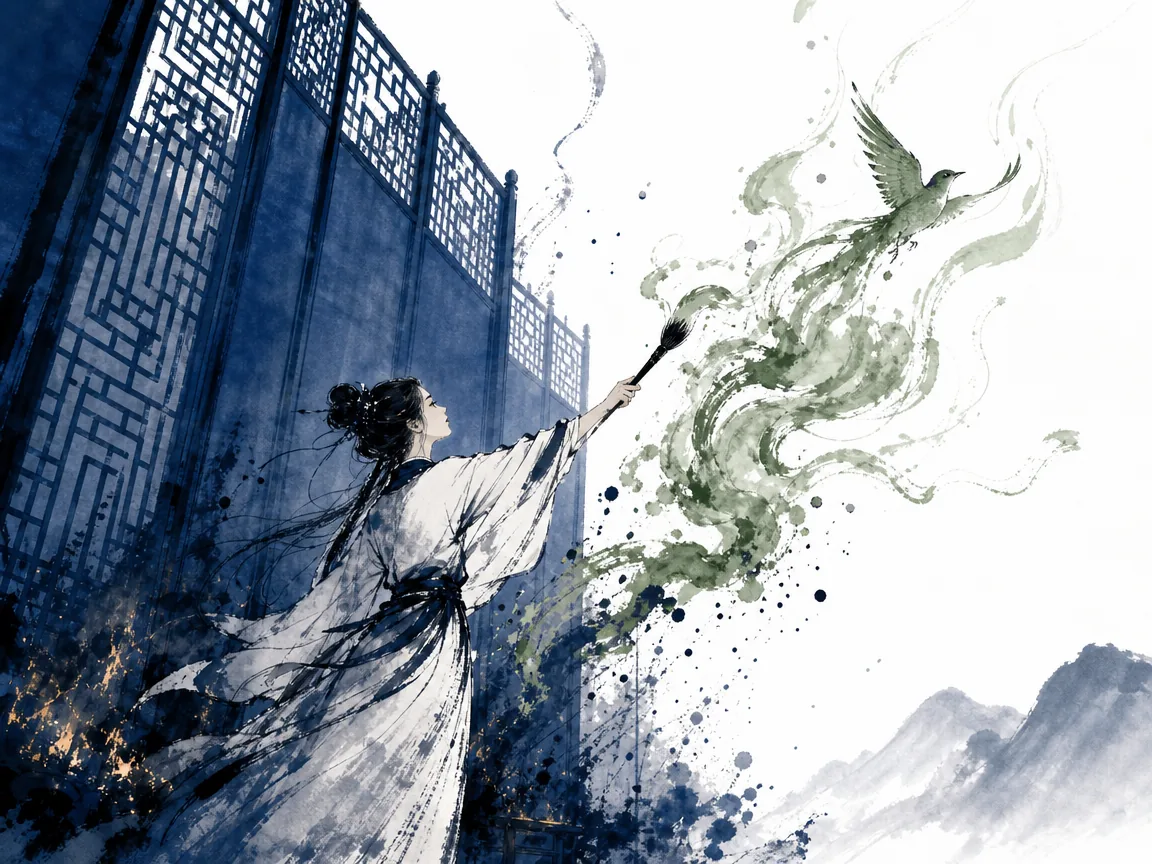
In the eighth century, during China’s Tang Dynasty (唐朝), the country was home to an extraordinary number of women who wrote poetry—scholars today estimate there were over two hundred recorded female poets during the Tang Dynasty alone. Among them, one figure stands out for the sheer intensity of her emotional honesty and the sharpness of her wit: Li Ye (李冶), known by her courtesy name Jilan (季兰), a woman who loved boldly, laughed loudly, and ultimately paid for her refusal to perform quiet femininity with her life [2]. Her story is not a scandal waiting to be gossiped about—it is a case study in what happens when a person chooses authenticity over survival, and what we might learn from the cost.
Li Ye lived at a time when women were expected to embody a very particular kind of silence: dutiful, restrained, invisible in their ambition. She chose to be none of these things. She wrote poems that named longing without apology. She made jokes at public gatherings that would have earned a woman harsh censure in almost any other era. And when political chaos swept through the empire and she was caught between powers she did not wield, the state decided that her voice itself was treason [3]. What follows is not a biography written as legend, but a meditation on one woman's attempt to live openly in a world that demanded she shrink—a foundational perspective explored in Tang Poet Who Broke Every Rule.
Tang Poet Who Broke Every Rule: The Poem That Captured Everything
Li Ye's most widely remembered poem is only four lines long. Its title, Ba Zhi (Eight “Utmosts”, 《八至》), refers to the eight appearances of the word zhi (“the utmost,” 至). The poem moves from physical distance to the paradox of human closeness:
The nearest and the farthest: east and west. (Zhi jin zhi yuan dong xi; 至近至远东西。)
The deepest and the shallowest: a clear stream. (Zhi shen zhi qian qing xi; 至深至浅清溪。)
The highest and the brightest: the sun and moon. (Zhi gao zhi ming ri yue; 至高至明日月。)
The closest and the most distant: husband and wife. (Zhi qin zhi shu fu qi; 至亲至疏夫妻。) [1]
Read literally, the poem maps opposites onto the same axis. Distance and proximity are not fixed points but relational experiences. The fourth line—often cited as the poem's emotional center—carries a truth that requires no modern psychology to validate: the people closest to us by convention can also be the most alien to us by experience. This is not a cynical observation. It is an honest one, and its honesty is what makes it endure.
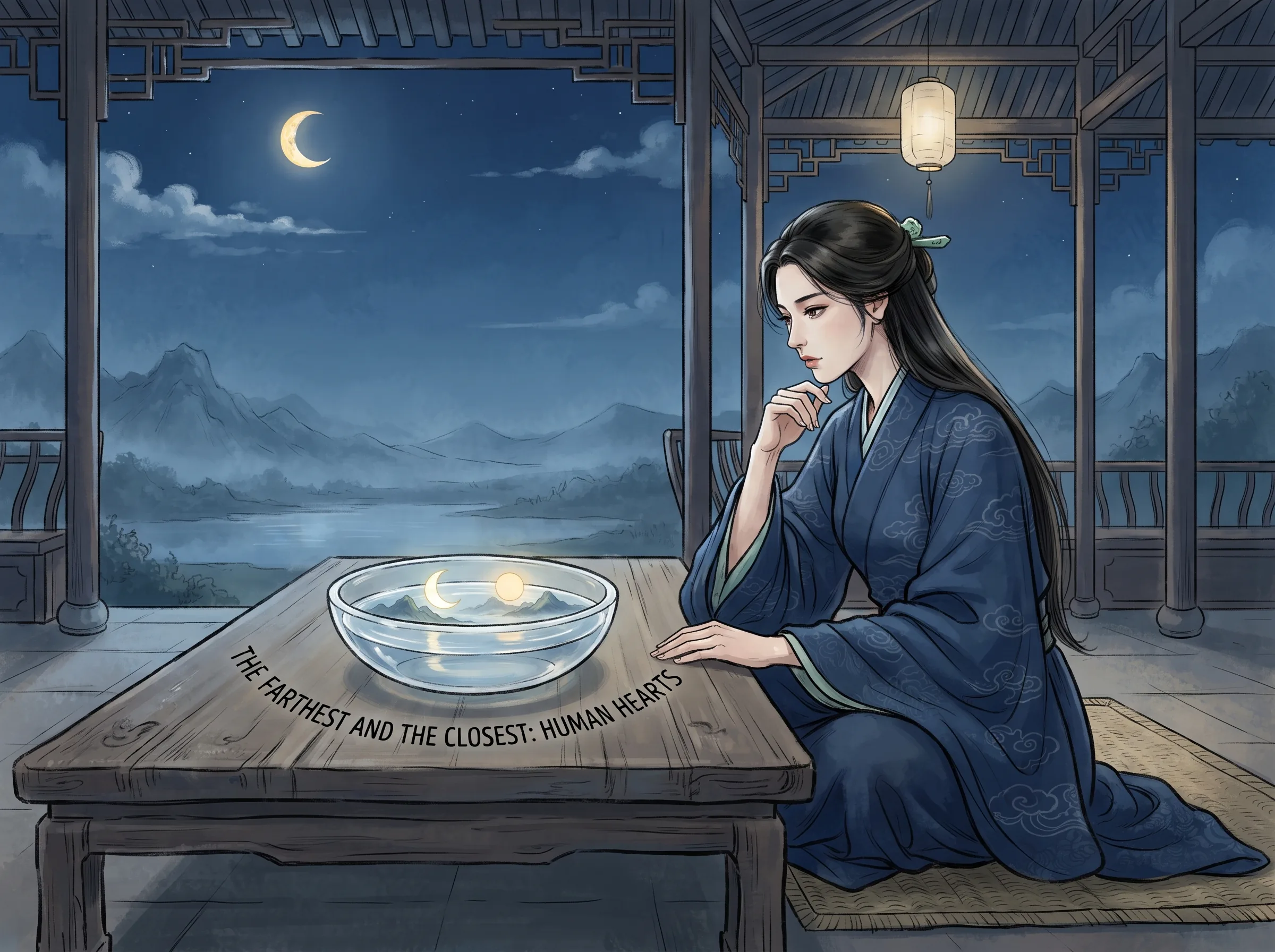
For readers today navigating relationships that feel simultaneously intimate and isolating, Li Ye's poem offers something rarer than advice: it offers recognition. She does not tell us how to fix a marriage, how to choose a partner, or how to avoid pain. She simply names a condition—the coexistence of closeness and distance within a single bond—with such clarity that the naming itself becomes a kind of relief. There is a quiet Daoist resonance here, in the acceptance of opposites as part of a single pattern, without rushing to resolve the tension.
A Woman Who Named Her Longing
Much of what we know about Li Ye's emotional life comes through her poetry rather than through biography, and the distinction matters. Ancient Chinese literary culture often allowed women poets to express desire, grief, and longing in ways that would have been considered improper in direct personal testimony. Poetry became a socially acceptable channel for feelings that had no other safe outlet [4]. Li Ye appears to have understood this implicitly and used it fully.
One poem traditionally attributed to her begins with the lines: "People say the sea is deepest / I say the sea has edges / But my longing has no shore." Whether or not the exact wording survives in every collection, the sentiment is consistent with what we know of her voice—a willingness to measure inner experience against the largest natural images available and find them insufficient [2]. This is not melodrama. It is a genuine attempt to articulate the scale of feeling in a culture that often demanded women minimize exactly such expressions.
Her friendship with the monk Jiaoran (皎然), another major literary figure of the period, is recorded in the Biographies of Talented Tang Poets (Tang Caizi Zhuan, 《唐才子传》), which notes that the two “got along exceptionally well” (yi shen xiang de, 意甚相得) [2]. Jiaoran responded to her attention with a poem that gently declined her romantic overtures, using the image of a celestial maiden whose flowers cannot take root in a Buddhist mind already devoted to stillness [2]. The exchange is remarkable not for its romantic outcome—there was none—but for its mutual recognition. Both poets saw each other clearly. Neither pretended otherwise. In an era when women's desires were typically treated as either nonexistent or dangerous, this kind of candid exchange was itself a form of defiance.
Wit as a Weapon and a Shield
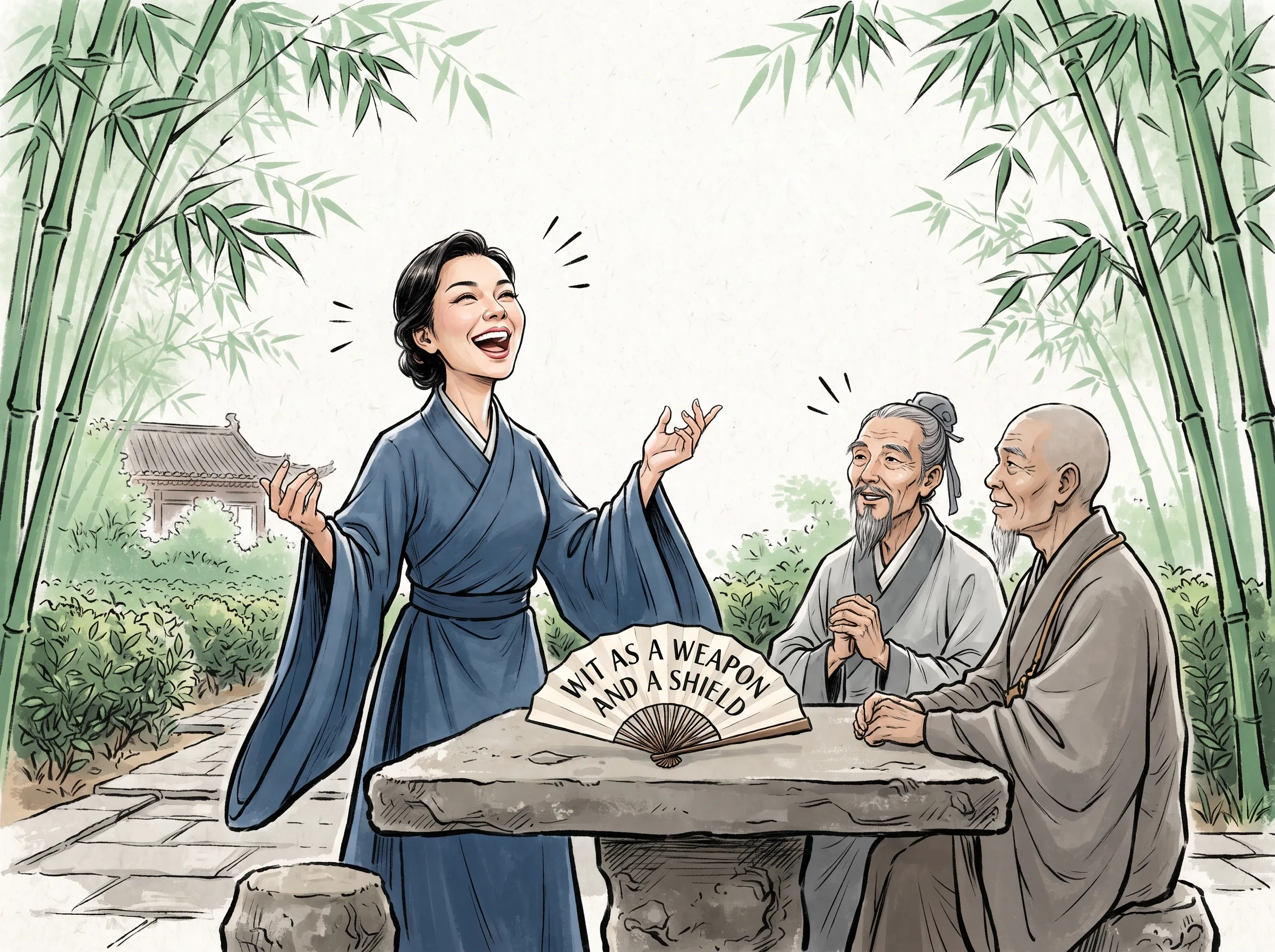
Li Ye was not only a poet of tender feeling; she was also sharp-tongued, quick-witted, and unafraid of public humor. One anecdote recorded in the Tang Caizi Zhuan describes a gathering at Kaiyuan Temple (开元寺) in Wucheng (吴兴), where Li Ye learned that the poet Liu Changqing (刘长卿) suffered from a private ailment [2]. Rather than pretending ignorance, she invoked the line “The mountain air is lovely at sunset” (shan qi ri xi jia, 山气日夕佳)—a well-known poetic phrase that, in this context, served as a knowing reference to his condition [2]. Liu Changqing replied instantly with “The returning birds flock together” (zhong niao xin you tuo, 众鸟欣有托), turning the moment into shared laughter rather than embarrassment [2]. The record states that those present praised both of them [2]. Gain deeper perspective on weathering adversity through the poetic resilience explored in When Doors Close: A Tang Poet’s Story of Unexpected Paths.
This story tells us something important about Li Ye's place in her literary world. She was not tolerated as a polite decorative presence. She was engaged with as an intellectual equal, and her boldness was met with amusement rather than censure—at least in that room, at that moment. The later collector Gao Zhongwu, writing in the Zhongsheng Ji, observed that she did not conform to the traditional virtues expected of women, possessing instead a masculine vigor in both temperament and poetic style [2]. Whether that observation was meant as criticism or admiration is unclear; what is clear is that contemporaries could not pretend she was ordinary.
The discomfort her presence caused some readers is itself instructive. Creativity and emotional honesty rarely arrive wrapped in the comfort of those who prefer the world to stay neatly ordered. Li Ye's wit was not reckless—it was precise. She knew exactly what she was doing when she spoke in public. That she was admired for it by some and unsettling to others says as much about the limits of her society's tolerance as it does about her own character.
The Price of Speaking Truth
In 783 CE, the Jingyuan Mutiny (泾原兵变) shattered the Tang court. Emperor Dezong (唐德宗) fled the capital, and the general Zhu Ci (朱泚) declared himself emperor of a short-lived regime called Qin (秦). In the chaos, members of the former imperial household—including Li Ye—were left behind [3]. When imperial forces recaptured the capital the following year, Li Ye faced charges not for any act of violence or sustained collaboration, but for having composed a poem for Zhu Ci during the occupation [3]. The Fengtian Lu (《奉天录》) records that the emperor confronted her directly, asking why she had not followed the example of Yan Juchuan (严巨川), who had written verses expressing loyalty to the legitimate throne [3]. Her response, if she made one, is not preserved. She was ordered executed by beating [3].
The disproportion of this punishment deserves attention. Li Ye was a woman with no military power, no political office, and no army. She was captured, not chosen. Her poem for Zhu Ci was likely an act of survival in impossible circumstances—not ideology, not treason in any meaningful sense. Yet the state treated her words as evidence of disloyalty and her gender as proof that she lacked the integrity of male officials who had also survived the crisis [3]. Her death illustrates a pattern that recurs across many societies: when women step outside prescribed roles, their transgressions are punished more severely than equivalent behavior by men, and their deaths are often justified as moral correction rather than political violence.
Li Ye was approximately fifty-four years old at the time of her death, according to traditional chronologies [2]. She had lived a full life by any measure—famed, published, traveling, debating, loving, grieving, laughing in company. She died because the state decided her voice had crossed a line it could not forgive. That is not a philosophical abstraction. It is a historical fact, and it carries weight.
What Li Ye's Life Offers the Modern Reader
Li Ye did not leave behind a systematic philosophy. She left poems, anecdotes, and a biography that reads more like a warning than a handbook. What she offers, then, is not doctrine but observation—the kind of insight that comes from watching a life played out in full rather than theorized from a distance.
Emotional honesty is itself a form of courage, and courage carries risk. Li Ye's poems named longing, distance, and heartbreak without the buffer of euphemism. She did not write to be comforting; she wrote to be true. That choice made her work endure and made her life precarious.
Talent and boldness invite both admiration and danger. Her contemporaries recognized her literary power even as some found her manner unsettling. The same qualities that make a person memorable in good times can make them vulnerable in crises. This is not a reason to suppress either talent or boldness—it is a reason to understand their cost honestly.
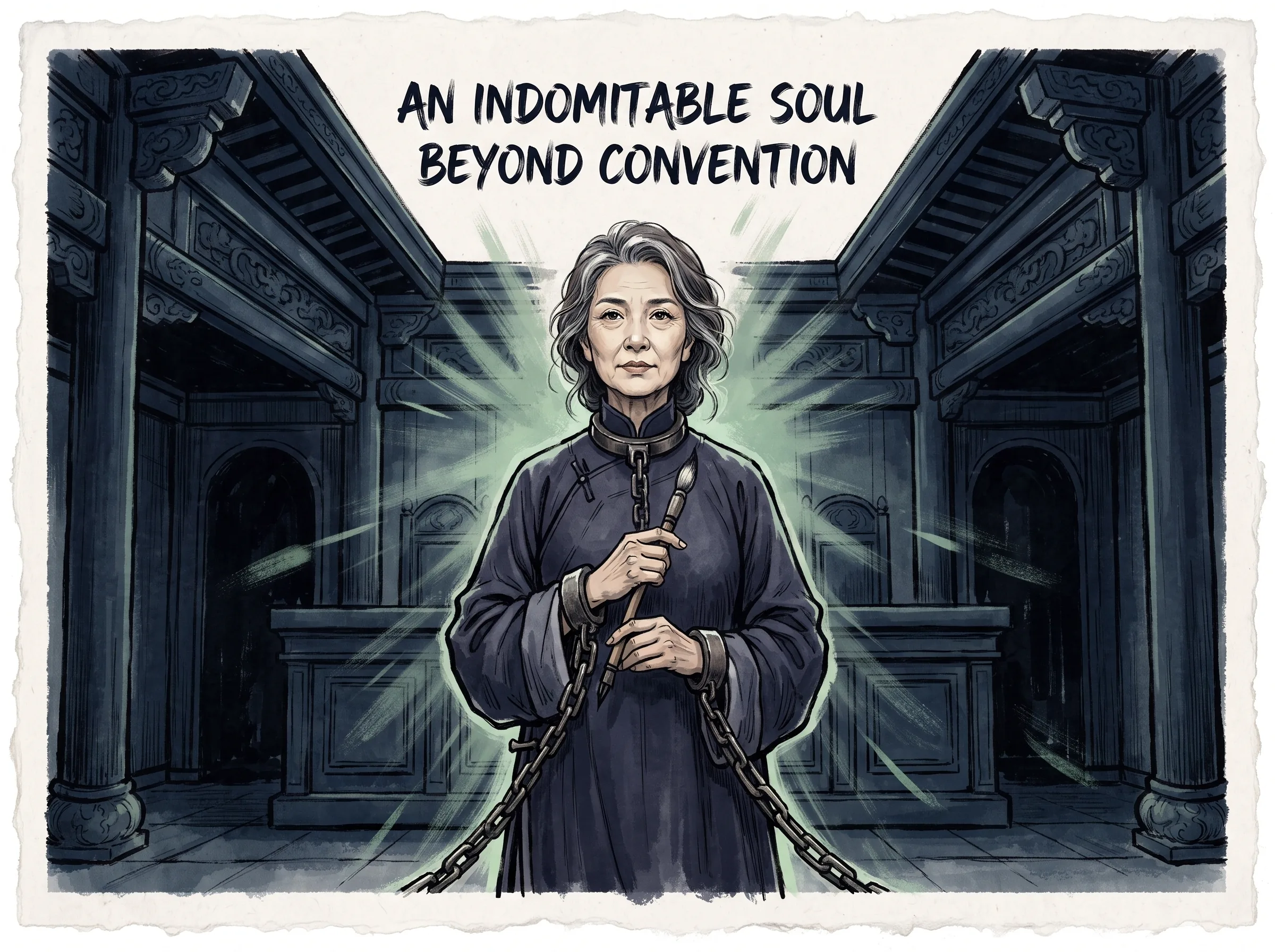
The tension between inner truth and external expectation is timeless. No era has resolved it completely, and no era has avoided punishing those who refuse to perform conformity. Li Ye's life reminds us that this tension is not a personal failing but a structural condition—one that each generation must confront anew.
For modern readers, the question her life raises is not "How can I be like Li Ye?" but rather "Where do I compromise authenticity for safety—and am I willing to name the cost?" There is no simple answer, and no single tradition offers one. What Li Ye's story provides is permission to take the question seriously.
FAQ
Was Li Ye really executed for writing a poem? According to the Fengtian Lu (《奉天录》), after imperial forces recaptured the capital in 784 CE, Emperor Dezong ordered Li Ye's execution, citing a poem she had composed for the rebel leader Zhu Ci during the occupation [3]. She had no political power and was caught amid the chaos as a member of the abandoned imperial household. Historians continue to debate the extent to which her death was punitive justice and the extent to which it reflected the disproportionate punishment afforded to women who failed to perform loyalty convincingly.
Did Li Ye actually love the monk Jiaoran? The Tang Caizi Zhuan (《唐才子传》) records that Li Ye and Jiaoran were close literary companions who “got along exceptionally well” (yi shen xiang de, 意甚相得) [2]. Jiaoran is said to have composed a poem declining her romantic attentions, using the metaphor of a celestial maiden whose flowers cannot take root in a devoted Buddhist mind [2]. While traditional accounts suggest romantic feelings on her part, scholars note that the surviving evidence describes a close creative friendship rather than documenting a confirmed love affair [2].
What is the significance of "The closest and the most distant are husband and wife"? This line from Ba Zhi (《八至》) captures a paradox that requires no modern theory to understand: the people closest to us by social arrangement can also be the most alien to us by emotional experience [1]. The poem does not diagnosemarital relationships or prescribe solutions; it observes a condition. Its endurance across centuries suggests that readers continue to recognize something true in that observation, regardless of when or where they live.
How reliable are the biographical details about Li Ye? Most of what we know about Li Ye comes from the Tang Caizi Zhuan (《唐才子传》), a thirteenth-century biographical collection written well after her lifetime, and the Fengtian Lu (《奉天录》), which records her death [2]****[3]. Some details—her birth year, her age at death, the specifics of her romantic relationships—are contested or undocumented in earlier sources. Scholars generally treat the broad outline of her life as historically plausible while noting that individual anecdotes may reflect later literary embellishment [4]****[5].
Li Ye's life ended violently, but her poems survived. What she modeled was not a recipe for happiness or a strategy for success, but something harder to achieve and rarer to find: the willingness to feel openly and express clearly in a world that often rewards the opposite. Her story does not promise that authenticity will protect you. If anything, it suggests the reverse. But it does invite us to consider whether a life lived without self-betrayal—even a short one, even a dangerous one—might be worth more than a longer life spent performing a version of ourselves that feels increasingly unfamiliar.
If this portrait of Li Ye resonated with you, you might next explore how other Tang Dynasty women poets—such as Xue Tao and Yu Xuanji—navigated similar tensions between creative expression and social constraint, or return to the source poems themselves and read Ba Zhi in its original Chinese context to see what gets lost and gained in translation, reflecting the enduring wisdom of Tang Poet Who Broke Every Rule.
Gain deeper perspective on weathering adversity through the poetic resilience explored in How to Stay True to Yourself When the World Keeps Pushing You Down.
Deepen your understanding of these principles in our reflection on Hong Kong Wuxia Cinema: Where the Sword Meets the Soul — Ancient Chinese Wisdom in Blade and Shadow.
Sources & Further Reading
[1] “Ba Zhi” (《八至》) — Wikisource
[2] Biographies of Talented Tang Poets, vol. 2 (《唐才子传/卷2》) — Wikisource
[3] Fengtian Lu, vol. 1 (《奉天录/卷1》) — Wikisource
[4] Study of women poets in the Tang Dynasty — KCI
[5] Study of the social status of Tang women poets, centered on Li Ye and Xue Tao — Lingnan University






