
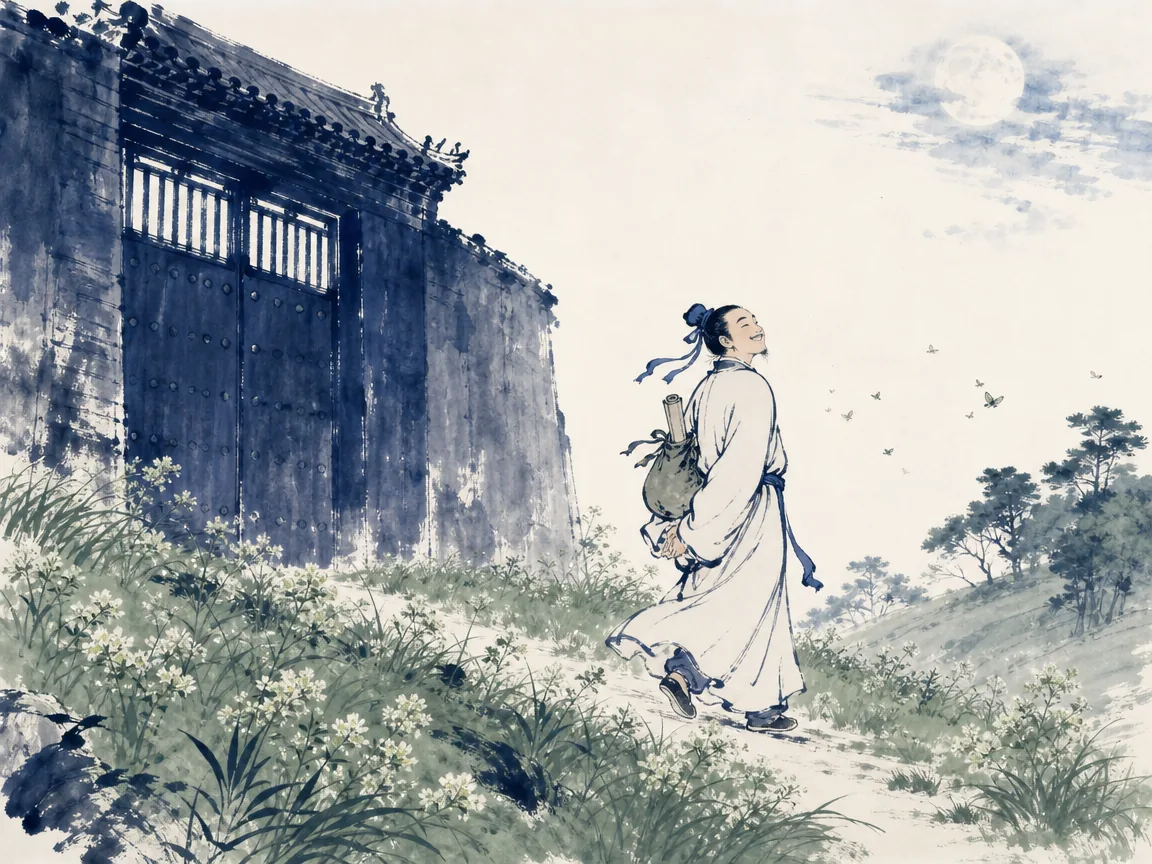
There is a particular kind of grief that comes not from trying and failing, but from trying your hardest and finding the door locked anyway. Talent is not enough. Hard work is not enough. You do everything right and something outside your control closes the path in front of you.
The Tang dynasty poet Li He (李贺) knew this grief intimately. He was recognized as a prodigy by the greatest literary figures of his age. He wrote lines that would be remembered for over a thousand years. And yet, almost every institution that could have given his gifts a meaningful outlet systematically turned him away — until he died at twenty-seven, still hungry for purpose, still unheard in the world he was born into—a foundational perspective explored in Tang Poet Unexpected Paths.
His story is often told as one of tragic failure. But reading it alongside classical Chinese wisdom suggests something else: Li He's life offers a meditation on what happens when the external world refuses to validate you, and how a person might still choose to live — not with resignation, but with a different kind of courage.
Tang Poet Unexpected Paths: A Prodigy Who Could Not Be Stopped
Li He was born into a family that traced its lineage back to the Tang royal house, though by his time that legacy amounted to little more than pride and a modest county official father What he did have was a mind that moved differently from almost everyone else.
At seven years old, he could already compose poetry with fluency [2]. When the towering literary figures Han Yu (韩愈) and Huangfu Shi (皇甫湜) came to test whether the rumors were true, Li He took up his brush and produced a poem called The Visit of Honored Guests (Gao Xuan Guo, 《高轩过》) — a work so polished that the two visitors left in genuine astonishment [2]. That moment, recorded in the New Tang Book, established Li He as a voice the literary world could not ignore.
A few years later, at around eighteen, he sent his masterpiece Song of the Yanmen Gate Governor (Yanmen Taishou Xing, 《雁门太守行》) to Han Yu. The poem opens with the line "Black clouds crush the city, about to crush it" and moves into imagery of golden armor catching the sun, horn sounds filling the autumn air, and banners heavy with cold frost [4]. Han Yu reportedly read the first two lines, put the manuscript down, and then read it again with new eyes. The poem opened a world of possibilities — and for a brief moment, it seemed the world would open in return.
But Li He's brilliance came with conditions. His family had no money. His branch of the royal lineage carried no real power. In a system where recommendation mattered as much as talent, he was always one step behind those with connections. And then the system found a reason it did not need connections to reject him.
The Name That Blocked a Future
The decisive moment in Li He's life came when he reached the age to take the jinshi (进士, the highest-level imperial civil service examination) — the path that would have given a gifted poet real influence in the Tang court. Someone objected. His father was named Li Jinsu (李晋肃), and the character jin (晋) in his name sounded like the jin (进) in jinshi (进士), the examination title. Under the custom of avoiding a parent's name (避讳), opponents argued that Li He should therefore be forbidden from taking the exam.
Han Yu, furious, wrote A Defense Against the Naming Taboo (Hui Bian, 《讳辩》) — an essay that remains one of the most logically devastating defenses in Chinese literary history. He pointed out that the law did not require avoiding a merely similar-sounding name—a practice called xianming (嫌名). He then pushed the argument to its absurd conclusion: If a father is named Ren (仁), must his son cease to be human (ren, 人)? The logic was sound. The result was not.
Li He was barred. The reasons behind the objection are disputed — some later accounts suggest the rival poet Yuan Zhen (元稹) orchestrated the complaint out of professional jealousy, though the source for that claim is a Song dynasty anecdotes collection rather than a historical record [4]. What is clear from the documents is that Li He never took the examination [2]. Whatever the conspiracy, the door was closed.
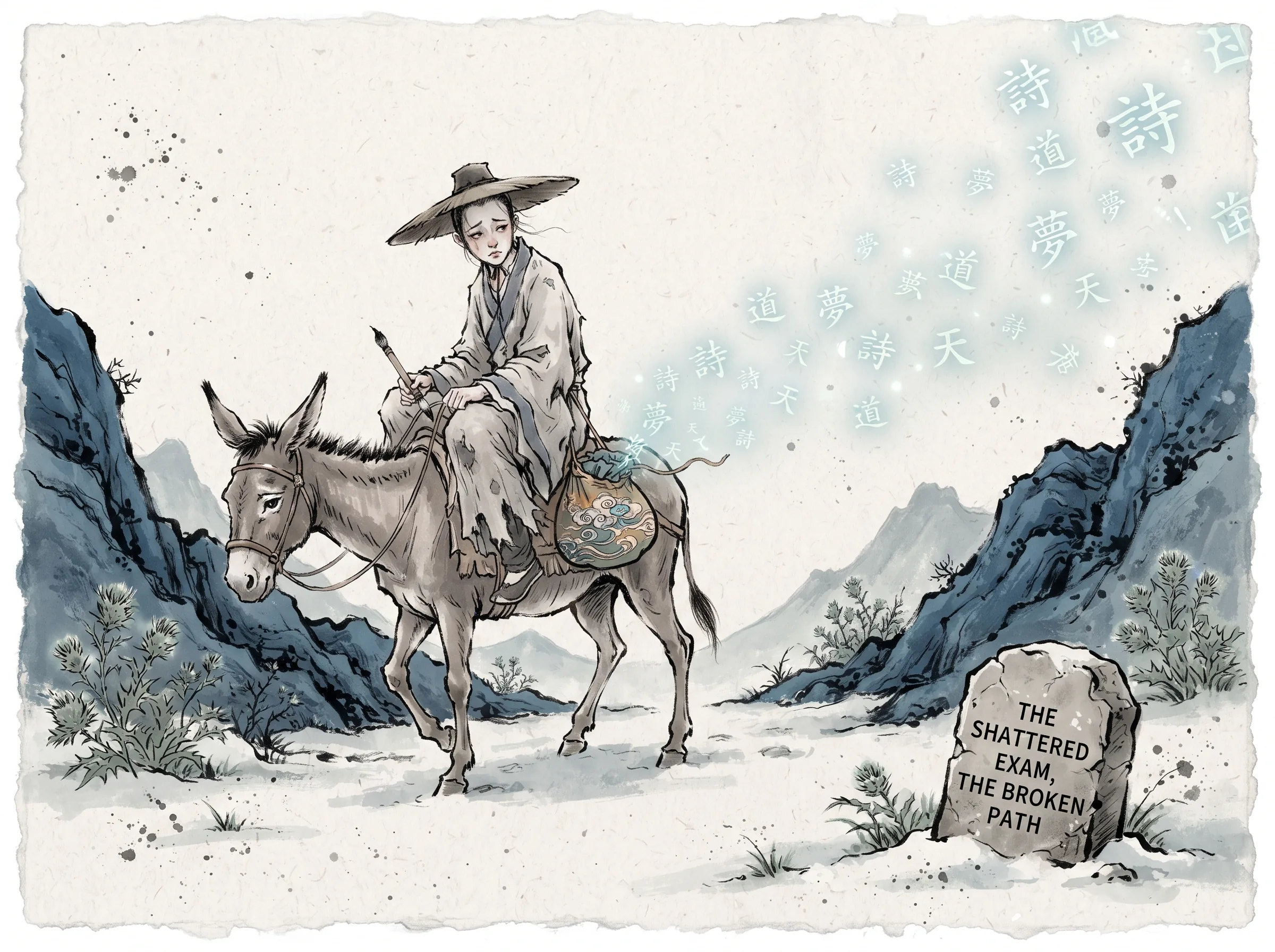
For anyone who has watched a fair process be subverted by something arbitrary, this moment carries a familiar sting. Li He had done everything he was supposed to do. He had the talent, the work ethic, the recognition. And still, the rules — or the people who wielded them — found a way to exclude him.
A Zhuangzi reading of this moment might pause at the surface-level virtue of "following the rules." The rule was invoked in bad faith, disguised as propriety, used to protect someone's position. Zhuangzi often wrote about how conventions become weapons when wielded by those who benefit from them. The deeper lesson is not that Li He failed — it is that the system that rejected him was already compromised, and his exclusion tells us more about that system than about his worth.
Writing When There Is No One Left to Hear
After the exam ban, Li He eventually received a minor post — the rank of Court Music Officer (Xielü Lang, 协律郎), essentially a ceremonial position overseeing musical rituals at court. It was a ninth-rank appointment, far below what his talent deserved, and it offered no real path to influence. He held it for a few years before leaving in frustration. Gain deeper perspective on weathering adversity through the poetic resilience explored in How a Tang Dynasty Poet Broke Every Rule—and Paid the Price.
With institutional doors closing, his poetry changed. The brilliant, vivid imagery of his earlier work gave way to darker, more haunting tones. In Autumn Comes (Qiu Lai, 《秋来》), he wrote:
Autumn graves where ghosts sing Bao's poems, Hatred-blood for a thousand years turns green.
(秋坟鬼唱鲍家诗,恨血千年土中碧。)
These lines are not the product of a man who succeeded and then grew cynical. They are the product of a man who kept writing even when there was nothing left to gain from it. That persistence, in a context where no one was reading and no reward was coming, carries a particular kind of meaning.
The Analects (Lunyu, 《论语》) contains a passage about the junzi (君子, the noble person) — who maintains their integrity precisely when the Way does not prevail in the world. Confucius did not teach that virtue requires success. He taught that virtue requires constancy, especially when constancy brings no external reward. Li He's continued writing, despite being shut out of every formal channel, aligns with this idea: the work matters because it is the work, not because the world has agreed to value it.
There is also a resonance here with what later traditions would call Stoic acceptance — not the resignation that comes from giving up, but the clarity that comes from distinguishing what you can control from what you cannot. Li He could not control the rules, the politics, or the timing. He could only control whether he stopped writing. He did not.
If Heaven Had Feelings, Heaven Would Grow Old
One of the most quoted lines in all of Chinese poetry came from a moment of defeat. After resigning from his post and beginning the long journey back to his hometown, Li He wrote The Song of the Bronze Immortal Leaving the Han Capital (Jin Tong Xianren Ci Han Ge, 《金铜仙人辞汉歌》). In it, he imagined the bronze statue of a deity being dismantled and removed from its temple — a meditation on impermanence, loss, and the cruelty of time. The poem contains the line:
If heaven had feelings, heaven would grow old.
(天若有情天亦老。)
What makes this line extraordinary is not just its beauty but its origin. It was not written in triumph. It was written in exile — heartbroken, politically finished, watching his life slip through his fingers. And yet, it is this line, more than any other, that Li He is remembered for.
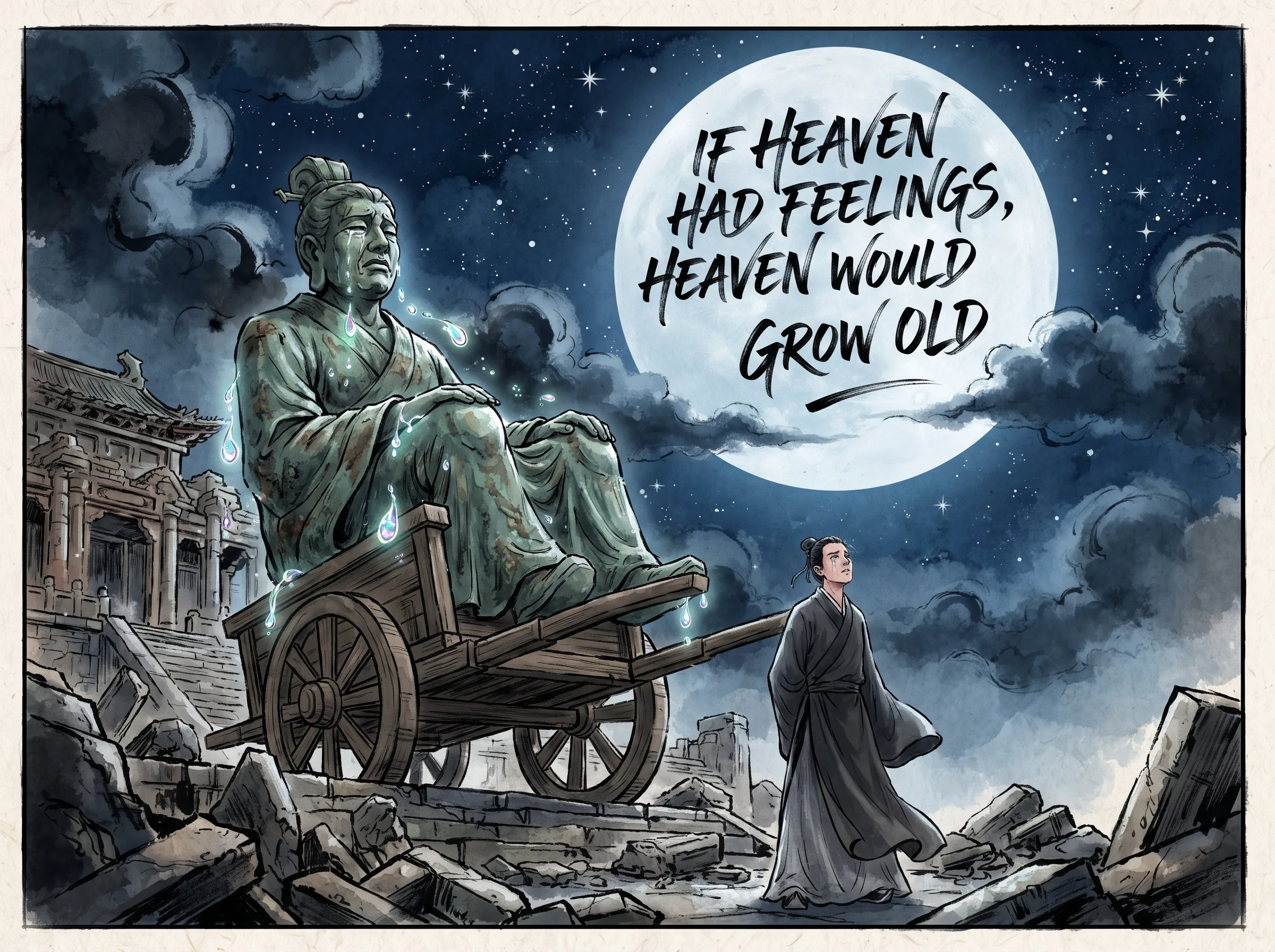
The couplet's fame is such that it became a standard challenge among scholars. According to later accounts, no one in the entire Tang dynasty could match it — until a drunken scholar named Shi Yannian, two centuries later, proposed the line If the moon had no regret, the moon would stay full (月如无恨月长圆). Whether this attribution is fully reliable remains debated. What is certain is that Li He's line entered the cultural bloodstream so completely that it became a measuring stick for poetic excellence across generations.
The philosophical insight here is not romantic. It is simply observational: the greatest art often emerges not from the satisfaction of ambition but from the honest confrontation with limitation. Suffering does not guarantee greatness. But the willingness to face limitation directly — without flinching, without pretense — creates something that outlasts the circumstances that produced it.
What We Make of a Tragic Genius
Li He died at twenty-seven, though one source records his age as twenty-four. The discrepancy itself is a reminder that we are working with incomplete records, and the uncertainty should not be smoothed over. Different accounts of his final days also exist — Li Shangyin wrote that he was summoned by the Jade Emperor to compose a record for a newly built white jade tower in heaven. Whether this is legend, comfort, or something else entirely is impossible to determine. What is clear is that it reflects a persistent human impulse: the need to spare the dead the finality of loss.
The late-Tang writer Zhang Du (张读) gave Li He a beautiful ending — a heavenly calling, a celestial reward. The historical reality was far less gentle. Li He died in poverty, unrecognized in life, his work largely ignored by the institutions that mattered most to him.
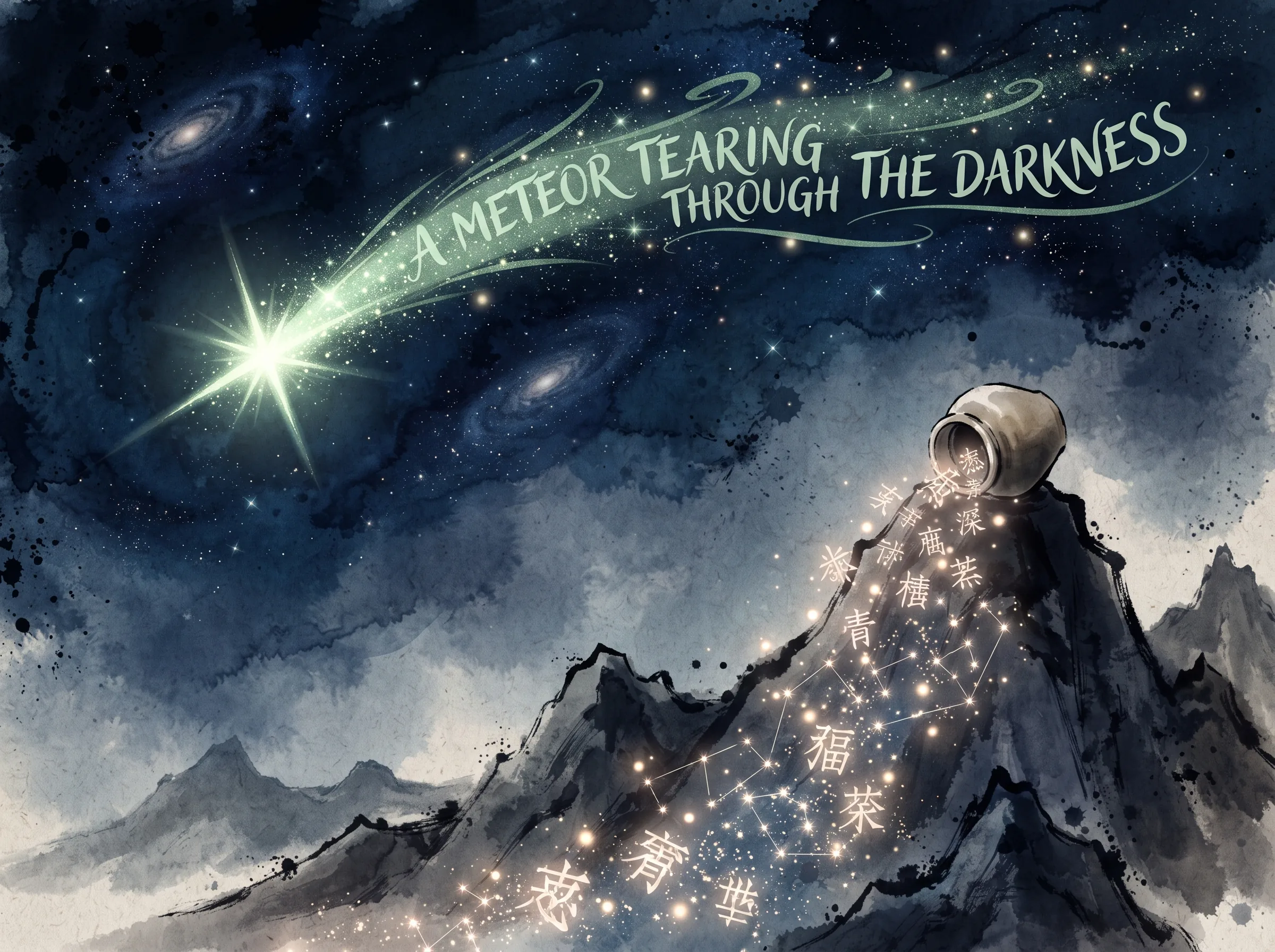
So what do we make of this? Not that ambition is worthless. Not that effort is pointless. But perhaps that the measure of a life is not entirely contained in the doors it opens — and that a person can remain true to their gift even when the world refuses to receive it.
What This Offers Today
Li He's story is not a blueprint. It is a mirror. It asks us to sit with the question: what do we do when the systems we believed in — merit, hard work, fairness — turn out to be partial, arbitrary, or controlled by forces beyond our influence?
The answer classical Chinese wisdom offers is not simple. It does not say "let go and be happy." It says: notice what you can control, practice constancy in your work, and allow yourself to feel the grief of what you cannot. None of these things are easy. All of them are honest.
Practical Takeaways
1. Separate your worth from institutional validation. Li He's genius was not created by the examination system, and it was not destroyed when that system rejected him. The work remained. The question is how often we tie our sense of value to formal recognition — and how quickly we recover when that recognition is withheld.
2. Write even when no one is reading. Not in the sense of ignoring feedback or refusing to grow, but in the sense of not letting the absence of an audience annihilate the act itself. Some of the most enduring work in every tradition was created in obscurity.
3. Notice when rules are being used as weapons. The taboo that blocked Li He was not really about respect for tradition. It was about power. Learning to distinguish between genuine principle and institutional convenience is a practical skill, not just a philosophical one.
4. Allow grief without letting it become your only story. Li He did not stop feeling the injustice of his situation. His poetry proves that. But he did not stop working. The space between grief and action is where most people live — and where most meaningful work happens.
FAQ
Was Li He really banned from the examination because of his father's name? Yes. The New Tang Book records that his father was named Li Jinsu (李晋肃), and opponents argued that the homophony between jin (晋) in his father's name and jinshi (进士, the examination title) disqualified him [2]. Han Yu wrote a famous defense arguing that the law did not recognize homophonic taboo, but Li He was still barred
How do we know Li He's age at death? Sources differ. The New Tang Book records that he died at twenty-seven Li Shangyin's Short Biography of Li Changji (《李长吉小传》) states he lived to twenty-four Both are traditional sources, and neither explanation resolves the discrepancy definitively.
Did Li He actually believe in the legend about being summoned to heaven? We do not know. The story that Li He was called by the Jade Emperor to write a record for a white jade tower appears in Li Shangyin's Short Biography of Li Changji (《李长吉小传》) It was likely composed as a literary legend after his death, reflecting cultural impulses to soften the finality of a young genius's passing — not necessarily as a statement of Li He's personal beliefs.
What is the actual source of "If heaven had feelings, heaven would grow old"? The line comes from Li He's poem The Song of the Bronze Immortal Leaving the Han Capital. Its attribution to Li He is standard in scholarship. The story that Shi Yannian later matched it with "If the moon had no regret, the moon would stay full" appears in later literary records, but the reliability of that attribution is debated
Li He never became the official the Tang dynasty needed. He never held the influence his gifts deserved. But he left behind poems that still move readers more than a thousand years later — poems born from the honest confrontation with a life that did not go as planned. That is not a guarantee of success. It is something quieter, and perhaps more honest: the evidence that a person can remain faithful to their work even when the world has not yet learned how to receive it.
The next time a door closes — not because you failed, but because something outside your control decided you should not enter — Li He's life offers no simple comfort. It offers something better: the reminder that the work itself can outlast the rejection, and that constancy is its own form of victory, reflecting the enduring wisdom of Tang Poet Unexpected Paths.
Gain deeper perspective on weathering adversity through the poetic resilience explored in When All Good Things Fade: What a Prosperous Poet Teaches Us About Letting Go.
For a deeper comparative examination of these ideas, explore our related study on How a Tang Dynasty Poet Quit the Rat Race Before It Existed—And What His Life Teaches Us About Stepping Off the Grind.
Sources & Further Reading
[1] New Tang Book (Xin Tang Shu, 《新唐书》), Biography of Li He — records Li He's early talent, his father's name, the exam ban, his post as Court Music Officer (Xielü Lang, 协律郎), and his death at twenty-seven
[2] Han Yu, Hui Bian ("On Name Taboo") — documents the argument against homophonic taboo and includes the reductio ad absurdum about a father named Ren
[3] Li Shangyin, Li Changji Xiao Zhuan ("Short Biography of Li Changji") — records the legend of the Jade Emperor's white jade tower, notes Li He's age as twenty-four, and describes his creative habit of riding a donkey with a brocade bag
[4] Gushiwen.cn — confirms "Autumn Graves where ghosts sing Bao's poems, Hatred-blood for a thousand years turns green" as lines from Li He's Autumn Comes (《秋来》)
Further Reading
- New Tang Book (Xin Tang Shu, 《新唐书》), Volume 203 — available at Wikisource
- Han Yu's A Defense Against the Naming Taboo (Hui Bian, 《讳辩》) — original text discussing the naming taboo controversy
- Li Shangyin's Short Biography of Li Changji (Li Changji Xiao Zhuan, 《李长吉小传》) — available at Wikisource
- Scholarly introductions to Li He's poetry, particularly studies on Jin Tong Xian Ren Ci Han Ge ("The Song of the Bronze Immortal Leaving the Han Capital")







[…] Li Ye was not only a poet of tender feeling; she was also sharp-tongued, quick-witted, and unafraid of public humor. One anecdote recorded in the Tang Caizi Zhuan describes a gathering at Kaiyuan Temple (开元寺) in Wucheng (吴兴), where Li Ye learned that the poet Liu Changqing (刘长卿) suffered from a private ailment [2]. Rather than pretending ignorance, she invoked the line “The mountain air is lovely at sunset” (shan qi ri xi jia, 山气日夕佳)—a well-known poetic phrase that, in this context, served as a knowing reference to his condition [2]. Liu Changqing replied instantly with “The returning birds flock together” (zhong niao xin you tuo, 众鸟欣有托), turning the moment into shared laughter rather than embarrassment [2]. The record states that those present praised both of them [2]. Gain deeper perspective on weathering adversity through the poetic resilience explored in When Doors Close: A Tang Poet’s Story of Unexpected Paths. […]