
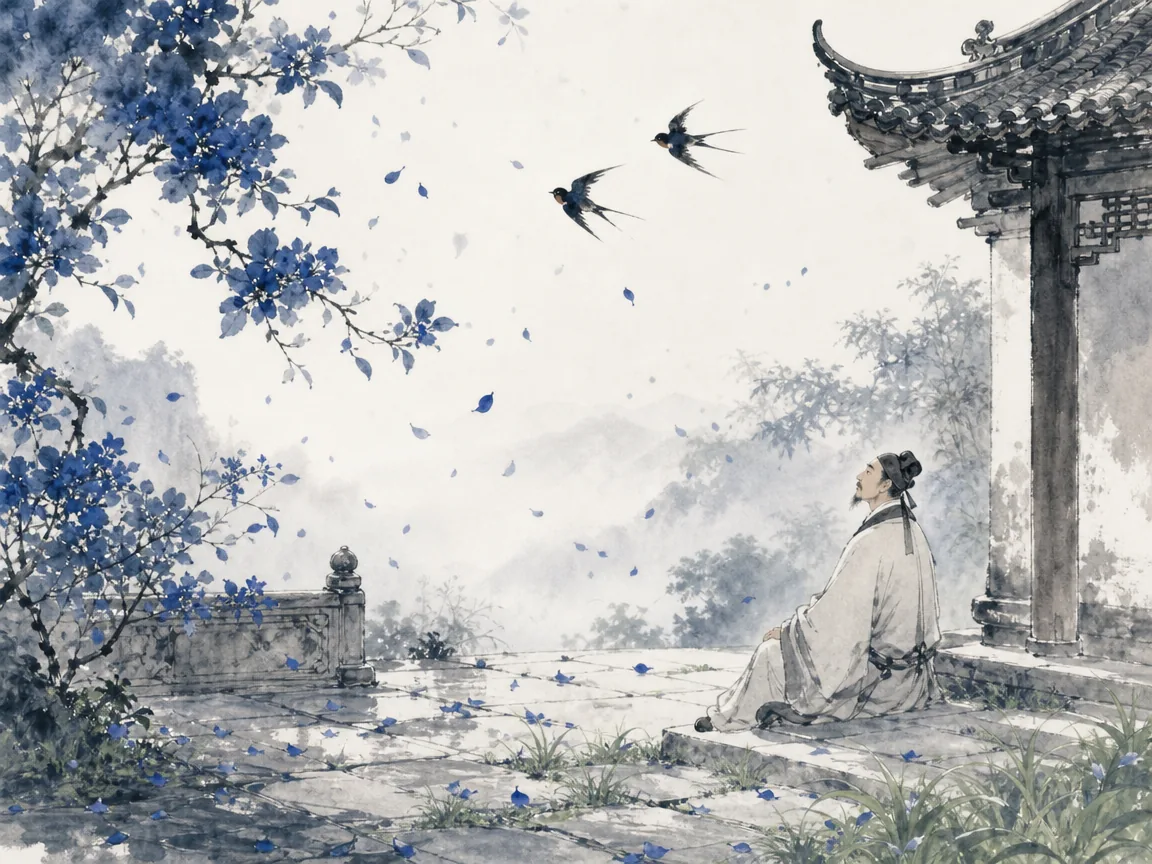
We have all felt it — the slow, almost imperceptible sense that something precious is slipping away. A career that no longer fits. A relationship that has quietly shifted. A chapter of life closing while we are still trying to turn the page. Our culture hands us two default responses: fight harder to make it stay, or force a bright perspective and move on quickly. Neither option leaves much room for the actual experience of loss, which is rarely so dramatic or so simple.
There is another way, one that has been quietly available in Chinese literary and philosophical tradition for over a thousand years. It does not ask you to resist change or to pretend it does not hurt. Instead, it asks you to look directly at what is ending, feel its weight without rushing to fix it, and then notice what is returning in a form you may not yet recognize. This is not optimism sold as strategy. It is a disciplined attention to reality as it actually moves—a foundational perspective explored in Tang Poet on Letting Go.
The poet who best models this approach is Yan Shu (991–1055), a Northern Song figure whose public life was unusually stable and fortunate by the standards of Chinese history [3]****[4]. He became a civil servant as a teenager, rose to high office, and later served as a chancellor who helped shape the educational and political culture of his era [2]. Yet his most famous poem does not celebrate success. It opens with drinking wine to new music, remembers an old terrace, watches the sun set, and then faces two lines that have echoed through centuries: “Flowers fall, and there is no way to stop them” and “Swallows return, strangely familiar” [3]. Between those two lines lives a complete philosophy of how to meet change with grace.
Tang Poet on Letting Go: The Poem That Has Haunted Readers for a Thousand Years
Yan Shu’s Huanxi Sha (Silk-Washing Stream, 《浣溪沙》) is instantly recognizable to readers of classical Chinese poetry. For readers encountering it in English, a straightforward rendering captures the essence:
One more new song, another cup of wine, Last year’s weather, the old pavilion. When the sun sets in the west, when will it return? Flowers fall — there is no way to stop them. Swallows come back — I half recognize them. Alone on the fragrant garden path, I linger and pace. [3]
The original Chinese, included here as a reference, reads:
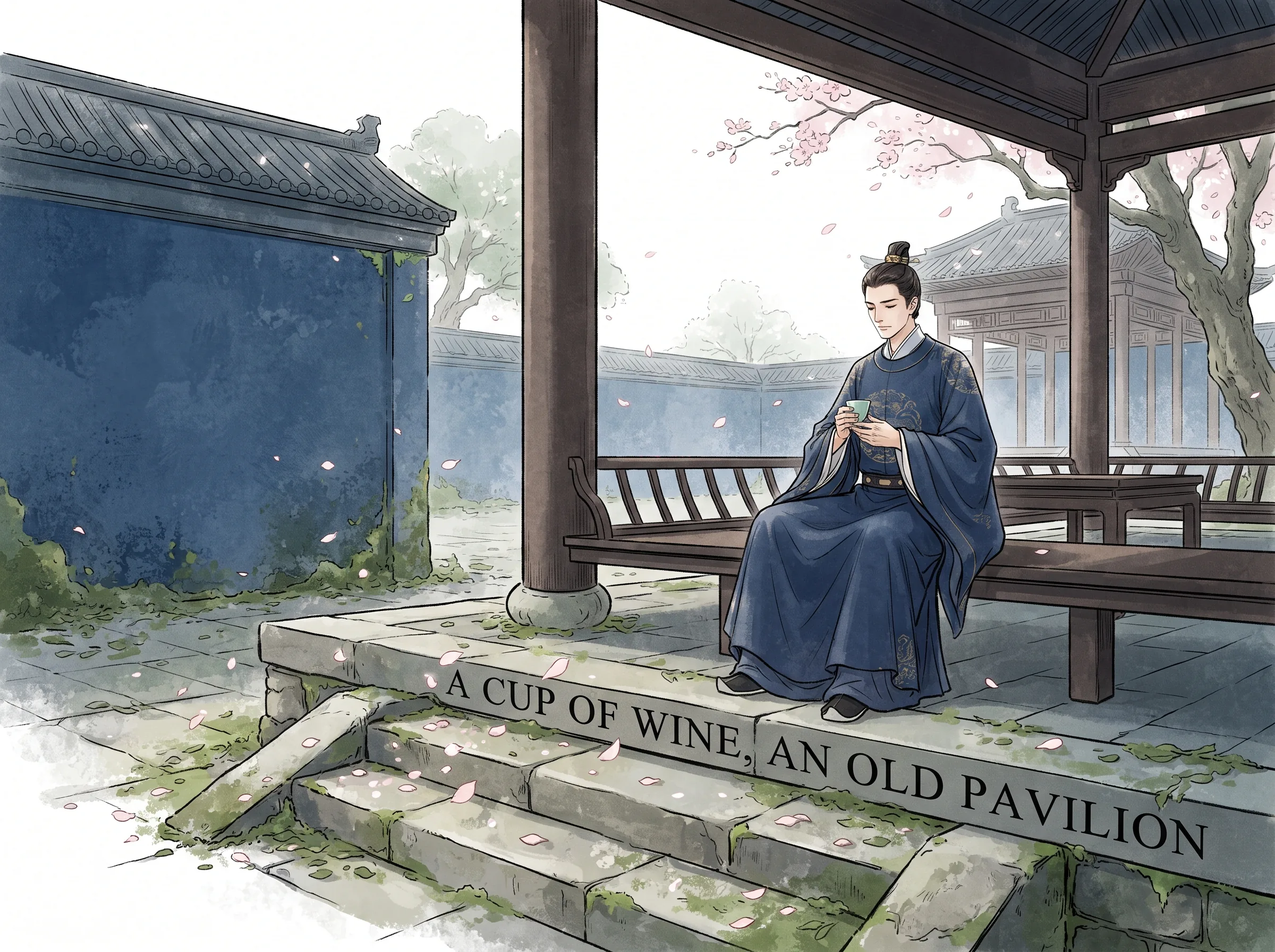
“A new song, a cup of wine” (一曲新词酒一杯),
“Last year’s weather, the old pavilion; when will the setting sun return?” (去年天气旧亭台。夕阳西下几时回?)
“Helplessly, I watch the flowers fall; familiar-seeming swallows return” (无可奈何花落去,似曾相识燕归来),
“Alone, I pace the fragrant path of the little garden” (小园香径独徘徊). [3]
The poem’s power does not come from mystery. It comes from precision. The first three lines establish a scene of quiet ritual — wine, music, a familiar place, the daily arc of sunlight. There is pleasure in it, but also an undercurrent of recognition that none of this stays. Then the central couplet arrives, and the poem’s true architecture becomes visible.
“Helplessly, I watch the flowers fall” (无可奈何花落去) names the part of experience we cannot control. Flowers do not stay on branches because we want them to. Seasons change. Relationships fade. Careers end. Bodies age. The phrase is often misread as resignation, but in its original context it is closer to clear-eyed discernment. It is the honest acknowledgment that some things must end, and that acknowledging this is not defeat — it is fidelity to reality.
“Familiar-seeming swallows return” (似曾相识燕归来) then offers a second movement. Swallows do return each spring, but not the exact same swallows, not to the exact same nest, not in circumstances identical to last year. The familiarity is real, but so is the transformation. This is the poem’s quiet radicalism: it refuses both despair and forced cheer. It allows sorrow and hope to exist in the same breath.
Modern readers often arrive at grief — of any kind — looking for either a battle plan or a pep talk. Yan Shu offers something rarer: permission to stand in the garden path and feel both losses and returns at once.
The Man Who Had Everything and Still Named What Was Fading
Yan Shu’s biography reads like a series of fortunate turns. Born in 991 in Linchuan, he was recognized early as remarkably gifted [3]****[4]. At fourteen, he was recommended as a child prodigy and examined alongside more than a thousand candidates in the imperial court [2]**. He performed with calm assurance and was awarded the degree status “of the same rank as a presented scholar” (同进士出身) [2]. A few days later, during a re-examination, he discovered that the fu topic assigned had been one he had privately practiced. Rather than accept the advantage, he informed the emperor and requested a different set of questions [2].
This detail matters more than it might initially appear. In a system where reputation and advancement depended on imperial favor, silence would have been the rational choice. Yan Shu chose honesty instead — not as performance, but as habit.
He went on to serve as an attendant in the Crown Prince’s household (太子舍人) [2]. He held influential positions, including serving as a Hanlin Academician (翰林学士), and later entered the highest levels of government [2]. He played a central role in promoting talented officials, including figures such as Fan Zhongyan and Han Qi, after becoming chancellor [2]. The educator Ouyang Xiu, among others, was associated with his circle [4].
Then, in what the sources describe as a sharp reversal, Yan Shu was removed from central office. The official record states that he had submitted a memorial opposing the appointment of Zhang Qi as commissioner of military affairs (枢密使), which offended the empress dowager, and was further punished after an incident involving his writing tablet during a court procession [2]. He was sent to Xuanzhou, and several months later transferred to Yingtian [2].
Rather than withdraw or retaliate, Yan Shu focused on education. He revitalized the Yingtian Academy and invited Fan Zhongyan to teach there [2]. This period of relative exile became one of the most consequential moments in Song educational history, contributing to what later scholars recognized as a broader revival of learning [2].
Ouyang Xiu later summarized Yan Shu’s life with the lines: “Wealth and leisure for fifty years; through it all, clear-sighted and preserved” [5]. Whether or not that summary captures everything, it points to a genuine pattern: Yan Shu’s prosperity did not dull his sensitivity to impermanence. If anything, it sharpened it. His poetry reflects someone who had not been hardened by suffering but who had learned, through reflection, to attend carefully to what passes and what returns. Gain deeper perspective on weathering adversity through the poetic resilience explored in How 23 Years of Exile Made the Poet Who Wouldn’t Bend.
Two Moments That Reveal a Philosophy
Yan Shu’s life contains episodes that function almost as case studies in how to meet change without collapsing into either resistance or false cheer.
The Exam Room Incident
When Yan Shu realized the re-examination topic matched material he had studied privately, he could have remained silent. The imperial examination system was fiercely competitive, and the stakes were extraordinarily high. Instead, he requested a new topic [2].
What this reveals is not simply moral courage in a dramatic moment. It is a consistent orientation toward integrity as a daily discipline rather than a rare heroic gesture. For modern readers, the parallel is unavoidable: how often do we choose the convenient untruth because the honest path is slower, riskier, or less rewarded? Yan Shu’s choice suggests that honesty is not only a virtue but a practical strategy for living without the accumulated weight of self-deception.
The Demotion That Became Foundation
Yan Shu’s transfer to Yingtian came after a politically complicated dismissal [2]. There is no evidence he welcomed the setback. But once there, he did not waste the time. He invested in the academy, brought in capable teachers, and helped establish a center of learning that would shape generations [2].
This aligns with a perspective found in texts like the Zhuangzi (《庄子》), where the “Understanding Life” chapter (“Da Sheng,” 达生) discusses accepting what cannot be controlled and focusing instead on what can be cultivated [6]. The world moves regardless of whether we welcome it. The practical question is not how to stop the movement but what to build within it. Yan Shu’s response to demotion illustrates that question in action.
“There Is No Way to Stop It” (无可奈何): Naming What You Cannot Control
The phrase “there is no way to stop it” (无可奈何) is one of the most misunderstood ideas in traditional Chinese thought when it is lifted from its original context. In contemporary usage it can sound like surrender. In Yan Shu’s poem, it functions differently.
“Helplessly, I watch the flowers fall” (无可奈何花落去) does not mean “nothing matters.” It means “some things are beyond my control, and pretending otherwise only increases suffering.” This distinction is crucial. The sadness that comes from loving something that will naturally end is not weakness — it is the honest cost of caring deeply. The sadness that comes from refusing to accept what is already happening is unnecessary suffering, the kind that multiplies the original pain.
Modern culture often treats control as the default virtue. We optimize schedules,curate images, pursue strategies, and blame ourselves when outcomes do not match our efforts. But Yan Shu’s poem suggests that a more sustainable posture begins with distinguishing two kinds of sorrow: the sorrow that teaches us how to let go, and the sorrow that keeps us trapped in resistance.
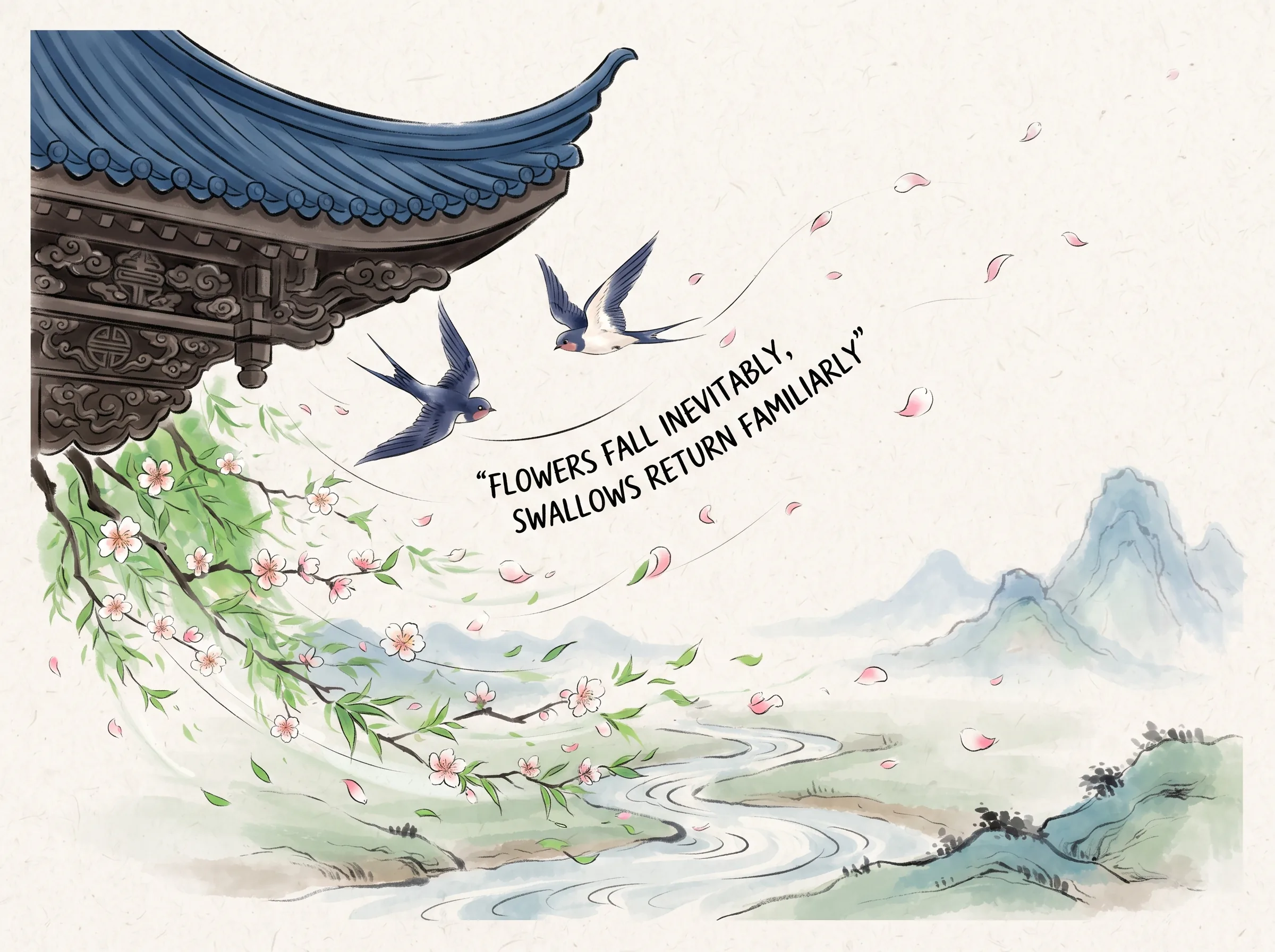
This does not require adopting any particular religious framework. It does require, however, the courage to ask a direct question: what in my current situation am I still trying to fight against, when fighting itself is the source of most of my exhaustion?
“Strangely Familiar” (似曾相识): How Return Actually Works
The swallow line — “familiar-seeming swallows return” (似曾相识燕归来) — is frequently quoted as a symbol of hope. That is partially correct, but incomplete. The swallow does not return exactly as before. The phrase “strangely familiar” (似曾相识) literally means “as if already known,” which implies resemblance without identity.
This is an important distinction for anyone navigating a major life transition. When a job ends, a friendship fades, a health diagnosis shifts priorities, or a longtime routine disappears, the pain is real. But transition is rarely a pure ending. Something always reorganizes in new form. A career change may reintroduce creativity that had been suppressed. A relationship shift may create space for different kinds of connection. Aging may reduce certain capacities while deepening others.
The swallow is not a promise that things will return to exactly how they were. It is an observation that life tends to renew itself through change, even when that change is unwelcome. Recognizing this pattern does not minimize grief. It places grief within a larger movement.
This also connects to the Confucian emphasis on continuous self-cultivation. You are not expected to remain the same person through every loss. The process of encountering change, reflecting on it, and adjusting your practice is itself the path [2]****[4]. The goal is not to preserve a fixed self but to develop the capacity to meet each new situation with increasing clarity.
A Practical Framework for Meeting Change With Grace
The following steps are not a formula for avoiding pain. They are a structure for moving through it without losing yourself.
1. Name what is ending. Do not spiritual-bypass the loss or rush past it. Yan Shu names falling flowers directly. Write down, in plain language, what is actually changing in your life. Vague anxiety shrinks when it is given specific form.
2. Distinguish control from acceptance. Ask clearly: what can I influence, and what can I only meet with attention and grace? This is not surrender to passivity. It is the removal of futile effort so that real effort can be directed where it matters.
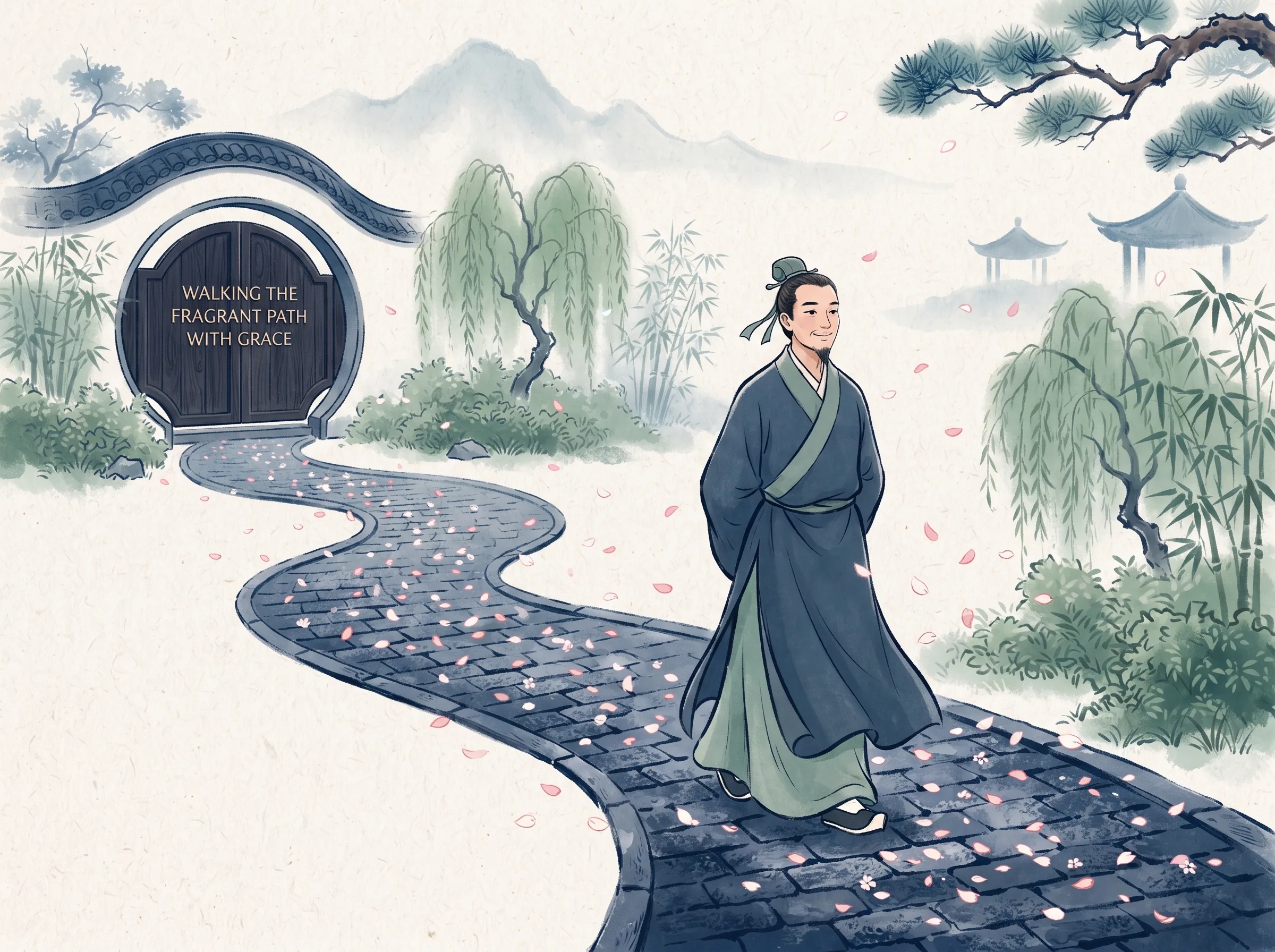
3. Look for the swallow. This does not mean pretending everything is fine. It means staying open to the possibility that something valuable is returning in a form you do not yet recognize. Pay attention to small signs of renewal — a new interest, a conversation that shifts, a problem that suddenly seems manageable.
4. Build anyway. Even in exile, Yan Shu invested in education [2]. Even when circumstances are uncertain, action is never meaningless. Ask: what can I cultivate today, given exactly where I am?
5. Write it down. The act of articulating what you cannot control (无可奈何) is itself a form of wisdom-making. Yan Shu’s poem survived because he turned personal reflection into lasting form. Your own writing does not need to be published to be useful. It needs only to be honest.
FAQ
Are the lines “Flowers fall—there is no way to stop them; familiar-seeming swallows return” (无可奈何花落去,似曾相识燕归来) really about accepting change?
Yes, in the context of Yan Shu’s poem, the lines are widely understood as an expression of accepting impermanence while remaining open to renewal [3]. The first half acknowledges what cannot be stopped; the second half notes what returns in transformed form.
Did Yan Shu write this poem during a difficult period in his life?
The historical record does not specify the exact date or occasion of the poem’s composition. What is clear is that Yan Shu’s overall life was marked by considerable prosperity and official success, which makes his willingness to dwell on loss and passage even more noteworthy [2][3][5].
Does this approach require religious belief?
No. The framework draws on classical Chinese poetic and philosophical sensibilities, but it does not require commitment to any specific tradition. It asks only that you pay honest attention to what is happening.
What should I do if I feel stuck in resistance?
Begin by naming what is ending without judgment. Then separate what you can influence from what you can only meet with grace. Small, concrete actions taken in acceptance tend to loosen the grip of resistance more effectively than attempts to force a change of feeling.
Closing Thought
Facing change with grace does not mean feeling less. It means feeling honestly, naming clearly, and then acting from wherever you actually are rather than from where you wish you were. Yan Shu’s poem endures because it refuses the false choice between despair and denial. Flowers fall. Swallows return. The garden path remains.
If this reflection resonated with you, consider writing down one thing that is ending in your life and one small action you can take this week that honors both the loss and the possibility of renewal. You do not need to resolve everything at once. You only need to meet the moment with enough honesty to see it clearly, reflecting the enduring wisdom of Tang Poet on Letting Go.
Gain deeper perspective on weathering adversity through the poetic resilience explored in How a Tang Dynasty Poet Quit the Rat Race Before It Existed—And What His Life Teaches Us About Stepping Off the Grind.
Deepen your understanding of these principles in our reflection on When Doors Close: A Tang Poet’s Story of Unexpected Paths.
Sources & Further Reading
[1] Primary sources referenced in this article
[2] History of Song, vol. 311, “Biography of Yan Shu” (《宋史》卷三百十一·晏殊传), Chinese Wikisource()
[3] Yan Shu, “Silk-Washing Stream — A New Song and a Cup of Wine” (《浣溪沙·一曲新词酒一杯》), Guwendao / former Gushiwen.cn()
[6] Zhuangzi, “Understanding Life” (《庄子·达生》), Chinese Wikisource()
[7] Further reading (延伸阅读)
[8] History of Song (《宋史》), Chinese Wikisource()
[9] Zhuangzi (《庄子》), Chinese Wikisource()
[10] An authoritative annotated edition of The Lyrics of Yan Shu (《晏氏词》), for checking textual details in Huanxi Sha (《浣溪沙》) and his other lyrics
[11] Scholarly books and articles on Northern Song political history, educational history, and literati networks
[12] Relevant entries in the Biographical Dictionary of Chinese Civilization






