
When the political reform he championed collapsed in 805, Liu Yuxi was thirty-three years old and already celebrated as one of the brightest literary minds of his generation. A decade earlier he had passed the imperial examinations at twenty-two, distinguished himself in further screenings, and stood at the threshold of an extraordinary career alongside his close friend Liu Zongyuan [2]. The rebellion against his faction ended with a single decree: demotion to a remote provincial post far from the capital, stripped of influence, prestige, and security. What followed was not a quiet retreat into obscurity but a stubborn, nearly quarter-century-long series of refusals — to accept bitterness, to surrender his voice, to let the landscape of his inner life be redrawn by anyone else's handwriting.
Liu Yuxi's story is often reduced to a trope: the talented official punished by corrupt politics, yet rising again through perseverance. But the texture of his experience resists simple heroism. He wrote poems that mocked the very people who had power over him, twice. He nursed a sick community with remedies he compiled from local knowledge. He carried his friend's young children when that friend died in exile, a responsibility taken on without obligation. Twenty-three years of demotion did not break him, and understanding why matters more now than at any point in Chinese literary history — because what we call resilience today is too often confused with optimism, or with the ability to simply bounce back. Liu Yuxi's life suggests something quieter and more demanding: the refusal to let external circumstance determine the quality of your inner world—a foundational perspective explored in Liu Yuxi Exile and Resilience.
Liu Yuxi Exile and Resilience: and Why It Mattered
Liu Yuxi's early career reads like a blueprint for success in the Tang dynasty [3]. Born around 772, he entered the elite circle of scholar-officials exceptionally young, earning recognition that surprised even his contemporaries—Bai Juyi (白居易) noted that Liu was the youngest among the twelve honored at the ceremony. His involvement in the Yongzhen Reform movement, allied with Wang Shuwen and twelve other officials collectively remembered as the "Two Wangs and Eight Ministers," placed him at the center of a brief but ambitious attempt to reshape the bureaucracy and curb the power of regional military governors [2].
When Emperor Xianzong ascended the throne and the reform faction fell, the punishment was severe and meticulously calculated. Liu Yuxi was first demoted to prefect of Lianzhou (刺史), then—before he could even reach the post—stripped further and sent to serve as an exiled military aide in Langzhou (司马) [2]****[3]. The court record puts it tersely: "After Shuwen's faction fell, Liu was implicated and demoted to prefect of Lianzhou; while still on the road, he was demoted again to military aide in Langzhou" (叔文败,坐贬连州刺史。在道,贬朗州司马) [3]. But the implications were enormous. The demotions were not merely administrative; they were designed to erase. A special clause was added to his sentence: even if general amnesties were declared, officials implicated in his faction would not be considered for recall. He was to remain outside the world of power indefinitely.
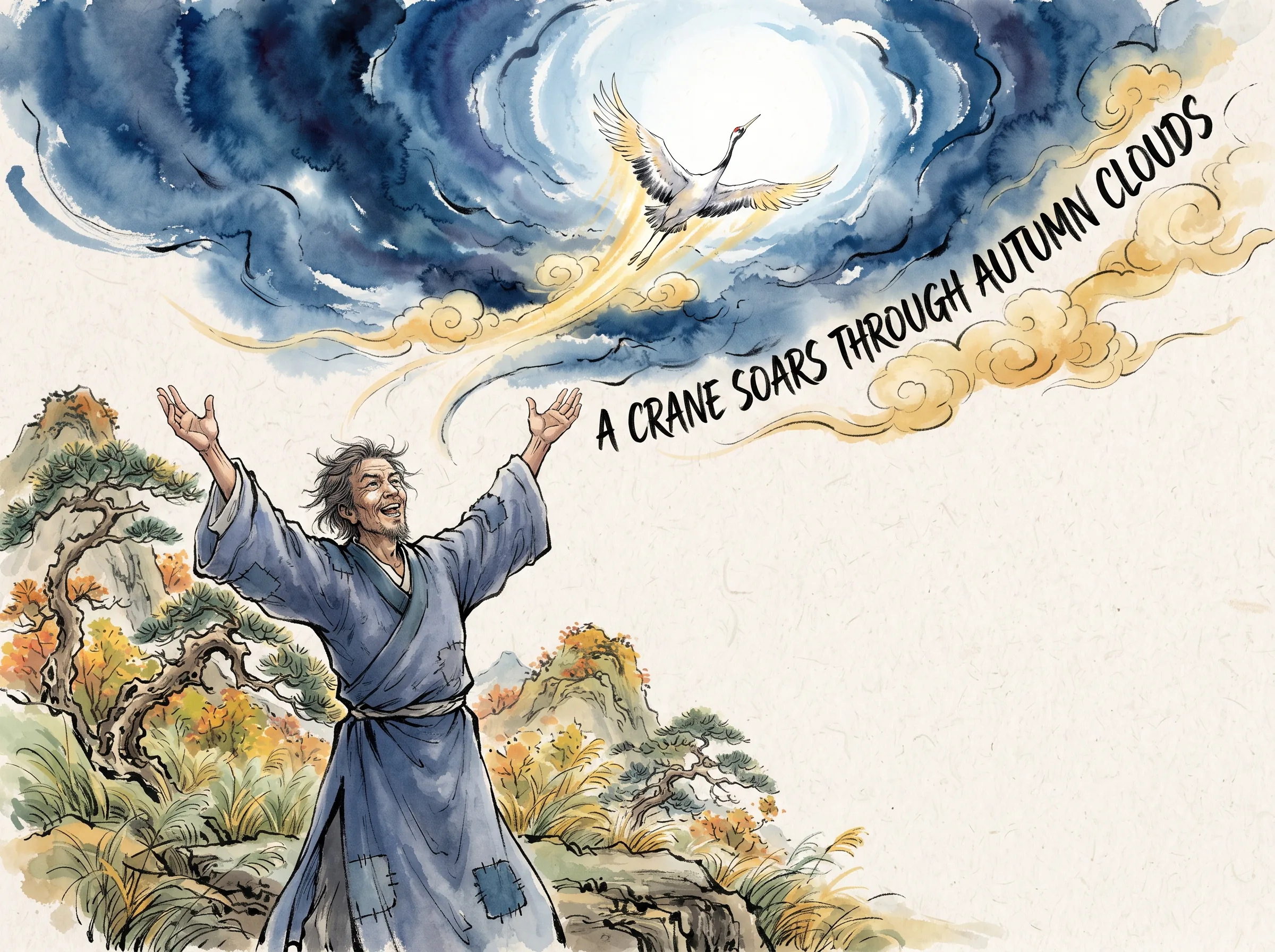
Most men would have spent those years cataloguing grievances. Liu Yuxi wrote an autumn poem that became one of the most unmistakable declarations of independence in all of Chinese literature: "Since antiquity, men have grieved at autumn's desolation; I say autumn outshines the spring morning. A lone crane cleaves the clear sky, carrying my poetic spirit into the blue beyond" (自古逢秋悲寂寥,我言秋日胜春朝。晴空一鹤排云上,便引诗情到碧霄). While other poets of his circle—including his friend Liu Zongyuan—wrote of autumn as a season of blades and cuts, Liu Yuxi chose the image of a single bird ascending.
This was not the oblivious cheerfulness of someone who had not yet understood how harsh the world could be. It was a deliberate positioning of the self against prevailing expectations — a refusal to perform the suffering that authority demanded of him.
Ten Years in Langzhou: Writing as an Act of Survival
Langzhou, in modern Hunan province, was a long way from Chang'an's literary salons and political intrigue. The environment was humid, the roads uncertain, and the cultural references available to a scholar accustomed to the capital's libraries were scarce. Yet Liu Yuxi remained productive—not as a retreat from reality, but as a way of engaging with it on his own terms [3]. As one account says, "During his ten years in Langzhou, Liu Yuxi devoted himself to writing and poetry, refining his emotional and moral character" (禹锡在朗州十年,唯以文章吟咏,陶冶情性) [3].
The phrase "refining one's emotional and moral character" (陶冶情性, táoyě qíngxìng) is telling. It does not describe escapist writing. In the Chinese tradition, cultivating one's character through literary practice was a serious undertaking—part of the Confucian project of self-cultivation, but also something that drew on Daoist sensibilities about aligning with the natural order rather than fighting against it. Liu Yuxi did not write to forget his circumstances; he wrote to understand them, transforming the raw materials of displacement into something that could outlast the power that had produced them.
His poems from this period reveal a man in conversation with a landscape that refused to be diminished by his marginalization. In "Viewing Dongting Lake" (《望洞庭》), he describes the lake as a silver plate holding a single green snail, reducing the vastness of nature to an intimate, almost playful image. This is not naive cheerfulness. It is the act of a mind that refuses to be shrunk by its surroundings, one capable of holding the grandeur of a lake in the palm of its imagination.
The ten years were not passive. Liu Yuxi engaged with local customs, absorbed folk songs, and later drew on this experience to produce his famous "Bamboo Branch Songs" (《竹枝词》) cycles—poems rooted in the musical traditions of the region rather than in the formal, courtly styles that dominated literati literature. He turned the geography of his exile into a source of creative material. This is a pattern worth noticing: resilience as creative appropriation, not mere endurance.
The Dangerous Wit: Two Returns, Two Poems, Two Punishments
In 815, after a decade in Langzhou, Liu Yuxi and Liu Zongyuan were summoned back to the capital [3]. The invitation itself was a small victory — proof that the court could not erase them entirely. They traveled to the Xuantu Temple gardens, and Liu Yuxi wrote a poem that has since become one of the most cited examples of literary boldness in Chinese history:
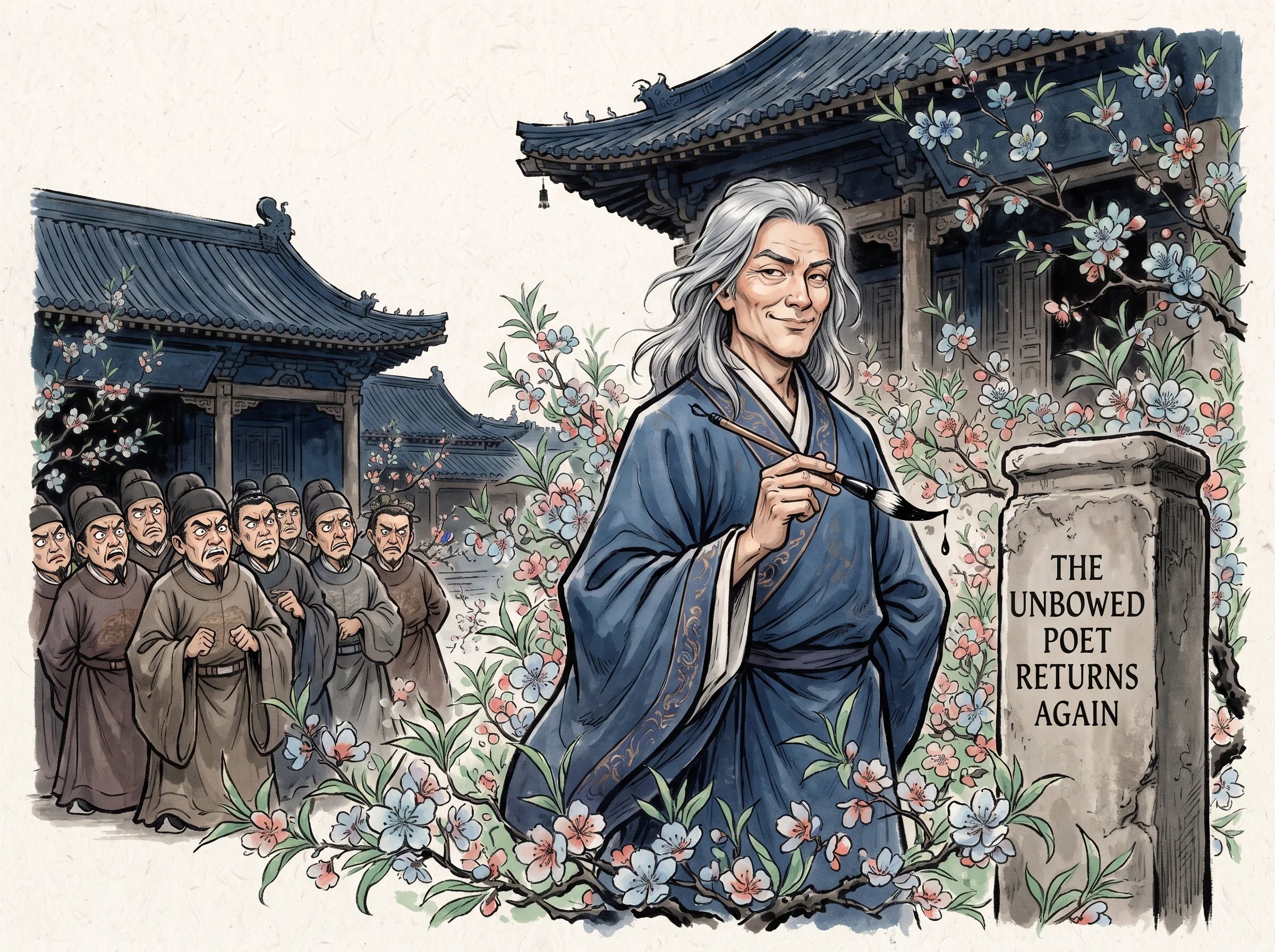
"Red dust from the capital road sweeps across my face; everyone returns speaking of the flowers. A thousand peach trees fill Xuantu Temple—all planted after Liu Lang went away" (紫陌红尘拂面来,无人不道看花回。玄都观里桃千树,尽是刘郎去后栽).
The poem operates on two levels. On the surface, it describes a garden in bloom. Beneath it, it remarks that the powerful officials who had risen to prominence during his absence — the newcomers who had occupied the positions he and his faction once held — were like the peach trees that grew only after he was removed. The metaphor was unmistakable, and the authorities took it exactly as intended [5]. Connect these enduring values to the broader cultural heritage explored in The Rivers of China: How Two Waterways Teach Us to Hold Opposing Values at Once.
The punishment was swift. He was dispatched again, this time to Bozhou—a post considered so remote and unhealthy that even his friend Liu Zongyuan panicked when he learned of it. Liu Zongyuan, himself reassigned to Liuzhou, immediately petitioned the emperor to swap places with Liu Yuxi, arguing that Bozhou was uninhabitable and that Liu Yuxi's elderly mother could not survive such a journey [2]****[3]. He pleaded: "Bozhou is no place for a person to live, and Yuxi's elderly mother is still at home. I cannot bear to see him driven to such an extremity; if she cannot make the journey, mother and son will be separated forever" (播非人所居,而禹锡亲在堂,吾不忍其穷,无辞以白其大人,如不往,便为母子永决) [2]**. The petition, joined by others, succeeded, and Liu Yuxi was rerouted to Lianzhou instead [3].
Twenty-seven years later, in 832, Liu Yuxi visited the same temple gardens again. The peaches were gone. Weeds and wild oats filled the space where flowering trees had stood. He wrote:
"Half the hundred-mu courtyard is covered in moss; the peach blossoms are gone, and rapeseed flowers bloom. Where is the Daoist who planted the peaches? The Liu of former days has come again" (百亩庭中半是苔,桃花净尽菜花开。种桃道士归何处,前度刘郎今又来) [2]****[3].
Different textual traditions preserve slight variants: "where is he now?" (今何在) versus "where has he gone?" (归何处), and "has arrived again" (又到来) versus "has now come again" (今又来). The meaning remains consistent across all versions: the author returns, the power structure that rose in his absence has withered, and the poet remains [2]****[3]. This was not merely defiance; it was a philosophical statement about impermanence dressed in the language of personal vindication. The Taoist who planted the trees—a metaphor for the faction that had elevated itself on Liu Yuxi's removal—had disappeared. Only the poet remained.
Friendship, Responsibility, and the Work Behind the Poetry
Liu Yuxi's resilience cannot be separated from the relationships that sustained him and the responsibilities he accepted when others could not. The bond with Liu Zongyuan was one of the most significant friendships in Tang literary history, and its most consequential moment came not in shared exile but in the aftermath of Liu Zongyuan's death in 819 [3].
When Liu Zongyuan died in Liuzhou, he left behind young children — sons named Zhou Liu and Zhou Qi — and a body of work that required editing and preservation [1]. Liu Yuxi took on both responsibilities. He cared for Liu Zongyuan's sons, raising them as his own, and spent years compiling and organizing his friend's collected writings [1]. These were not minor gestures. In a period when exile families were scattered and intellectual estates could vanish with their authors, Liu Yuxi assumed a burden that went beyond personal loyalty — it was an act of cultural preservation, of ensuring that a whole mode of thinking and writing would not be lost to the very political machinery that had exiled them both.
There is also the matter of his medical work. During his time in Lianzhou, Liu Yuxi encountered a local illness affecting the digestive system and, drawing on his knowledge and perhaps on consultations with Liu Zongyuan, developed a remedy that he distributed to the community. He later compiled these observations and others into a medical text known as Prescriptions Handed Down in Good Faith (《传信方》, Chuanxin Fang). Later bibliographies recognized the work, and subsequent writers may have cited some of its formulas, possibly including Li Shizhen's Compendium of Materia Medica (《本草纲目》) [4]. Although that particular connection is not fully verified, Chuanxin Fang itself is a documented work whose existence is confirmed by modern scholarship on textual preservation [4].
These actions — caring for a friend's children, developing and sharing medical knowledge, preserving intellectual legacies — reveal a dimension of resilience that is often overlooked. Resilience is not only about enduring hardship; it is about continuing to act with generosity and purpose even when the world has given you every reason to withdraw. Liu Yuxi did not stop contributing to the lives of others because his own life had been disrupted. If anything, the disruption deepened his sense of obligation.
What 23 Years of Exile Teaches About Modern Resilience
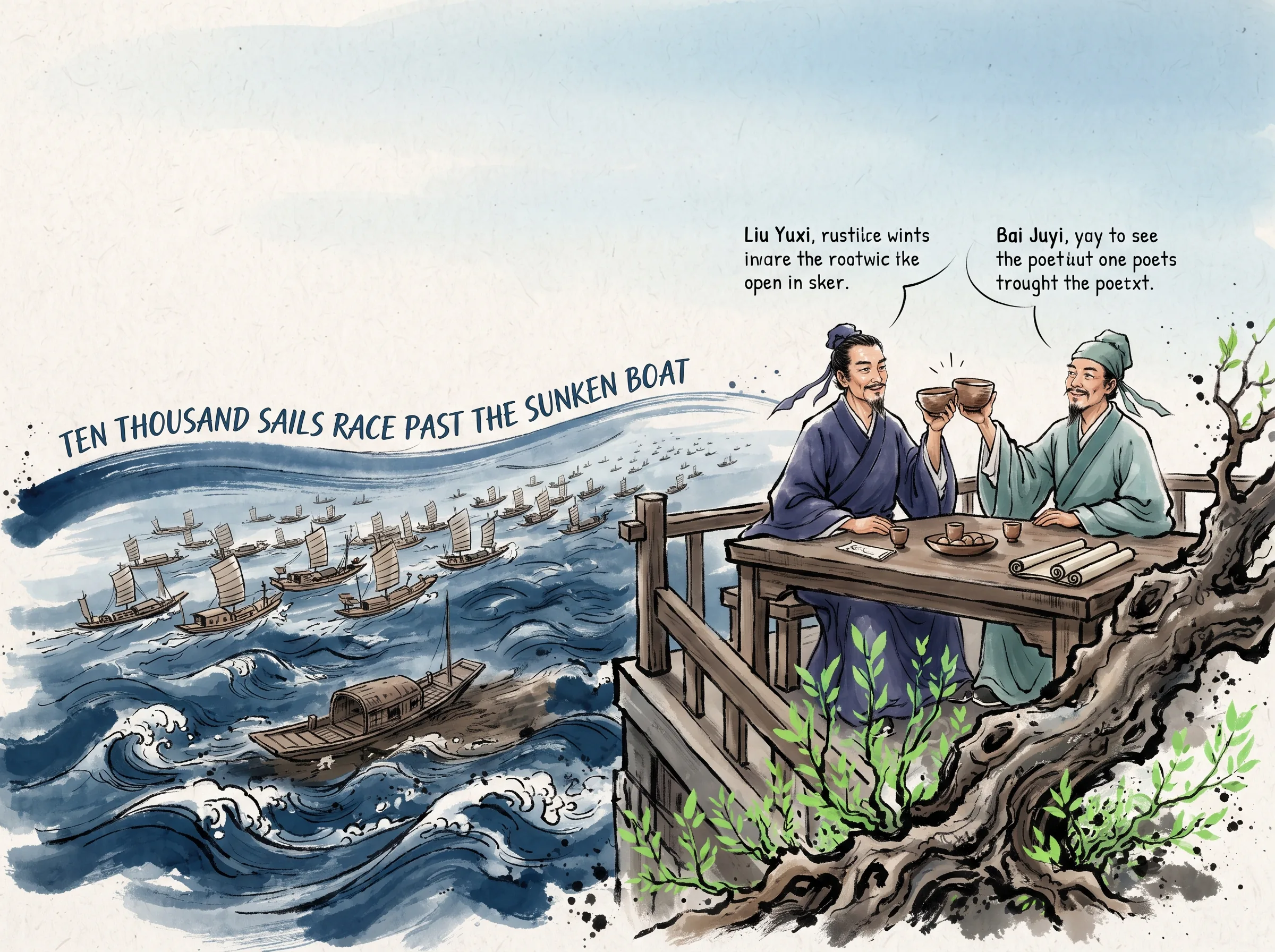
The phrase "for twenty-three years, I was cast aside" (二十三年弃置身) belongs to a poem Liu Yuxi wrote upon his final recall to the capital, addressed to Bai Juyi (白居易). Bai had expressed grief on his friend's behalf, noting that while others enjoyed visibility and honor, Liu Yuxi alone had lost his prime years to repeated demotions. Liu Yuxi's response is one of the most famous closing stanzas in Chinese poetry:
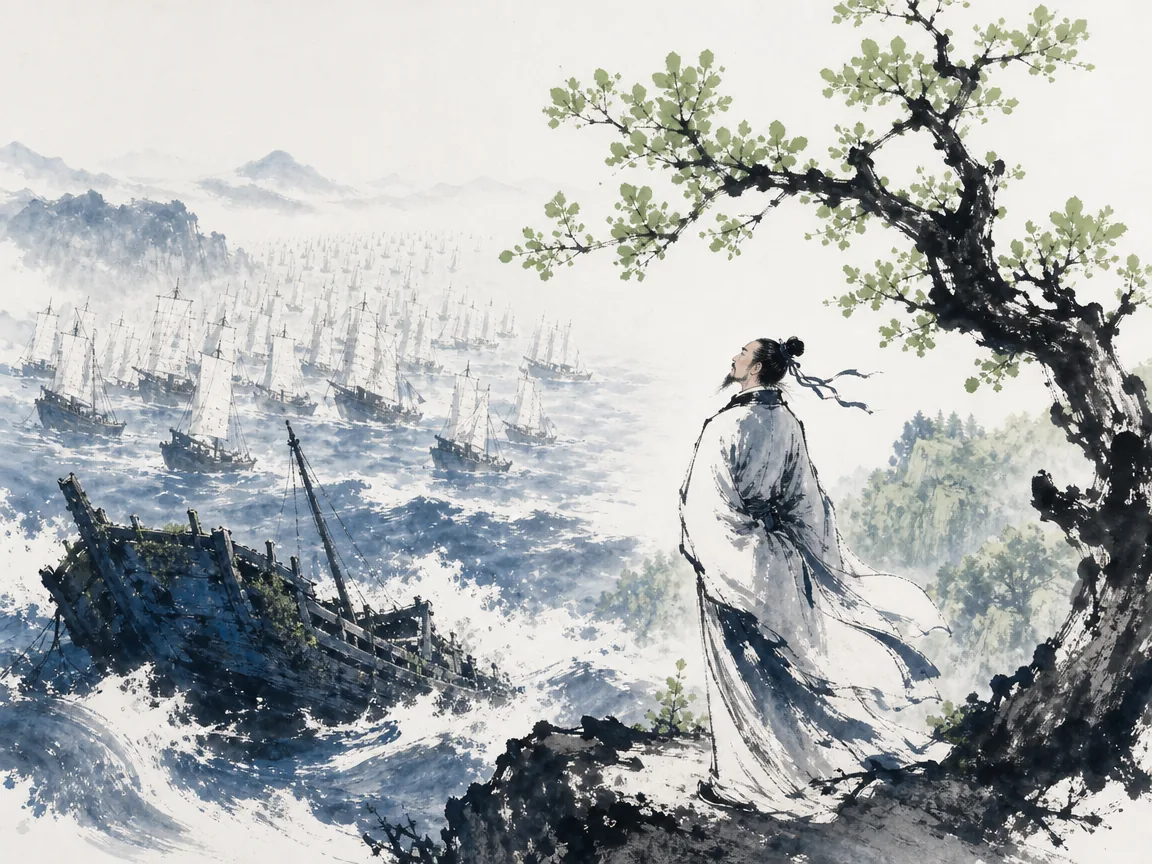
"Beside the sunken boat, a thousand sails pass; before the ailing tree, ten thousand others greet the spring. Today I hear you sing this song, and for a while, with a cup of wine, I lift my spirits" (沉舟侧畔千帆过,病树前头万木春。今日听君歌一曲,暂凭杯酒长精神).
The poem acknowledges loss—the sunken boat, the ailing tree—without mistaking it for finality. Life continues around individual misfortune, and the appropriate response is neither despair nor denial but a conscious reaffirmation of spirit. This is resilience grounded in clear-eyed awareness (清醒, qīngxǐng): seeing what has happened and deliberately choosing to engage with what remains.
For modern readers, Liu Yuxi's life offers several insights that resist the simplifications of contemporary self-help discourse:
Resilience is not optimism. Optimism assumes the future will improve on its own. Liu Yuxi's poems show no such assumption. They assume the opposite — that circumstances can and will worsen, that power can turn against you, that injustice is a recurring feature of institutional life. His response is not to hope things will get better but to refuse to let the present condition define his inner posture.
Creative expression is a form of self-preservation. Writing "An Inscription on My Humble Room" (《陋室铭》) was not escapism. It was an act of reclaiming space—transforming physical limitation into a philosophical declaration: "A mountain need not be high; the presence of an immortal gives it fame. Water need not be deep; the presence of a dragon gives it spirit" (山不在高,有仙则名;水不在深,有龙则灵). The dwelling was small, but the mind within it was not constrained by its dimensions. This is a practical lesson in how to maintain agency when external conditions shrink.
Loyalty and responsibility compound over time. The decisions Liu Yuxi made regarding Liu Zongyuan's family and intellectual legacy were not spectacular gestures. They were sustained, ordinary acts of fidelity — the kind that accumulate into a life of integrity precisely because they require nothing in return. In a culture that often measures success by individual advancement, these actions remind us that much of what makes a life unbroken happens in the shadow of public recognition.
Wit has consequences, and silence has costs. Liu Yuxi's poetry was sharp, sometimes scathing. He paid for it repeatedly. But the alternative — the silence that would have spared him further punishment — carried its own cost: the erasure of a moral voice and the betrayal of his own understanding of justice. The question his life poses is not whether honest speech is safe, but whether a life without it is worth living.
Frequently Asked Questions
Q: Was Liu Yuxi's resilience a form of denial or emotional suppression? No evidence suggests he suppressed his feelings. His poems from the exile period contain clear acknowledgment of hardship, loss, and injustice. The line "for twenty-three years, I was cast aside" (二十三年弃置身) is itself an honest accounting of exclusion. What distinguishes his response is not the absence of negative emotion but the refusal to let it become the sole determinant of his actions and self-conception.
Q: Did Liu Yuxi ever reconcile with the political factions that exiled him? The historical record does not document formal reconciliation. Liu Yuxi returned to the capital multiple times and held offices, but his poetic responses—particularly his second poem on Xuantu Temple (玄都观)—indicate that he maintained his critical perspective throughout. Resilience in his case meant refusing to adopt the attitudes of those who had displaced him, not assimilating into the system that had marginalized him.
Q: How do we know Liu Yuxi raised Liu Zongyuan's children? The autobiographical record (Zizhuan, 《自传》) attributed to Liu Yuxi documents the existence of Liu Zongyuan's young sons, Zhou Liu and Zhou Qi, following Liu Zongyuan's death [1]. The narrative of Liu Yuxi's involvement in their care appears in later biographical traditions and is widely accepted in scholarly accounts of their relationship, though the precise legal and domestic arrangements are not fully detailed in surviving primary sources.
Q: Is there a practical method for applying Liu Yuxi's approach to modern life? Liu Yuxi did not leave behind a systematic method — his resilience was embodied, not theorized. What can be drawn from his life is a principle: identify what external conditions you cannot control, protect what internal conditions you can — your judgment, your relationships, your capacity to create — and act from that protected center regardless of outward circumstance. This aligns with broader traditions of Chinese philosophical thought that emphasize inner governance over outer compliance.
Conclusion
Liu Yuxi spent twenty-three years outside the centers of power and yet never ceased to write, to care for others, and to speak truth when silence would have been safer. His life demonstrates that resilience is not the absence of damage but the refusal to let damage dictate the terms of your existence. "An Inscription on My Humble Room" (《陋室铭》) turned a cramped dwelling into a statement of dignity. "Autumn Song" (《秋词》) was composed in a province most scholars would have considered a sentence rather than a posting. The poems that mocked the powerful were written by a man who had every institutional reason to flatter them.
What remains from this story is not a formula for avoiding hardship but a model for meeting it without surrendering what makes a life worth living. The ancient Chinese tradition of self-cultivation — whether Daoist in its attention to natural alignment, Confucian in its emphasis on moral character, or Buddhist in its practices of mental clarity — offers resources for exactly this kind of question. Liu Yuxi's genius was not in inventing a new philosophy but in living an old one under conditions that made it extraordinarily difficult.
If you are navigating a period of professional or personal displacement, the first step is not to find a silver lining but to ask: what can I still control, and what will I still do with that control? Liu Yuxi's answer, repeated across two decades of exile, was poetry, friendship, responsibility, and an unyielding commitment to seeing the world clearly — even when the world offered him every reason to look away, reflecting the enduring wisdom of Liu Yuxi Exile and Resilience.
Gain deeper perspective on weathering adversity through the poetic resilience explored in What Can Du Fu’s Lifelong Failures Teach Us About Finding Meaning in Disappointment?.
Deepen your understanding of these principles in our reflection on How a Frustrated Genius Used Self-Release to Find Inner Peace: The Daoist Lesson Behind Du Mu’s Yangzhou Years.
Sources & Further Reading
[1] Primary Sources & Biographical References
[2] New Book of Tang, Volume 168 (《新唐书·卷168》) — Wikisource — Biographical entry covering Liu Yuxi's demotions, the Xuantu Temple poems, and Liu Zongyuan's exchange petition.
[3] Old Book of Tang, Volume 160 (《旧唐书·卷160》) — Wikisource — Parallel biographical account with details on Liu Yuxi's career trajectory, Langzhou decade, and literary reputation.
[4] Liu Yuxi's Autobiography (《子刘子自传》) — Wikisource — Liu Yuxi's autobiographical text documenting his posts and personal circumstances, including the fate of Liu Zongyuan's children.
[5] Secondary Scholarship
[6] An Academic Study of Omissions and Misattributions in Reconstructed Editions of Liu Yuxi's Chuanxin Fang (《刘禹锡〈传信方〉辑佚本漏收误收举隅》) — Academic study on the textual preservation and compilation history of Liu Yuxi's medical work.
[7] Further Reading (not cited as direct evidence)
[8] Complete Tang Poems (《全唐诗》) — Comprehensive collection of Tang poetry including Liu Yuxi's major works.
[9] Canglang's Remarks on Poetry (《沧浪诗话》) by Yan Yu (严羽) — Critical text referencing Liu Yuxi's poetic style and his mentor Jiaoran (皎然).
[10] Studies on the Yongzhen Reform and the "Two Wangs and Eight Ministers" faction in mid-Tang political history.
[11] Collected Works of Bai Juyi (《白居易集》) — Poems and correspondence providing context on the relationship between the two poets.






