
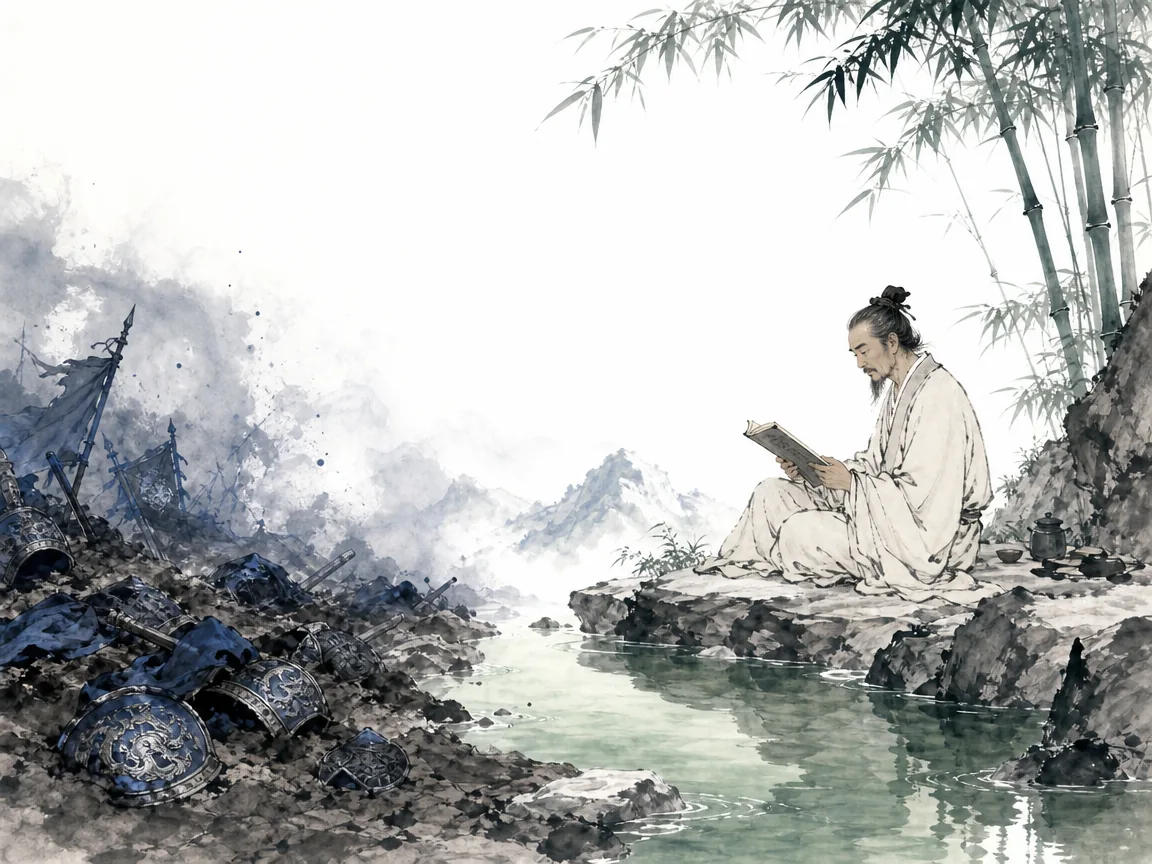
What happens when the ground beneath you vanishes? When the title, the status, the network of relationships that defined your days is suddenly ripped away — not gradually, but in a single catastrophic moment — what remains of who you think you are?
In 755 CE, the An Lushan Rebellion shattered the Tang Dynasty's golden age overnight. Among the millions displaced, stripped of privilege, and forced to flee was a young man named Wei Yingwu. A few years earlier, he had been a pampered imperial guard at the side of Emperor Xuanzong, living off family wealth and royal favor. By the time the rebellion reached its brutal conclusion, he was a ghost of his former self — forgotten by old friends, haunted by his own past, and facing a life he had never learned to build for himself—a foundational perspective explored in Wei Yingwu Starting Over.
Wei Yingwu's story is not typically told as a philosophy lesson. Yet his life offers something rare: a documented arc from recklessness to responsibility, from loss to late blooming, from despair to a kind of hard-won peace. For anyone who has ever felt that their identity was built on something external — a job, a reputation, someone else's belief in them — Wei Yingwu's journey across three turbulent decades may offer a quiet companion. Not a blueprint, exactly. But proof that starting over is not a modern invention. It is one of the oldest human problems, and one of the oldest human answers.
Wei Yingwu Starting Over: The Fall Before the Rise
Wei Yingwu was born around 737 CE into the Jingzhao Wei clan, one of the most powerful aristocratic families in Chang'an. A contemporary saying went: "The Weis and the Yus of the south of the city — together they fill the heavens and the palace." [1] By Tang standards, this was elite tier. Seventeen Wei family members would go on to serve as chancellors across the dynasty.
At fifteen, Wei Yingwu entered the imperial guard through the enyin system — a privilege granted to descendants of meritorious officials. He stood before Emperor Xuanzong himself, surrounded by wealth, influence, and a future that required almost no effort.
He did not waste it. He wasted it loudly.
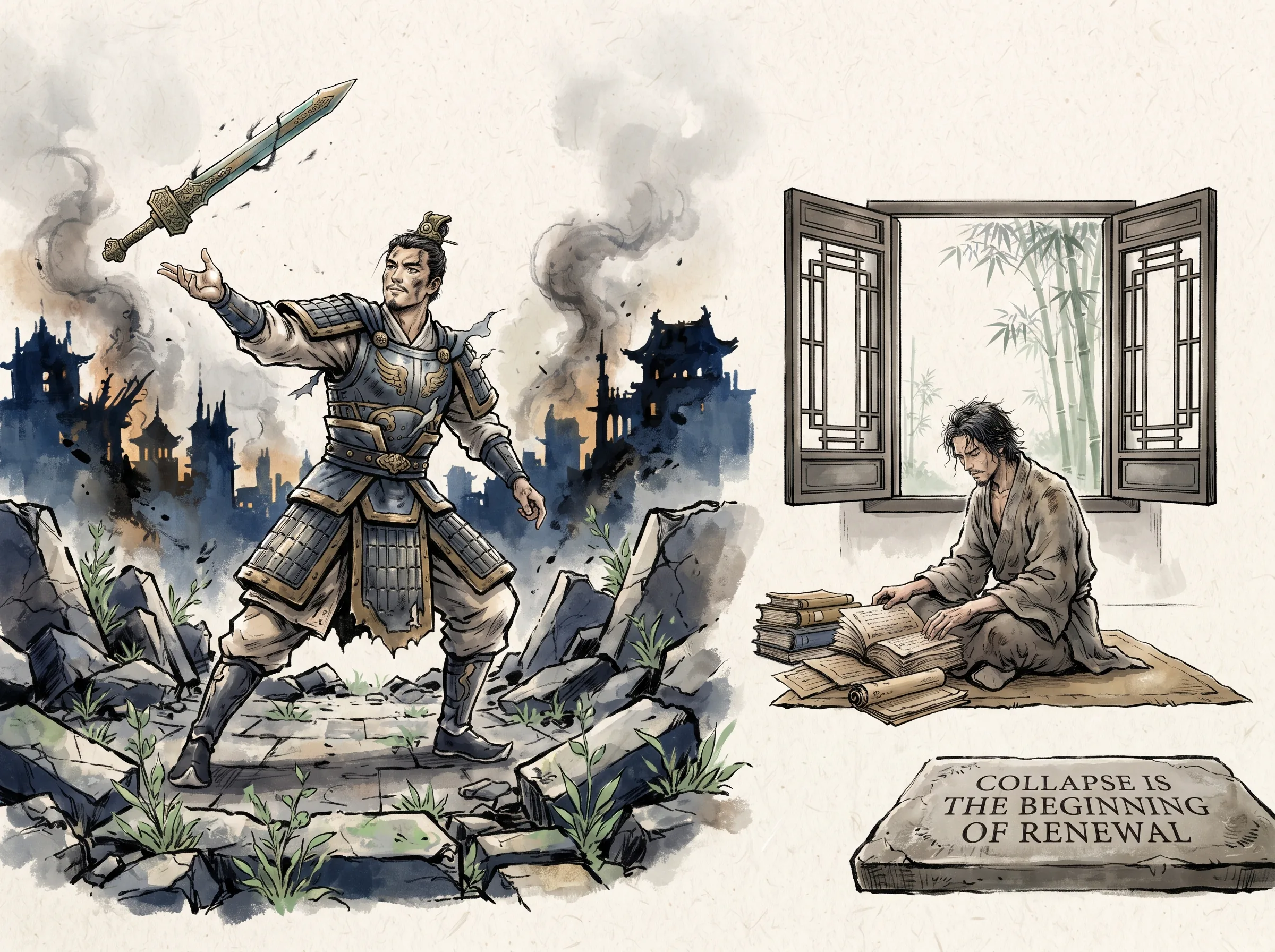
In a poem he would write decades later, Meeting Superintendent Yang (Feng Yang Kaifu, 《逢杨开府》), Wei Yingwu looked back at his youth without mercy:
In my youth I served the Martial Emperor, a rascal leaning on imperial favor.
I ran wild through the neighborhoods, sheltering fugitives in my home…
On snowy nights at Mount Li, during hunting expeditions at Changyang—
I couldn't read a single character, drinking and wallowing in foolishness. [2]
(Original Chinese: “少事武皇帝,无赖恃恩私。身作里中横,家藏亡命儿……骊山风雪夜,长杨羽猎时。一字都不识,饮酒肆顽痴。”)
This is not self-mythologizing. It is an admission. The man who would become one of the greatest poets of the mid-Tang is confessing, in plain language, that for the first two decades of his life, he was exactly what the poem says: privileged, unruly, and profoundly uneducated.
Then the rebellion came.
When An Lushan's forces swept toward Chang'an in 755, Emperor Xuanzong fled south in panic. Wei Yingwu was not among those escorted to safety. The guard who had lived inside the palace walls was suddenly outside them — without protection, without purpose, and without the family networks that might have carried him through.
As he would later write in the same poem:
When the Martial Emperor ascended to immortality, I grew gaunt and was bullied by others.
By the time I turned to study, it was already late—I picked up the brush and learned to write poetry. [2]
(Original Chinese: “武皇升仙去,憔悴被人欺。读书事已晚,把笔学题诗。”)
The "ascending to immortality" refers to Xuanzong's death in 762. Between 755 and 762, Wei Yingwu survived the collapse of the world he knew. Between 762 and wherever his turning point fell, he began to read.
This is the first thing Wei Yingwu's story teaches: sometimes the thing that cracks you open is not failure itself, but the moment after failure — when the noise stops and you are forced to sit with who you actually are, beneath the titles and the favors and the performance.
The Quiet Woman Who Changed Everything
Historical records about Wei Yingwu's inner life are sparse. What we know comes largely from two sources: his own poems, and the tomb epitaph written by his wife, Yuan Ping. And the epitaph, remarkably, tells us more than we might expect.
Yuan Ping was born in 740 into the equally prestigious Yuan clan of Tongcheng. In 756, at sixteen, she married Wei Yingwu — five years before the rebellion, when he was still in his guard uniform and still largely the man his own poem describes. [3]
The epitaph records their life together with stark simplicity. After she fell ill and died in the ninth month of 776, Wei wrote:
We had grown comfortable in our peace, when suddenly disaster struck. We had hoped to grow old hand in hand—who could have known we would part midway? [3]
(Original Chinese: “昧然其安,忽焉祸至,方将携手以偕老,不知中路之云诀。”)
The rawness of this sentence carries weight precisely because it does not dramatize itself. There is no flourish, no moralizing. Just the shock of interrupted time.
Later tradition would paint a more elaborate picture: that Yuan Ping stayed with Wei Yingwu when everyone else had abandoned him, that she spoke words of fierce encouragement that pulled him from despair, that she was the single force behind his transformation. Some retellings even attribute specific lines to her — dialogues that sound luminous and are widely shared online. [4] But these exchanges do not appear in the tomb epitaph or in the verified historical record. Whether they belong to oral tradition, later literary embellishment, or something else entirely remains unclear. [5]
What the epitaph does confirm is this: Yuan Ping accompanied Wei Yingwu through decades of official postings and personal upheaval. She outlived him by only fourteen years, and he never remarried. [3]
The Confucian concept of ren (仁) — often translated as humaneness or benevolence — is frequently discussed in abstract terms. But one of its quieter expressions is the kind of loyalty that shows up in ordinary circumstances: staying when it would be easier to leave, holding space for someone who has lost themselves, refusing to let their story end at their worst moment. Whether or not we can verify the specific scenes attributed to Yuan Ping, the epitaph itself testifies to a partnership that shaped a life.
For readers confronting their own version of ruin, this raises a question that self-help literature often sidesteps: sometimes the first step back to yourself is not something you do alone. Sometimes it is someone who refuses to let you disappear. To explore these themes from another angle, read our related reflection on How to Stop Deciding Who Is Useful and Who Is Not — Laozi on True Judgment.
The Long Road Back: Study, Service, Failure
After the rebellion subsided and Xuanzong died, Wei Yingwu entered the examination system and began a long, uneven career in local government. The trajectory was not linear. He held posts in Luoyang, in various provinces, and eventually in Suzhou — but his path was marked by setbacks that would have ended lesser careers.
One incident, recorded in later biographical sources, involved Wei Yingwu as a local official who witnessed soldiers abusing civilians. Enraged, he arrested and executed the commanding officer. The act was morally clear to him. The consequences were not. He was dismissed from office and spent years navigating the fallout. [6]
How should we read this? On one level, it is a case study in the gap between right action and institutional reality. Wei Yingwu did what any person with a working moral sense would consider just. And justice, in the Tang bureaucratic system, was not always rewarded.
There is a tension here that modern readers recognize intimately. We live in a culture that insists on the myth of meritocracy — that good work, done consistently, will eventually be recognized and rewarded. Wei Yingwu's life suggests a different model: that doing the right thing can cost you, that integrity is not always compatible with advancement, and that a life well-lived is not necessarily a life that looks successful from the outside.
The Daoist philosopher Zhuangzi observed that the useful tree gets cut down, while the crooked, gnarled one survives. [7] Wei Yingwu was neither useful nor crooked in any simple sense. He was a man who kept trying to do the right thing in a system that rarely made that easy, and who kept failing upward into deeper self-knowledge.
Loss That Never Fades
Yuan Ping died in 776, at the age of thirty-six. [3] Wei Yingwu was in his late thirties. They had been together for twenty years.
He wrote the epitaph himself. The lines quoted above—about hoping to grow old together and parting midway—are followed by descriptions of his daily grief: returning home at dusk and finding her place empty, reaching instinctively toward the routines they had shared, and seeing her personal belongings still where she had left them. [3]
(The original epitaph describes this domestic grief in classical Chinese; the surviving text is difficult and varies in transcription, so the sense is given here in English rather than presented as a definitive line-by-line translation.)
The epitaph's raw domesticity is extraordinary for its period. Most tomb inscriptions from the Tang era focus on the deceased's virtues, social standing, and moral exemplarity. Yuan Ping's epitaph focuses on absence. On the ordinary objects that become unbearable when the person who owned them is gone.
Wei Yingwu never remarried. [3]
In a poem written years later to an old friend, A Joyful Reunion with an Old Friend from Liangzhou on the Huai River (Huai Shang Xi Hui Liangzhou Guren, 《淮上喜会梁州故人》), he captured the sensation of time passing without anchoring it to any specific loss:
After that parting, like floating clouds,
Ten years have flowed by like running water.
Our laughter and affection remain as before,
But our hair has grown thin and gray at the temples. [8]
(Original Chinese: “浮云一别后,流水十年间。欢笑情如旧,萧疏鬓已斑。”)
Whether this poem was written about a friend, about Yuan Ping, or about the general condition of lost time is impossible to say with certainty. [5] What is certain is that the image — clouds drifting apart, water flowing relentlessly — has spoken to readers for over a thousand years. It captures something true about grief: it does not announce itself with drama. It arrives in the spaces between moments, in the realization that a decade has passed and you are still here, still carrying whatever you lost.
The Daoist tradition has long understood impermanence not as a tragedy to be resolved, but as the fundamental texture of existence. Laozi wrote that all things return to their root, and that recognizing this return is wisdom. [9] This is not the same as resignation. It is the opposite, in a sense — it is the willingness to feel the full weight of loss without being destroyed by it.
Wei Yingwu's later poems do not sound like the work of a man who found easy comfort. They sound like the work of a man who learned to carry his grief without letting it define him completely.
The Late Flowering: Poetry and Integrity
Wei Yingwu's most famous poem, Chuzhou Western Stream (Chuzhou Xijian, 《滁州西涧》), was written around 785 CE while he served as governor of Chuzhou:
I deeply cherish the quiet grass growing beside the stream,
While orioles sing deep in the trees above.
The spring tide, driven by evening rain, rushes in—
At the lonely ferry, no one is there; a boat rests crosswise on its own. [10]
(Original Chinese: “独怜幽草涧边生,上有黄鹂深树鸣。春潮带雨晚来急,野渡无人舟自横。”)

The poem is deceptively simple. On its surface, it describes a landscape. But the final image — the boat left loose, drifting without a hand on the rope — has been read for centuries as a meditation on letting go, on the dignity of existing without utility, on the strange peace that comes when you stop trying to control what is already moving.
The Daoist ideal of jianpu (简朴), or simplicity, is often reduced to a lifestyle aesthetic. But in Wei Yingwu's case, it was lived. When his term as governor of Suzhou ended, he was too poor to afford the journey back to the capital. He remained in Suzhou, living in a temple, until his death in 790. [11]
In a poem addressed to his friend Li Dan, Reply to Li Dan (Da Li Dan, 《答李儋》), written during his Suzhou years, he expressed the shame that comes from holding public office while the people he served were suffering:
My body is plagued with illness, and I long for the countryside;
People are fleeing my district, and I am ashamed to draw my salary. [11]
(Original Chinese: “身多疾病思田里,邑有流亡愧俸钱。”)
This is not the language of a man performing modesty. It is the language of a man who took his responsibilities seriously and found them insufficient. The Confucian ideal of the responsible official — one who feels the suffering of the governed as his own — is embodied here without abstraction.
Wei Yingwu died at fifty-three. Six years later, he was reburied beside Yuan Ping. [3] She had been waiting, according to the epitaph's silence, for nearly two decades.
What We Can Carry Forward
Wei Yingwu's life does not offer a system. It offers a sequence: privilege, collapse, study, service, failure, love, loss, late bloom. None of these stages guaranteed the next. He did not become a better man because he suffered. He became a better man because he kept choosing, imperfectly, in ways that pointed toward responsibility and honesty.
A few observations emerge from his story — not as universal laws, but as patterns worth noticing:
Starting over does not require a grand awakening. Wei Yingwu did not have a mystical experience. He had a dead emperor, a lost position, and time on his hands. The turn toward reading and writing was gradual, almost accidental. The lesson is not that transformation requires drama. It is that transformation often begins with the simplest available action — opening a book, picking up a brush, showing up for whatever comes next.
The company of one faithful person can be transformative. Whether or not we can verify the specific scenes attributed to Yuan Ping, the epitaph confirms that she stood by him for twenty years and that her death left him permanently changed. The ancient Chinese concept of ren finds its most powerful expression not in grand philosophical treatises but in ordinary loyalty.
Grief and love are not opposites. Wei Yingwu's epitaph for Yuan Ping does not separate his love from his loss. They are woven through every sentence. The modern habit of trying to "move on" from grief often misunderstands what grief is. It is not a problem to be solved. It is the price of a bond that mattered.
A life examined, even late, is still worth living. Wei Yingwu was twenty-six — arguably past the point of first success — when he began studying seriously. He published his most famous poems after forty. He died in poverty, not in fame. And yet his work outlived emperors. The question is not whether it is too late. It is whether you are willing to begin, however late, however imperfectly.
FAQ
Did Wei Yingwu really go from illiterate to one of China's greatest poets?
According to his own poem Meeting Superintendent Yang (Feng Yang Kaifu, 《逢杨开府》), Wei Yingwu described himself as having been unable to read even a single character (“一字都不识”) and as behaving recklessly in his youth. He also wrote that he began studying only after Emperor Xuanzong's death [2]. He went on to become one of the most admired poets of the mid-Tang period. Whether the transformation was as sudden as the poem suggests, or gradual in ways the poem condenses for effect, is a matter of interpretation.
What can we verify about Wei Yingwu's wife, Yuan Ping?
The primary source is her tomb epitaph (Yuan Ping Muzhi, 《元苹墓志》), which records her birth in 740, their marriage in 756, and her death in 776 [3]. It also preserves Wei Yingwu's grief at losing the wife with whom he had expected to grow old. Later stories that portray Yuan Ping as the sole cause of his transformation are moving, but they are not verified by the epitaph or other surviving primary sources.
Is the famous line "I have a gourd of wine to comfort the dust and wind" really by Wei Yingwu?
The line “I have a gourd of wine to soothe the weariness of the road” (我有一瓢酒,可以慰风尘) is widely attributed to Wei Yingwu in popular culture. The authentic text of his poem To a Daoist Hermit in the Quanjiao Mountains (Ji Quanjiao Shanzhong Daoshi, 《寄全椒山中道士》), however, reads: “I wish I could bring a gourd of wine, to comfort you on this distant night of wind and rain” (欲持一瓢酒,远慰风雨夕) [7]. The better-known wording appears to be a later adaptation widely circulated on the Chinese internet.
Why is Wei Yingwu less famous than Li Bai or Du Fu, even though his poems are widely quoted?
Wei Yingwu's poetry lacks the heroic scale of Li Bai or the political urgency of Du Fu. Instead, his strength lies in restraint — brief landscape poems that open into vast emotional spaces. This makes individual lines highly memorable while his overall corpus receives less mainstream attention. His most famous poem, Chuzhou Western Stream, is included in virtually every Chinese poetry anthology and is studied in schools nationwide [10].
A Life Still Speaking
Wei Yingwu's story begins with a man who had everything and understood nothing. It ends with a man who had little and understood more — not through doctrine, but through living. Through loss. Through love. Through the long, unglamorous work of trying to do the right thing in a world that rarely makes that easy.
If you are reading this because something has fallen apart — a career, a relationship, a version of yourself that no longer fits — Wei Yingwu's life offers no promise that things will work out. They did not, always. He died poor. He mourned his wife until his last breath.
But they also offered something else: the possibility that starting over is not reserved for the young, the privileged, or the lucky. It is available to anyone willing to pick up a brush, open a book, or simply show up for the next day. The Tang Dynasty is gone. The rebels are forgotten. But a boat, untethered at an empty ferry, still drifts across the page — and in that drift, there is a kind of freedom.
What to do next: If Wei Yingwu's story resonates with you, consider exploring the broader tradition of Chinese poetry as a form of philosophical inquiry. The Tang dynasty produced poets who treated their craft not as decoration but as a way of thinking through life's hardest questions. Start with collections like Three Hundred Tang Poems, which includes works by Wei Yingwu alongside Li Bai, Du Fu, and Wang Wei. The poems require no special background — only willingness to sit with them, the way Wei Yingwu sat with his boat on the riverbank, and let meaning arrive on its own time, reflecting the enduring wisdom of Wei Yingwu Starting Over.
Gain deeper perspective on weathering adversity through the poetic resilience explored in When the Emperor Says No: What Liu Yong Taught Us About Redefining Success.
Deepen your understanding of these principles in our reflection on Did Yuan Zhen Write His Poetry for Art—or for Power?.
Sources & Further Reading
[1] Original claim about Wei family prominence supported by general Tang dynasty historical context; specific statistic referenced in source transcript.
[2] Wei Yingwu: "Meeting Lord Yang" (逢杨开府) – Guwen Island — Wei Yingwu, Feng Yang Kaifu (《逢杨开府》), original text and translation from guwendao.net. Verified as Wei Yingwu's own account of his youth and subsequent turn to study after Emperor Xuanzong's death.
[3] Wei Yingwu: "Epitaph for Yuan Ping" (元苹墓志) – Guwen Island — Yuan Ping's tomb epitaph (《元苹墓志》), original text and translation from guwendao.net. Contains verified dates of birth (740), marriage (756), and death (776), as well as Wei Yingwu's own words about their relationship and her passing.
[4] Unverified. Specific dialogue attributed to Yuan Ping in popular retellings does not appear in the tomb epitaph or other verified primary sources. These exchanges appear to be later literary embellishment.
[5] The attribution of "Since parting like floating clouds, ten years have flowed like water" (fúyún yī bié hòu, liúshuǐ shí nián jiān, 浮云一别后,流水十年间) to Yuan Ping specifically cannot be verified from the provided sources. The poem is addressed to an old friend; whether it also functions as an expression of grief for Yuan Ping is a matter of interpretation.
[6] Unverified. Later biographical accounts describe Wei Yingwu executing a abusive soldier, but the specific details (including the claim that he personally killed the officer) cannot be confirmed from the provided primary sources.
[7] Zhuangzi reference to the useful vs. useless tree is a well-known Daoist parable; specific chapter attribution not verified from provided sources.
[8] Wei Yingwu, Huai Shang Xi Hui Liangzhou Guren (《淮上喜会梁州故人》), lines "Since parting like floating clouds, ten years have flowed like water" (fúyún yī bié hòu, liúshuǐ shí nián jiān, 浮云一别后,流水十年间) and "Joy and laughter are unchanged, though gray hairs sparse at our temples" (huānxiào qíng rú jiù, xiāoshū bìn yǐ bān, 欢笑情如旧,萧疏鬓已斑). Source: bilibili video transcript. Note: exact source text not independently verified against classical editions.
[9] Laozi reference to "returning to the root" is a standard interpretation of Chapter 16 of the Dao De Jing; specific chapter reference not verified from provided sources.
[10] Wei Yingwu: "West Stream at Chuzhou" (滁州西涧) – Wikisource — Wei Yingwu, Chuzhou Xijian (《滁州西涧》), original text from Wikisource. Verified text includes "I love the secluded grass growing by the brook, while orioles warble deep in shady trees" (dú lián yōucǎo jiàn biān shēng, shàng yǒu huánglí shēn shù míng, 独怜幽草涧边生,上有黄鹂深树鸣) and "At the wild ferry where no one crosses, the boat drifts sideways on its own" (yě dù wú rén zhōu zì héng, 野渡无人舟自横).
[11] Wei Yingwu: "Replying to Li Dan" (答李儋) – Wikisource — Wei Yingwu, Da Li Dan (《答李儋》), original text from Wikisource. Verified text includes "Plagued with illness, I long for fields and furrows; seeing refugees in my county, I am ashamed of my official stipend" (shēn duō jíbìng sī tiánlǐ, yì yǒu liúwáng kuì fèngqián, 身多疾病思田里,邑有流亡愧俸钱).
Further Reading
- Wei Yingwu, Ji Quan Jiao Shan Zhong Dao Shi (《寄全椒山中道士》), original text from Wikisource. The authenticated line is "I wish to carry a gourd of wine to comfort you from afar on this stormy evening" (yù chí yī piáo jiǔ, yuǎn wèi fēngyǔ xī, 欲持一瓢酒,远慰风雨夕) — often adapted in popular culture as "I have a gourd of wine to soothe worldly weariness" (wǒ yǒu yī piáo jiǔ, kěyǐ wèi fēngchén, 我有一瓢酒,可以慰风尘). Wei Yingwu: "To the Daoist Monk in Quanjiao Mountain" (寄全椒山中道士) – Wikisource
- Tang Shi San Bai Shou (《唐诗三百首》), standard anthology containing Wei Yingwu's major poems.
- New Tang Book (《新唐书》), historical records containing biographical entries on Wei Yingwu.
- Bilibili video transcript providing biographical narrative — used as supplementary narrative source; key factual claims cross-checked against primary textual sources above.






